
How to Use GEO Tools to Analyze AI Content Summaries
Learn how to analyze AI-generated summaries with GEO tools. Follow actionable steps for measuring coverage, citations, faithfulness, and more.
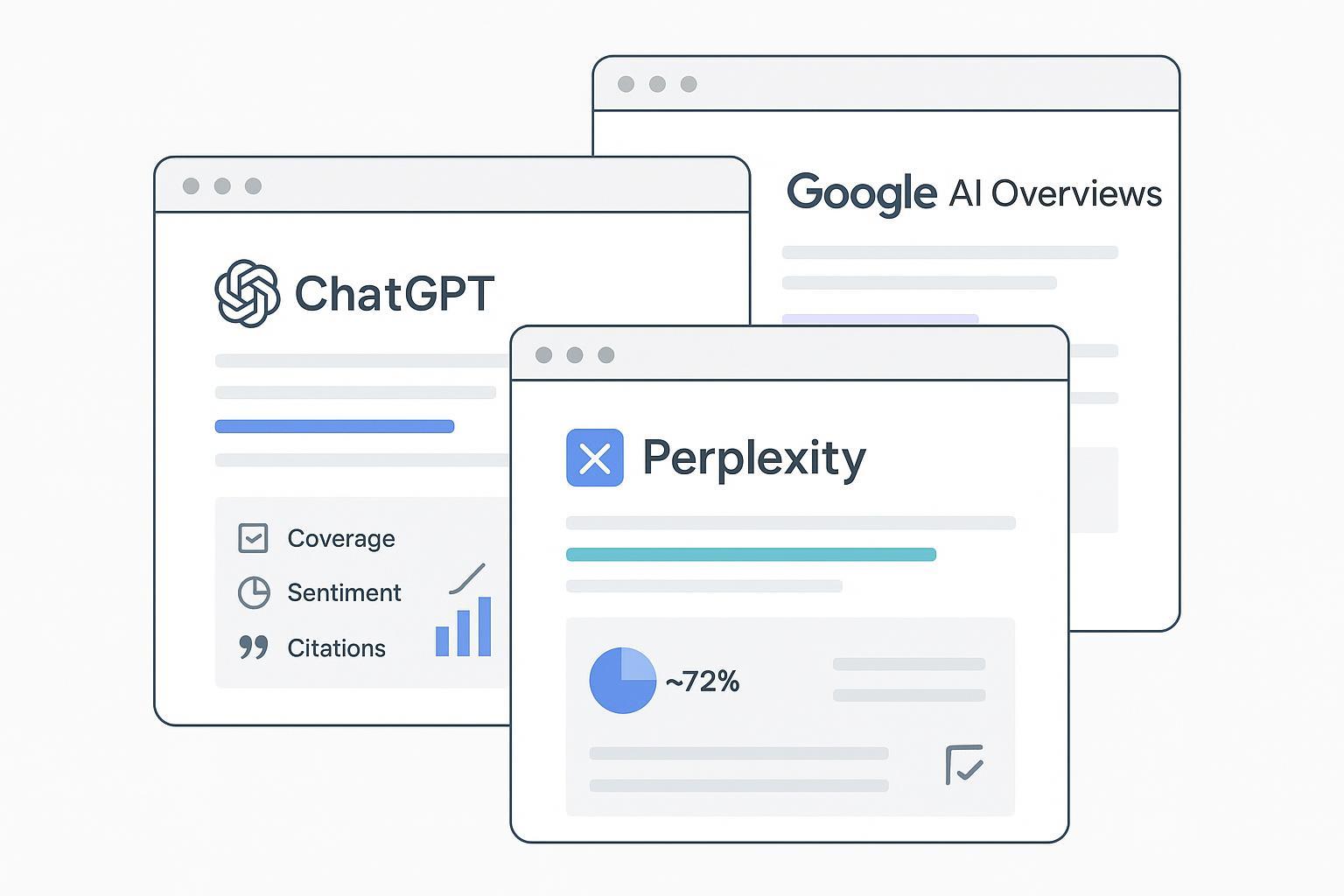
AI answer engines don’t just list links—they synthesize, attribute, and rank ideas inside the summary itself. That’s why GEO (Generative Engine Optimization) matters: you’re optimizing for inclusion, accuracy, and citation inside those summaries, not only classic blue links. For a clear primer on how GEO complements SEO, see Search Engine Land’s overview of the field in What is Generative Engine Optimization (GEO)?.
What to measure in AI summaries (and how)
Different engines behave differently: Google’s AI Overviews shows linked sources within the panel, Perplexity attaches clickable citations by design, and ChatGPT’s links depend on retrieval/browsing modes. Google explains how AI Overviews cite sources in its site-owner guidance in AI features in Search, and Perplexity notes its citation behavior in its Help Center.
Here’s the measurement model I use across engines:
-
Coverage: How much of the expected topic is actually addressed? Method: Maintain a weighted topic inventory for each query (the “must-have” subpoints). Compute Coverage = present key points / inventory key points. You can proxy “present” with simple semantic similarity or ROUGE recall.
-
Citation quality and accuracy: Are claims supported by credible, relevant sources? Method: Extract claims, map each claim to cited sources, then check support. Compute Precision = supported claims among cited claims; Recall = supported claims among all expected claims. Microsoft’s roundup of LLM evaluation signals provides context in its List of evaluation metrics for LLMs.
-
Faithfulness (hallucination risk): Does the summary stick to evidence? Method: Use entailment/QA-style checks; spot-audit with human review. AWS walks through QA ground-truthing in its guide on evaluating generative QA with FMEval.
-
Sentiment and tone: How is your brand portrayed? Method: Sentence-level sentiment classification on mentions; aggregate by platform and query theme.
-
Visibility/share of voice (SOV): Are you mentioned or cited versus competitors? Method: Entity recognition across summaries and citation lists; SOV = your mentions or citations / total tracked entities. For fundamentals on AI visibility and SOV framing, see our explainer, What Is AI Visibility?.
-
Prominence/position: Where and how do you appear? Method: Weight placements (e.g., top-of-answer mention with link > footer source). Track a weighted score over time.
A reproducible monitoring workflow
If you can’t reproduce results, you can’t trust your conclusions. Here’s a tight workflow that scales without losing rigor.
- Build a versioned query set
- Capture both informational and commercial intents; include disambiguation cases for core entities.
- Fix neutral phrasing and define a coverage inventory for each query.
- Version-control the set and note the platform context (e.g., countries, signed-in state if relevant).
- Schedule and sample consistently
- Run weekly or biweekly passes. Randomize order, keep the set fixed per cycle.
- Record model/version when available (e.g., ChatGPT mode, Perplexity model, AIO rollout notes).
- Log everything
- Store prompts, raw summaries, all citations/URLs, timestamps, and environment notes in a structured format (JSON/database).
- Capture screenshots for AIO and any UI where citation placement matters; archive immutably.
- Score with automation and humans together
- Automate coverage, citation precision/recall, and basic faithfulness checks using entailment/QA proxies. Calibrate an LLM-as-judge only after you establish agreement with human labels; EvidentlyAI offers a solid orientation in its guide to LLM-as-a-judge.
- Add a human rubric such as R.A.C.C.A. (Relevance, Accuracy, Completeness, Clarity, Appropriateness) for periodic spot-checks and sensitive topics.
- Governance and drift control
- Keep change logs for prompts and scoring scripts; note model releases and observed shifts.
- Use simple distribution checks (e.g., coverage mean/variance) to detect drift between cycles.
Quick gut-check: If you ran the same query set next week, would you be able to explain any SOV or faithfulness swing with logs and screenshots? If not, tighten steps 2–5.
Troubleshooting common issues
-
Hallucinations or unsupported claims Fixes: Add claim–evidence checks to the pipeline; confirm that cited pages actually contain the asserted facts; require retrieval/browsing when using ChatGPT for factual queries; bias your topic inventories toward primary sources.
-
Missing or low-quality citations Fixes: For Perplexity, prefer authoritative domains in your content strategy and supply clean, scannable answer blocks; for AIO, click through to confirm that your page actually contains the concise answer and updated facts; in ChatGPT, request sources or use modes that surface links.
-
Outdated facts Fixes: Update your pages with current statistics, clear timestamps, and citations; where engines allow, constrain retrieval to recent years during testing to validate behavior.
-
Volatility in Google AI Overviews Fixes: Expect variability. Repeat sampling on a schedule, document when AIO triggers, and report confidence intervals around inclusion and SOV rather than single-run point estimates. See Google’s “AI features in Search” documentation for what can appear, but don’t treat it as a stability guarantee.
From insights to action
Measurement without change is theater. Turn your findings into specific updates:
- Strengthen answer blocks: Add concise definitions, steps, or fact boxes near the top of pages for your priority queries. Ensure each claim is source-backed.
- Improve evidence and structure: Add or refresh citations; use schema where relevant (FAQ, HowTo, Organization); maintain consistent entity names across your site and profiles.
- Close gaps competitors occupy: If engines prefer certain domains, study their content patterns—clarity, recency, data density—and adapt your pages accordingly.
- Validate and report: Re-run the monitoring pass, compare coverage/SOV/faithfulness deltas, and share a tight KPI snapshot with stakeholders. For reporting cadence ideas, see our guide to AI Search KPI frameworks.
A compact scoring table you can adapt
| Metric | What you record | Simple score |
|---|---|---|
| Coverage | Key points present / inventory | 0–1 ratio |
| Citation quality | Supported claims among cited claims | Precision (0–1) |
| Faithfulness | Supported claims / total claims | 0–1 ratio |
| Sentiment | % positive / neutral / negative mentions | Split by platform |
| SOV | Brand mentions or citations / total tracked entities | % per engine |
| Prominence | Weighted placement score | Index per query |
Practical example/workflow (neutral, single mention)
Disclosure: Geneo is our product. Geneo can be used to configure a cross-engine monitoring pass like this: define your entities and competitors; upload or compose a versioned query set; select engines to monitor (e.g., ChatGPT in browsing-enabled contexts, Perplexity, and Google AI Overviews); set a weekly schedule; and enable modules for sentiment, citation extraction, and share-of-voice. The resulting logs and screenshots help you validate coverage, faithfulness, and prominence over time while you iterate content updates.
Wrap-up
Here’s the deal: AI summaries are the new front page for many queries. Measure what matters—coverage, citation quality, faithfulness, sentiment, SOV, and prominence—using a reproducible workflow that blends automated checks with human judgment. Maintain clean, evidence-dense pages with clear answer blocks and consistent entities. Re-run on a cadence, watch for volatility (especially in AI Overviews), and document every change. Do that, and your team won’t just “track AI”—you’ll steadily improve how engines represent your expertise.