
How Content Analysis Tools Interpret E-E-A-T for SEO
Discover how content analysis tools assess E-E-A-T signals—experience, expertise, authority, trust—to guide SEO quality and strategy.
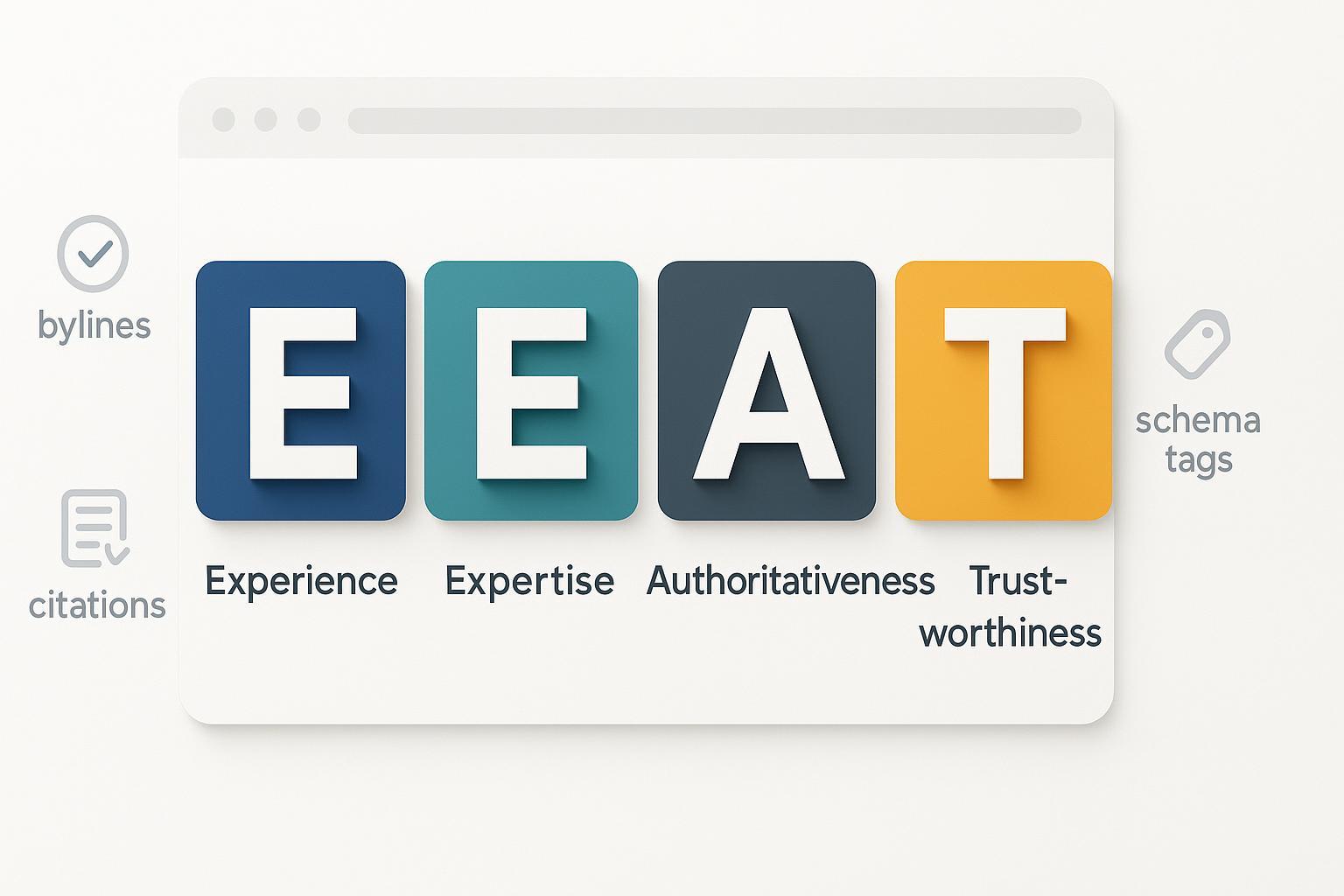
What does it actually mean when a tool says it “checks E‑E‑A‑T”? If E‑E‑A‑T is a set of quality principles, not a single dial you can turn, how do software platforms even “see” it?
Think of E‑E‑A‑T like a passport. The passport itself isn’t your journey; it’s proof you’re legitimate. Stamps—bylines, citations, reviews, structured data, topic coverage—suggest where you’ve been and what you can be trusted to do. Tools inspect those stamps. They don’t decide your destination, but they can flag whether your documentation looks solid.
Google’s stance: a quality framework, not a single signal
Google has been clear that its ranking systems aim to reward original, helpful content that demonstrates qualities of Experience, Expertise, Authoritativeness, and Trustworthiness. The guidance on authorship transparency and the “Who, How, Why” disclosure applies whether content is human-written or AI-assisted, as explained in Google’s own 2023 note on AI authorship and quality in the post “Google Search and AI content” (2023).
Broad updates continue to refine how Google’s systems assess overall quality. The company advises creators to focus on helpful, reliable content rather than chasing specific “signals,” as summarized in Google’s Core Updates overview.
Separately, the Search Quality Rater Guidelines (SQRG) PDF detail how human raters evaluate page quality, E‑E‑A‑T, and YMYL sensitivity. Raters don’t set rankings; their evaluations help Google understand what high‑quality results look like. Conflating SQRG with the ranking algorithm is a common mistake.
How tools approximate E‑E‑A‑T
Because E‑E‑A‑T isn’t a single ranking factor, tools rely on measurable proxies. Below are the major categories you’ll see analyzed in audits and content intelligence reports.
| Proxy category | What tools can check | Where it breaks (limitations) |
|---|---|---|
| Author identity & credentials | Presence of bylines, author pages, role-appropriate bios; crosslinks to credentials | Verifying real-world expertise beyond text is hard; credentials need third‑party validation |
| Citations & attribution | Existence of outbound links, descriptive anchors, reference freshness; alignment to claims | Tools can’t fully confirm accuracy or context; they may miss nuance in paraphrased claims |
| Backlink profile & referring domains | Volume, diversity, topical relevance, anchor patterns; toxic link warnings | Correlation ≠ causation; link quality judgments can be noisy or delayed |
| Topical authority & depth | Entity coverage, internal link graphs, content gaps, cluster completeness | Depth isn’t just breadth; thin expertise can masquerade as coverage without strong analysis |
| Technical trust & hygiene | HTTPS, canonicalization, mobile parity, page speed, structured data validity | Technical health can’t compensate for weak expertise or poor evidence |
| Freshness & update history | Publication and updated dates, revision notes, cadence tracking | New isn’t always better; frequent edits don’t guarantee improved accuracy |
| Transparency (Who/How/Why) | Presence of author/methodology notes, AI assistance disclosures, editorial policy | Disclosure quality varies; tools can detect presence, not sincerity or rigor |
| Reputation & UGC signals | Third‑party reviews, ratings, press mentions, knowledge graph corroboration | Reputation is context‑dependent; fake or niche signals can skew impressions |
What tools can—and cannot—do
- Can: detect technical trust signals, structured data errors, and mobile/HTTPS hygiene; analyze backlinks and topical coverage; spot bylines, bios, citations, and freshness markers at scale.
- Can’t: produce a true “E‑E‑A‑T score,” validate real‑world experience beyond text, or guarantee ranking gains from proxy improvements—especially for YMYL topics.
A pragmatic workflow to strengthen E‑E‑A‑T proxies
- Author transparency and expertise
- Add clear bylines and build robust author pages with role‑appropriate credentials, affiliations, and representative work. Crosslink authors to topic hubs and policy pages. Require expert reviewers for sensitive topics.
- Evidence hygiene
- Anchor key claims to primary sources or official documentation; prefer the latest editions. Use descriptive anchor text and verify that citations truly support the claims they’re attached to.
- Topical coverage and internal linking
- Map entities and subtopics; establish or update cornerstone pages; connect articles with purposeful internal links; de‑duplicate thin pages to consolidate authority.
- Reputation and reviews
- For products, local, or service queries, encourage verified reviews and maintain a press/mentions page. Track third‑party citations so reputation signals are discoverable.
- Technical trust and structured data
- Ensure HTTPS, mobile parity, clean canonicalization, and valid schema (Organization, Person, Article, Review as appropriate). Surface privacy, terms, and editorial policy.
- Freshness governance
- Set SLAs for updates on time‑sensitive content; add “last updated” notes when materially revising pages; keep a lightweight revision log for editors.
- YMYL safeguards
- Require expert review, authoritative sourcing (government, medical, financial institutions), strict conflict‑of‑interest disclosures, and conservative claims.
Advanced note: YMYL requires editorial rigor
YMYL (“Your Money or Your Life”) content raises the bar. Human raters evaluate these pages with heightened scrutiny in the SQRG, and your internal processes should mirror that expectation. Automation helps you find gaps, but it can’t replace qualified experts, rigorous sourcing, and careful review workflows. If you publish health, finance, safety, or civic information, invest in credentialed authorship, formal editorial policies, and a documented review chain.
Industry guides can help you pressure‑test your practices. For a vendor summary of what E‑E‑A‑T means in SEO, see the Semrush overview of E‑E‑A‑T. For a perspective on higher standards in sensitive niches, review Surfer’s notes on E‑E‑A‑T in YMYL contexts. Use vendor content as a secondary reference; let primary sources lead.
Generative AI answers and brand visibility
As AI Overviews and LLM answers summarize the web, sources that project strong E‑E‑A‑T‑aligned signals are more likely to be cited or paraphrased. That doesn’t mean a direct “E‑E‑A‑T ranking boost”—it means the qualities that make humans (and systems) trust a page often make it a better candidate for inclusion in answers.
Disclosure: Geneo is our product. In AI search contexts, a platform like Geneo can be used to monitor how often your brand is cited or recommended across ChatGPT, Perplexity, and Google AI Overview. This complements your E‑E‑A‑T work by showing whether your reputation and authoritative citations are reflected in AI answers—without implying any ranking impact. If you need a primer on why this matters, this explainer on AI visibility and brand exposure in AI search offers helpful context.
Measurement and governance
Two questions keep E‑E‑A‑T programs honest: How will we measure progress? How will we keep standards from drifting?
- Define outcome‑oriented KPIs: track citation accuracy rates, the share of pages with complete bylines/bios, successful schema validations, and the proportion of time‑sensitive pages refreshed on schedule. For a structured approach to metrics in AI‑search contexts, see the guide to KPI frameworks for AI search visibility, sentiment, and conversion.
- Strengthen the people layer: public author profiles matter. Align internal bios with external profiles and team presence on professional networks. Practical steps are covered in this guide to LinkedIn team branding for AI search visibility.
Governance turns good intentions into habits. Codify a short editorial policy that includes Who/How/Why disclosures (especially when AI assistance is used), citation standards, review requirements for YMYL, and an update cadence per content type. Audit quarterly. Treat tool output as an early‑warning system, not the final verdict.
Common pitfalls to avoid (and what to do instead)
- Chasing a mythical “E‑E‑A‑T score.” Instead: instrument proxy checks (authorship, citations, reputation) and tie them to outcomes like reduced factual corrections and higher inclusion in reputable roundups.
- Over‑fixating on technical audits. Instead: treat technical trust as table stakes, then spend equal time on evidence quality and expert involvement.
- Assuming more content equals more authority. Instead: prune, consolidate, and strengthen clusters—thin coverage dilutes perceived expertise.
Here’s the deal: tools are excellent at surfacing missing stamps in your passport. But you still need to earn the stamps through genuine expertise, real experience, and transparent, well‑sourced work. Which proxy will you shore up first?