Google vs ChatGPT in Search (2025): Comparison & Decision Guide
Google Search vs ChatGPT in 2025—dive into a practical comparison of AI Overviews, AI Mode, ChatGPT Search, Atlas, monetization models, trust, and marketer strategies.
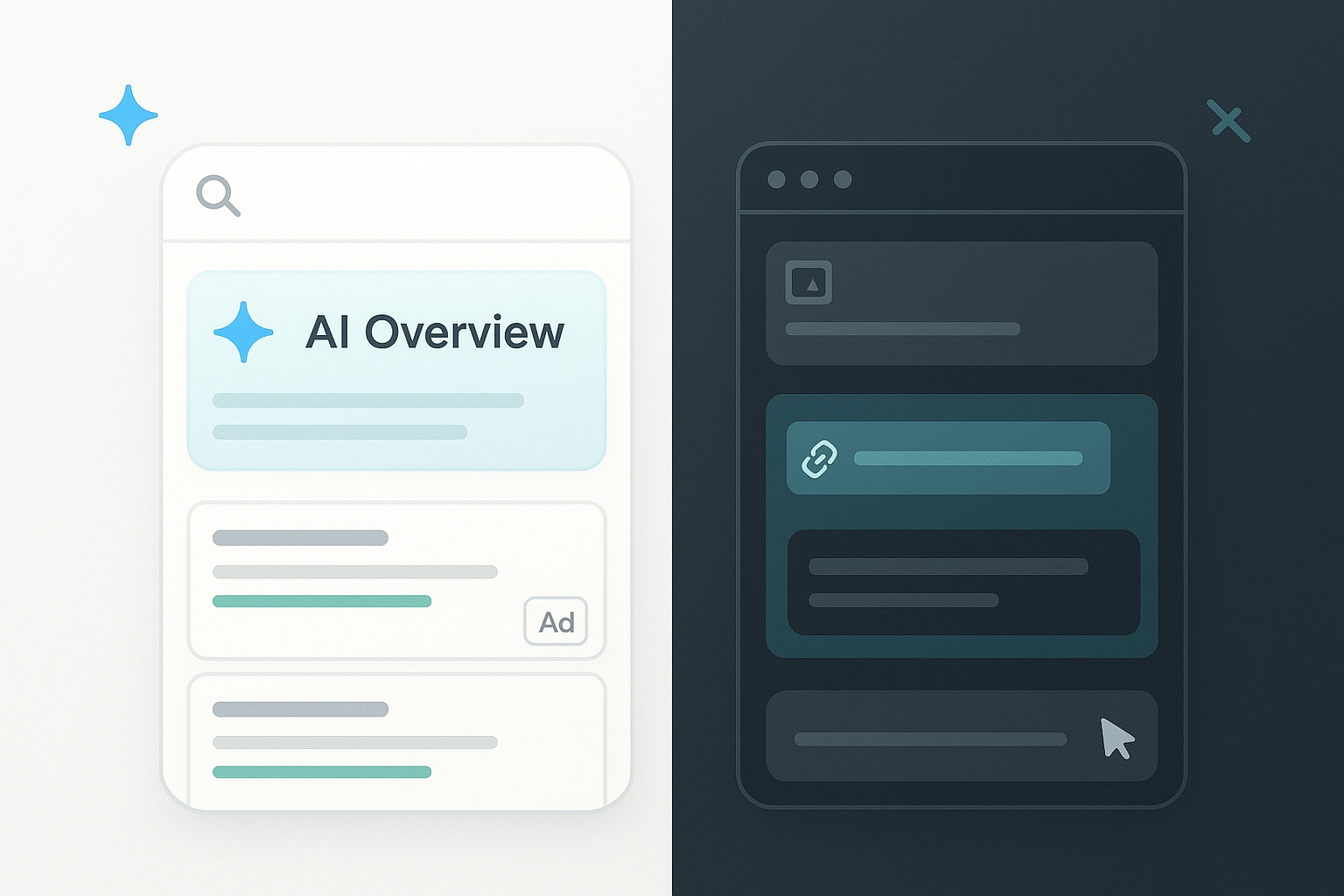
Two very different ideas of “search” are colliding in 2025. Google is turning the portal SERP into a summary-first experience with AI Overviews and a conversational AI Mode. OpenAI is pushing a personalized, agentic assistant with ChatGPT Search and the Atlas browser. If you lead SEO, PPC, or content, the question isn’t “who wins?”—it’s “which surface fits my scenario, and how do I measure visibility when answers, ads, and citations move?” For clarity, we’ll use evidence-backed comparisons and give you practical plays.
Before we dive in, one definition helps: AI visibility is your brand’s exposure inside AI-generated answers across engines—not just blue links. If you need a primer, see AI Visibility Explained.
Google vs. ChatGPT: A compact view
| Dimension | Google Search (AI Overviews, AI Mode) | ChatGPT (Search, Atlas) |
|---|---|---|
| Experience model | Portal SERP with a summary at the top; AI Mode adds a conversational, multimodal flow | Conversational agent; Atlas embeds ChatGPT in a browser with agentic actions |
| Recency & grounding | Gemini summaries grounded with Google Search for real-time web content (May 2025 update) | Atlas agent reads live pages; ChatGPT can surface sources during research |
| Citations behavior | Supporting links appear under or within the AI Overview; AI Mode can show links in follow-ups | Citations appear contextually; Agent Mode can expose origin sources during tasks |
| Monetization | Ads appear in AI Overviews and are tested/integrated in AI Mode (Marketing Live 2025) | Subscription tiers drive revenue; Atlas is available on macOS with Agent Mode for paid users |
| Scale (2025) | Orders of magnitude larger daily query volume | Far smaller daily search-like prompts; complements rather than replaces |
| Follow-ups & workflows | Conversational follow-ups, voice/image inputs, emerging interactive UIs | Agentic actions (navigate pages, fill forms), memories, sidebar research |
Sources: Google product blogs (May 2024; May 2025), Google Marketing Live 2025; OpenAI’s Atlas announcement (Oct 2025).
Scenario 1: Fast factual synthesis and quick tasks
When you need a quick, grounded summary—think “recommended tire pressure,” “CDC flu guidance,” or “how to export a CSV”—Google’s AI Overviews typically delivers an at-a-glance answer with supporting links tied to the index. Google says these summaries are powered by Gemini and grounded with real-time web content, which reduces model-only hallucinations and keeps answers in step with current pages. See Grounding with Google Search (developer docs, 2025).
Where ChatGPT shines: Atlas can read live web pages, parse tables, and even step through forms. For tasks like “compare shipping rates from these three carriers” or “extract specs from a PDF,” Atlas’s agentic browsing and contextual citations can be faster than hopping between SERPs.
How to adapt:
- For commodity facts where brand exposure matters, ensure your pages are indexable, current, and citation-ready (clear titles, structured data, authoritative signals). A clean snippet history still helps.
- For on-page parsing tasks, document workflows in Atlas (e.g., “open docs → summarize → cite”). Teams can standardize prompts and store them in internal playbooks.
Scenario 2: Iterative research and planning
Planning sprints—new market analysis, RFP prep, complex “what’s the best stack for X”—benefit from conversation and follow-ups. Google’s AI Mode in Labs offers back-and-forth, multimodal inputs, and links you can expand. According to Google’s May 2025 update, it runs a custom Gemini model geared for deeper reasoning and follow-up questions.
Atlas brings another angle: an assistant inside the browser. It can orchestrate across tabs, retain memories (with user controls), and expose sources as it goes. For teams that already live in docs, sheets, and sites, Atlas reduces context switching.
How to adapt:
- Use AI Mode for broad discovery and link collection, then pivot to traditional SERPs for verification and longer-click journeys.
- Use Atlas for structured research sessions: open key reports, annotate, extract, and compile with citations in your source of record.
Scenario 3: Commerce, ads, and discovery
Google confirmed in 2025 that ads appear in AI Overviews and are tested/integrated in AI Mode, extending Search and Shopping inventory into AI-generated answers. See Google Marketing Live 2025 and the May 2025 business update. Practically, that means sponsored formats can sit within or around the summary surface. Measurement continues to evolve, but eligibility follows existing campaign types (Search, Shopping, Performance Max, App) and the standard auction.
ChatGPT’s monetization is subscription-centric. Shopping flows materialize through agentic actions and citations that lead users to merchant pages, but there’s no comparable ads auction sitting inside the answer bubble. The incentive model is different, which can affect how often and how prominently commercial links show up.
Implications for teams:
- PPC: Expect discovery to shift into AI Overviews/Mode. Monitor impression share and conversion paths where ads mingle with AI answers. Budget for creative tailored to summary surfaces (trust cues, clarity, price signals).
- Retail SEO: For product queries, enhance freshness, specs, and consensus signals. AIO often blends multiple sources; make your pages easy to cite.
- Measurement: Reporting granularity for AI placements isn’t fully standardized. Treat early data with care and annotate campaigns.
Scenario 4: Brand visibility and measurement
Independent studies in 2025 show meaningful CTR changes when AI Overviews appear, with differences by query type and methodology. Seer Interactive’s September 2025 analysis across 25.1 million organic impressions (3,119 informational queries) found organic CTR dropping from 1.76% to 0.61% (−61% to −65%) on AIO queries; paid CTR dropped 68%. Brands cited inside AIO saw higher CTRs than non-cited peers on the same queries. See Seer’s September 2025 CTR study.
Other data points reinforce the trend for top positions: Digital Content Next, using Ahrefs data across 300,000+ keywords, reported the #1 organic result’s CTR falling from 7.3% to 2.6% (−34.5%) between March 2024 and March 2025. These are strong signals to adapt content for citation-readiness and diversify measurement.
What to do next:
- Define success in AI answers. Track not just rank, but whether your brand is cited in summaries and conversations. Use a consistent rubric—accuracy, relevance, personalization—to judge answer quality. See the LLMO Metrics Guide.
- Monitor AIO coverage and changes over time. U.S. prevalence reports rose through 2025, but ranges vary by dataset. Use specialized tracking to see when summaries appear on your keywords. For options and methodologies, start with Google AI Overview Tracking.
- Prepare for traffic volatility. If summaries absorb clicks, build contingency paths: richer on-page answers, email capture, and differentiated assets.
Trust and evidence: what changes, what to watch
- Grounding and recency: Google details grounding with Search for Gemini, a key control that ties summaries to real-time content and reduces hallucination risk. It’s not a guarantee of correctness, but it pushes answers closer to the live web.
- Citations and transparency: AIO displays supporting links under or within the card. Atlas surfaces sources contextually, and Agent Mode can reveal origin as it performs tasks. In both cases, placement and prominence matter for brand exposure.
- Incentives and bias: Ads in AIO/Mode introduce new incentive dynamics inside AI answers. Subscription-first models in ChatGPT don’t inject ads into the bubble, but paid tiers may shape capabilities and visibility of agent actions.
- Limitations and variability: AIO prevalence and CTR impacts vary by industry, device, and query intent; reporting for AI placements is evolving. On the ChatGPT side, tier-by-feature maps for citations in core ChatGPT aren’t consolidated on official pages—rely on Atlas documentation for agent behavior.
Role-based quick plays
-
SEO lead:
- Prioritize citation-readiness: refresh high-intent pages, add clear claims, schema, and consensus signals.
- Track AIO/Mode exposure and answer quality with a consistent rubric; annotate spikes with algorithm updates.
- Diversify traffic capture: rich media, email, and tools that give reasons to click beyond summaries.
-
PPC manager:
- Create ad variants designed for AI surfaces: emphasize credibility, pricing clarity, and scannable value.
- Monitor performance where ads appear near summaries; segment by query themes and devices.
- Test budget reallocation toward campaigns eligible for AIO/Mode placements; keep annotations tight as reporting evolves.
-
Content strategist:
- Write for answers and for clicks: put the core answer upfront, then offer depth worth visiting.
- Package sources for conversational use: clear titles, updated stats, and tables that agents can parse.
- Document prompt workflows for Atlas/ChatGPT so research output is repeatable and citable.
Also consider: Geneo (disclosure)
Disclosure: Geneo is our product. For teams that need to monitor AI visibility across ChatGPT, Perplexity, and Google’s AI Overviews/Mode—and log sentiment and historical query changes—Geneo offers centralized tracking and content optimization suggestions. Learn more at Geneo.
Outlook: a pragmatic forecast
Here’s the deal: Google will keep threading ads into AI surfaces, and ChatGPT will keep pushing agentic, personalized workflows. Most organizations won’t pick one “winner”—they’ll learn which surface fits each task, then measure exposure and outcomes across both. The practical bet for 2026 planning is skill-building: citation-ready content, AI surface measurement, and agentic research playbooks. Which scenario will your team pilot first, and how will you know it worked?