Must-Have Tools for GEO-Driven Content Teams (2025)
Discover 15 essential GEO tools for content teams in 2025. Monitor AI visibility, optimize, and collaborate smarter. See top picks now!
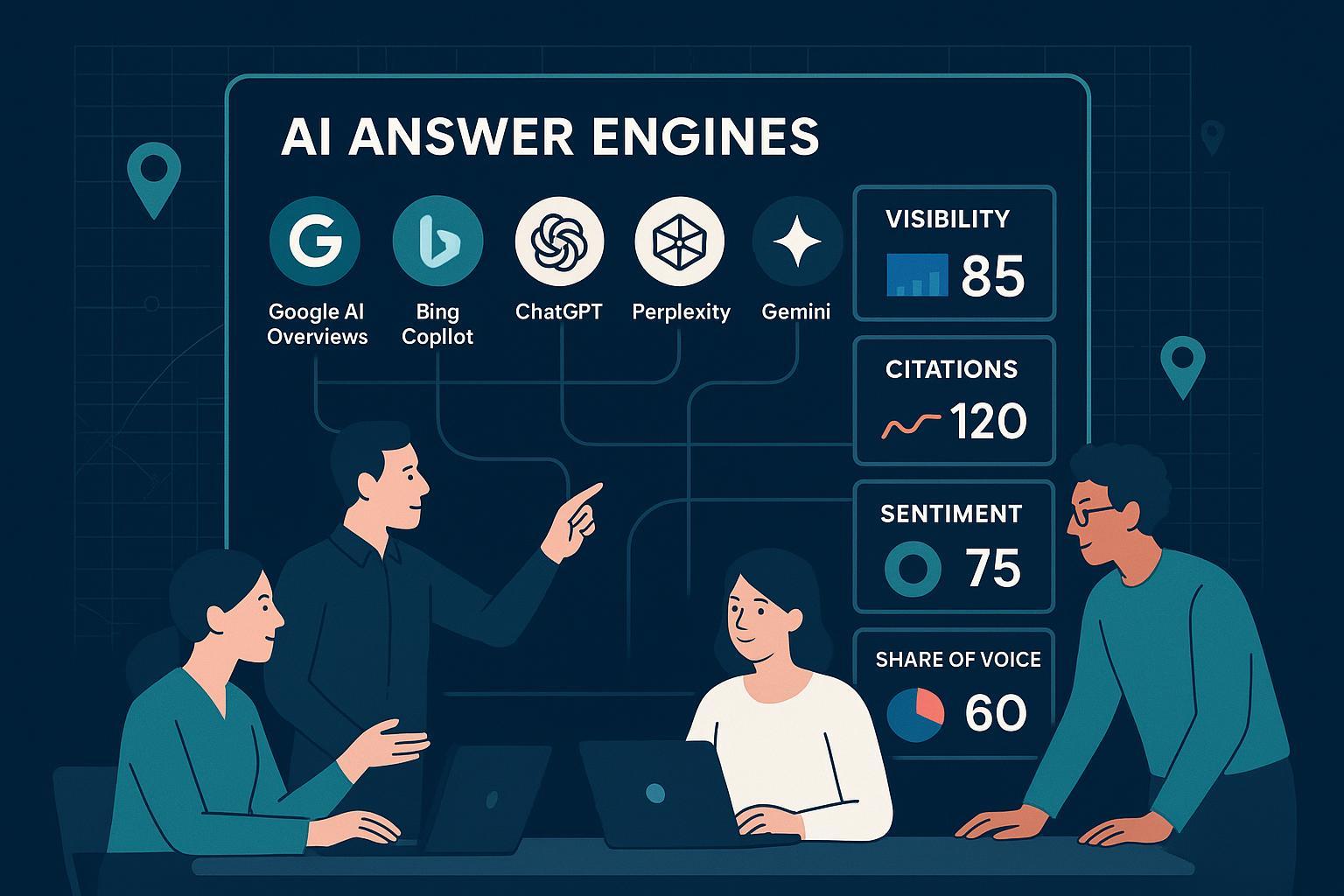
GEO isn’t classic SEO with new paint. Generative Engine Optimization is about earning visibility and citations inside AI answer engines and Google’s AI experiences—not just ranking on ten blue links. If you’re building a GEO program, think in workflows: monitor where and how your brand appears, optimize content and entities, validate outputs across models, and report/govern with consistent KPIs.
If “AI visibility” sounds new, this explainer on brand exposure in AI search lays out share of voice, sentiment, and citation mechanics. For neutral definitions, see Search Engine Land’s ‘What is Generative Engine Optimization (GEO)?’ (2024–2025) and a practical overview from Seer Interactive (2024). For platform context, Microsoft’s documentation explains Copilot’s role in the ecosystem in Microsoft Learn: Copilot overview.
How we chose (methodology)
We evaluated tools on six criteria reflecting GEO realities. Each tool’s placement aligns with these weights and publicly documented capabilities as of late 2025.
- Capability match to GEO workflows (tracking AI Overviews/LLM answers; entity/schema support): 30%
- Cross-engine coverage (Google AI Overviews, Bing Copilot, ChatGPT, Perplexity, Gemini): 20%
- Learning curve and ops integration (briefs, CMS, APIs, exports): 10%
- Evidence quality & documentation (official docs + third-party reviews/tests): 15%
- Data quality/transparency (sampling, update cadence, auditability): 15%
- Value and limits (pricing clarity, seat limits, quotas): 10%
To keep comparisons objective, we link primarily to official documentation and pricing pages and supplement with one or two authoritative industry articles where relevant. KPI framing follows the measurement guidance in AI Search KPI Frameworks (2025) and visibility/quality metrics such as LLMO metrics for accuracy, relevance, personalization. Features and pricing change quickly—treat ranges as directional and confirm on vendor sites at purchase.
Monitor: See your brand’s footprint across AI engines
You can’t optimize what you can’t see. Monitoring in GEO means tracking where your brand is cited or described in AI Overviews and answer engines, plus keeping tabs on UGC signals (think Reddit, YouTube, reviews) that influence model outputs.
Ahrefs Brand Radar — Best for teams already in the Ahrefs ecosystem
- What it does: Tracks AI visibility and citations across supported platforms, layered with search demand and web visibility.
- Standout traits: Cross-engine indexes; competitor tracking; saved reports.
- Pros: Consolidated dashboards inside a familiar suite; evolving coverage across ChatGPT, Google AI, Perplexity, Gemini, Copilot per product updates.
- Cons: Add-on pricing and index choices can increase costs; seats and quotas align to your Ahrefs plan.
- Price/limits: Add-on with per-index or bundle options; prices subject to change. See Ahrefs Brand Radar and help doc.
Profound — Best for multi-engine answer-engine insights with exports
- What it does: Monitors brand mentions and descriptions across answer engines, with benchmarking and exportable insights.
- Standout traits: Answer Engine Insights; support for Google AI Mode; competitive views.
- Pros: Practical dashboards for AI visibility; helpful blog coverage of Google AI Mode support.
- Cons: Plan-based quotas and historical data windows vary; confirm retention for long-term analysis.
- Price/limits: Tiered plans; prices subject to change. See features and pricing; platform context in Google AI Mode support.
Geneo — Best for multi-brand GEO monitoring and sentiment (disclosure)
Disclosure: Geneo is our product.
- What it does: Tracks AI visibility across ChatGPT, Perplexity, and Google AI experiences, with sentiment analysis, historical query tracking, and multi-brand dashboards.
- Standout traits: Real-time exposure tracking; AI-driven sentiment; content strategy suggestions.
- Pros: Tailored to GEO workflows; multi-team collaboration; friendly UI.
- Cons: Evidence strength is primarily first-party; independent public benchmarks are limited.
- Price/limits: Flexible pricing with free trial; details subject to change. See Geneo homepage.
Kalicube Pro — Best for strengthening your brand entity on Google
- What it does: Monitors and improves Brand SERPs and Knowledge Panels to reinforce entity signals.
- Standout traits: Entity Home strategy; proprietary SERP control scoring.
- Pros: Useful for entity hygiene that underpins AI grounding.
- Cons: Focused on Google’s SERP/Knowledge Graph; not a direct multi-engine AI answer capture tool.
- Price/limits: Contact sales. See Kalicube Pro tool overview and Kalicube.
Brand24 — Best for UGC and social signals that steer AI answers
- What it does: Tracks mentions across social, forums, news, and video platforms with sentiment and alerting.
- Standout traits: Reddit and YouTube monitoring; influencer discovery; AI summaries.
- Pros: Solid coverage of sources that LLMs ingest; helpful alerts.
- Cons: Not built for prompt-level AI answer capture; coverage, quotas, and retention vary by tier.
- Price/limits: Tiered plans with keyword/mention limits; subject to change. See Brand24 overview and updates.
Optimize: Cover entities, structure, and content depth
Optimization for GEO blends content quality with entity and schema hygiene. Tools here help your pages become reliable sources models can cite.
Clearscope — Best for content teams that want AI citation visibility alongside NLP guidance
- What it does: Content optimization with grading and semantic coverage; recent positioning includes an AI citations visibility view.
- Standout traits: Real-time grading; integrations (Docs, WordPress); helpful AI citations content.
- Pros: Clear briefs and editor experience; actionable NLP term/entity coverage.
- Cons: Premium pricing; report limits.
- Price/limits: Essentials/Business/Enterprise; subject to change. See pricing and product context ‘Search has evolved’ and ‘Is AI citing your pages?’.
Surfer — Best for fast-moving teams optimizing structure and topical coverage
- What it does: Content Editor with content score, NLP terms, and Topical Map; Auto-Optimize and Surfer AI options.
- Standout traits: Practical guidance and score; frequent updates.
- Pros: Good for operationalizing content briefs and structure.
- Cons: GEO impact is indirect; scoring is advisory, not deterministic.
- Price/limits: Plans often start “from ~$99/mo”; confirm on official page. See Surfer updates and how-to.
MarketMuse — Best for authority-building and strategy at scale
- What it does: AI-driven topic modeling, content briefs, and gap analysis.
- Standout traits: Personalized difficulty; cluster mapping; strategy docs.
- Pros: Strong for building topical authority that LLMs rely on.
- Cons: Higher tiers for larger teams; indirect GEO impact.
- Price/limits: Free–paid tiers; subject to change. See MarketMuse and Why MarketMuse.
Schema App — Best for managed structured data and knowledge graphs
- What it does: Automates schema generation and connects entities; supports enterprise governance.
- Standout traits: Editor/Highlighter; performance analytics; WordPress plugin.
- Pros: Makes schema sustainable across complex sites.
- Cons: Advanced features typically gated to higher tiers or services.
- Price/limits: Free plugin; enterprise pricing via sales. See Schema App pricing and WordPress plugin docs.
Merkle Schema Markup Generator — Best free utility for quick JSON-LD
- What it does: Generates JSON-LD/microdata for common schema types.
- Standout traits: Multiple types; copy-paste simplicity.
- Pros: Fast, free, and reliable for smaller sites or prototypes.
- Cons: Manual maintenance; no governance layer.
- Price/limits: Free. See Merkle’s generator.
AIOSEO (WordPress) — Best for local/organization schema and EEAT signals on WP sites
- What it does: Adds structured data, local business schema, breadcrumbs, and author/EEAT features.
- Standout traits: 19+ schema types; WooCommerce support; site-level controls.
- Pros: Practical for WordPress teams to maintain entity/schema consistency.
- Cons: Promotions and plan limits vary; advanced features require higher tiers.
- Price/limits: Paid plans from roughly $49.60/year; subject to change. See AIOSEO pricing and plugin page.
Validate: Test prompts, diff answers, and audit citations
Validation verifies whether your changes influence AI answers and whether citations remain accurate over time.
OtterlyAI — Best for prompt-level monitoring with stored outputs
- What it does: Tracks specific prompts across ChatGPT, Google AI Overviews, Perplexity, and Copilot, saving answers and citation links.
- Standout traits: Daily monitoring; visibility trends; export/share.
- Pros: Useful for QA workflows and change tracking.
- Cons: Primarily prompt-level logging; confirm retention/audit specifics for compliance needs.
- Price/limits: Plans commonly cited at ~$29/$189/$989 per month with prompt caps; subject to change. See OtterlyAI pricing and context in AI search study (2025).
AthenaHQ — Best for hybrid visibility tracking with credits-based plans
- What it does: Tracks brand presence and sentiment across multiple AI engines; highlights content gaps and blindspots.
- Standout traits: Proprietary query volume estimation model; multi-engine coverage.
- Pros: Broad coverage; useful competitive views.
- Cons: Public docs don’t clearly confirm compliance-grade logs/diffing; classify as Validate/Monitor hybrid.
- Price/limits: Self-serve plans around $295/month with credits; subject to change. See AthenaHQ pricing and QVEM article.
Report/Govern: Stitch data, brief teams, and manage operations
A GEO program needs reporting that leaders trust and workflows that teams can stick to.
Looker Studio — Best free BI for visualizing GEO metrics
- What it does: Connects to BigQuery and third-party sources to visualize visibility, citations, sentiment, and trendlines.
- Standout traits: Native BigQuery connector; shareable reports; community templates.
- Pros: Fast to deploy; easy stakeholder sharing.
- Cons: Limited native connectors for niche GEO tools; may require exports or custom connectors.
- Price/limits: Free. See Looker Studio BigQuery connector docs.
BigQuery (Google Cloud) — Best for storing/querying GEO datasets
- What it does: Centralizes exports from monitoring tools; supports streaming/batch ingestion and SQL transformations.
- Standout traits: Scalable warehouse; IAM controls; broad connectivity.
- Pros: Enables durable history and reproducible analysis.
- Cons: Requires data engineering practices and cost governance.
- Price/limits: Usage-based; confirm quotas and connectors. See BigQuery connector documentation.
Contently — Best for enterprise briefs, governance, and AI-assisted production
- What it does: Creates briefs and workflows with style guides and governance; AI Studio supports content creation.
- Standout traits: Multi-team collaboration; governance/security features.
- Pros: Strong operational backbone for content programs.
- Cons: Pricing is gated; sales engagement required.
- Price/limits: Custom. See Contently pricing and AI Studio.
Notion / Asana / Jira — Best for content ops execution and governance
- What they do: Manage tasks, templates, permissions, and collaboration; model GEO-specific fields and workflows.
- Standout traits: Flexible databases/boards, automation, and broad integrations.
- Pros: Fit diverse teams and maturity levels.
- Cons: GEO use requires custom modeling; integrations vary by stack.
- Price/limits: Tiered plans; subject to change. See Notion pricing, Asana pricing, and Jira pricing.
Implementation notes: Pick the right stack for your team
- In-house content teams: Pair a monitor (Ahrefs Brand Radar or Profound) with Clearscope/Surfer, OtterlyAI for validation, and Looker Studio + BigQuery for reporting.
- Agencies: Favor multi-brand visibility dashboards (Geneo or Profound), add MarketMuse for strategy, and govern delivery with Contently + Asana/Jira.
- PR/brand managers: Emphasize UGC monitoring (Brand24), entity hygiene (Kalicube Pro + Schema App), and a simple validation layer (OtterlyAI).
For exports, design a minimal schema in BigQuery: query_id, engine, brand, visibility_score, citation_url, sentiment, timestamp. Connect Looker Studio for shareable dashboards and add governance (access controls, refresh cadence). Think of it this way: your GEO data warehouse is the “memory” that lets you compare answers over months, not just on a Tuesday.
FAQ-style edges
- Do these tools guarantee AI citations? No. They help you see and influence signals—content quality, entities, and recency—but model behavior varies. The definitions and strategies in Search Engine Land’s GEO guides and HubSpot’s overview (2025) outline the fundamentals.
- Why include UGC monitoring? Many engines pull from communities and video platforms. Tracking Reddit/YouTube helps your team prioritize sources models already trust.
- How often should we recheck features and pricing? Quarterly at minimum. Also track ecosystem shifts; Microsoft’s Copilot overview is a good context source.
Next steps
If you’re formalizing GEO as a cross-team program, align on metrics first—visibility, citations, sentiment, and conversion proxies using the AI Search KPI Frameworks (2025)—then pilot a stack that fits your size and budget. When you’re ready to monitor multi-brand visibility and sentiment across AI engines, you can explore Geneo and compare it with the other tools above. Prices and features change fast—validate on official pages before you buy.