
GEO Strategies for Early-Stage Companies: Best Practices 2025
Learn best practices for GEO (Generative Engine Optimization) in 2025. Actionable AI search visibility playbook for startups: audits, KPI, technical guides, measurement.
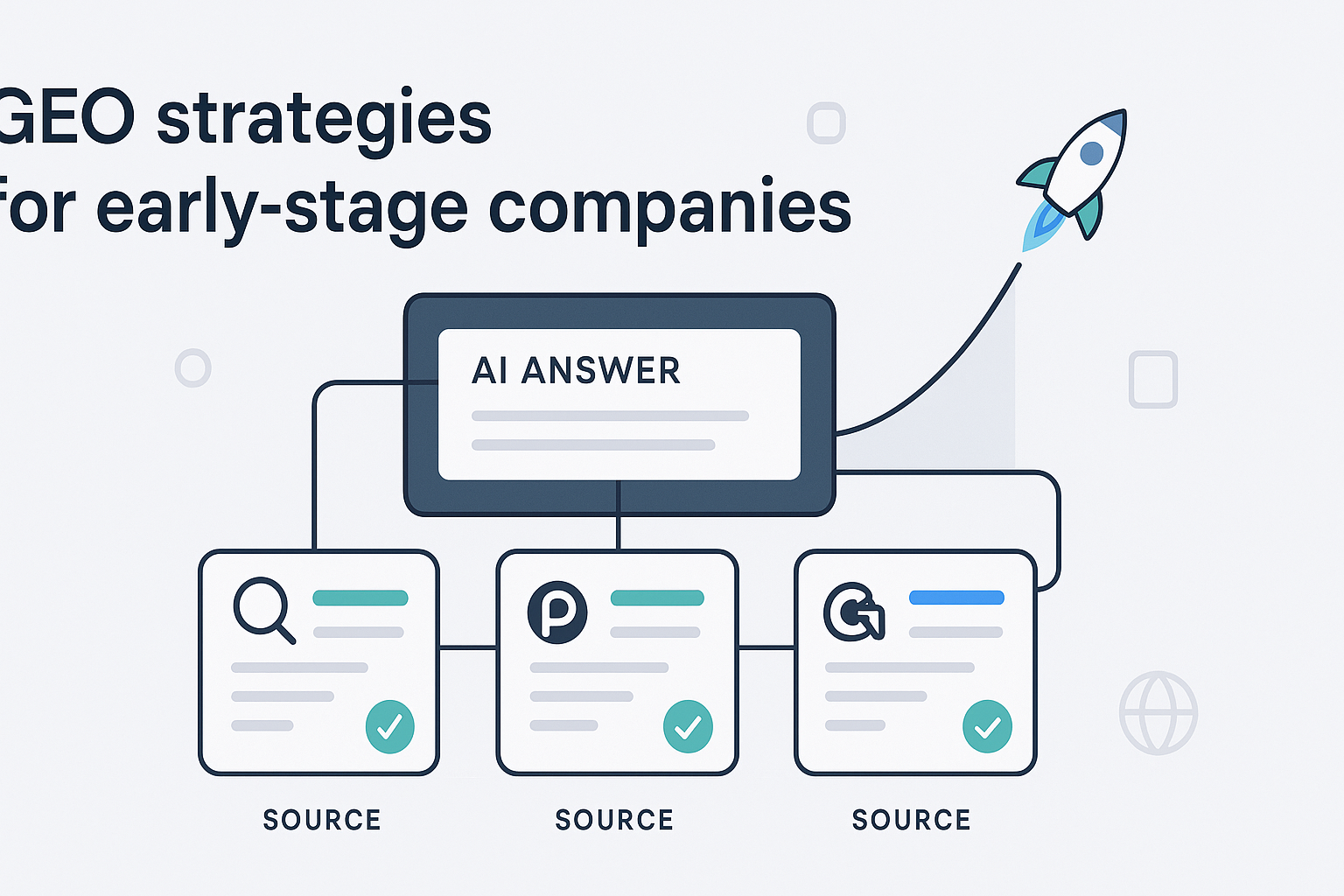
If you’re building a brand from near-zero authority, you can’t afford to wait months for classic SEO alone. Generative Engine Optimization (GEO) helps your company get named and cited inside AI answers on Google’s AI Overviews, Perplexity, Bing Copilot, and ChatGPT—where users increasingly read, decide, and sometimes convert without ever clicking.
1) GEO in one page: how it differs from SEO
GEO aims to earn citations and brand mentions inside AI-generated answers, not just blue‑link rankings. Think of GEO as tuning your entity and content so AI systems can unambiguously quote you as a trusted source. That means answer‑first pages, explicit evidence, consistent entity markup, and corroboration across the web. For a jargon primer, see the quick GEO/GSVO/GSO acronym explainer.
Authoritative outlets describe GEO as complementary to SEO: SEO secures discoverability; GEO secures attribution inside AI summaries. For orientation, Search Engine Land’s overview explains GEO’s emphasis on entity clarity and helpful, people‑first content in 2024–2025 in “What is Generative Engine Optimization (2024).”
2) A 30‑minute GEO audit for lean teams
Run this fast pass to spot the biggest wins before you invest engineering cycles:
- Query reality check: For your top 20 buyer and problem queries, ask Google’s AI Overviews, Perplexity, Bing Copilot, and ChatGPT (with browsing). Are you cited, merely mentioned, or absent? Screenshot and log results.
- Entity hygiene: Does your homepage/About show clear Organization/Person details, author bios with credentials, and consistent names across LinkedIn, Crunchbase, and Wikipedia (if applicable)?
- Answer‑first content: Do cornerstone pages open with a 50–80‑word answer that states the facts plainly, followed by evidence and sources?
- Structured data: Is Organization/Person/Article/FAQ/HowTo schema implemented and valid via Rich Results tests?
- Freshness: Are key stats, pricing, integrations, and changelogs updated within the last quarter and dated on-page?
3) Build answer‑first, entity‑rich content
Start with a tight topic cluster mapped to your ICP’s questions. Each cornerstone or guide should open with a concise, plain‑English answer box: what it is, who it’s for, and the most current numbers you can support. Follow with evidence‑dense paragraphs that cite primary sources, expert quotes, and original data. Keep headers scannable and avoid fluff; AI systems prefer clarity over cleverness.
Add internal links that reinforce topical relationships, and publish supporting pages (FAQ, comparisons, implementation notes) to increase coverage. For lean teams, programmatic content can help: template FAQs, comparison matrices, and integration pages generated from a well‑maintained spreadsheet or CMS can expand your footprint fast—as long as the facts are current and the copy is human‑reviewed. One more thing: make your authors visible. Bios, real credentials, and consistent profiles help models resolve who you are.
4) Technical scaffolding that de‑risks ambiguity
Your technical layer tells AI systems what your entity is and how to trust it.
- Schema and entity alignment: Implement Organization, Person, Article, FAQ, HowTo, Product (as relevant) and use sameAs to link out to verified profiles. Validate regularly. Google documents how AI features surface content and reiterates people‑first content and structured data in AI features and your website (Search Central, 2025).
- Authors and provenance: Attribute content to named experts and include edit histories or update notes where stakes are high.
- Data freshness: Flag updates clearly for time‑sensitive pages. Google’s guidance and recent core‑update messaging continue to reward genuinely up‑to‑date, helpful content; stale stats are a fast way to be skipped.
5) Measurement that actually matters
Traditional rank tracking won’t tell you if you’re winning inside AI answers. Build a lightweight dashboard around these KPIs (and review weekly):
- AI Share of Voice (SOV): Share of target questions where your brand is mentioned in AI answers. NAV43 outlines practical methods to calculate this in “How to measure AI SEO wins (2025).”
- Citation Rate by engine: Percent of target questions where your exact URL is linked as a source in AI Overviews, Perplexity, Copilot, or ChatGPT browse.
- Question Coverage: Portion of your cluster where you appear at all (mention or link). Mature programs aim for majority coverage on core clusters.
- Sentiment of mentions: Track polarity inside AI answers; shifting from neutral to positive is a leading indicator of message-market fit. See our AI search KPI frameworks for a complete metric set.
- AI‑assisted conversions: Because many interactions are zero‑click, watch branded search lift 7–14 days after exposure and attribute assisted conversions where possible. Seer Interactive’s September 2025 analysis documents CTR compression when AI Overviews appear in Google, underscoring the need for mention/citation tracking: AIO impact on Google CTR (2025).
6) Platform‑specific moves that compound
- Google AI Overviews/AI Mode: Studies use different overlap definitions. One 2024 analysis found that at least one AIO source overlaps the top‑10 organic results 99.5% of the time—helpful for prioritizing SEO fundamentals alongside GEO, per Search Engine Land’s overlap analysis (2024). Later reporting puts the overall share of AIO citations overlapping organic rankings closer to ~54% across queries (varying by vertical), meaning organic strength helps but isn’t sufficient; freshness and corroboration still matter, per Search Engine Journal’s summary (2025).
- Perplexity: It retrieves the live web and shows transparent, clickable sources. Empirically, pages with clear Q&A structure, current data, and explicit outbound references tend to be cited. Treat this as observation-backed best practice given limited official documentation.
- Bing Copilot: Inline citations are standard. Maintain crawlable, structured content and authority signals; enterprise Copilot docs are clearer than public search selection specs, so follow Bing Webmaster Guidelines and keep evidence front‑and‑center.
- ChatGPT/SearchGPT (Browse): Independent analyses suggest it favors authoritative, recent sources and often mirrors Bing‑like results patterns. Publish recent, evidence‑backed pages and ensure you’re represented in reputable directories/wikis.
Here’s the deal: across engines, unambiguous entities, fresh evidence, and answer‑first structures travel well.
7) Practical micro‑example (disclosure)
Disclosure: The following workflow references Geneo, a platform that tracks brand visibility and sentiment across AI engines.
A lean team wants to improve visibility for “best SOC 2 automation for startups” and a 15‑question cluster. They ship an answer‑first guide with fresh 2025 pricing data, author credentials, and Organization/Article/FAQ schema. Then they run weekly tests in AIO, Perplexity, Copilot, and ChatGPT, logging mentions, citations, and sentiment per question. Over six weeks, they iterate: update the stats in the intro answer box, add third‑party corroboration (industry reports), and publish two programmatic FAQs to fill coverage gaps. The result: AI SOV rises from 8% to 41% on the cluster; citation rate in Perplexity moves from 0 to 27%; sentiment shifts from neutral to mildly positive as expert quotes are added. Sales attributes two inbound demos to branded search spikes within 10 days of Perplexity exposure. That’s GEO doing exactly what early‑stage companies need—earning trust where decisions are made.
8) Operating cadence and common pitfalls
Quarterly operating cadence
- Q0 (setup): Ship entity and schema fixes, publish/update 3–5 cornerstone pages with answer boxes, build a KPI dashboard, and define your 30–50 question map.
- Q1 (expansion): Add supporting FAQs/comparisons, secure 3–5 third‑party corroborations (reviews, quotes, data references), and refresh any out‑of‑date stats.
- Q2 (optimization): Close coverage gaps, improve author bios and case evidence, and internationalize priority pages if relevant.
- Every week: Run the four‑engine test set and log SOV, citations, and sentiment; ship micro‑updates.
Common pitfalls to avoid
- Treating GEO as “just SEO” with new keywords. You’re optimizing for being cited, not only ranked.
- Thin, undated statistics. If your numbers lack dates and sources, AI systems will pass.
- Anonymous authorship. Faceless content is harder to trust and cite.
- Neglecting corroboration. Earn and reference third‑party coverage; AI models look for consensus.
- One‑and‑done publishing. Without visible updates, your freshness signal fades quickly.
Final thoughts
GEO gives early‑stage teams a faster path to perceived authority by earning mentions and citations where users make decisions. Start narrow, publish answer‑first content with real evidence, wire up your entities, and measure relentlessly. For a deeper dive on metrics and dashboards, explore our AI search KPI frameworks; if you want help monitoring multi‑engine visibility and sentiment as you scale, Geneo can support your workflow.
—
Further reading on our blog hub: Geneo Blog