
Productized GEO Services for B2B: Generative Engine Optimization Explained
Discover productized GEO services for B2B companies—what Generative Engine Optimization means, how it differs from SEO, and actionable service components.
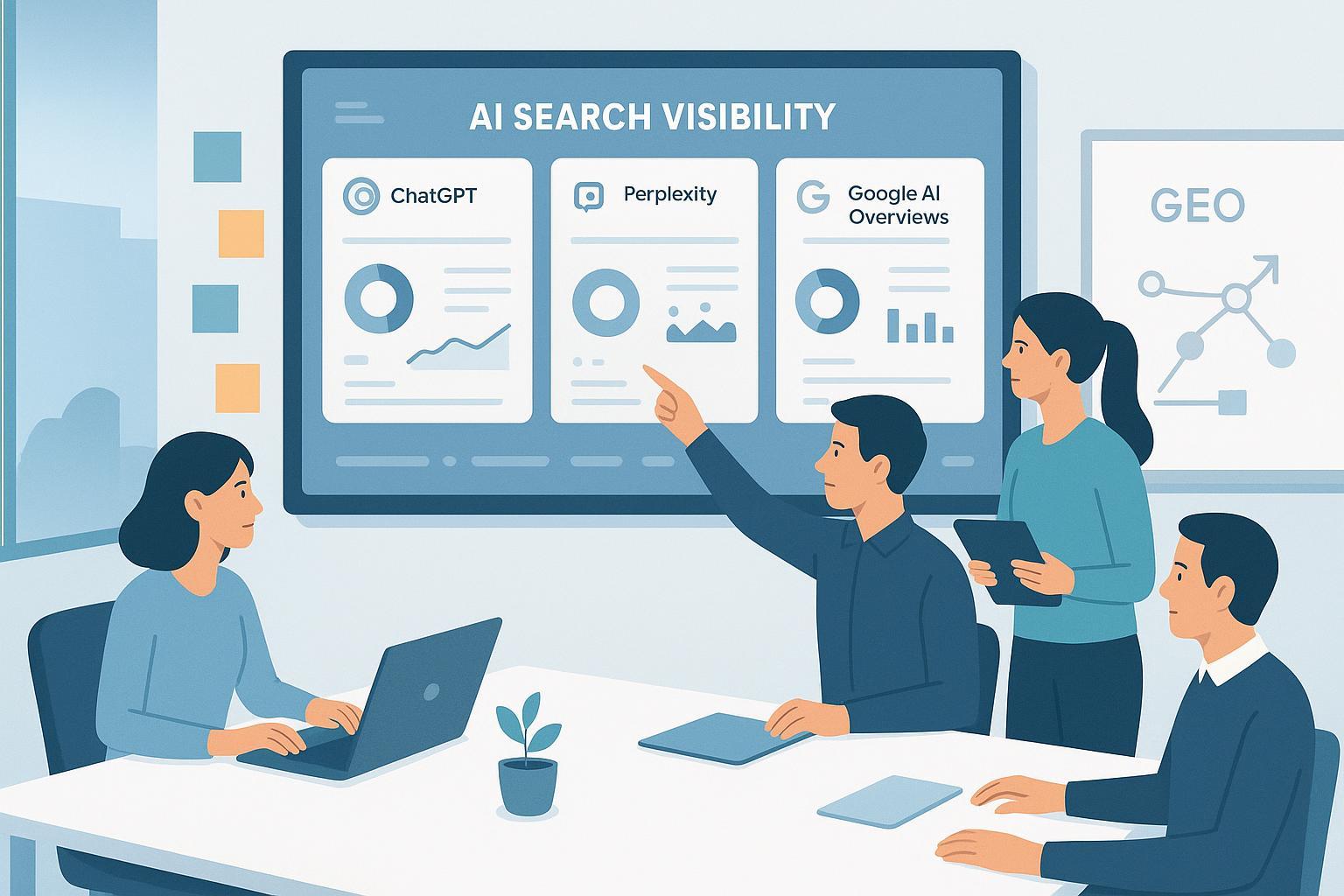
If your buyers ask ChatGPT, Perplexity, or Google’s AI Overviews before they ever land on your site, how do you make sure your brand shows up—accurately and often? That’s the promise of Generative Engine Optimization (GEO): shaping how generative engines cite and represent your expertise inside their answers.
According to the industry consensus, GEO focuses on getting your content and evidence used by AI engines—not just ranking in traditional SERPs. See the formal definition in Generative engine optimization (Wikipedia) and practitioner explainers like Optimizely’s glossary (2025) and SEO.com’s overview (2025). For a broader foundation on AI visibility, this primer is helpful: What Is AI Visibility? Brand Exposure in AI Search Explained (Geneo).
What GEO means (and why B2B teams care)
GEO is the practice of optimizing your digital footprint so that generative engines preferentially cite your pages and correctly summarize your claims inside their synthesized answers. It differs from SEO (which aims to rank pages for clicks) and AEO (which aims to capture direct answers/snippets). B2B buyers often do deep, multi‑source research, and AI engines compress that research into a few authoritative citations. If you’re absent—or misrepresented—you lose influence long before a sales conversation.
Two quick reasons it matters:
- AI engines are shaping discovery with fewer outbound clicks. Industry breakdowns on zero‑click dynamics and AI answer behavior appear in analyses such as Digiday’s overview (2024–2025) and their traffic trend report.
- Accuracy and trust signals determine whether your brand is cited. Practitioner guides from Walker Sands (2025) and Foundation Inc. (2024–2025) emphasize evidence, schema, and corroboration.
GEO vs. SEO vs. AEO: the practical differences
Think of SEO as getting invited to the list of links, AEO as being the short spoken/snippet answer, and GEO as being the source an AI trusts when it crafts a full, conversational response. The goals, tactics, and outcomes diverge.
- SEO: rank for clicks.
- AEO: win the concise answer.
- GEO: be cited and accurately represented inside AI answers.
Below is a compact comparison you can use with your leadership team. For a deeper dive, see Traditional SEO vs GEO: 2025 Marketer’s Comparison (Geneo), and foundational distinctions from Optimizely’s “SEO vs AEO” (2023–2025) and SEO.com’s “AEO vs SEO” (2025).
| Approach | Primary Goal | Key Tactics | Typical Outcome |
|---|---|---|---|
| SEO | Rank pages in SERPs | Keywords, links, technical hygiene | Clicks and conversions |
| AEO | Capture direct answers/snippets | Q&A formatting, schema, concise definitions | Zero‑click visibility via snippets |
| GEO | Be cited inside AI answers | Authoritative content, citations, entity clarity, corroboration across trusted sources | AI presence, sentiment control, share of voice in generative answers |
What goes into a productized GEO service
A productized GEO service gives you repeatable components, clear deliverables, and a cadence that leadership can evaluate. Here’s a pragmatic packaging model you can take to your exec team.
- Strategy & discovery
- AI visibility audit across ChatGPT, Claude, Google AI Overviews, and Perplexity; competitive citation mapping.
- Buyer‑question taxonomy and prompt list aligned to intents (informational, investigational, navigational, transactional).
- KPI tree and opportunity sizing: inclusion percentage, top‑3 share, sentiment, coverage, share of voice, assisted conversions.
- Content optimization for AI reuse
- Build AI‑friendly “money pages”: comparisons, FAQs with schema, definitions, SME‑authored sections with stats and citations.
- Entity and schema hygiene: Organization, Product, FAQ, HowTo; consistent naming; internal corroboration.
- Authoritativeness: third‑party references (analyst reports, standards), expert quotes, verifiable data.
- Authority and corroboration
- Editorial outreach and PR for respected placements (listicles, directories, analyst briefings, industry publications).
- Community participation (LinkedIn, Reddit, YouTube) to seed trusted signals in public training corpora.
- Technical foundations
- Crawlability, performance, canonical hygiene; machine‑readable feeds/APIs; robots.txt rules that don’t block AI crawlers; structured data across templates.
- Monitoring and iteration
- Cross‑engine tracking for citations, sentiment, coverage, and share of voice; freshness checks; iterative content and outreach adjustments in response to platform updates.
- Governance and enablement
- Editorial standards and evidence requirements; SME/legal review for claims; privacy and data protection alignment (e.g., GDPR, SOC 2, ISO 27001, HIPAA as applicable); enablement for sales/CS to supply validated proof points.
These components align well with practitioner perspectives from Foundation Inc. (2024–2025), Walker Sands (2025), and platform explainers from SEO.com (2025).
Measurement & KPIs for GEO
GEO measurement emphasizes visibility inside AI answers over clicks. If you can’t see when, where, and how you’re cited, you can’t manage the narrative.
Key KPIs
- Inclusion percentage: percent of target prompts where your brand is cited.
- Top‑3 share: presence among the first three citations or mentions.
- Citation volume and quality: number and authority of URLs cited by AI.
- Sentiment: tone of AI mentions (positive/neutral/negative).
- Coverage: breadth of queries/topics covered by your citations.
- Share of voice: citation share relative to competitors across engines.
- Assisted conversions: multi‑touch attribution tying AI exposure to outcomes.
Methods
- Target prompt workshops; monthly sampling and manual verification across ChatGPT, Claude, Perplexity, and Google AI Overviews.
- Citation mapping of the top category sources engines rely on; outreach to reinforce inclusion.
- AI visibility tools for citation extraction; NLP for sentiment; CRM/MA integration for assisted conversions.
For a structured measurement framework, see LLMO Metrics: Measure Accuracy, Relevance, Personalization in AI (Geneo), and practitioner sources such as Terakeet’s engine comparisons (2024) and Foundation Inc.’s GEO RFP guidance (2025).
Packaging & pricing models
How do you make GEO predictable for procurement and finance? Productize the engagement.
- Fixed‑scope packages: Define the number of audits, AI‑optimized pages, schema deployments, and outreach targets per quarter.
- SLAs: Set response times for monitoring alerts, cadence for reporting, and quarterly governance reviews.
- Governance add‑ons: Privacy reviews, SME/legal approvals, and bias audits.
- Pricing references: Industry analyses such as First Page Sage’s cost breakdown (2025) help benchmark the market; verify with current vendor proposals.
Practical workflow example
Here’s how a typical quarter might run.
- Weeks 1–2: Intake and discovery. Conduct an AI visibility audit across engines; map competitor citations; run a target prompt workshop. Deliverables: audit report, prioritized prompt list with intent tags, KPI proposal.
- Weeks 2–4: Strategy and planning. Build the KPI tree, content calendar, and outreach plan. Deliverables: strategy deck, roadmap.
- Weeks 4–12: Content and technical execution. Publish AI‑optimized FAQs and comparison pages; implement schema and entity hygiene; add third‑party citations.
- Ongoing monthly: Outreach and community. Secure placements in credible publications and directories; summarize engagement.
- Weekly/monthly: Measurement and iteration. Track inclusion %, sentiment, coverage, and share of voice; adjust content and outreach.
Disclosure: Geneo is our product. In this workflow, a neutral AI visibility monitoring platform can track citations across ChatGPT, Perplexity, and Google AI Overviews, analyze sentiment, and flag weak coverage so your team can add corroborating references. Practitioner guides from Zapier (2025) and SEO.com’s roundup of AI visibility tools (2025) provide examples of how teams operationalize this.
Risks, compliance, and governance
The upside of GEO is significant, but B2B teams need safeguards.
- Hallucinations and misattribution: LLMs can invent facts or mix up brands. Mitigation: sturdy evidence, consistent messaging, and ongoing citation checks; embed SME/legal review.
- Negative AI bias: Engines may preference larger brands or outdated narratives. Mitigation: third‑party corroboration, fresh content, and proactive outreach.
- Privacy and data protection: Ensure content and tooling comply with relevant standards (GDPR, SOC 2, ISO 27001, HIPAA as applicable). Mitigation: clear policies, audit trails, and role‑based access.
Governance frameworks from Optimizely’s academy guide (2025) and industry reporting like Digiday’s zero‑click analyses (2024–2025) reinforce the need for substantiation and continuous monitoring.
Tool stack and vendor evaluation checklist
Selecting tools for GEO should be criteria‑driven and pragmatic.
- Cross‑engine coverage: ChatGPT, Claude, Perplexity, Google AI Overviews.
- Citation extraction: Accurate detection of which URLs are being cited.
- Sentiment analysis: Reliable classification and trend tracking.
- Data export & APIs: Integration with BI/CRM tools for attribution.
- Governance & compliance: Privacy controls, audit trails, user roles.
- Reporting & visualization: Clear dashboards; configurable reports.
- Error detection: Flags for blocked AI crawlers, paywalls, or content gaps.
To survey the landscape, review vendor roundups like SEO.com’s “Best AI visibility tools” (2025). Tool capabilities evolve quickly—validate with current documentation during selection.
Next steps
If you’re ready to package GEO for your B2B org, start with a cross‑engine visibility audit, define your buyer‑question taxonomy, and ship a first wave of AI‑optimized FAQs and comparison pages. Then set measurement cadences and governance.
For deeper reading and operational alignment:
- What Is AI Visibility? Brand Exposure in AI Search Explained (Geneo)
- Traditional SEO vs GEO: 2025 Marketer’s Comparison (Geneo)
- LLMO Metrics: Measure Accuracy, Relevance, Personalization in AI (Geneo)
- Google Algorithm Update October 2025 (Geneo)
- LinkedIn Team Branding for AI Search Visibility (Geneo)
Ready to operationalize GEO? Set your first audit, nominate SMEs for evidence reviews, and align tooling with your reporting stack. Let’s make AI answers work for you.