
GEO Roadmap for Marketing Teams: Step-by-Step Guide to AI Visibility
Learn how marketing teams can boost AI visibility with a step-by-step GEO roadmap including discovery, implementation, measurement, and troubleshooting for Google AI Overviews, ChatGPT, and more.
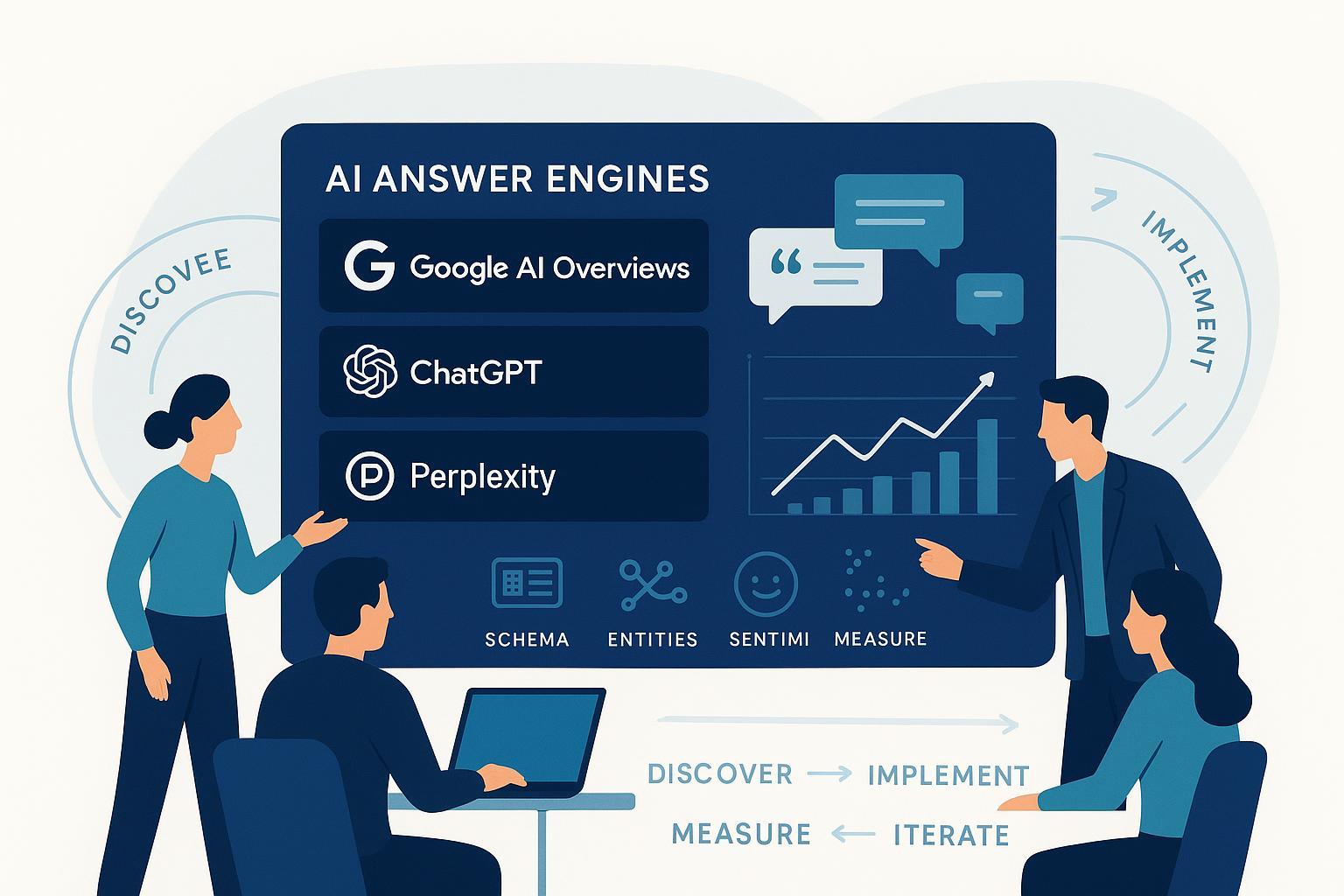
If answer engines are where customers get their first impression of your brand, can you afford to be invisible—or misrepresented? Here’s the deal: Generative Engine Optimization (GEO) is now a repeatable program, not a side project, and this roadmap shows your team exactly how to run it.
GEO in one page: what it is and how it differs from SEO
GEO is the practice of earning accurate inclusion and citations inside AI-generated answers across Google AI Overviews/AI Mode, ChatGPT Search, Perplexity, Gemini, and Claude. The goal shifts from ranking blue links to being part of the answer with correct attribution and tone. Industry primers position GEO as complementary to SEO, emphasizing entity clarity, verifiable facts, and structured context over keyword density, as summarized by the overview from Search Engine Land in 2024: “What is Generative Engine Optimization (GEO)”.
If you want a deeper comparison of program design and KPIs, see our short primer on traditional SEO vs GEO.
The quarterly GEO loop: Discover → Prioritize → Implement → Measure → Iterate
GEO works best as a quarterly loop with weekly and monthly touchpoints. Assign clear owners, define done, and keep a living backlog.
| Phase | Goal | Key outputs | Suggested owners | Completion criteria |
|---|---|---|---|---|
| Discover | Map opportunities and risks | Query library, entity audit, technical eligibility report | SEO lead, content strategist, analyst | Target query set approved; entity and schema gaps documented |
| Prioritize | Choose high-impact targets | Scored backlog by platform; brief per target | SEO lead, PM, brand owner | Top N targets locked; briefs signed off |
| Implement | Ship answer-ready content and fixes | Content updates, schema parity, entity disambiguation, approvals | Content team, SEO/engineering, brand/Legal as needed | Pages updated, validated, and published |
| Measure | Prove visibility and correctness | KPI dashboard (AI SOV, citation rate, entity accuracy, sentiment) | Analytics lead, SEO lead | Reporting circulated; deltas vs. prior cycle |
| Iterate | Refresh and scale | Backlog cleanup, refresh triggers, playbook updates | Program owner, cross-functional reviewers | Next quarter plan approved |
Step-by-step execution
1) Discover
- Build a query library that reflects buying journeys and brand-critical topics for each platform. Include commercial, comparison, troubleshooting, and “best”/“vs” queries.
- Run an entity audit. Ensure your Organization, Product, and key People entities are unambiguous across your site and authoritative profiles (Wikidata, LinkedIn, Crunchbase). Structured data should map to real pages; use JSON-LD and complete required/recommended fields per Google’s guidelines on structured data policies.
- Validate technical eligibility. Google states AI features (AI Overviews/AI Mode) draw from its standard index; pages must be indexable and snippet-eligible, controlled via common directives like nosnippet/noindex when necessary, per Google’s AI features and your website (Search Central, 2025).
- Capture current AI visibility. Manually test a representative set in Google AI Overviews/AI Mode, ChatGPT Search, Perplexity, and Gemini’s “double-check” views to see who’s cited, how often, and with what sentiment.
For background on the business concept behind this, see our explainer on AI visibility and brand exposure.
2) Prioritize
Create a simple scoring model: Impact × Feasibility × Risk mitigation need.
- Impact: Does the query surface an Overview/answer frequently and influence pipeline? Studies suggest AI Overviews appeared in roughly 18.76% of U.S. desktop queries in late 2024, according to SE Ranking’s 2024 recap (Dec 2, 2024). Treat prevalence as directional and re-validate for your market.
- Feasibility: Can you deliver answer-ready content and schema parity this sprint? Are subject-matter experts available?
- Risk: Any misattribution today? Are there safety/compliance sensitivities requiring Legal review?
Mind platform nuances while scoring. Google’s guidance emphasizes people-first content and trust signals rather than AI-specific markup, per Google’s “Succeeding in AI Search” (Search Central Blog, 2025-05-21). Perplexity is citation-forward by default; ChatGPT Search shows inline citations; Gemini offers a “double-check” that surfaces related sources—each favors clarity and verifiability.
3) Implement
Design content for “answerability.” Aim for:
- Concise definitions near the top; short, sourced claims; and clear subheadings.
- Explicit entity names and relationships. Use Organization, Person, Product, Article/BlogPosting, FAQPage/HowTo where appropriate, mapped to the page subject with complete properties.
- Schema parity: the facts in schema must match the visible content.
- Authorship, review processes, and last reviewed dates (for trust) where appropriate.
- Conflict resolution: where the topic is ambiguous, define scope and trade-offs.
Technical hygiene still matters. Ensure crawlability, mobile parity, and fast rendering. For Google, eligibility remains standard Search; AI Overviews launched broadly in the U.S. in May 2024 and evolved into AI Mode in 2025 (see Search Central guidance above for current criteria).
4) Measure
Your GEO KPI core should be compact and comparable across platforms:
- AI Share of Voice (AI SOV): What percent of tested AI answers cite or mention you vs. competitors?
- Citation rate/count and prominence: How often are you included, and how visible is the citation?
- Entity correctness and sentiment: Are brand/product/person details accurate and positive/neutral?
- Leading indicators: Structured data validation rate, answerability checks, and freshness.
Tie these to executive outcomes with a simple model: visibility → assisted traffic or branded demand → opportunity creation. For deeper KPI definitions aligned to AI experiences, see our post on LLMO metrics for accuracy, relevance, and personalization.
Cadence matters. Establish weekly spot checks on priority queries, a monthly deep dive across platforms, and a quarterly roadmap refresh. What would you learn faster if you instrumented one more check this week?
5) Iterate
Use refresh triggers: significant ranking/citation shifts, product launches, policy changes, or new competitor content. Keep a clean backlog, retire low-yield targets, and fold learning into your briefs and templates.
Platform nuances that actually change your plan
- Google AI Overviews/AI Mode: To appear as a supporting link, pages must be indexed and eligible for snippets; no special markup is required beyond standard Search, per Google’s AI features guidance (Search Central, 2025-05-21). Google also reiterates trust signals and structured data used appropriately in “Succeeding in AI Search” (2025-05-21).
- ChatGPT Search: OpenAI documents that the system decides when to browse and presents answers with inline, clickable citations; see OpenAI’s ChatGPT Search help (updated 2025-11-12).
- Perplexity: Citations are first-class and always visible; users can choose focus modes for sources, per Perplexity Help Center (2025-01-27).
- Gemini: Users can “double-check” responses against Search and view related sources, as explained in Google’s Gemini help (2024-02-08).
Practical workflow example (neutral, with alternative)
Disclosure: Geneo is our product.
Scenario: Your brand isn’t cited for “best payroll software for startups” in AI answers, despite strong reviews.
- Week 1: Discover. Build the query set across Google AI Overviews/AI Mode, ChatGPT Search, Perplexity, and Gemini double-check; capture current citations and sentiment. Confirm Organization and Product schema and sameAs links are complete and consistent.
- Week 2: Prioritize. Score the query by potential pipeline impact and feasibility. Draft a brief: page to update, expert reviewer, target sub-intents (pricing transparency, startup discounts, security certs), and sources you’ll cite.
- Week 3: Implement. Add a crisp definitions block, a comparison table, sourced claims, and FAQ. Ensure Product schema mirrors on-page facts. Publish with author/reviewer details.
- Week 4: Measure & Iterate. Re-test target queries across platforms. If citations appear but misattribute features, add explicit clarifications and a short “who it’s for” section.
How teams run this:
- Using Geneo: Teams can centralize cross-engine monitoring—citation frequency, mention sentiment, and entity correctness—and review a history of answer snapshots to see what changed. This saves time when running weekly spot checks and quarterly refreshes.
- Manual alternative: Maintain a shared spreadsheet of target queries by platform. Each week, run tests in private/incognito, capture screenshots/URLs for cited sources, and log sentiment and entity accuracy. Use schema validators and Search Console for technical checks.
Troubleshooting and governance
When something goes off track, act fast and document the fix.
- Hallucinations or incorrect facts: Tighten on-page sourcing with authoritative links and ensure schema matches visible claims. Where possible, add clarifying context that reduces ambiguity.
- Misattribution or the wrong entity: Confirm entity home pages, consistent naming, and robust sameAs networks (e.g., Wikidata, LinkedIn). In persistent cases, file feedback through platform channels.
- Negative or outdated citations: Add recency cues, update facts, and include a short “what changed” note to help models pick up freshness.
Escalate when:
- Repeated misattribution occurs on revenue-critical queries.
- Safety/compliance risks surface (YMYL-adjacent topics, regulatory claims).
- Sentiment flips negative for more than one reporting cycle.
Reporting leaders will read
Translate GEO KPIs into business outcomes:
- AI SOV improvements on comparison and solution queries suggest future branded demand.
- Citation prominence and positive sentiment correlate with stronger mid-funnel consideration.
- Entity accuracy reduces support costs from confusion and protects reputation.
Present a single dashboard with trends by platform, plus a short commentary: what changed, why it matters, and what you’ll do next. If you need a refresher on metrics foundations, review our LLMO metrics guide and adapt the definitions to GEO.
Next steps
GEO becomes durable when monitoring and iteration are routine. If you lead a team or agency and want to centralize cross-engine visibility and reporting, explore our agency-ready options on Geneo for teams and agencies. Prefer to start manually? Clone the phases in this roadmap into your project tool, assign owners, and run your first 4-week cycle this quarter.