
GEO Report Checklist: What to Include for Complete AI Visibility
Follow this actionable GEO report checklist for all essential metrics, citations, sentiment, benchmarking, and evidence logging in AI-driven search visibility reporting.
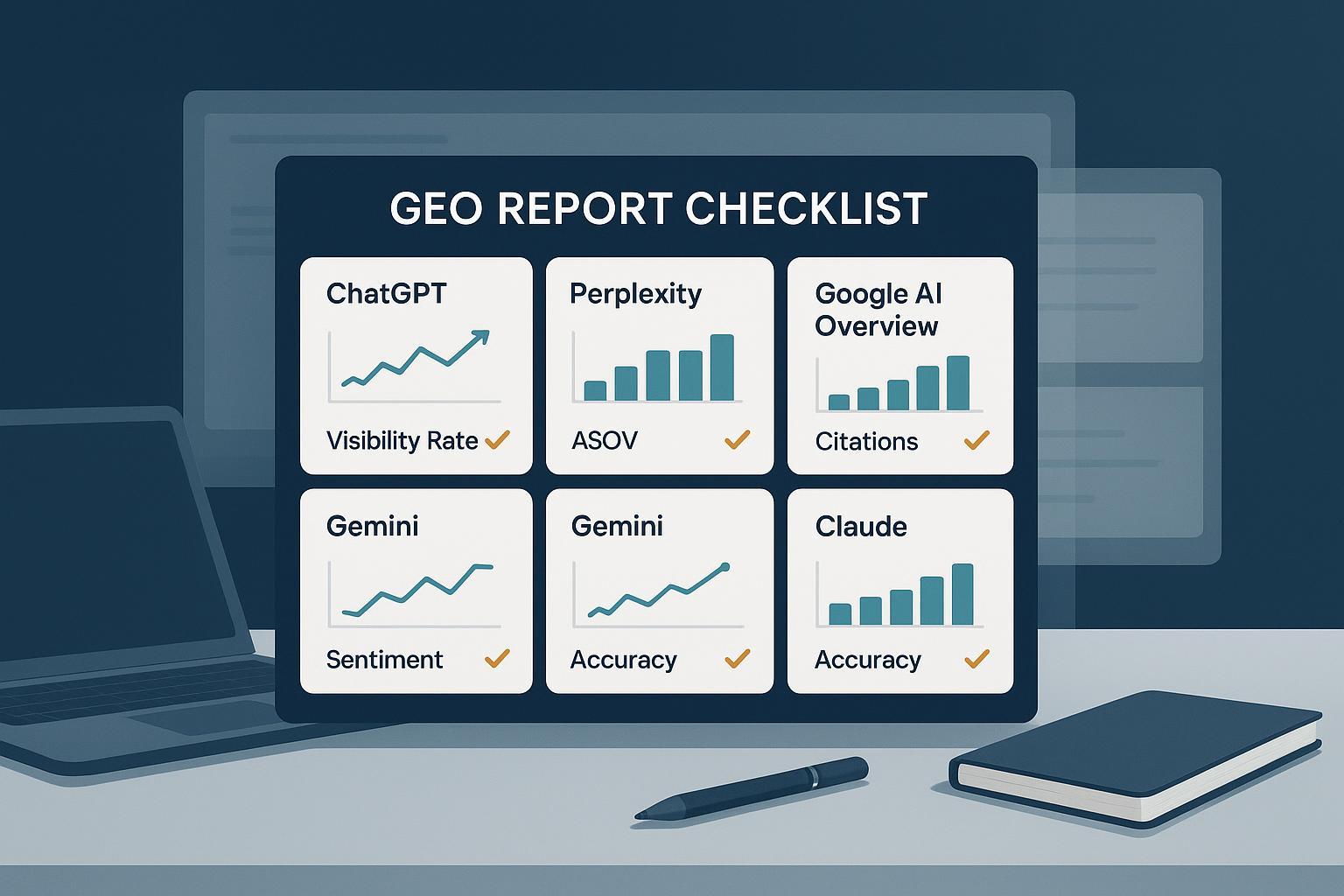
Generative Engine Optimization (GEO) reporting documents how your brand shows up inside AI-generated answers—not just where you rank. Think ChatGPT, Perplexity, Google’s AI Overviews, Gemini, and Claude. A strong GEO report captures inclusion, citations, prominence, sentiment, accuracy, and trends in those answers, then turns findings into action your team can repeat and audit. If you’ve ever wondered, “Are we getting cited in AI answers—and does the story match our brand?” this checklist is for you.
According to Search Engine Land, GEO builds on SEO fundamentals but shifts measurement toward visibility in AI answers and the sources those systems trust. See their definition and tracking guidance in the Generative Engine Optimization overview and multi-engine monitoring notes in how to monitor AI search visibility. For deeper context, Ahrefs outlines AI visibility concepts in their GEO guide.
1) Measurement foundation: query set, engines, and methods
Lay out the measurement scaffolding so results are reproducible. Define canonical prompts grouped by topic/intent (e.g., product comparisons, how-to use cases, brand reputation), keep variants that reflect natural phrasing, and track at minimum ChatGPT, Perplexity, Google AI Overviews, Gemini, and Claude across relevant locales and languages. Document model/version, prompt templates, session reset rules, and timestamps. Export full answers, not just screenshots, and store citation lists. Record the exact run context (engine, model, locale, date/time, annotator), and maintain a change log when engines update. Search Engine Land emphasizes visibility-first measurement and multi-platform tracking in their GEO primer. Keep your methods block tight—this is the backbone of trust.
2) Platform-specific performance breakdown
Report performance per engine because philosophies differ. For each platform, capture visibility rate (inclusion/citation presence in tested prompts), citation frequency (how often your URLs appear among sources), prominence/position (where and how your brand shows in the answer), sentiment (positive/neutral/negative tone and descriptors), and accuracy (verified vs. mistaken statements; note any hallucinations). Per Search Engine Land’s monitoring guidance in multi-engine visibility tracking, engines weigh freshness, structure, and evidence differently—document these distinctions to tailor fixes.
3) Core metrics: definitions and formulas
Below are the metrics most teams use to quantify AI answer presence. Use per-engine calculations and query-cluster rollups.
| Metric | What it captures | Formula / guidance |
|---|---|---|
| AI Visibility Rate | How often you’re included or cited across prompts | (Brand mentions or citations ÷ Total prompts) × 100. See visibility framing in Ahrefs’ GEO guide. |
| Answer Share of Voice (ASOV) | Competitive share of inclusion across brands | (Your brand mentions ÷ Total mentions across all brands) × 100. Position-weighted variants exist; ASOV is articulated by BrandRadar’s methodology. |
| Citation Rate | How often your own URLs are cited when you’re included | (Your domain citations ÷ Your brand mentions) × 100. Track self vs. third-party. |
| Prominence Score | Your visibility position within the answer | Weight primary vs. secondary inclusion (e.g., 1.0 first, 0.5 second); compute a weighted average. |
| Sentiment Balance | Net tone of mentions | Positive% − Negative%; annotate descriptors. |
| Accuracy/Hallucination Rate | Reliability of claims | (False statements ÷ Total checked statements) × 100; add notes and remediation plan. |
| Trend Deltas | Changes over time | Track MoM/QoQ shifts across engines and clusters; visualize platform variance. |
For a deeper measurement backdrop (accuracy, relevance, personalization, sentiment), see LLMO metrics and measurement framing.
4) Citation analysis: frequency, source mix, recency, and quality
AI answer citations are not traditional backlinks—they’re traceability signals inside the response. Your report should log frequency (how often your brand and URLs appear), source mix (self-owned vs. third-party citations like .gov/.edu, media, reviews, listings), prominence (whether your sources appear in top cards or deeper notes), recency (publish/update dates; engines often prefer fresher pages), and quality (authoritative, well-structured sources with clear attribution). Industry analysis shows engines vary in citation behavior; see patterns in Search Engine Land’s sector study on AI search citations across 11 industries.
For concept grounding on AI visibility as an operational KPI, read AI visibility definition and cross-platform monitoring.
5) Qualitative review: sentiment, narrative framing, and accuracy
Numbers tell you if you show up; qualitative review tells you how you’re portrayed. Use standardized rubrics and multi-rater annotation. Classify sentiment (negative/neutral/positive; optionally −2 to +2 scoring with descriptor notes). Assess narrative framing: Is the guidance clear, useful, and aligned with brand messaging? Are product names, features, and positioning correct? Verify claims against authoritative sources; mark partially correct vs. incorrect and log remediation. Marketing-focused analysts highlight E-E-A-T, structure, and evidence in GEO practice; Walker Sands’ overview provides context for marketing leaders.
6) Competitive benchmarking across engines and clusters
Build head-to-head comparisons that show where rivals are gaining ground. Compare ASOV by engine and query cluster, visibility rate and citation quality overlays, descriptor sentiment and accuracy scores, and citation overlap (what sources engines rely on for each brand). Your benchmarking should be table-first, with clear schemas for prompts, responses, annotations, and aggregates. BrandRadar describes ASOV and prompt coverage as core GEO KPIs in their GEO visibility measurement resource.
7) Trends and deltas, platform variance, and locale considerations
Your GEO report isn’t just a snapshot—it’s a trend instrument. Track MoM/QoQ changes in visibility, ASOV, citations, sentiment, and accuracy; note platform variance (e.g., Google AI Overview volatility) and log model/version differences; segment by locale and language since engines may surface non-English sources in English sessions. Search Engine Land’s AI Visibility Index highlights platform-level shifts and brand rises/falls; see three months of visibility data for methodological cues.
8) Insights and recommendations (turn findings into action)
Translate the data into prioritized moves with owners and tests. Strengthen content structure and clarity to improve citability—headings, summaries, and evidence blocks. Update key pages with visible dates and changelogs to boost recency signals. Seed citations via PR/partnerships to place authoritative third-party references. Clarify Organization, Person, and Product schema to avoid entity name collisions. Localize high-intent pages and check multi-language model behavior as needed. Search Engine Land provides technical guidance and citation-focused tactics in their GEO technical notes and data-backed suggestions in how to get cited by AI (8,000 citations).
9) Governance: cadence, ownership, evidence logging, reproducibility
Think of governance as your quality system. Establish weekly spot checks for priority prompts, monthly dashboards, and quarterly deep dives with rubric calibration. Assign prompt set maintenance, engine coverage, annotation QA, and recommendation ownership to named roles. Export full responses with timestamps and model/version notes; store hashes and maintain a chain-of-custody style repository for defensibility. After major engine changes, re-run a baseline set and document deltas. Legal/forensic practitioners advise metadata-rich exports and authentication steps for synthetic content; see guidance on chain-of-custody in authenticating AI-generated evidence and screenshots.
Practical example (disclosure)
Disclosure: Geneo is our product. You can operationalize parts of this checklist with neutral workflows. For instance, export per-engine AI visibility by topic cluster, then annotate sentiment and accuracy for a sample of prompts. From there, compute ASOV and citation rates, and visualize MoM deltas.
- Explore platform capabilities at geneo.app.
Keep your methods and evidence logs independent of any single tool so your GEO report remains auditable.
Closing: next steps
If your current reporting stops at “are we in AI answers?” expand it to “how are we cited, portrayed, and changing over time?” Start by formalizing your query set, annotating sentiment/accuracy, and logging evidence. When you’re ready to centralize workflows, consider using a dedicated tracker—Geneo among them—to streamline exports and trend dashboards while you keep governance tight.