
GEO (Generative Engine Optimization) for Medical Devices: A Compliance‑First Playbook for 2025
Expert guidance for Generative Engine Optimization (GEO) in medical devices—actionable 2025 best practices, AI search, compliance & dual-channel visibility.
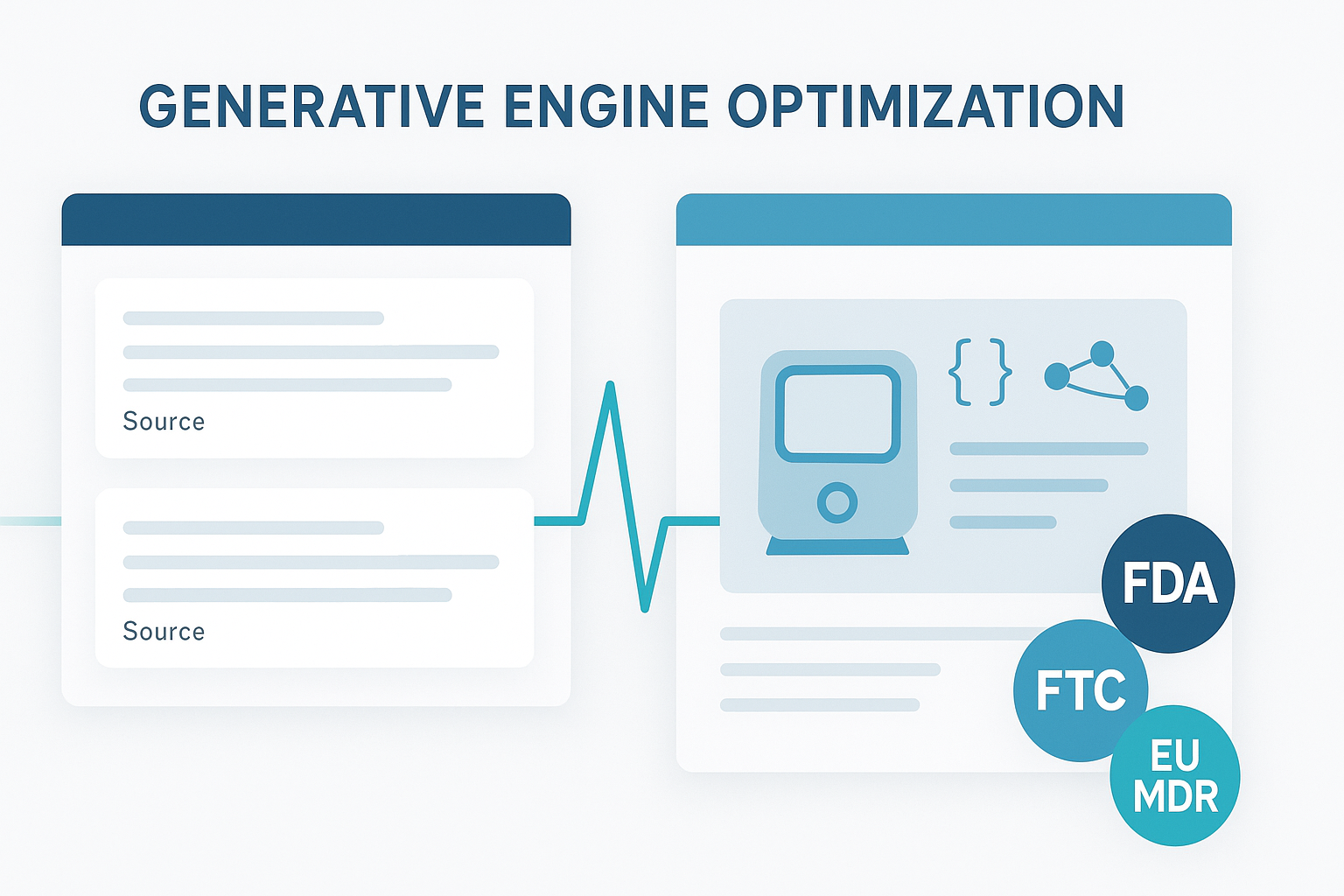
Generative engines now write the first draft of many buying journeys. For medical devices—squarely in YMYL territory—that shift raises the bar. You must be findable in AI answers and classic search while meeting FDA/FTC/EU MDR expectations every step of the way. Google’s AI Overviews began rolling out broadly in 2024, reshaping how results are assembled and cited, as outlined in the official announcement on the generative AI expansion to Search (May 2024). Independent analyses through 2025 have reported meaningful click declines where AI Overviews appear; for example, Search Engine Land summarized large CTR drops on informational queries based on Seer Interactive’s dataset in late 2025 in “Google AI Overviews drive a drop in CTR” (2025). The practical takeaway: build content that engines can trust and cite, and keep a verifiable audit trail that satisfies regulators.
1) Build a compliance‑by‑design GEO workflow
Start where risk actually lives: claims. Create a living claims register that maps each web statement to its source (510(k)/PMA, IFU/labeling, clinical evidence), and run every asset through regulatory review before and after publication.
- Balance benefits and risks using clear, quantitative presentation. FDA’s final guidance for DTC-style materials recommends absolute probabilities, comparable denominators, and inclusion of control data where applicable—see “Presenting Quantitative Efficacy and Risk Information” (FDA, 2023).
- Substantiation is non‑negotiable. The FTC requires competent and reliable scientific evidence for health claims, including implied ones. Review the FTC Health Products Compliance Guidance (2022) and ensure any endorsements and online disclosures follow the Endorsement Guides.
- Avoid misleading advertising in the EU. Article 7 of the MDR prohibits claims that could deceive users about performance, safety, or approvals. Align web statements with technical documentation as required by EU MDR Article 7 (EUR‑Lex consolidated text).
- Separate scientific communications about unapproved uses from promotion. If you provide firm-initiated scientific information to HCPs, follow FDA’s SIUU framework (clear disclosures, no promotional tone) and keep it out of patient-facing channels.
Common pitfalls illustrated in recent warning letters include implying broader indications than clearance, overstating capabilities, and suggesting outcomes without evidence. Think of your claims register as the single source of truth that prevents those errors from slipping into copy, graphics, or captions.
2) Engineer content that generative engines can trust
Generative systems favor content that looks consistently expert, structured, and current. That’s also what quality raters expect for YMYL content. Google’s raters evaluate medical content against very high E‑E‑A‑T thresholds, emphasizing clear credentials, expert consensus, and fresh accuracy, per the Search Quality Rater Guidelines (current PDF). Build that trust into your pages, not as an afterthought but as the default.
- Author and reviewer signals: Use expert bylines with credentials, institutional affiliations, and an on-page reviewer note for safety‑critical pages. Add a last-reviewed date and a short “what changed” log.
- Dual‑audience layering: Offer plain‑language summaries for patients, and an HCP tab or section with indications, use conditions, endpoints, and references. Keep the message identical in meaning across both layers to avoid inconsistent net impressions.
- Reference consistency: Cite peer‑reviewed studies and official government or academic sources. Maintain a consistent citation style and link policy.
- Entity and structured data: Implement JSON‑LD on device pages to help engines understand the device, organization, and evidence relationships. Follow Google’s eligibility and property guidance for Product data in Search Central’s Product structured data documentation, and pair relevant MedicalDevice properties from Schema.org.
Here’s a compact JSON‑LD starter you can adapt (ensure values reflect cleared labeling and on‑page copy):
{
    "@context": "https://schema.org",
    "@graph": [
      {
        "@type": "Organization",
        "@id": "https://www.examplemed.com/#org",
        "name": "Example MedTech Inc.",
        "url": "https://www.examplemed.com",
        "logo": "https://www.examplemed.com/assets/logo.png",
        "sameAs": [
          "https://accessgudid.nlm.nih.gov/"
        ]
      },
      {
        "@type": "Product",
        "@id": "https://www.examplemed.com/device-x/#product",
        "name": "Device X",
        "url": "https://www.examplemed.com/device-x/",
        "image": ["https://www.examplemed.com/device-x/hero.jpg"],
        "brand": { "@id": "https://www.examplemed.com/#org" },
        "description": "Single‑use catheter intended for [indication consistent with cleared labeling].",
        "isAccessoryOrSparePartFor": {
          "@type": "MedicalDevice",
          "name": "Device X System"
        }
      },
      {
        "@type": "MedicalDevice",
        "@id": "https://www.examplemed.com/device-x/#md",
        "name": "Device X System",
        "manufacturer": { "@id": "https://www.examplemed.com/#org" },
        "guideline": {
          "@type": "MedicalGuideline",
          "url": "https://pubmed.ncbi.nlm.nih.gov/",
          "name": "Peer‑reviewed evidence summary"
        },
        "indication": "Indicated for [population/procedure] as per cleared labeling.",
        "contraindication": "See IFU for contraindications and risks.",
        "url": "https://www.examplemed.com/device-x/"
      }
    ]
  }
Pro tip: link entities with sameAs where appropriate (e.g., GUDID/UDI entry, ClinicalTrials.gov NCT IDs, PubMed references) and make sure the structured data mirrors the visible page content exactly.
3) Measure and improve visibility across AI and classic search
You can’t manage what you can’t measure. Track where your brand and devices are cited inside generative answers (ChatGPT, Perplexity, Gemini, Bing/Copilot) and whether Google’s AI Overviews include your pages and links. Correlate those signals with featured snippets and traditional rankings to prioritize fixes.
- Build a repeatable prompt set and capture screenshots with timestamps for an audit trail. Note which answers cite you, how they summarize your indications or risks, and any hallucinations that appear.
- Establish a monthly or quarterly reporting cadence: share‑of‑voice in AI answers, sentiment patterns, and changes after content updates.
Disclosure: Geneo is our product. As a neutral example, a unified monitor like Geneo can track cross‑engine citations and sentiment for brand queries, device names, and core use cases, then flag mismatches between AI summaries and your cleared labeling. For a deeper dive on behavioral shifts and measurement basics, see AI Search User Behavior 2025.
4) Refresh, remediation, and audit cadence
High‑impact pages—indications, safety information, clinician guides—deserve fast refresh cycles. Aim for 6–8 weeks on those, with quarterly checks elsewhere. Maintain a visible change log on page or in a linked revision note. When AI engines misstate your device, move quickly: publish a clarifying page with citations, update relevant FAQs and HCP guidance, and document the correction.
Why this pace? Generative surfaces are evolving, and so are ranking systems. Google’s rollout of AI Overviews began in 2024 and expanded through 2025, altering which pages are cited and how context is summarized. Algorithmic adjustments also continue to shape what earns visibility; our summary of practical takeaways is here: Google Algorithm Update October 2025: What Actually Changed?. The short version: sites that show expertise, maintain clean entity signals, and keep content up to date tend to be cited more reliably.
5) A pre‑publish GEO checklist for device pages
- Map every claim to labeling or clinical evidence in a maintained claims register; confirm consistency with intended use.
- Add risk/benefit balance with absolute numbers where possible; include control data if applicable and keep denominators consistent.
- Show expert authorship and medical review; add last‑reviewed date and what changed.
- Implement JSON‑LD for Product + MedicalDevice + Organization; link out with sameAs to authoritative records.
- Cite peer‑reviewed or government/academic sources in a consistent format and ensure the citations reflect consensus.
- Capture a baseline: featured snippet status, AI Overview presence/linking, and generative‑engine citations with screenshots.
- Schedule the refresh cadence (6–8 weeks for top pages) and set up alerts for brand/device mentions.
Bringing it all together
GEO for medical devices works when compliance, evidence, and technical execution move in lockstep. If you keep your claims register current, demonstrate real expertise on the page, structure your entities clearly, and measure outcomes across both AI and classic search, you’ll put your brand in a position to be cited—and trusted—by the engines shaping discovery.
If you’re standing up a monitoring program, start small: pick 10–15 priority queries, establish your audit trail, and run a single refresh cycle on your top device page. Then expand the coverage as your process matures.
Optional next step: explore a unified monitor for cross‑engine citations and sentiment; tools like Geneo can centralize visibility and audit trails without changing your stack.