Why Brands Without GEO Will Lose Market Share in 2025
Latest 2025 data: AI engines boost zero-click rates, shifting market share to cited brands. Learn how GEO can protect your presence—read now!
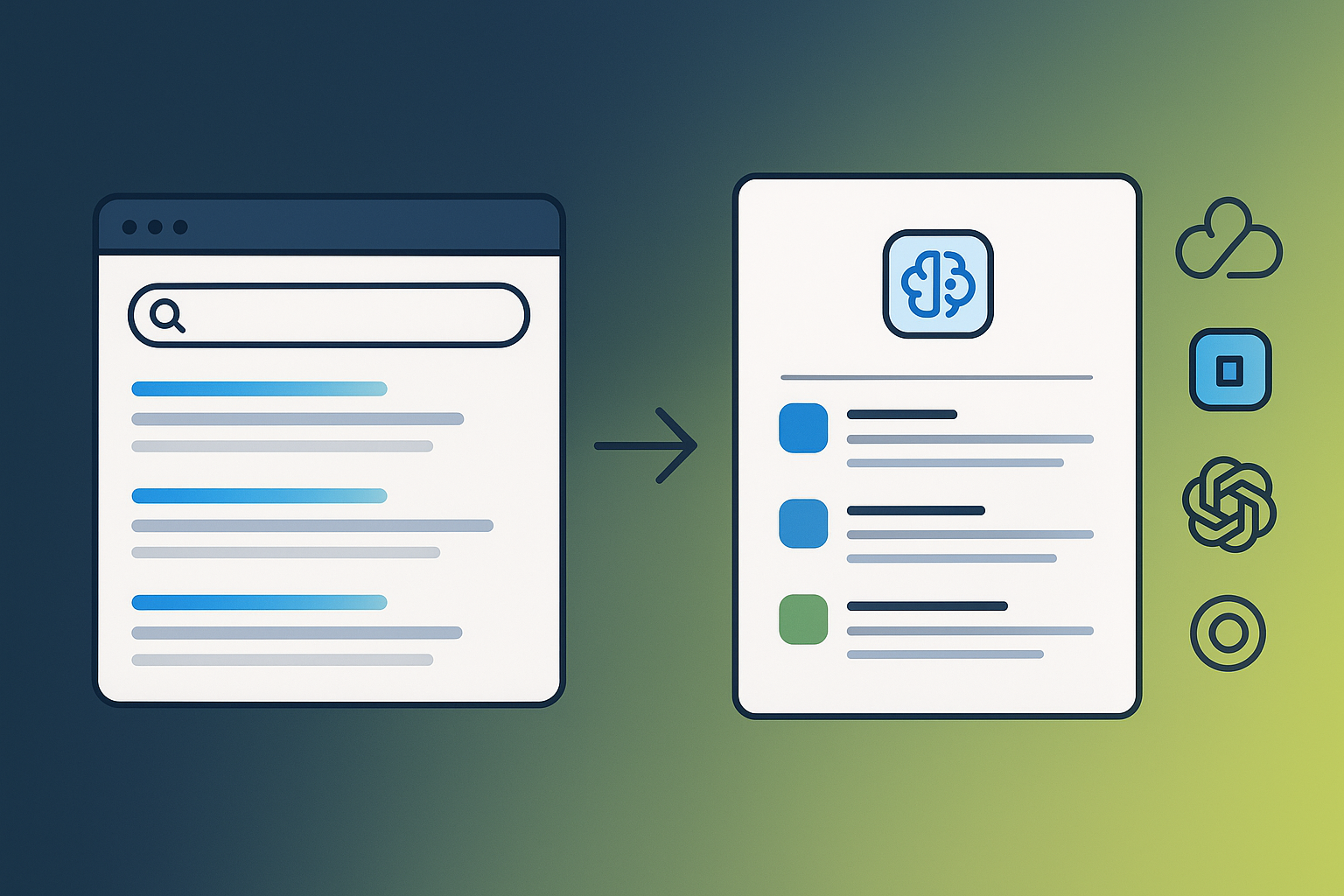
Picture a high‑intent query in your category—“best payroll software for startups,” “sustainable running shoes,” “enterprise backup solutions.” Instead of a familiar page of blue links, the experience collapses into an AI answer with a short list of citations and a couple of brands explicitly recommended. Most users don’t click out. If your brand isn’t named there, demand flows to whoever is.
That’s the crux of Generative Engine Optimization (GEO): earning accurate mentions, links, and recommendations inside AI answer interfaces. Below, we’ll ground this in late‑2024–2025 evidence, map the causality chain that reassigns market share, and give you a practical playbook to compete.
The evidence: AI answers compress clicks and re-route demand
Start with the baseline. In 2024, an independent clickstream analysis found that 58.5% of U.S. Google searches ended without a click to the open web (EU: 59.7%), establishing a durable “zero‑click” majority of sessions. The finding comes from SparkToro and Datos’ session‑level study and is summarized in industry coverage; we use 2024 as a conservative benchmark while treating 2025 increases cautiously until newer primary data is published. See the full methodology in the SparkToro/Datos 2024 zero‑click study.
Now layer in AI summaries. A March 2025 panel study by Pew measured real user searches and observed that about 18% of queries showed a Google AI summary. On pages with a summary, users clicked a traditional result 8% of visits vs. 15% when no summary appeared. That’s a stark behavior shift tied to the presence of the AI panel. Details are in Pew’s July 2025 analysis of AI summaries and click behavior.
Across vendor trackers, late‑2025 snapshots show higher prevalence: Advanced Web Ranking reported U.S. AI Overviews on roughly 60% of queries in a November 10, 2025 corpus; BrightEdge’s live tracker often showed 50%+ in many samples, with strong category variance. Treat these with their methodological caveats, but the direction is clear—more AI answers, more sessions resolved in‑panel. For a representative summary of the AWR figure, see this November 2025 analysis, and for industry‑level variation, see Conductor’s 2025 AI Overviews analysis.
What happens to clicks and paid media performance? A multi‑month study from Seer Interactive (June 2024–September 2025; 3,119 informational queries, 42 organizations) documented organic CTR on AI‑Overview queries dropping 61% (from 1.76% to 0.61%) and paid CTR falling 68% (from 19.7% to 6.34%). That’s not a blip—it’s a structural shift. Read the full breakdown in Seer’s September 2025 CTR impact study.
If fewer people click, but they still get an answer, where does demand go? It goes to the entities, sources, and brands that the engines cite and recommend inside the answer.
The causality chain: from AI answers to a citation economy
Here’s the sequence driving share movement:
- AI answer engines (Google AI Overviews, Perplexity Answers, ChatGPT with browsing) synthesize responses for common queries.
- Users resolve needs inside the answer interface—zero‑click behavior expands.
- A “citation economy” emerges: a small set of domains and brands get named, linked, and sometimes explicitly recommended.
- Recommendation bias matters: a prescriptive endorsement (“best for X”) captures outsized intent compared to a neutral mention.
- Over time, the brands most often cited and positively recommended absorb demand—without traditional click‑throughs.
Think of “citation share” as your new visibility KPI: how often your brand is mentioned or linked across relevant AI answers by engine and query cluster. Add “sentiment share” to capture tone and recommendation type.
A simple measurement framework
Below is a compact way to track GEO performance by engine, query cluster, recommendation type, and sentiment. Use it to quantify progress and spot where rivals are getting named.
| Engine | Query cluster | Citation frequency | Recommendation type | Sentiment | Notes/owner |
|---|---|---|---|---|---|
| Google AI Overviews | “Best [category]” | 7/20 panels show brand cited | Best/pricing/feature fit | Positive/neutral/mixed | Owned by SEO; PR contributes |
| Perplexity Answers | “Compare [brand] vs [brand]” | 12/30 answers cite brand | Pros/cons list | Neutral/mixed | Owned by SEO; PMM supports |
| ChatGPT (browse/search) | “[brand] reviews” | 5/25 answers link brand | Neutral mention | Positive/neutral | Owned by comms; legal reviews |
Recommendation types to track:
- Neutral mention
- Pros/cons list
- Prescriptive endorsement (e.g., “best for startups,” “top pick for compliance”)
The GEO playbook: how to compete for citations and recommendations
-
Audit your current AI visibility Identify top query clusters (brand, category, competitor comparisons). Sample answers across engines and devices weekly. Log citation frequency, recommendation type, and sentiment. Note gaps and anomalous or harmful outputs.
-
Strengthen entity signals and structured data Ensure consistent organization, product, and person schema; clean canonical URLs; precise specs; FAQs; pricing; compatibility; policies; expert bios. Freshness matters—answers bias toward updated, verifiable information.
-
Run PR/citation operations where the engines source Earn coverage and references in sources favored for your category (e.g., reputable industry outlets, standards/government pages for regulated topics, high‑quality review hubs, and credible UGC communities). Align pitches to the question forms users ask.
-
Craft content for synthesis Publish concise, verifiable answers with reference links, comparisons, and clear “who it’s for.” Structure pages to match common question phrasing. Create category explainers and comparison pages that engines can quote.
-
Institute risk hygiene Monitor for hallucinations, misattribution, or outdated guidance. Maintain safety/quality pages that engines can cite. Define an escalation path to correct public records and coordinate with platforms when necessary.
Mid‑article audit example (vendor‑neutral; disclosure included)
To make the audit concrete: sample a “best [your category]” query set across Google AI Overviews, Perplexity, and ChatGPT each week. Record which brands get named, whether your brand appears, the recommendation type (neutral vs. prescriptive), and the sentiment.
For teams consolidating this monitoring, a platform like Geneo can help track AI visibility, citations, sentiment, and historical changes across AI engines in one place. Disclosure: Geneo is our product. For foundational context on KPIs, see the concept explainer What is AI visibility?, and if you operate across multiple brands or clients, the agency collaboration page outlines workflows for cross‑team monitoring and change tracking.
Vertical nuances: retail, SaaS/B2B, finance/health
Retail and consumer goods
- Expect a heavy mix of UGC sources (YouTube, Reddit) and commerce reviews in AI citations. Invest in credible reviewers, detailed product specs, and comparison content that answers “best for [use case].”
SaaS and B2B
- Author entities and technical documentation matter. Maintain updated docs, pricing, integration guides, and expert bios. Build authoritative comparisons (“X vs Y”) with clear audience fit and proof points.
Finance and health
- Government and standards pages are cited proportionally more in AI summaries. Ensure compliance pages, disclosures, and evidence are current and easy to parse. Coordinate with legal and regulatory leads; avoid speculative claims.
For platform‑specific sourcing differences and link presentation rules, see this overview from Search Engine Land: How different AI engines generate and cite answers (Oct 2025).
Change‑log and governance
Fast‑moving facts require a cadence. Assign ownership (SEO + PR + Comms) to refresh high‑value query clusters every 4–6 weeks. Update entity data, citations, and evidence pages; record significant shifts (new endorsements, lost mentions, sentiment changes). Define escalation for harmful outputs.
Suggested fields to refresh quarterly:
- AI Overviews coverage and engine behavior by category
- Citation concentration and rivals’ recommendation types
- Key usage metrics for alternative engines (e.g., ChatGPT, Perplexity)
- CTR/traffic impacts on your monitored query sets
As you operationalize this, a practical resource for tool selection is this brief overview of trackers and workflows for Google AI Overviews: GEO tracking tools.
Monitoring toolkit and process tips
- Combine independent trackers (e.g., BrightEdge/Conductor panels) with your own sampling to avoid over‑reliance on any single dataset.
- Segment measurement by engine and query type; avoid rolling everything into one aggregate.
- Use a shared template to log changes, owners, and next steps after each audit cycle.
The share shift is already happening—act now
If your competitors are the ones named in AI answers while you wait for “more stable” guidance, they’ll accumulate recommendation share—and the intent you expected from organic rankings will quietly move. Start with weekly audits and entity hygiene, then build PR/citation ops around the sources your category’s engines actually favor.
When you’re ready to centralize monitoring across engines and teams, Geneo can be part of the stack to help track visibility, citations, sentiment, and change history. Keep it vendor‑neutral: the real win is owning your measurement and governance process.
Mini change‑log template
Updated on: 2025-12-13
  Owner(s): SEO Lead, PR Director
  Scope: “Best [category]” queries; U.S.; desktop + mobile

  Highlights
  - Google AIO: Brand cited in 9/20 panels (+2 vs. prior); 2 prescriptive endorsements (“best for startups”).
  - Perplexity: Neutral mentions in 8/30 answers; 3 pros/cons recommendations.
  - ChatGPT (browse): 4/25 answers link brand; sentiment neutral-to-positive.

  Actions
  - Publish updated comparison page with pricing clarifications.
  - Pitch industry outlet on compliance feature deep‑dive.
  - Refresh schema for product specs and FAQs.

  Risks
  - One outdated policy link cited in answers; replace and request re‑crawl.
  - Competitor gained “best for enterprise” endorsement on 3 panels.