
Are GEO Jobs the Future of SEO Careers? Latest 2025 Insights
Discover the 2025 outlook for GEO jobs, SEO career shifts, real hiring signals, and actionable skills. Explore new job trends now!
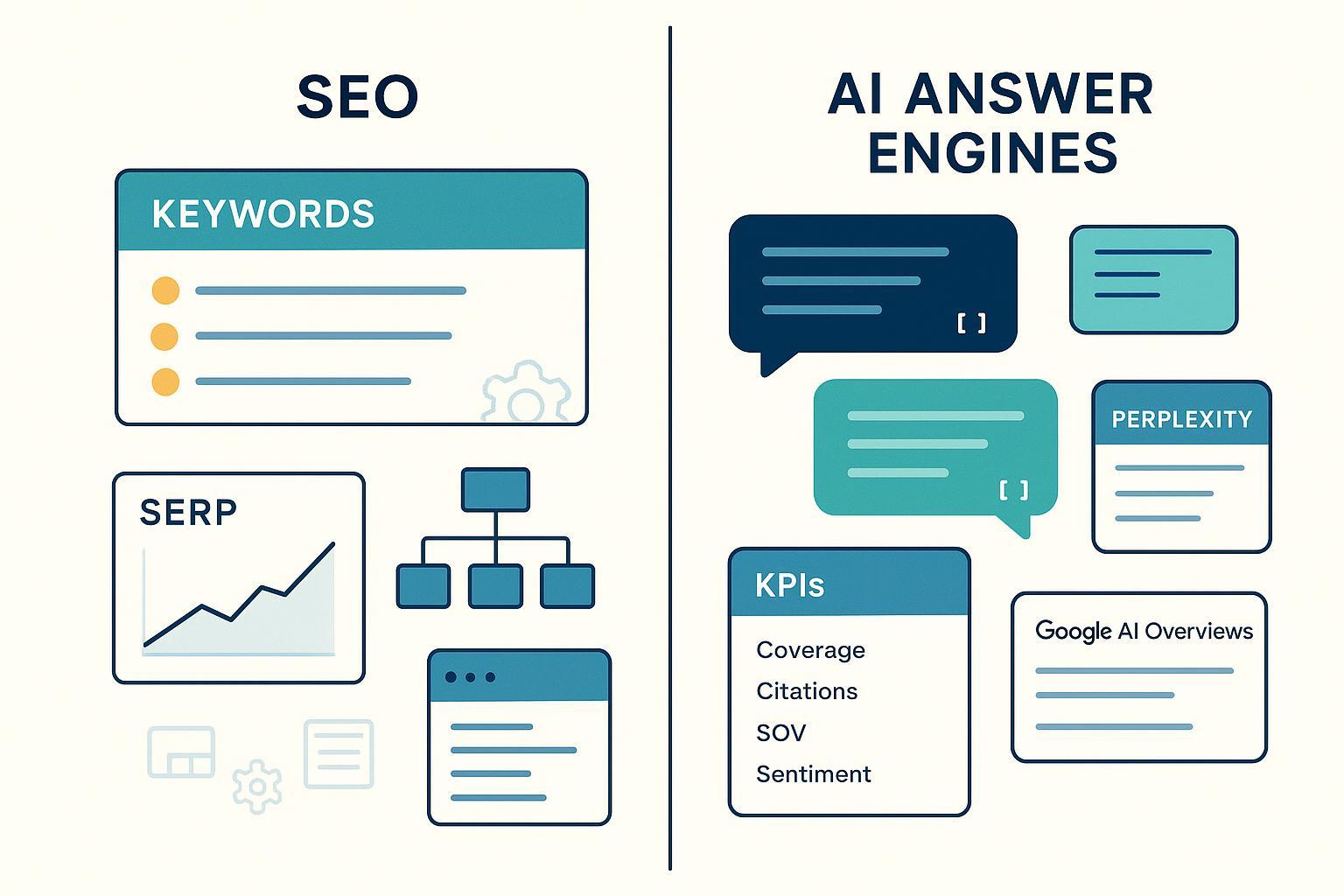
If you run search today, you’re already juggling two realities: classic SERPs and AI answers. The open question isn’t whether AI answer engines matter—it’s whether they create a new job track. Short answer: GEO work is real and growing, but it’s most often folded into SEO roles rather than replacing them. Think of GEO as the AI-search layer that widens what SEOs do, measured by presence and accuracy in AI-generated answers, not just blue-link rankings.
GEO vs. SEO: What’s Actually Changing
GEO (Generative Engine Optimization) focuses on being found, understood, and cited by AI answer engines such as ChatGPT/Copilot, Perplexity, and Google’s AI Overviews. Multiple authoritative sources describe GEO as complementary to SEO rather than a substitute. Walker Sands defines GEO as optimizing site structure and content so generative models represent your brand correctly—updated in 2025 in their agency guidance, which frames GEO as an operational practice, not hype. See the agency perspective in the Walker Sands article, “Generative Engine Optimization (GEO): What to Know in 2025” (2024/2025) for context: Walker Sands’ 2025 GEO guidance.
Google’s documentation reinforces the direction of travel. In its 2025 guidance, Google explains that AI features appear when confidence is high and serve as a “jumping off point” with links out—meaning eligibility and link-worthy depth still matter. See Google Search Central: AI features and your website (2025). In practice, that’s a signal to keep SEO fundamentals sharp while structuring content for LLM comprehension.
If you’re hearing “GEO” and thinking local “geo,” that’s a different thing. GEO here is about AI answer inclusion and accuracy—part of broader AI visibility. For a clean comparison of responsibilities and success metrics, see Traditional SEO vs GEO: 2025 Marketer’s Comparison.
Hiring Signals: GEO Responsibilities Are Spreading Into Search Roles
You won’t often see “GEO” in job titles yet, but you will see AI-search responsibilities inside SEO, content, and digital PR postings. Example: a late-2025 listing explicitly titled “SEO & Generative Engine Optimization (GEO) Writer” calls for content optimized for both SEO and GEO—evidence that hybrid roles are real. See the posting captured in October 2025: SEO & GEO Writer — DailyRemote (Oct 23, 2025). Agency service pages and jobs roundups also reflect client demand for AI Overviews and Perplexity optimization, even when titles remain “SEO Manager” or “Content Lead.”
Practically, employers are asking for: experience improving inclusion in AI Overviews, familiarity with Perplexity/Copilot behaviors, structured content that LLMs can quote cleanly, and a way to report presence/sentiment over time. The job market reality in late 2025 is a hybrid: SEO → SEO+GEO now, with specialist GEO leads emerging where AI answers drive material demand.
What Employers Want: Skills and Toolsets That Translate to AI Answers
Content still wins—but its packaging matters more. Engines reward depth, clarity, and unambiguous claims that can be cited. Observational studies suggest that detailed “deep pages” often power AI Overviews citations. Search Engine Land reported in March 2025 that a majority of AI Overview citations came from deeper, specialized content within sites, not just top-level hubs. See Search Engine Land: Deep pages and AIO citations (Mar 19, 2025). And Ahrefs’ August 2025 analysis found most AIO citations still originate from pages that rank in the top 100, with a large share from the top 10—classic quality signals still apply. See Ahrefs: Search rankings and AI citations (Aug 26, 2025).
Below is a concise mapping of role types to responsibilities and the KPIs hiring managers increasingly ask for.
| Role type | Primary responsibilities in an AI-answers world | KPIs you can own |
|---|---|---|
| SEO Manager (hybrid SEO+GEO) | Maintain crawlability/canonicalization, restructure priority pages with answer blocks/FAQs/tables, ensure schema and entity clarity, monitor citations in AIO/Perplexity | Coverage % of priority prompts, citation count by query cluster, share of voice vs. peers, sentiment/accuracy trend |
| Content Lead / Strategist | Brief writers for LLM-friendly structure; enforce citeable claims with sources; build “deep page” assets addressing long-tail intents | Improvement in citation prominence for target topics, win/loss by topic cluster, depth assets created vs. citations earned |
| Technical SEO | Instrumentation and logs; page speed; schema (FAQ, HowTo, Organization/Product); entity disambiguation | Crawlability and schema health; correlation of technical fixes to citation changes |
| Digital PR / Comms | Earn authoritative mentions to strengthen entity signals; correct inaccurate AI answers; coordinate brand framing | Third‑party mentions gained, correction cycles completed, sentiment improvement |
| GEO Specialist (emerging) | Cross-engine audits, prompt libraries for QA, engine-specific playbooks; stakeholder reporting | Cross-engine coverage delta, contradiction rate reduced, time-to-correction for inaccuracies |
A few skill highlights keep coming up in interviews and postings: structured answers and FAQs, schema hygiene, entity consistency, prompt suites for QA (contradictions, tone, and brand safety), and measurement discipline.
Measuring Impact in AI Answers: KPIs and How to Capture Them
Clicks are decoupling from answers. Experiments show users often click less when an AI summary is present. Pew Research observed in July 2025 that people exposed to AI summaries were less likely to click external links than those who were not. See Pew Research Center: click behavior with AI summaries (Jul 22, 2025). That means your KPIs should reflect presence, accuracy, and influence even when traffic is muted.
Recommended KPI set, tied to practical collection methods and quality metrics:
- Coverage rate and citation count: How often your brand is cited across a defined prompt set and how many citations you earn per query cluster.
- Share of voice: Your proportion of citations versus competitors across those prompts, optionally weighted by placement prominence.
- Sentiment and accuracy: Whether the answer frames the brand favorably/neutral and whether factual claims about your product are correct. For measurement concepts, see LLMO Metrics: Measure Accuracy, Relevance, Personalization.
- Prominence and placement: Whether you’re the first citation, in the visible source cards, or buried; track movement over time.
A lightweight, auditable workflow: build a weekly prompt list that covers your must-win intents in AI Overviews, Perplexity, and ChatGPT/Copilot. Log for each prompt: date, engine, whether an AI answer appeared, whether you were cited, which page was cited, the sentiment/accuracy score, and citation position. If you need a DIY approach for Google AI Overviews, see the stepwise method using Sheets + SerpAPI/SPCS described by practitioners in late 2025: Search Engine Journal’s AIO tracking walkthrough (Dec 3, 2025).
When to Shift From SEO to GEO (and How to Do It Without Drama)
Don’t abandon SEO; widen it. Start by allocating 10–20% of your SEO capacity to GEO monitoring and experiments. Increase that allocation when three conditions show up consistently:
- Priority queries show high AI-answer penetration (AIO is present frequently in your category).
- Your brand’s AI answers are missing, inaccurate, or framed poorly.
- Leadership asks for AI-search reporting alongside organic sessions.
From there, expand the footprint: add structured answer blocks to top pages, publish deeper assets that directly address nuanced questions, and build entity clarity across your site. Where perception matters, run coordination with PR/Comms to influence third-party authority and correct misinformation. For a complementary angle on external signals and team presence, see LinkedIn Team Branding for AI Search Visibility: 2025 Best Practices.
Portfolio and interview prep that stand out: show before/after coverage %, citation prominence improvements on key prompts, sentiment corrections, and the exact interventions that drove those changes (content restructure, schema fixes, PR wins). Keep screenshots and a dated changelog so hiring managers can verify impact.
A Practical Workflow Example (Mid-Funnel, Neutral)
Disclosure: Geneo is our product.
One pragmatic pattern for a hybrid SEO+GEO team:
- Run a cross-engine audit of priority prompts weekly to identify where your brand should be cited but isn’t.
- Cluster gaps by intent (e.g., “pricing comparisons,” “implementation steps,” “limitations”), then map each cluster to the most authoritative “deep page” you can build or improve.
- Implement structural fixes: add concise answer blocks, clarify entities, tighten schema, and link to original sources for key claims.
- Track week-over-week coverage, prominence, and sentiment deltas.
This workflow can be supported by tools that centralize AI-answer monitoring and sentiment analysis. Geneo supports cross-engine tracking (AI Overviews, Perplexity, and more), helps surface missing/incorrect citations, and preserves historical logs so your change impact is auditable. Keep verbs objective, keep your methods transparent, and tie any reported wins to a dated measurement window.
Outlook: What the Next 6–12 Months Mean for Your Career
Near term, expect most “GEO jobs” to live inside SEO and Content leadership roles. Dedicated GEO specialists will appear where AI answers materially affect demand capture (think complex B2B and high-stakes consumer queries). Watch for job descriptions explicitly naming AI Overviews and AI answer inclusion, dashboards that elevate AI-answer coverage and sentiment as first-class KPIs, and content programs that prioritize deep, citeable pages to compete for nuanced intents.
Next Steps
- Audit your top 50 priority queries across AI Overviews, Perplexity, and ChatGPT/Copilot; establish a baseline for coverage, citations, and sentiment.
- Restructure 5–10 cornerstone pages with clear answer blocks, FAQs, and clean schema; publish 2–3 deep pages aimed at nuanced intents.
- Stand up a weekly reporting cadence—coverage %, SOV, sentiment, and key wins/losses tied to specific changes.
If you need centralized AI-answer monitoring and sentiment, you can evaluate Geneo.
Updates
- 2025-12-07: Initial publication with late‑2025 sources; includes KPI framework, hiring signals, and a neutral GEO workflow example.