
GEO Explained: Generative Engine Optimization for Exporters
Learn what GEO means for export trade companies—optimize for AI engine citations, boost supplier discoverability, and ensure compliance clarity.
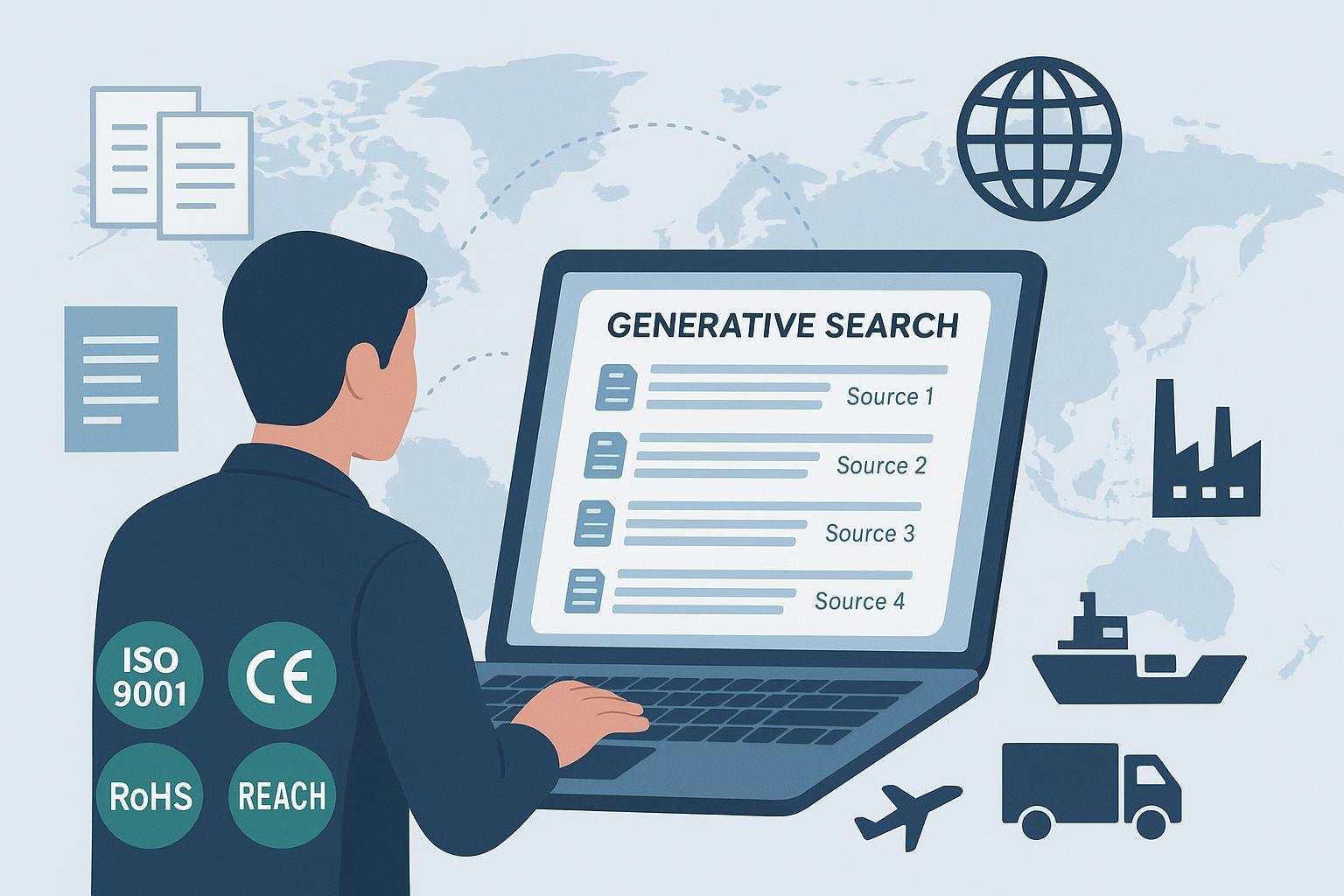
Buyers and procurement teams increasingly ask AI to find, compare, and vet suppliers. If your company exports, the question is simple: how do you get your brand cited—accurately—in those generative answers?
What GEO Means (in plain terms for exporters)
Generative Engine Optimization (GEO) is the practice of making your content easy for AI-driven answer engines (e.g., Google’s AI Overviews, Perplexity, Bing Copilot, ChatGPT) to cite and summarize. Instead of competing for a blue link on a traditional results page, you’re optimizing to be included in the synthesized response.
Academic work introduced GEO as a creator‑centric framework focused on visibility in generative engines; experiments measured how structuring content and evidence can influence inclusion across platforms such as Perplexity, according to Aggarwal et al.’s GEO introduction (arXiv, 2023). Industry practitioners echo that GEO emphasizes clarity, authoritative sourcing, and parseable structure so AI answers can reliably reference your pages, as Search Engine Land’s 2024 explainer outlines.
How is this different from traditional SEO? SEO optimizes for ranked lists; GEO optimizes for answer inclusion and citation behavior. Foundational quality overlaps, but GEO adds a stronger focus on factual precision, third‑party validation, and content formats AI can digest.
How AI Answer Engines Choose and Cite Sources
Understanding source selection helps exporters build pages that actually show up in answers.
- Google AI Overviews: Google’s public update in 2024 explains that Overviews blend core ranking signals with generative responses and surface prominent links with visible citations when complex queries benefit from multi‑source synthesis. See Google’s May 2024 AI Overviews announcement.
- Perplexity: Every answer includes numbered citations pointing to source pages, enabling quick verification and publisher credit, per the Perplexity Help Center. Research modes expand references while maintaining in‑line attribution.
Implications for exporters: engines prefer clearly written, well‑structured, verifiable content and tend to reference standards bodies, official guidance, and reputable industry sources. Your pages should look and read like something a procurement analyst would trust.
Build Pages AI Wants to Cite
Focus your effort where buyers look during discovery and evaluation.
- Product/category pages with structured, citable data: specs, materials, HS codes where appropriate, datasheets/manuals, safety sheets.
- Verified compliance signals: ISO 9001 scope stated correctly, CE marking applicability and Declaration of Conformity, RoHS restrictions, REACH obligations; include formal references or links to official guidance.
- Buyer‑intent details: RFQ‑ready facts like MOQ, lead times, Incoterms, payment terms, warranty/returns, logistics footprint.
- Third‑party validation: listings or mentions from reputable trade associations, standards bodies, analyst coverage, or trusted directories.
- Multilingual parity: English plus target market languages, with facts kept consistent across versions.
Query archetypes mapped to actions and measurement
| Archetype | Example queries | Content actions | Measurement focus |
|---|---|---|---|
| Discovery | “Top ISO 9001‑certified suppliers for [category]” | Build category pages with specs, certifications, and citable references; include associations/directories | Inclusion rate across engines; citation count; source types referenced |
| Evaluation | “Compare CE‑marked [product] manufacturers with RoHS compliance” | Publish DoC summaries, compliance notes, spec comparisons, and datasheets | Sentiment in answers (recommended/neutral); accuracy of compliance details |
Measure and Iterate Like a Procurement Team Would
You can’t improve what you don’t observe. Track how often your brand appears, what’s cited, and the tone of recommendations, then run controlled updates.
- Baseline inclusion and citations across engines; segment by discovery vs. evaluation queries.
- Monitor answer quality (accuracy, relevance, personalization) and sentiment; see LLMO metrics for assessing AI answer quality.
- Compare cross‑engine behaviors and refresh cycles; different platforms surface different citation patterns. For context, review ChatGPT vs. Perplexity vs. Gemini vs. Bing monitoring differences.
- When AI answers omit key facts or cite outdated pages, update your content (e.g., certification wording, spec tables), document changes, and re‑check after indexing.
Why Certain Brands Get Cited (and How to Earn It)
Engines tend to favor sources with clear authority signals—official compliance documentation, standards references, and reputable third‑party mentions. If your category is competitive, build your evidence network: precise certification language, transparent QMS scope, DoCs for CE where applicable, and verifiable references. For background on citation patterns, see Why ChatGPT mentions certain brands.
A Neutral Workflow Example for Export Teams
Disclosure: Geneo is our product. An export marketing lead wants to understand citation gaps for “CE‑marked LED luminaires manufacturer” queries.
- Step 1: Establish a baseline by checking generative answers in ChatGPT, Perplexity, and Google AI Overviews. Record whether your brand appears, which pages are cited, and any sentiment cues (e.g., “recommended,” “consider alternatives”).
- Step 2: Identify missing or weak signals on your product/category pages—e.g., incomplete CE DoC summaries, unclear RoHS statements, or sparse spec tables.
- Step 3: Update pages with precise compliance wording, add datasheets/manuals, and include references to official guidance.
- Step 4: Re‑check engines after refresh cycles to see if citations improve and whether answers reflect the updated facts. A monitoring platform like Geneo can be used to track multi‑engine citations, sentiment shifts, and historical changes without manual spreadsheets.
Compliance Hygiene: Avoid Overclaims
Be meticulous with regulatory terminology. For example, medical device exporters should use “FDA 510(k) cleared,” not “approved,” and include identifiers that aid verification; see FDA’s official 510(k) pathway overview. Similarly, accurately state ISO 9001 certification scope and CE responsibilities; align page copy with official frameworks to reduce AI uncertainty and prevent misattribution.
Closing
GEO helps export trade companies show up—correctly—in AI‑generated supplier discovery and evaluation. Build citable pages, publish precise compliance signals, and measure inclusion and sentiment across engines. Then iterate like a procurement analyst would: update, verify, and re‑check. Ready to start? Audit a few high‑intent queries in generative engines and see how your brand is represented today.