
GEO (Generative Engine Optimization) for AI Startups: A Practical Guide
Learn how AI startups can use GEO to boost brand citations in AI-generated answers. Practical steps for Generative Engine Optimization success.
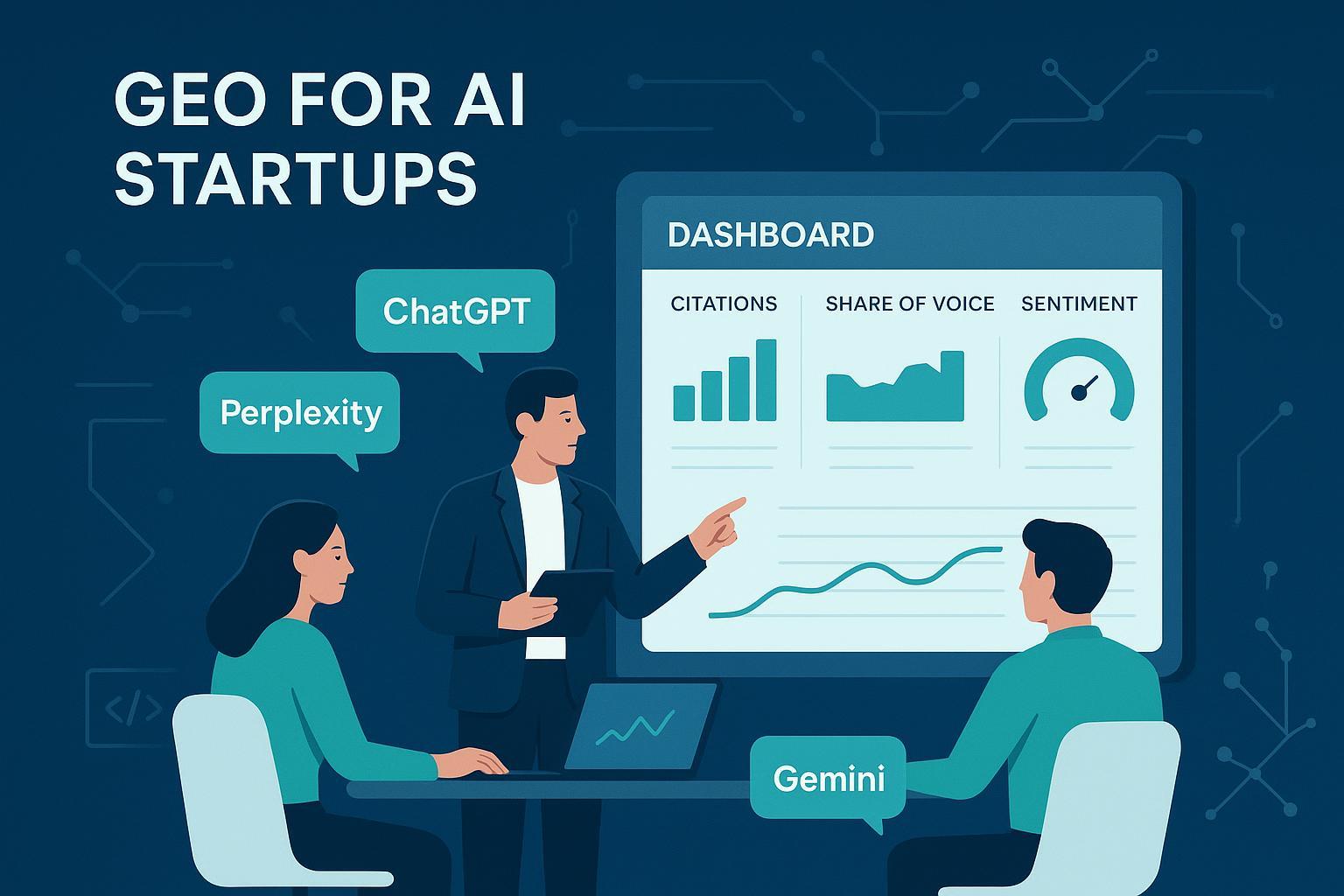
If AI answers are becoming the new front door to your product, how do you make sure your startup shows up—accurately—inside them?
What GEO means (and how AI engines cite sources)
Generative Engine Optimization (GEO) is the practice of structuring and publishing content so that AI answer engines (e.g., ChatGPT Search, Perplexity, Google’s AI Overviews/Gemini) can find, understand, and confidently cite it in synthesized responses. The term and formal framework were introduced in late 2023 by a multi‑institution team; their paper proposes a creator‑centric, black‑box optimization method and evaluates visibility effects on a large query set. See “GEO: Generative Engine Optimization” (arXiv, 2023/2024) for the academic origin.
Practically, you’re optimizing for how these systems attribute sources:
- ChatGPT Search (OpenAI): Answers include inline citations and a Sources panel that lists references. OpenAI outlines the basics in ChatGPT Search help.
- Perplexity: Responses feature clickable citations by design, and advanced modes gather and synthesize across many sources. See Perplexity’s Help Center.
- Google AI Overviews / AI Mode: Google states that AI responses are supported by links to the web and gated by confidence. Read Google’s AI Mode update.
The selection criteria for sources aren’t fully public, but consistent patterns emerge: clear entities, verifiable facts, strong author signals, and citation‑friendly formatting increase your chances of being referenced.
GEO vs. SEO for startups (and why you need a hybrid)
SEO aims to rank a specific page for a query and earn a click. GEO aims to be included and cited inside an AI‑generated answer—often a zero‑click context. That difference has downstream effects:
- Goals: SEO chases rankings and CTR; GEO chases citations, accurate representation, and share of voice in AI answers.
- Tactics: SEO leans on keywords, backlinks, and technical performance; GEO adds extractable structures (Q&A headings, fact boxes, concise tables, code samples) that LLMs can quote.
- Metrics: SEO tracks positions and traffic; GEO tracks citations/mentions, sentiment, and referral clicks from AI engines.
Most startups shouldn’t pick one over the other. A hybrid strategy ensures your content is discoverable (traditional search) and present inside answers (AI engines). For a deeper comparison, see Traditional SEO vs. GEO: a side‑by‑side.
A startup‑ready GEO workflow
Think of GEO as a weekly sprint that moves from research to structured publishing to monitoring. Here’s a pragmatic sequence you can implement with a small team.
-
Research conversational queries and intents
- Start with the questions real users ask about your product category, API, or model: “How do I tokenize streaming responses?”, “Best open‑source alternatives to X?”, “What’s the difference between embedding models A and B?”
- Use engine UIs to explore how answers are assembled. Prompt with “Which sources are you citing?” and note which formats show up.
-
Create citation‑friendly formats
- Structure pages with Q&A headings that map to conversational queries.
- Add fact boxes (single‑sentence, verifiable statements) and succinct tables (e.g., SDK support, rate limits, latency). LLMs frequently extract table cells.
- Include code samples, model cards, and comparison pages with crisp summaries. Keep language tight and avoid filler.
-
Clarify entities, authorship, and sources
- Ensure the startup, products, and models are consistently named, with an “About” or glossary page tying aliases to canonical entities.
- Display author credentials (role, experience) and link primary sources. Where claims rely on external authority, cite the original research or official docs.
-
Publish with an update cadence
- Ship small improvements regularly. When specs change, update docs and summary pages promptly.
- Add changelogs and “last reviewed by” notes (not dates in H1s; keep them on the page) to signal freshness.
-
Monitor across engines and iterate
- Run a simple, repeatable check: prompt a few representative queries weekly in each engine; record whether your pages are cited, how they’re described, and the sentiment.
- If citations dip, diagnose what changed—your content, competitor content, or the query wording—and update accordingly.
A neutral example of consolidating this work: teams can use Geneo to track multi‑engine citations, sentiment, and share of voice without juggling screenshots — Disclosure: Geneo is our product. Keep the workflow tool‑agnostic if you already have internal scripts or dashboards.
What to measure (and how to use it)
Tracking GEO isn’t just “did we appear?” You’ll want a small set of decision‑ready metrics.
| Metric | What it tells you | How to act |
|---|---|---|
| AI citations/mentions | Frequency and placement of your pages in answers across engines | Double down on formats that are cited; fix missing coverage for key queries |
| Share of voice in AI answers | Your visibility vs. competitors for critical queries | Identify content gaps; publish comparison pages or clarifying docs |
| Sentiment of citations | Whether mentions are positive/neutral/negative | Correct inaccuracies; add authoritative evidence; reach out for errata if needed |
| Referral traffic from AI engines | Clicks from citation links (where available) | Strengthen linked pages’ clarity and calls to value; add short summaries near links |
| Query coverage & entity presence | Percentage of target queries where your entity is recognized and included | Standardize naming; add glossaries and schema; prompt‑test ambiguous topics |
Risk management: accuracy and ethics
Generative engines synthesize; they can misattribute. Your job is to make the correct answer the easiest answer to assemble.
- Ground claims in verifiable sources. Link original papers, official docs, and your own primary data. When in doubt, reduce speculation.
- Disambiguate entities. If your product name overlaps with common terms, add clarifying context and structured data.
- Prompt‑test tricky topics. Ask engines to explain your feature under different phrasings and note where confusion appears; update docs to address it.
- Avoid hype. Keep language objective and precise. For conceptual grounding, the original arXiv paper on GEO is a reliable starting point.
Mini case: earning citations for an API‑first startup
Picture a startup shipping a vector database API. Early on, answers in Perplexity and ChatGPT describe the product vaguely and cite competitors’ benchmark tables.
- The team adds a “FAQ” page with question‑based headings and direct, two‑sentence answers to top developer queries.
- They publish a concise comparison table showing throughput, latency, and SDK support across common workloads, with a short methodology note and links to reproducible code.
- Model cards and spec sheets get a “Summary” box at the top: one sentence on purpose, one on key limits, one on versioning.
- Authors are identified (Developer Relations lead; Staff Engineer); external claims link to the original papers or docs.
Within a few weeks, Perplexity begins citing the FAQ and the comparison table; ChatGPT’s Sources panel shows the spec sheet on streaming limits. Sentiment shifts from neutral to positive as descriptions become crisper. The team notices missing citations for “Python client auth” and fills the gap with a small code example and a one‑paragraph explainer. They keep iterating weekly.
Next steps: run a weekly GEO sprint
- Pick 10–15 conversational queries that matter.
- Map each query to a page section or snippet (FAQ, table, fact box, code sample).
- Publish or update two items per week; add authorship and source links.
- Monitor citations and sentiment across 3–4 engines; adjust content where coverage is weak.
If keeping tabs across multiple engines is time‑consuming, consider consolidating monitoring in a single place. A tool like Geneo can help teams see citations, sentiment, and share of voice together while you focus on publishing. Keep it neutral—whichever workflow keeps you shipping and measuring wins.
Further reading and references
- Academic origin and evaluation: GEO: Generative Engine Optimization (arXiv, 2023/2024)
- Platform behaviors: ChatGPT Search help; Google’s AI Mode update
- Industry framing: Traditional SEO vs. GEO: a side‑by‑side (Geneo)