
GEO for Fitness Influencers: 2025 Best SEO Practices Guide
Discover proven GEO strategies for fitness influencers—cross-channel SEO, AI search visibility, technical steps, and analytics. 2025 best practices included.
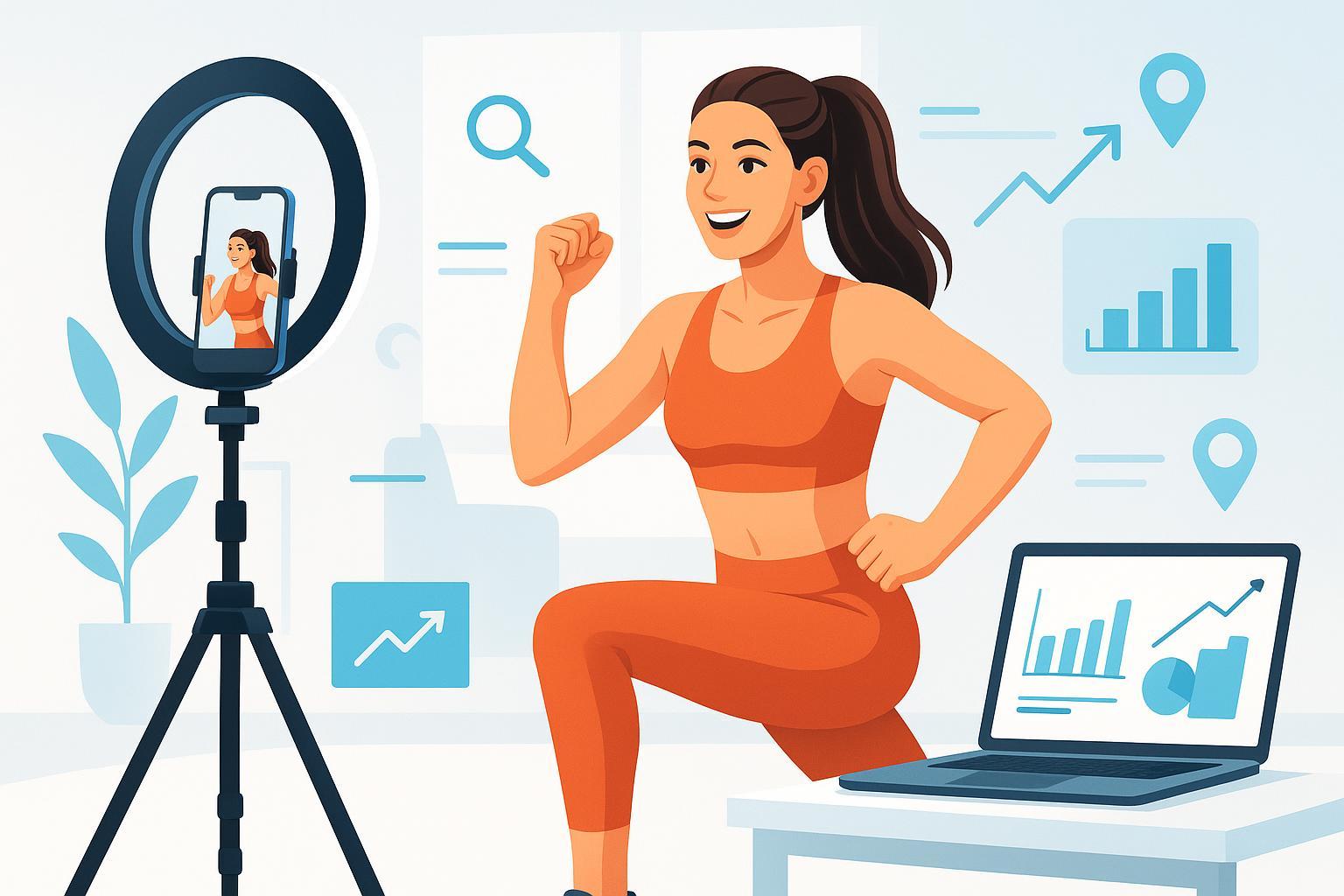
If your workouts help people get stronger but your content isn’t getting found, you’re leaving clients and impact on the table. GEO—search and visibility optimization—makes your brand discoverable across Google (including AI experiences), YouTube, Instagram, TikTok, and local search. You don’t need viral luck; you need a system that connects what you publish to how people actually search.
What GEO Means for Fitness Creators in 2025
GEO is a practical framework to improve how your content and services appear where people look for fitness help: Google’s traditional results and AI experiences, YouTube, Instagram, TikTok, and Google Business Profile for local intent. Google recommends creating unique, people-first content and ensuring it’s technically accessible for AI surfaces; see the guidance in Google’s 2025 note on succeeding in AI search experiences. Your job is to align topics with real queries, ship content that answers those needs, and keep your site and profiles clear, fast, and credible.
Map Your Niche and Queries (Before You Hit Record)
Most fitness creators publish first and retrofit keywords later. Flip it. Start with a simple mapping exercise:
- Audience intent layers: goals (fat loss, strength, mobility), modalities (HIIT, kettlebells, Pilates), and constraints (home, travel, postpartum). Include local modifiers if you train in person (“in Brooklyn,” “near me”).
- Program formats: time-bound challenges (4-week beginner kettlebell), ongoing programs (hypertrophy split), and single-session tutorials (15‑minute core finisher).
- Seasonal peaks: January/September resets, summer cut cycles, post‑holiday routines. Map when demand spikes and plan ahead.
Group terms into a three-tier map:
- Primary hubs: broad topics you want to own (e.g., “beginner kettlebell workouts”).
- Supportive spokes: specific needs and questions (e.g., “kettlebell form for swings,” “20‑minute kettlebell workouts at home”).
- Conversion queries: service-led terms (e.g., “personal trainer for kettlebell beginners in Brooklyn”).
Use this map to plan long-form pieces (hubs) and a steady cadence of short-form posts (spokes) that answer searchers’ exact questions.
Build a Content System That Feeds Search
Think hubs and spokes. Long-form assets on your site and YouTube become the hub (program guides, form breakdowns, comparison posts). Short-form clips—Reels, Shorts, TikToks—are the spokes that tease, answer one micro-question, and direct people to the hub.
Below is a compact weekly view to keep your system consistent:
| Channel | Primary GEO levers | Weekly actions (example) |
|---|---|---|
| Website/Blog | Clear titles/H1s, internal links, fast pages, schema for videos/how‑tos | 1 long-form guide or program page; link to 2–3 related posts; embed key videos |
| YouTube | Descriptive titles, concise descriptions, chapters, captions, retention | 1 long video per week; 2–3 Shorts that point to the long video; add timestamps and captions |
| Specific bios, concise captions, relevant hashtags, Reels cadence | 3–4 Reels; 3–5 relevant hashtags each; add alt text; geo-tag when local | |
| TikTok | On‑screen text, topic keywords, trend alignment, clear CTAs | 4–5 posts; test 2 hooks; use on-screen text and caption keywords |
| Local (GBP) | Complete profile, right categories, fresh photos, reviews | Add 2 photos; ask 3 clients for reviews; respond to all reviews |
On-Site and Technical Hygiene
Your site is your home base. Make it clean and easy to parse—for both people and machines.
- Titles and headings: Match search intent in plain language. One H1 that mirrors the page’s primary query; descriptive H2s for sections. Avoid stuffing keywords.
- Internal links: Help readers (and crawlers) move between hubs and spokes. From a “Beginner Kettlebell Guide,” link to “Kettlebell Swing Form” and “Home Kettlebell Workouts.”
- Media and accessibility: Compress video thumbnails and images; add descriptive alt text; include readable font sizes and sufficient contrast.
- Structured data that still matters: VideoObject for workout videos and Clip markup for chapters; HowTo for genuinely step-by-step routines; FAQPage for common questions that appear on the page. Google’s docs outline discoverability and markup; see video best practices and Video structured data.
- Site speed and stability: Fast, mobile-first pages keep people around and improve engagement signals.
Platform Execution
YouTube: Build Depth and Discovery Together
On YouTube, discovery and retention work hand in hand. Title and describe videos in clear, non-clickbait terms. Use chapters for longer tutorials (warm‑up, main set, cool down), and always add captions for accessibility and comprehension. Pair one long-form video per week with 2–3 Shorts that answer a single question from the main video, then point viewers to the full version. For implementation specifics and markup, align with Google’s video best practices referenced above.
Practical flow:
- Long video: “Beginner Kettlebell Full‑Body (20 minutes)” with chapters and a link to your program page.
- Shorts: “How to fix kettlebell swing hinge,” “3 mistakes with goblet squats,” each with a soft CTA to the full video.
Instagram: Make Discovery Earned, Not Random
Instagram doesn’t publish a formula for ranking organic posts by keywords, but consistent signals help people find you. Keep your bio specific (“Kettlebell coach for beginners | NYC + online”). Write concise captions that mirror how people would ask for help, add descriptive alt text for accessibility, and prefer 3–5 highly relevant hashtags over broad, generic tags. Reels remain a key discovery surface; focus on strong hooks and interactive elements, and stay consistent with your posting rhythm.
TikTok: Clarity, Hooks, and Topic Signals
TikTok’s creator-facing materials highlight on‑screen text overlays and clear topic signals as engagement aids—good for search, too. Use on-screen text that matches the audience’s query (“Fix your kettlebell swing in 15 seconds”) and reinforce with concise captions. Explore TikTok’s Creator Search Insights to identify trending questions your audience is asking and fill content gaps.
Local SEO for Trainers and Coaches
If you coach in person—even part‑time—treat local search as a primary channel. A complete Google Business Profile (GBP) helps you show up for “near me” and city-based queries. Google lists the main factors as relevance, distance, and prominence, and encourages complete information and active management; see tips to improve local ranking on Google.
Do the basics well:
- Pick the most accurate primary category (e.g., Personal Trainer) and add relevant secondary categories within limits.
- Fill services, description, hours, photos, and enable messaging if appropriate.
- Post fresh photos or short clips from sessions (with consent) and respond to every review.
- Align your website’s local landing page with the same keywords and neighborhoods you list in GBP.
Earn Authority—Without Tripping Spam Policies
Authority grows when other credible sites and creators reference your work. Focus on value, not schemes. Publish original assets—program results, case studies, movement form data, or a simple “beginner kettlebell baseline test” template—and pitch them to podcasts, local media, and partner creators. Avoid scaled guest posting, PBNs, or anchor-text manipulation; these fall under Google’s anti-spam guidance clarified during the March 2024 updates. Review Google’s spam policies and March 2024 update notes for safe practices.
The Analytics Loop
Set a weekly review to learn what’s working and double down.
- Search Console: Track clicks, impressions, CTR, and queries for your top landing pages. Compare non-branded queries (reach) and branded queries (demand for you specifically).
- GA4 engagement: Monitor engagement rate, average engagement time, and key events for conversions (email sign‑ups, program purchases, booking requests). GA4 defines an engaged session when it lasts more than 10 seconds, triggers a key event, or has 2+ pageviews; see Google’s GA4 engaged session definition.
- Platform analytics: For YouTube, check click‑through rate and retention; for Instagram/TikTok, track reach from explore/search surfaces and saves/shares. Use UTMs in bios/descriptions so you can see social-to-site conversions.
Example, neutral tool reference: If you’re trying to understand how your brand shows up in AI answers across Google’s AI experiences, ChatGPT, or Perplexity, a monitoring tool like Geneo can help track mentions and sentiment across those surfaces, then feed those insights back into your content plan. For deeper measurement frameworks around AI visibility and evaluation, see the Geneo posts on LinkedIn team branding for AI search visibility and LLMO metrics for assessing AI answer quality.
2025 Watchlist and Common Pitfalls
- AI surfaces in Search: Google continues to expand AI experiences and outlines how to align content with people-first principles in its AI search guidance cited earlier. Keep author bios, credentials, contact info, and transparent sourcing visible on your site.
- Structured data simplification: Google is trimming certain rich result types for simplicity. Rankings aren’t directly affected by these removals, but visual enhancements may change; stay current via Google’s note on simplifying search results and continue to validate markup that remains supported.
- Pitfalls to avoid: Chasing trends without a topic map, inconsistent posting, bloated pages that load slowly, thin affiliate pages, templated outreach for links, and ignoring local SEO when you offer in‑person coaching.
Pick one workflow to ship this week: publish a 1,200‑word hub on your core beginner topic, record a 12–15 minute YouTube tutorial to match, slice two Shorts/Reels that answer the top questions from the tutorial, and update your GBP with two fresh photos. Then review the numbers next week and repeat. The best GEO system isn’t flashy—it’s the one you actually run.