
GEO for Automotive AI Visibility: Agency Playbook
Practical GEO playbook for agencies—localization, schema, inventory feeds, and measurement to boost automotive brand visibility on AI search surfaces.
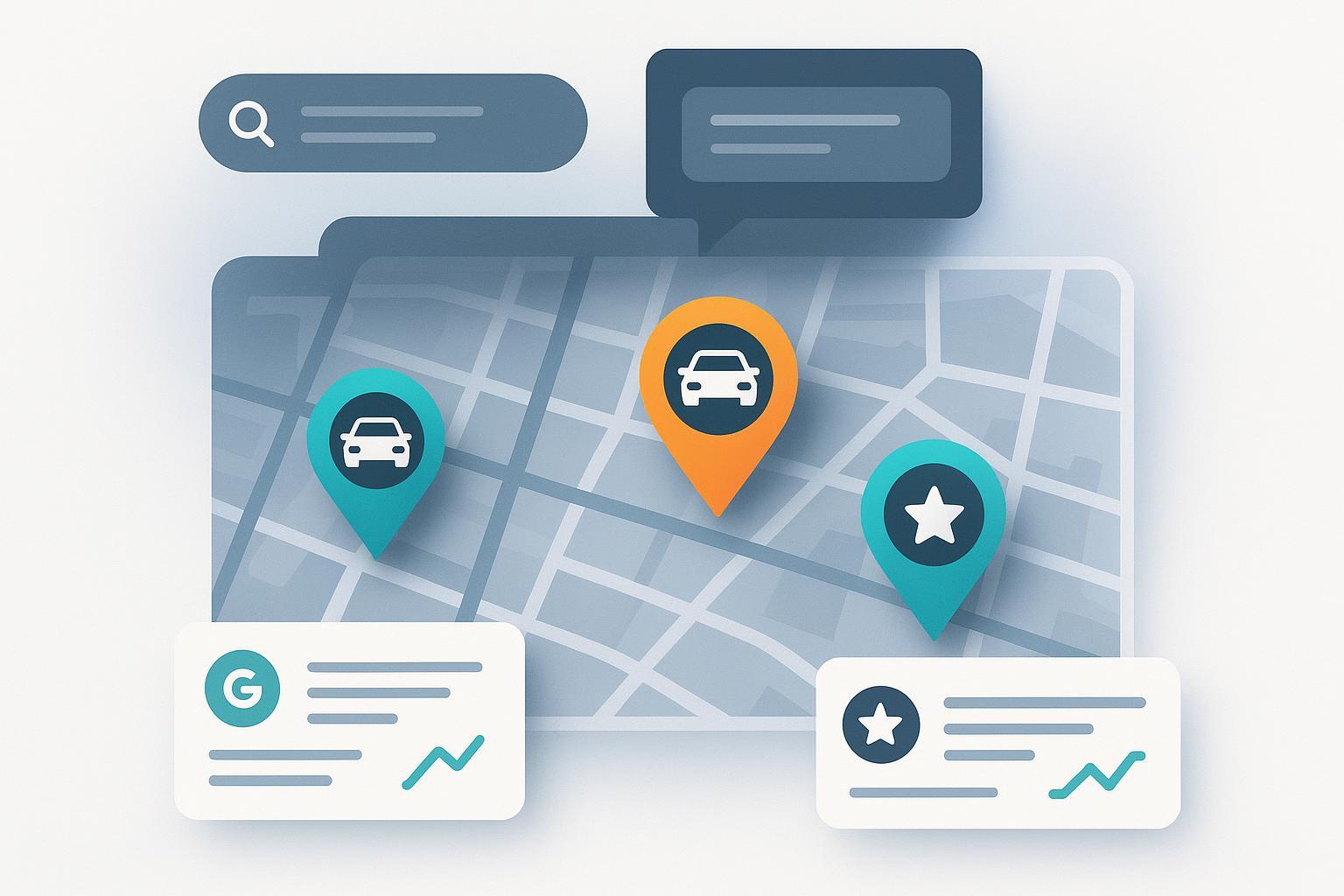
If a shopper asks an AI assistant “best hybrid SUVs near me with winter packages,” will your dealership be cited—and clicked? AI answers now stitch together local entities, reviews, and inventory details. That’s exactly where GEO work shines: it gives large models clean, consistent, and localized signals they can trust and surface.
Why GEO matters to AI answers
Google’s AI Overviews pull from a broader set of sources and reward content that’s technically accessible, specific, and helpful. Google’s guidance on AI features emphasizes people-first content and structured data to improve eligibility for enhanced displays, along with traditional quality signals. See Google’s overview of AI features and success guidance in the 2024–2025 period: the official documentation on AI features in Search and Google’s May 2025 article Succeeding in AI-driven Search.
Perplexity and ChatGPT Search also show explicit citations. Perplexity describes how it conducts real-time retrieval and displays sources alongside answers in its product documentation, and OpenAI explains how ChatGPT Search presents source links and refinements. See Perplexity’s explanation of how it works and OpenAI’s introduction to ChatGPT Search.
The takeaway: solid local SEO fundamentals make your brand legible to AI systems, while structured data and localized content give them something specific and cite-worthy to show.
Core local signals you need to nail
Start where AI systems start: your entities and their data freshness. For multi-location dealer groups, consistency isn’t nice-to-have—it’s the operating system.
First, tighten your Google Business Profile (GBP) footprint. Verify every location, set the correct categories (for dealerships, “vehicle_dealer”), align each listing to a precise Place ID, and keep hours, photos, and posts current. If you plan to use Google’s vehicle listings, you’ll need clean dealership matching and compliant inventory landing pages. Google documents the program’s requirements, including landing page fields and update cadence, in its official resources on vehicle listings structured data and feeds.
Second, treat reviews as both a ranking input and a trust signal. Expert surveys in 2025 highlight the importance of review quality and recency on local rankings, while consumer research shows mixed behavior—people trust reviews but scrutinize authenticity. Balance quantity with ongoing, photo-rich, descriptive reviews. For perspective, compare Whitespark’s Local Search Ranking Factors 2025 with BrightLocal’s 2025 Local Consumer Review Survey and calibrate your operations accordingly.
Third, go beyond Google. Apple Business Connect gives you control of Apple Maps profiles, images, and “Actions,” with Insights for performance. Apple’s 2023 announcement and help center outline the levers you can pull; start with Apple Business Connect basics. Bing Places remains worthwhile because Bing’s index and chat experiences often underpin enterprise assistants; ensure NAP and hours parity across platforms.
Finally, localize content across languages and regions if you sell to cross-border customers or diverse metro areas. Use clear city and neighborhood references, but keep the copy helpful—not stuffed. Think of it this way: if a service advisor wouldn’t say it to a customer, it doesn’t belong on the page.
Technical playbook — schema and feeds for dealerships
Structured data is how you “label the shelves” for AI systems. For automotive, that means dealership entities, service pages, and detailed inventory.
On dealership and location pages, implement Organization plus AutomotiveBusiness (or AutoDealer) with a complete PostalAddress, phone, geo coordinates, openingHours, sameAs profiles, and a stable URL. On Vehicle Detail Pages (VDPs), use Vehicle (a subtype of Product) with VIN, brand/model, mileage, fuel, transmission, images, and Offers for price and availability. Validate in Google’s Rich Results Test and continuously monitor publishing pipelines.
Here’s a compact JSON-LD example for a VDP (trim to your fields as needed):
{
    "@context": "https://schema.org",
    "@type": "Vehicle",
    "name": "2024 Honda CR-V Hybrid EX-L",
    "vehicleIdentificationNumber": "2HKRS78H0RH123456",
    "brand": {
      "@type": "Brand",
      "name": "Honda"
    },
    "modelDate": "2024",
    "vehicleConfiguration": "AWD, Hybrid, EX-L",
    "mileageFromOdometer": {
      "@type": "QuantitativeValue",
      "value": 12,
      "unitCode": "SMI"
    },
    "fuelType": "HYBRID_GASOLINE",
    "vehicleTransmission": "AUTOMATIC",
    "image": [
      "https://www.exampledealer.com/inventory/24-crv-exl-1.jpg",
      "https://www.exampledealer.com/inventory/24-crv-exl-2.jpg"
    ],
    "seller": {
      "@type": "AutoDealer",
      "name": "Example Honda",
      "address": {
        "@type": "PostalAddress",
        "streetAddress": "123 Main St",
        "addressLocality": "Denver",
        "addressRegion": "CO",
        "postalCode": "80202",
        "addressCountry": "US"
      },
      "telephone": "+1-303-555-0100",
      "url": "https://www.exampledealer.com/"
    },
    "offers": {
      "@type": "Offer",
      "priceCurrency": "USD",
      "price": "38450",
      "availability": "https://schema.org/InStock",
      "url": "https://www.exampledealer.com/vehicles/2024-honda-crv-hybrid-exl-denver-co",
      "itemCondition": "https://schema.org/NewCondition"
    }
  }
If you participate in Google’s vehicle listings, align your feed fields and landing page content to program requirements and refresh frequently so availability and pricing don’t drift. For international or multi-language markets, use clear URL patterns for locales (e.g., /en-us/, /es-us/) and implement reciprocal hreflang tags. This helps AI surfaces and traditional search map the right language-region page to a given user.
Content that earns citations in AI
AI assistants favor precise answers with real local context. You don’t need poetic prose; you need specificity and utility.
Start with intent-first FAQs. What questions do your shoppers actually ask? “Best AWD SUVs under $40k for Colorado snow,” “oil change near Plano on Saturday,” “can I lease with a 620 credit score?” Build Q&A blocks into relevant pages and service hubs where each answer is clear, actionable, and locally grounded. Include references like towing capacity for mountain driving or winter tire packages; cite internal pages that prove it.
Add localized multimedia. Show photos and short clips that reflect regional realities: snow-packed lots, summer road-trip cargo tests, or EV charging walk-throughs at your location. Describe those assets with alt text that mentions the scenario and locale naturally.
Shape prompt-aware copy. Voice queries often include “near me,” “open now,” and context like “with loaner cars.” Use similar natural phrasing in headers and body copy, but don’t force it.
Finally, clarify your entity. Add Organization markup with your logo and sameAs links to authoritative profiles, which Google highlights in its documentation. See Google’s Organization structured data guidance for the required and recommended properties.
Measurement and attribution for GEO for automotive AI visibility
If you can’t measure AI visibility, it’s hard to prioritize work—or defend retainers. Build a small but durable stack that tracks citations and connects them to outcomes.
Key KPIs to operationalize across clients:
- AI Mentions by platform and query set
- Share of Voice in AI answers versus a defined competitor cohort
- Brand Visibility Score trend alongside local pack rank and calls/leads
Instrumenting this stack relies on a few systems. In GA4, use data-driven attribution for session-based credit and annotate releases and feed updates to correlate visibility changes with site metrics. In your CRM, capture UTM parameters on forms and phone integrations so “assistant-sourced” sessions can be reviewed. When clicks are sparse, triangulate impact with panel surveys, call disposition notes, and lift tests.
Disclosure: Geneo (Agency) is our product. In a measurement workflow, a platform like Geneo’s agency solution can be used to monitor daily AI Mentions across ChatGPT, Perplexity, and Google AI Overviews, consolidate them into a Brand Visibility Score, and export platform breakdowns to a white-label client portal. Many agencies map these exports to their weekly decks and compare Share of Voice against a competitor set while keeping traditional local KPIs (GBP calls, local pack ranks) visible for context. Keep the tone neutral and tie every chart to a defined query set and time window.
Agency workflow at scale — from audit to 90-day rollout
A consistent operating model beats one-off fixes. Use a brief audit, sprint plan, and cadence that any account team can run.
Audit essentials you can complete in a week:
- GBP and maps coverage: verification, categories, Place IDs, hours, photos, posts, and dealership-to-feed matching
- Schema coverage and validation: Organization plus AutomotiveBusiness on location pages; Vehicle on VDPs; Rich Results Test clean
- Reviews and citations: review velocity, reply coverage, NAP consistency across Google, Apple, Bing, and top directories
Now move into a 30/60/90:
First 30 days: establish your baseline. Stand up AI Mentions tracking, document your monitored query sets, lock GBP data, and deploy Organization and AutomotiveBusiness markup. Launch a pragmatic review program with service and sales.
Days 31–60: expand. Roll Vehicle schema across priority VDPs, add Service schema to maintenance pages, and begin vehicle feed testing if relevant. Publish intent-first FAQs on two service hubs and one inventory hub per location. Wire CRM and call tracking so forms and calls carry UTMs.
Days 61–90: scale and localize. Add reciprocal hreflang where needed, normalize URL patterns for locales, and publish region-specific media. Build a simple weekly reporting cadence: AI Mentions, Share of Voice, local pack ranks, calls/leads, and notes on releases.
Recommended tools and where they fit:
| Area | Tool example | How it helps |
|---|---|---|
| Schema validation | Google Rich Results Test | Confirms JSON-LD parses and flags issues |
| Review ops | In-house CRM or dedicated review platform | Increases review velocity and reply coverage |
| Inventory feeds | OEM or dealership DMS/partner feed tools | Keeps availability and pricing fresh |
| AI visibility tracking | Geneo (Agency) | Consolidates AI Mentions and Brand Visibility in white-label reports |
| Internationalization | Search Console Intl Targeting and hreflang validators | Surfaces hreflang errors and mismatches |
Mini case snapshots
Dealer group, three metro locations. Baseline showed near-zero AI Mentions for localized queries like “best hybrid SUVs in Phoenix under 40k.” Actions over 60 days included GBP cleanup, Organization and AutomotiveBusiness schema, VDP Vehicle markup on top 200 SKUs, and a service hub with six intent-first FAQs. Results: AI Mentions increased from 2 per week to 17 per week across tracked queries, Share of Voice reached 24% in the Phoenix set, and calls from service pages rose 13% week-over-week during the final two weeks of the sprint. Downstream sales impact was directional, corroborated by annotated GA4 and CRM notes.
Single-store dealership near a state border serving bilingual audiences. Baseline revealed duplicated pages and mixed-language URLs. Actions included reciprocal hreflang between /en-us/ and /es-us/, localized media and captions, and schema corrections. After 45 days, AI Mentions appeared on Perplexity for Spanish queries and intermittently in Google AI Overviews for bilingual intent terms. Local pack ranks improved for three city-modified queries, and service appointment form submissions in Spanish rose modestly. Not every uplift was linear, but the visibility trend was clear and defensible.
Next steps
Pick one location, one service hub, and one inventory hub, and run the 30/60/90. Keep your monitored queries stable for eight weeks, and annotate every release. If you need a consolidated view of AI Mentions and Share of Voice, consider Geneo for agencies to standardize reporting.