
Why Agencies Should Add GEO to Their Service Portfolio in 2025
Explore why digital agencies must add Generative Engine Optimization (GEO) to service portfolios in 2025. Actionable best practices for proactive AI visibility and client growth.
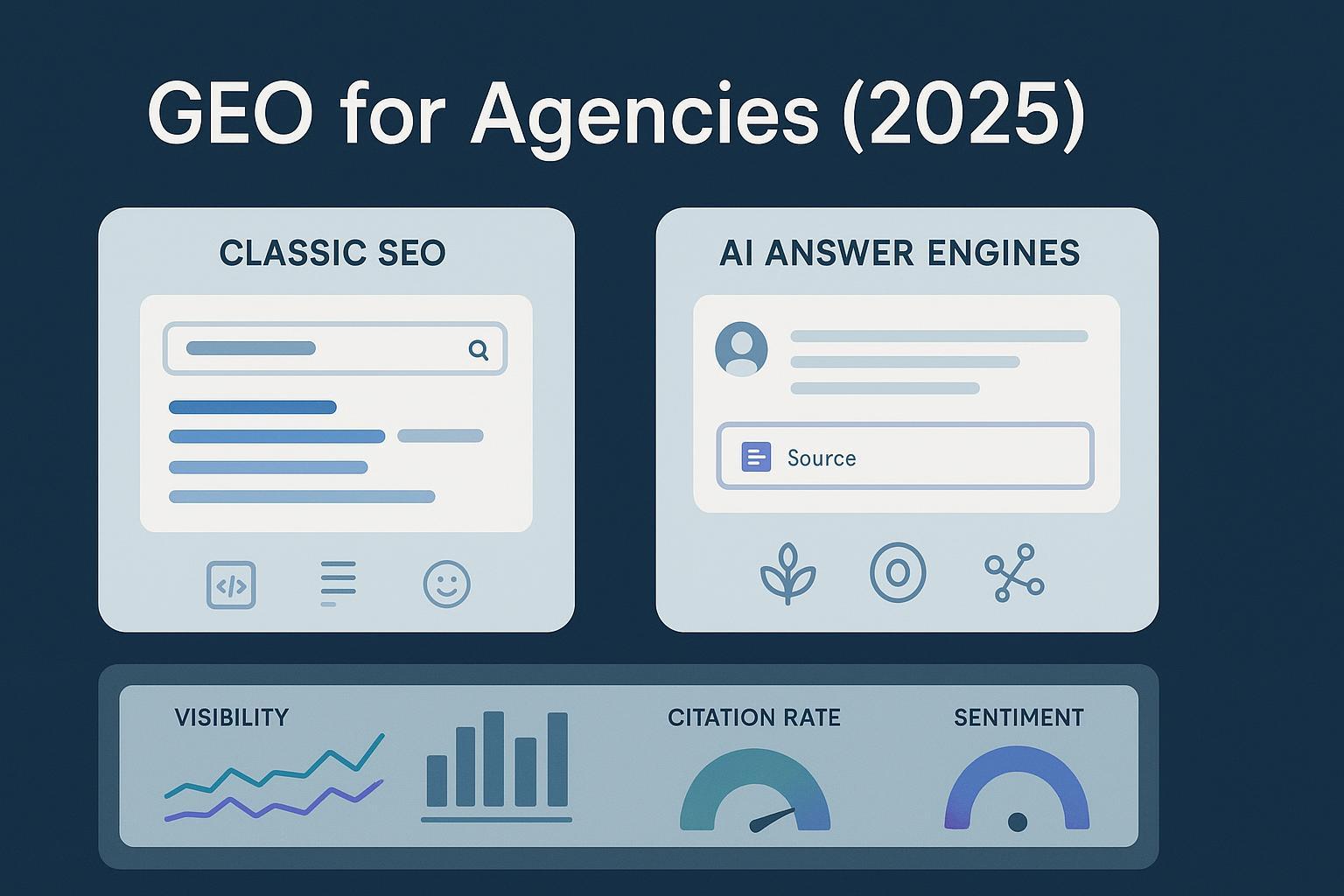
The center of search has moved from “10 blue links” to instant answers. Google’s AI Overviews now appear on a meaningful share of queries—Semrush tracked 13.14% of U.S. desktop searches in March 2025, up sharply from January, as covered by the team at Search Engine Land (May 2025)—and users click less when those summaries show. In a July 2025 national study, Pew Research Center found lower click propensity with an AI summary present. For agencies, that means visibility in the answer itself—not just the SERP—is the new battleground.
Harvard Business Review put it bluntly in 2025: brands must optimize for LLMs, not just rankings. If your clients’ content isn’t understood, trusted, and cited by AI systems, they’ll lose discovery share even if traditional rankings hold steady.
What GEO Adds to Your Portfolio
Generative Engine Optimization (GEO) expands an agency’s value beyond traffic. It aligns your work to how assistants assemble answers, where presence and accuracy drive outcomes.
- Client-visible outcomes shift from position tracking to assistant visibility, citation rate, answer accuracy, and sentiment. If you need a primer on this concept, see this overview of AI visibility and brand exposure in AI search.
- It creates a moat. GEO blends technical SEO, data architecture, content operations, and digital PR. That cross-discipline mix is hard to copy quickly, making your agency harder to displace.
- It opens new revenue lines: AI visibility audits, schema and entity modeling sprints, answer-focused content programs, and ongoing LLM monitoring/reporting.
Think of GEO as moving from “rank my page” to “make my brand the answer—correctly and consistently.”
The GEO Implementation Playbook (Phased)
A practical rollout lets you productize GEO while protecting margins. Use these phases to standardize delivery and retrain your team.
Phase 0: Readiness audit
- Entities and relationships: Do key people, products, and brands exist as well-defined entities on the site? Are relationships clear across pages and profiles?
- Structured data foundations: Implement and validate JSON‑LD for Organization, Person, Article, FAQPage, Product, and HowTo where appropriate. Google’s documentation on structured data remains the canonical checklist.
- Provenance and trust: Visible bylines, detailed author bios, source citations, and outbound links to primary research improve both human and model trust.
- Crawl controls and licensing posture: Update robots.txt with AI user‑agents; consider enterprise protections such as Cloudflare’s AI Crawl Control (July 2025) if your clients need enforcement and auditing.
Phase 1: Answer‑centric content
Reformat priority pages for LLM consumption: clear Q&A sections, tight definitions, concise steps, compact tables, and statistics with citations. Use headings that map to intents (“What is…?”, “How to…”, “Pros vs cons…”). Provide direct language that a model can safely quote.
Phase 2: Authority and citations
Earn and surface authoritative references. Digital PR should target credible publications and expert commentary. On‑site, elevate expert pages, link to primary sources, and keep author profiles consistent across the open web to strengthen entity signals.
Phase 3: Monitoring and iteration
Track assistant visibility, citations, sentiment, and answer accuracy across engines (Google AIO, ChatGPT, Perplexity, Gemini, Copilot). Build sprints around gaps you find. For an operational walkthrough of alerts and iteration rhythms, this practical guide to monitoring AI brand mentions offers a useful framework.
A practical example (monitoring-driven sprints)
Disclosure: Geneo is our product.
Here’s how a neutral monitoring‑driven sprint looks in the wild. An agency defines a trackable query set for a B2B SaaS client—category head terms, key “jobs to be done,” and branded navigational questions. Over two weeks, the team benchmarks assistant visibility (how often the brand appears in answers), citation rate (how often URLs are cited), and sentiment (tone of mention) across Google’s AI Overviews, Perplexity, ChatGPT, and Gemini.
Using a monitoring platform like Geneo, the team notices that the client is mentioned but rarely cited for “what is [category]?” and “best [category] tools” in Perplexity and Gemini, and that a competitor’s glossary page is cited more often. The sprint objective becomes: create a tightly structured definition page with clear Q&A, a compact comparison table, and schema that defines the entity and links out to two primary sources. In parallel, digital PR pitches a short expert quote to relevant industry publications to earn an independent reference.
Two weeks later, monitoring shows an uptick in citations on the definition query cluster, with sentiment moving from neutral to positive where the brand is referenced alongside credible sources. The agency rolls those learnings into a playbook: which content patterns win citations in which assistants, which PR targets move the needle fastest, and how often assistant answers refresh. That playbook then informs the next sprint and future client engagements. Repeatability—not a one‑off tactic—is the outcome you’re after.
Metrics, Reporting, and ROI Clients Will Care About
Executives will ask, “What does success look like?” Use a KPI model that reflects both classic SEO and GEO so clients see continuity and progression. Seer Interactive’s analysis (reported by Search Engine Land in Nov 2025) noted steep CTR compression when AIOs appear, which underscores why GEO metrics must sit alongside rankings and traffic.
| Program | Primary KPIs | How It’s Measured | Typical Cadence |
|---|---|---|---|
| Classic SEO | Rankings, organic sessions, non‑brand vs brand split, conversions | Rank trackers, GSC, analytics | Weekly–monthly |
| GEO | Assistant visibility rate, citation rate, answer accuracy, sentiment index, AI‑assisted conversions | Cross‑assistant monitoring, sampling for accuracy, tagged attribution | Weekly monitoring; monthly QBR |
For precise definitions of accuracy, relevance, and personalization in AI contexts, align with this primer on GEO & LLMO metrics. To attribute revenue, add “How did you hear about us?” options that include AI engines, group AI assistants as a distinct channel in multi‑touch models, and review assisted conversions from AI‑referred sessions.
Team Design and Training
Winning GEO programs are cross‑functional by design. You’ll need technical SEOs and engineers for schema, feeds, site architecture, and bot controls; strategists and editors to shape answer‑centric content and maintain topic hubs; digital PR to secure authoritative mentions that LLMs can cite; and analysts to monitor assistant visibility, sentiment, and accuracy—and translate those insights into sprints and QBRs. Authority signals still start with people. Your experts’ profiles, consistency, and publishing cadence matter because LLMs triangulate identity and expertise. For practical tactics—profile architecture, posting cadence, and cross‑linking—see this guide to LinkedIn team branding for AI search visibility.
To accelerate upskilling, build a short internal course covering entity‑first thinking, schema essentials, answer formatting, and evidence rules; create reusable SOPs for audits, Q&A refactors, and prompt mining (pilot with one client per vertical to tune QA); and add GEO KPIs to QBR templates so every account reinforces the new goals.
Packaging, Pricing, and Positioning GEO Services
Productize early to reduce custom overhead and set clear expectations.
- Starter (60–90 days): Readiness audit, schema baseline, 3–5 answer‑centric refactors, assistant visibility benchmark, and governance plan. Outcome: validated baseline and a quarterly roadmap.
- Growth (quarterly): Two sprints per quarter tied to opportunity clusters; digital PR support; monthly monitoring; accuracy sampling; QBR with GEO KPIs and recommendations.
- Enterprise (ongoing): Topic‑hub expansions, machine‑readable feeds (RSS/API), advanced bot controls, PR calendar integration, and joint planning with product and brand teams.
Position GEO as an extension of SEO, not a replacement. You’re future‑proofing discovery while keeping what works. Want a mental shortcut? GEO ensures your client shows up accurately inside answers; SEO ensures they’re still discovered via links. Both matter.
Common Pitfalls (and How to Avoid Them)
Don’t over‑promise on controls: robots.txt entries for AI bots are policy signals, not guarantees, and while enterprise solutions like Cloudflare’s AI Crawl Control help with authentication and enforcement, they won’t stop every bad actor—document the limits and set expectations. Avoid treating schema as a silver bullet; structured data correlates with clearer answers but doesn’t guarantee inclusion, so pair schema with strong content and citations. Don’t ignore accuracy: being mentioned is not enough—implement sampling to check whether assistants describe your client correctly, then fix the corpus that models rely on. And don’t measure only traffic; with AIOs present, impression growth can coexist with fewer clicks, so tie GEO to assistant visibility, citations, and AI‑assisted conversion lines so clients see the full picture.
Quick FAQ for Agency Leaders
Is GEO just “SEO with AI prompts”? No—GEO spans entity modeling, structured data, answer‑centric content, PR for authoritative mentions, and cross‑assistant monitoring. Prompts alone won’t move market share. Will this cannibalize our SEO retainer? It shouldn’t; GEO complements SEO. Many tasks overlap (schema, architecture, content), and you’ll increase perceived value by reporting on both. How fast will clients see results? Expect early wins within 4–8 weeks on well‑scoped clusters, faster in niche verticals with good source material. Durable gains arrive as topic hubs and external citations compound.
One last question to keep your roadmap honest: if a prospect asked an AI assistant to “recommend the best [your client’s category] platform,” would the model describe and cite your client correctly today? If not, GEO belongs in your 2025 service portfolio.