
What Clients Expect from GEO Deliverables in 2025
Discover top GEO deliverables for global SEO in 2025—KPIs, reporting cadence, technical localization, and governance frameworks. Essential for enterprise practitioners.
When AI answers sit above the fold, clients don’t just want “rankings.” They expect visibility, citations, and sentiment to move in the right direction—and they want proof, fast. Multiple studies in 2025 show AI Overviews appearing on a meaningful slice of queries, though estimates vary with method and timing: BrightEdge reported in May 2025 that impressions rose while CTR fell roughly 30% when AI Overviews appeared, and later studies from seoClarity and Comscore suggested coverage rose toward 30% of U.S. desktop queries by late 2025. See the time-stamped context in BrightEdge’s May 2025 summary and Comscore’s October 2025 AI Intelligence report for scope and variance.
The GEO deliverable stack: what arrives, what it proves
Clients don’t buy activity; they buy outcomes and clarity. Think of your GEO program like a flight deck: every artifact either guides the mission or gets tossed.
| Deliverable | Client expectation | Sign-off artifact |
|---|---|---|
| Market and prompt taxonomy | Priority markets, use cases, and prompt classes per funnel stage | Approved taxonomy doc + change log |
| GEO research pack | Multilingual keywords, entities, corroboration sources; competitor inclusion/citation map | Research workbook + source list |
| Technical international SEO audit | Hreflang, canonicals, geo-architecture, schema, rendering, sitemaps | Audit deck + issue tracker with SLAs |
| Localization brief + QA checklist | Natively localized content with legal/compliance fit and expert review | Briefs per market + QA sign‑offs |
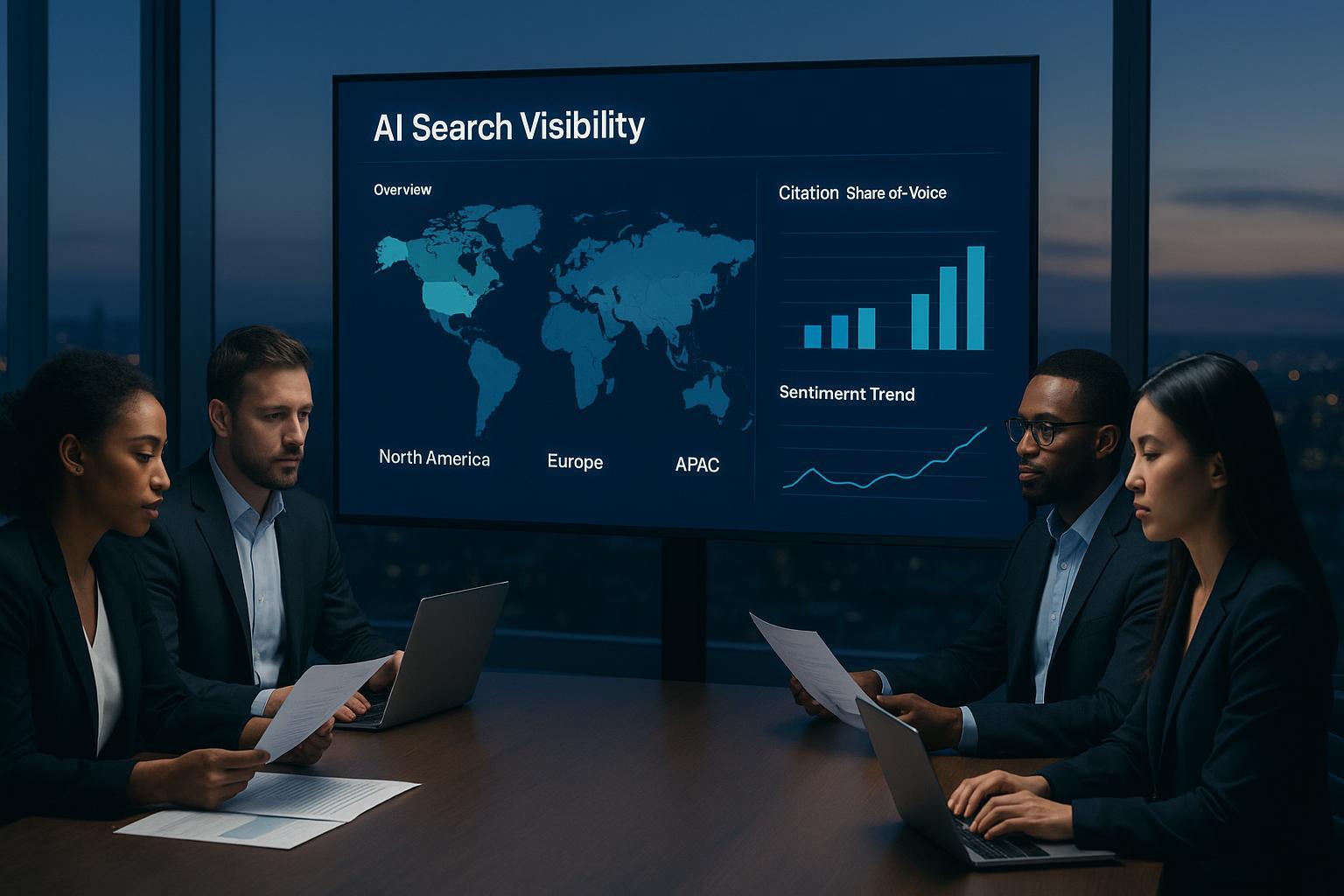
| Weekly ops dashboard | Inclusion rate, citation SOV, sentiment trend, freshness, AI referrals, SEO KPIs | Live dashboard link + weekly notes |
| Monthly executive readout | Progress to KPI targets, blockers, decisions needed | 1–2 page exec memo + highlights deck |
| Quarterly benchmark pack | Cross‑engine, cross‑market trendlines; cohort comparisons; plan adjustments | Benchmark report + roadmap update |
KPIs, benchmarks, and reporting cadence
You can’t manage GEO without measuring three things at once: inclusion, quality, and commercial impact. Here’s a pragmatic baseline.
- Inclusion & prominence: inclusion rate by engine and prompt class; citation share of voice and rank within AI answers.
- Quality & reliability: sentiment of AI answers, corroboration footprint (number and authority of supporting sources), and freshness/recency of cited assets.
- Commercial impact: referral traffic from AI engines (where measurable), non-brand organic traffic and assisted conversions, plus revenue or pipeline in priority markets.
A weekly ops dashboard should show trendlines; a monthly executive rollup should translate findings into decisions and budget asks; a quarterly benchmark should reset targets by engine and region. For a deeper KPI taxonomy, our guide on LLMO metrics for accuracy, relevance, and personalization (2025) explains how to formalize quality and reliability within AI answers.
| Widget | What it shows | Why it matters |
|---|---|---|
| AI inclusion rate (by engine) | % of tracked prompts that include the brand | Early signal of coverage and eligibility |
| Citation SOV & position | Share and placement of your citations among sources | Indicates authority and influence in answers |
| Sentiment trend | Positive/neutral/negative tone in AI answers over time | Protects brand and surfaces risk |
| Corroboration density | Count and quality of independent sources that support your claims | Reduces hallucination risk, boosts inclusion |
| Freshness index | Age/recency of cited pages and datasets | Nurtures eligibility as engines prefer up-to-date sources |
| AI referrals + SEO KPIs | Downstream traffic from AI engines + organic sessions, leads/revenue | Links visibility to business outcomes |
Two pieces of context to brief stakeholders:
- Coverage is volatile and methodology-dependent. BrightEdge’s May 2025 analysis cited CTR declines around 30% when AI Overviews display, while Seer Interactive observed drops exceeding 50% in some cohorts by September 2025. Present ranges with dates to avoid false precision.
- Google still drives far more traffic than assistants. Ahrefs estimated in November 2025 that Google sends roughly 345× more traffic than ChatGPT, Gemini, and Perplexity combined. GEO complements, not replaces, your SEO program.
Technical international SEO that actually ships
If the international foundations wobble, GEO outcomes wobble. Non‑negotiables:
- Hreflang with reciprocity and self-references; valid language‑region codes; include x‑default when appropriate; don’t canonicalize different languages together. Google’s documentation remains the gold standard for localized versions.
- Site architecture chosen and applied consistently (ccTLD vs subfolder vs subdomain). Subfolders consolidate authority; ccTLDs send the strongest geo signal but carry overhead.
- Self‑canonicals per language‑region; absolute URLs in hreflang; return 200 on all alternates; avoid JS‑only tag injection that isn’t rendered server‑side.
- Don’t auto‑redirect users solely on IP/browser; allow manual selection and keep all versions crawlable.
- Schema aligned to visible content (Organization, Product, FAQ, HowTo, LocalBusiness where relevant), consistent entity names/addresses/bios across properties.
Microsoft’s Bing emphasizes native-language content and supports hreflang in HTML, HTTP headers, and sitemaps. After fixes, use Bing Webmaster Tools for reindexing workflows.
Common pitfalls: inconsistent reciprocal sets, invalid codes, mixing canonicals, and orphaned alternates. Build a recurring audit into your deliverables, not a one‑and‑done.
Localization that feels native (and passes legal)
Clients expect localized content to read like it was written there, not translated. What that means in practice:
- Market briefs with terminology, examples, measurement units, and currency for each locale.
- Named expert reviewers for regulated or high‑risk topics; maintain a glossary and editorial notes.
- Localization QA that checks schema language tags, imagery, date/number formats, and internal links to local pages.
- Post‑publish monitoring: are AI answers citing the localized asset? What’s the sentiment? Schedule quarterly refreshes for top entities.
Governance and RACI: who owns what
Enterprise GEO succeeds when roles are unmistakable:
- Responsible: GEO analysts (tracking, dashboards), SEO leads (roadmap), localization managers (briefs/QA), data engineering (connectors/QA).
- Accountable: Head of SEO or CMO, ensuring budget, cross‑functional alignment, and risk posture.
- Consulted: Legal/compliance, brand guardians, regional marketing, and product owners for facts and claims.
- Informed: Executives, support, and sales enablement teams via monthly readouts.
Add an escalation path for brand‑damaging AI answers (misattribution, outdated facts). Define SLAs for investigation, source updates, and outreach where platforms accept feedback.
Micro‑example: integrating AI visibility monitoring into GEO (Disclosure: Geneo is our product)
Here’s how a monitoring loop fits into the deliverables without derailing the workflow. A GEO analyst tracks priority prompts across Google AI Overviews, Perplexity, and Bing Copilot. When the inclusion rate for “APAC pricing policy” drops in Singapore, they see two things in the dashboard: citation SOV fell as a regional publisher’s fresher page displaced your guide, and sentiment turned neutral-to-negative due to outdated screenshots.
They log a ticket to refresh the Singapore page (content + schema + date), add two independent corroborations from recent regulatory updates, and request a quick LinkedIn post from a local product lead to reinforce entity credibility. Within two weeks, inclusion returns and sentiment recovers. The monthly exec memo shows the cause, fix, and result in a single slide—no drama, just closed loop.
For GEO vs traditional SEO expectations and how the deliverables differ, compare our overview of Traditional SEO vs. GEO for 2025 marketers.
Packaging and time‑to‑value clients should expect
Set expectations early and stick to them. A sensible enterprise cadence looks like this:
- Week 2: baseline ops dashboard live with tracked prompts and initial inclusion/citation read; top 10 technical issues prioritized; market briefs drafted.
- Month 1: first executive memo with KPI baselines, risks, and asks; first localization QA cycle complete for priority markets; 3–5 content refreshes shipped with corroborations.
- Quarter 1–2: cross‑engine benchmark pack shows inclusion and citation SOV growth in priority prompts; sentiment improved from neutral to positive in at least two markets; organic revenue or pipeline uptick reported for target categories.
Is it perfect? No. But the runway is clear, and the instruments are working.
References worth sharing with stakeholders
- According to BrightEdge’s May 2025 analysis summarized by TheLetterTwo, impressions rose while CTR declined around 30% when AI Overviews displayed; present ranges, not single numbers. See the context in the BrightEdge study summary (2025).
- Comscore’s AI Intelligence Report (October 2025) and seoClarity’s impact research (2025) indicate rising AIO prevalence across late 2025.
- Ahrefs’ AI SEO statistics roundup (November 2025) estimates Google sends 345× more traffic than AI assistants combined—GEO complements SEO.
- Google’s official guidance on localized versions and hreflang and the SEO Starter Guide remain canonical for international foundations.
Next steps
- If you operate in China or APAC and need AIO-specific tracking and workflows, review our guide to Google AI Overview tracking tools for China GEO (2025).
- Want a pilot? We’ll scope a 90‑day GEO deliverable plan—audits, dashboards, localization QA, and governance—aligned to your priority markets and funnels.