
GEO Content Creation SOP for Agencies: A Definition
Define a GEO content creation SOP focused on AI citation rate/coverage with ChatGPT-led engine weighting, glossary, roles, and a one-panel SOP overview.
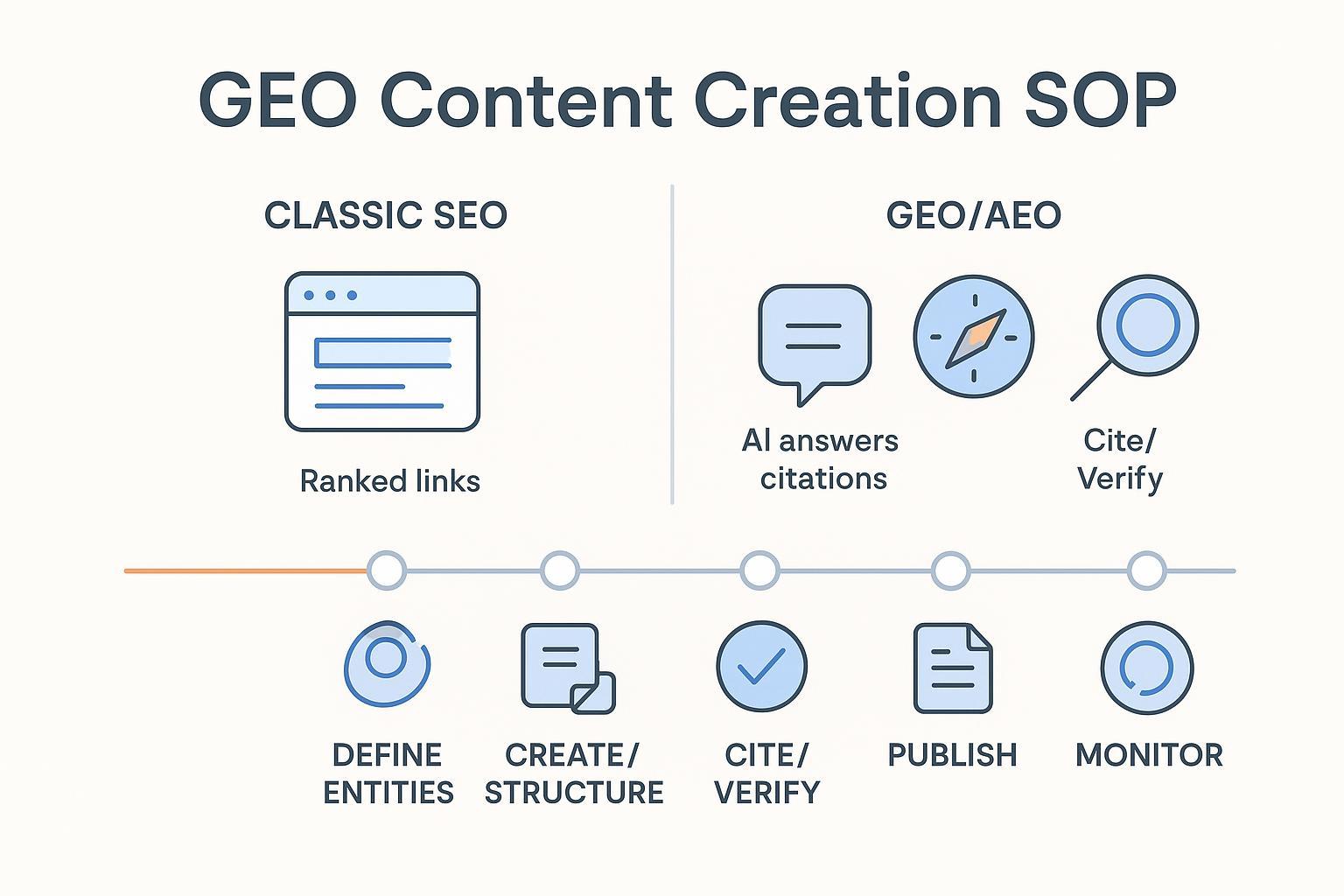
What is a GEO content creation SOP? It’s a standardized, engine-aware content protocol that aims to increase your AI citation rate—coverage across priority engines like ChatGPT, Perplexity, and Google AI Overviews—by designing answer-first, verifiable, and entity-clear content.
Put simply, think of GEO as PR for AI answers: you clarify who you are (entities), present extractable evidence, and structure content so generative systems can confidently cite you. The outcome you optimize for is citations and accurate link attribution, not just blue-link rankings.
GEO vs. AEO vs. Classic SEO — What’s Different?
Below is a concise comparison you can use in client briefings.
Practice | Primary goal | Core tactics | Core KPI | Best use |
|---|---|---|---|---|
GEO | Be represented and cited in LLM-generated answers across engines | Entity clarity, answer-first structure, extractable passages, verifiable sources | AI citation rate/coverage; link attribution accuracy | Cross-engine visibility and brand recall in ChatGPT, Perplexity, AI Overviews |
AEO | Earn direct answers on SERP/assistant surfaces | Concise Q&A formatting, schema, E-E-A-T, lists/tables | Answer presence and share-of-answer | SERP panels, voice assistants, and AI Overview inclusion |
Classic SEO | Earn rankings and organic clicks | Keyword intent mapping, technical SEO, link building | Rankings, CTR, traffic | Traditional SERP acquisition and conversion |
For foundational context on GEO and AEO distinctions, see the practical framing in Search Engine Land’s GEO guide (2026) and the answer-first emphasis in Conductor Academy’s AEO overview (2025). Google clarifies AI Overviews behavior in AI features and your website, noting that links may surface in various ways and do not require special markup.
Engine weighting for a GEO content creation SOP
Prioritize ChatGPT, with Perplexity and Google AI Overviews as secondary. Why lead with ChatGPT? Broad consumer reach and brand recall implications, plus expanding browsing capabilities and agent-style workflows that rely on credible citations. Perplexity is citation-forward and easily linkable; Google AI Overviews protect SERP presence.
A practical allocation for B2B agency programs:
ChatGPT-led: 50–60% of prompt monitoring and artifact design.
Perplexity: 20–30% with special attention to link attribution and evidence formatting.
Google AI Overviews: 20–30% aligned to core updates and volatility.
OpenAI’s product evolution underscores the importance of reliable browsing and source handling; see ChatGPT Release Notes. Perplexity’s design makes citations first-class; their documentation explains how Perplexity works and why clickable sources matter.
Visual SOP overview
Below is a one-panel overview you can share internally.
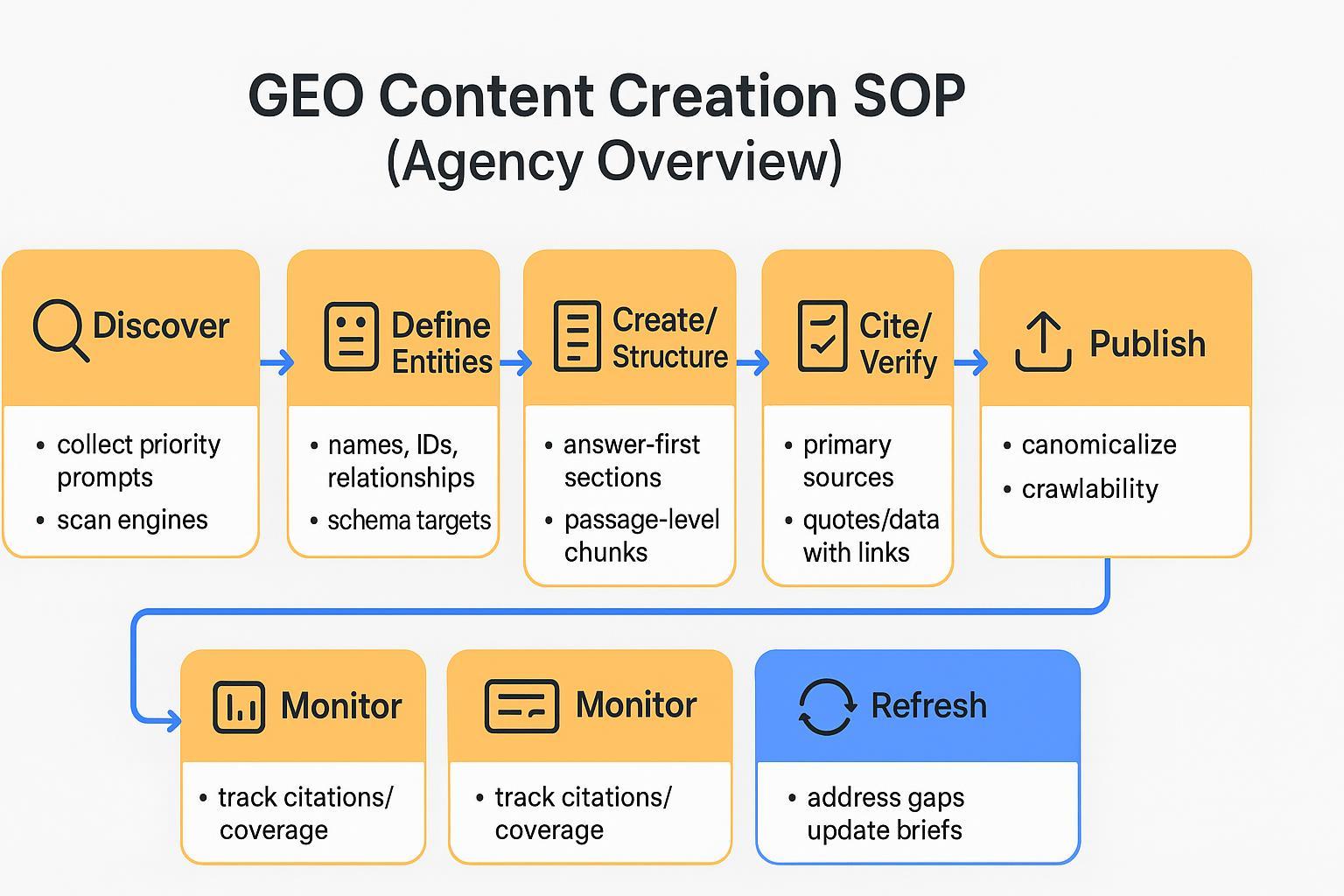
Discover: Collect priority prompts; spot-check engines.
Define entities: Standardize names, identifiers, and relationships; note schema targets.
Create/structure: Write answer-first sections; organize content into passage-level chunks.
Cite/verify: Include primary sources, quotes, and data with links; perform SME/legal checks for sensitive claims.
Publish: Ensure canonicalization, crawlability, and clean on-page markup.
Monitor: Track AI citations/coverage and link attribution accuracy; review sentiment.
Refresh: Address gaps, update briefs, and re-test priority prompts.
Search Engine Land highlights passage-level synthesis and extractable structures in Why “it’s just SEO” misses the mark (2025).
Roles at a glance (RACI-lite)
Strategist (R/A): Sets engine weighting (ChatGPT-led), KPI targets (AI citation rate), and entity scope.
Managing Editor (R): Enforces answer-first structure, sourcing standards, and schema requests.
SEO/AEO Specialist (R): Implements schema and on-page hygiene for extractable passages.
Analyst (R): Monitors AI citations/mentions and reports coverage deltas.
SME/Legal (C/I): Fact-checks and approves sensitive claims.
Concise glossary for GEO content creation SOP
AI citation rate/coverage: Percentage of tracked prompts where your brand is cited/linked across engines. Often paired with sampling logs per engine.
Share of Answer/Voice: Portion of AI answer real estate or mentions captured vs. competitors.
Entity clarity/consistency: Coherent brand identifiers across properties and knowledge bases; reinforced with appropriate schema (Organization, Person, Product).
Schema coverage/health: Percentage of eligible pages with valid, fit-for-purpose structured data; validate with Google’s Rich Results tools.
Link attribution rate: Share of mentions that include correct brand links; especially important in Perplexity where citations are clickable.
Freshness lag: Time between content updates and their appearance in AI answers; track with periodic prompt testing.
Citation-worthiness: Presence of verifiable evidence, primary data, and neutral formatting that models can confidently cite.
Disclosure: Geneo is our product. KPI terminology in this glossary aligns with concepts discussed in Geneo’s documentation; if you want a taxonomy reference, see Welcome to Geneo (Docs).
For conceptual framing of “AI visibility,” see the internal explainer What is AI visibility?, and for a broader GEO playbook, GEO Best Practices for AI Search Engines.
Measuring AI citation rate
Use a simple, transparent formula and consistent sampling. AI Citation Rate = (Number of prompts where your brand is cited at least once) ÷ (Total prompts tested) × 100%. Maintain per-engine prompt lists (e.g., 50–100 queries per client), record inclusion weekly or monthly depending on volatility, and track attribution accuracy separately. For example, if your weekly ChatGPT sample has 60 prompts and your brand is cited in 24 of them, your citation rate is 40%. Track trend lines and pair with share-of-answer notes when applicable.
Suggested update cadence by engine
ChatGPT: Monthly spot-checks on priority prompts, plus reviews after notable OpenAI updates. See ChatGPT Release Notes for timing.
Perplexity: Biweekly to monthly due to citation-forward surfacing; verify link attribution and evidence visibility.
Google AI Overviews: Weekly to monthly depending on volatility; align checks with core changes and Search Central updates. See AI features and your website.
Further reading
Practical overview: Search Engine Land’s GEO guide.
AEO fundamentals: Conductor Academy’s AEO overview.
Google’s AI features context: AI features and your website.
Internal overview: GEO Best Practices for AI Search Engines.