
GEO Case Study 2025: How to Boost AI Mentions by 300%
Discover GEO strategies for professional marketers in 2025. Learn how to achieve a 300% uplift in AI mentions through proven case frameworks and measurement best practices.
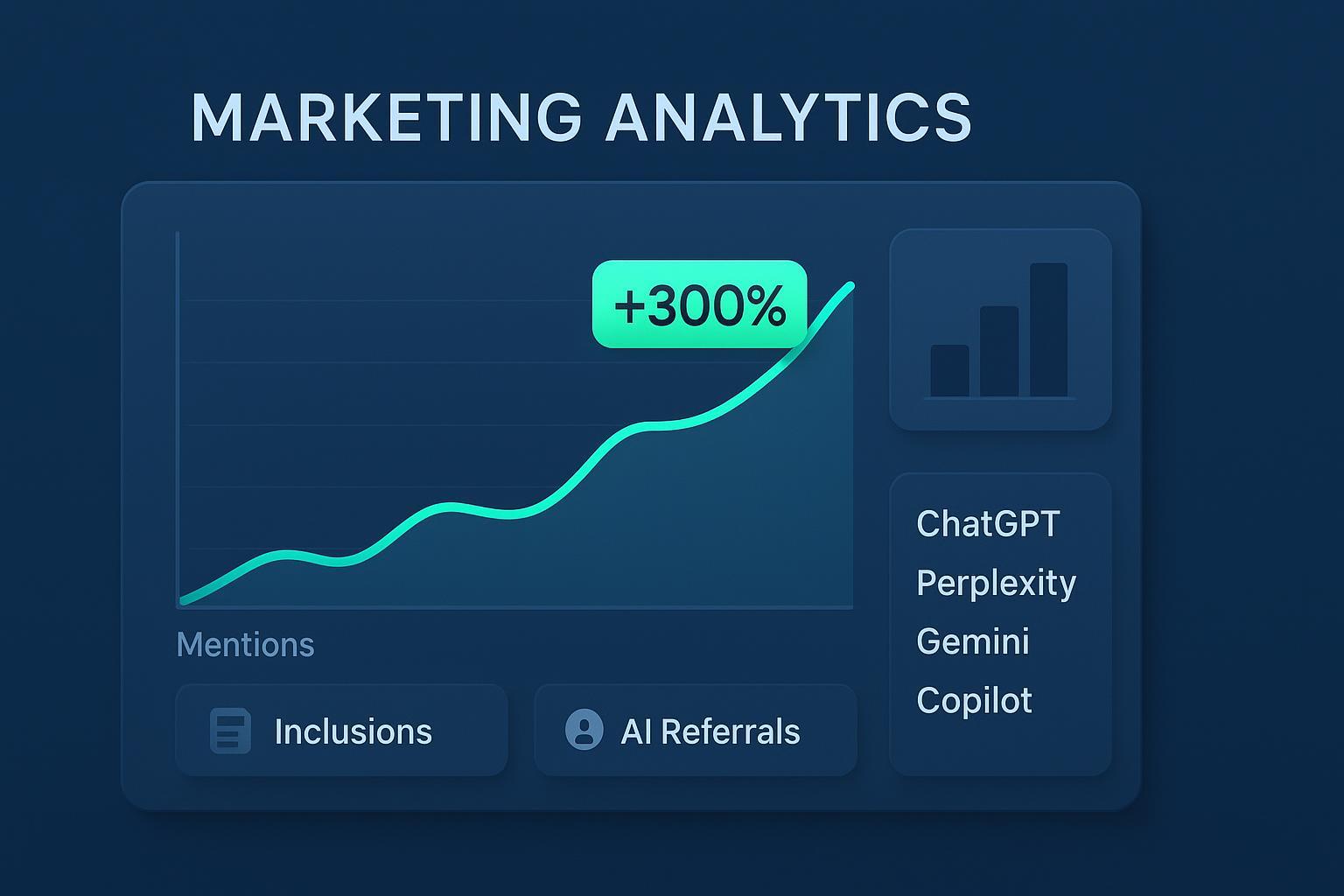
When AI Overviews show up, clicks go missing. Multiple independent analyses in 2025 report sharp CTR drops for traditional listings when Google’s AI Overviews are present—Ahrefs found a 34.5% decline across 300,000 keywords, published in 2025, in their AI Overviews reduce clicks analysis. Seer Interactive’s data, covered by Search Engine Land in 2025, shows informational queries can see organic CTR down 61% and paid CTR down 68% when AI Overviews appear, as detailed in Search Engine Land’s reporting on CTR impact. If fewer people click, you need more citations—and more inclusions—in the AI answers themselves. That’s where Generative Engine Optimization (GEO) becomes the lever.
Let’s get precise about terms, because “mentions” are often confused with traffic:
- A mention is text inclusion of your brand or resource in an AI-generated answer.
- An inclusion is when the answer actually references your page or brand in its source list.
- A link citation is a clickable reference back to your site.
- AI-sourced traffic is the visitor volume arriving via AI answer environments or their companion surfaces. It’s frequently under-attributed due to referrer gaps.
Why a 3X uplift is a realistic planning horizon
A 300% increase in AI mentions is ambitious but achievable when a disciplined GEO program rolls out over 12–16 weeks. We don’t need to invent numbers to believe this: practitioners have documented comparable gains.
- Go Fish Digital (2025) reported tripling leads from AI-driven environments in a three-month program, detailing persona/prompt mapping and entity-aligned cornerstone content in their GEO case study on tripling leads.
- Alpha P Tech (2025) documented a +540% increase in Google AI Overview mentions alongside a 67% organic lift by focusing on clarity rewrites, help-center style documentation, and structured data in their real-world GEO examples.
- Single Grain (2025) shared multiple anonymized cases where AI-sourced traffic reached ~10% of organic within 90 days, and 27% of that traffic converted to SQLs, captured in their GEO optimization case studies.
These are not identical to “mentions,” but they demonstrate the order of magnitude GEO can unlock. So how do you engineer for it?
The case framework marketers can run
Think of GEO as building better answers and better evidence. You’re designing content that answer engines want to cite, and the measurement loops that prove it.
-
Challenge: Map the click squeeze and the opportunity. Identify priority query clusters where AI Overviews or answer engines appear and your brand is missing.
-
Audit: Conduct prompt/entity mapping and asset inventory.
- List the core questions your buyers ask; expand into adjacent and intent-rich variations.
- Inventory cornerstone pages, FAQs, comparisons, technical docs, and third-party references.
- Baseline technicals: schema coverage (FAQ, HowTo, Product, Review), internal links, canonical hygiene, page speed, and “AI readability” (clear headings, scannable proof points, tables).
- Interventions: Build and improve assets to be reference-worthy.
- Cornerstone architecture engineered for information gain: tight topic focus, unique data/quotes, and explicit summaries that are easy for LLMs to extract.
- Q&A/FAQ pages that answer conversational questions; add FAQ/HowTo schema and link to deeper resources.
- Entity alignment: Clarify relationships and identities (brands, products, categories, authors) so answers can ground and re-rank you.
- Off-page authority and UGC: Publish expert posts on Reddit/Quora/LinkedIn; earn mentions in authoritative roundups; document processes publicly (help-center/engineering notes).
- Refresh cadence: Add new data, examples, FAQs, and Last-Modified signals to your cornerstone assets weekly.
- Measurement: Track inclusion, sentiment, and AI referrals.
- GA4 custom channel groups to bucket AI sources.
- UTM tagging for links shared inside AI platforms/communities.
- Manual auditing across ChatGPT, Perplexity, Gemini, and Copilot.
- Dashboards for visibility and alerts.
- Iteration: Respond to loss of citations and new queries quickly.
- Bi-weekly refreshes for long-tail content; weekly for cornerstones.
- A/B tests on landing pages tailored for AI-referred visitors.
Measurement you can trust
Because many AI surfaces don’t pass clear referrers, you need both analytics configuration and manual panels. Start by creating a custom channel group in GA4 called “AI Traffic,” then match session source/medium using regex. Validate with Explorations and keep a rolling change log.
^.*(chatgpt\.com|gemini\.google\.com|openai\.com|perplexity\.ai|copilot\.microsoft\.com).*
- Use UTM parameters on links placed in AI tools or communities to enforce attribution when referrer headers are missing. A simple pattern: utm_source=chatgpt|perplexity|gemini|copilot, utm_medium=ai, utm_campaign=ai_referral.
- Maintain a monthly manual audit: for a stable query set, record whether your brand is included, how it’s cited, and sentiment. Compare against GA4 spikes in Direct and your “AI Traffic” channel.
- For context on why this matters, see Ahrefs’ 2025 study showing clicks drop when AI Overviews appear in their AI Overviews reduce clicks analysis, and Search Engine Land’s coverage of Seer Interactive’s CTR declines in their report on AI Overviews and CTR.
| KPI | What it measures | Why it matters | Direction to watch |
|---|---|---|---|
| Citation frequency | How often your brand/resources appear in AI answers (per platform, per query set) | Early indicator of GEO impact before traffic shows up | Up and to the right |
| Inclusion quality | Link vs text-only mention; position and format in the source list | Higher-quality inclusion correlates with referral probability | More linked, higher in the list |
| AI referral sessions | Visits attributed to AI surfaces (via referrer, UTM, or Direct proxy) | Ties visibility to engagement outcomes | Rising with stable bounce/engagement |
| Sentiment distribution | Positive/neutral/negative tone in AI answers | Impacts reputation and click propensity | Neutral→positive shift |
| Assisted conversions | Conversions where AI traffic assisted in the path | Connects GEO to pipeline/revenue | Consistent growth over time |
Tip: External clicks from Google’s AI Mode can be low—Ipullrank’s early 2025 data suggests under 3%, covered in their early referral data write-up—so value GEO for assisted impact and answer dominance, not just raw sessions.
Execution timeline and checkpoints (12–16 weeks)
A practical program looks like this. Adjust based on team size and asset maturity.
- Weeks 1–2: Discovery and audit. Lock target query clusters, entity maps, and baseline dashboards. Identify cornerstone gaps and FAQ opportunities.
- Weeks 3–6: Build/upgrade cornerstone and FAQ/Q&A assets; implement schema; publish expert documentation; initiate off-page authority with 2–3 UGC posts.
- Weeks 7–10: Establish refresh cadence; add unique data, quotes, and tables; expand internal linking; begin manual panel audits across engines.
- Weeks 11–14: Measure early citation upticks; improve inclusion quality (push for linked sources); tailor landing pages for AI visitors; run small A/B tests.
- Weeks 15–16: Review assisted conversion trends; compare sentiment distributions; spread success patterns to adjacent query sets.
Common pitfalls:
- Conflating mentions with traffic; expecting clicks to rise in lockstep.
- Thin Q&A pages without schema or unique insight.
- Ignoring off-page authority; Reddit and LinkedIn can prime inclusion.
- One-and-done publishing; answer engines reward fresh, well-structured evidence.
Tooling and monitoring (neutral disclosure)
Disclosure: Geneo is our product. As a neutral option in your monitoring stack, Geneo tracks brand exposure, citations, and link references across ChatGPT, Perplexity, and Google AI Overviews, with built-in sentiment analysis and historical query logging. It’s designed for multi-brand/team collaboration and can surface content strategy suggestions from current visibility.
Prefer a mix of tools. Pair Geneo with: Ahrefs or Semrush for overall visibility and Profound for AI inclusion tracking. For strategy depth, see Geneo’s resources: Traditional SEO vs GEO: 2025 Marketer’s Comparison, What Is AI Visibility?, and Geneo vs Profound vs Brandlight.
Lessons learned: What really makes 3X possible
- Build for answers, not just rankings. Design pages with extractable, verifiable facts, tables, and citations.
- Treat entities like your schema of truth. Clarify who/what/where/why so models can ground you.
- Respect off-page gravity. A handful of credible UGC and expert posts can tilt inclusion odds.
- Iterate like you mean it. Weekly updates to cornerstone assets keep you inside the answer rotation.
Sector notes:
- B2B/SaaS: Lean into comparison matrices, implementation notes, and ROI proof points.
- Regulated industries: Favor help-center style documentation, reference official guidance, and keep claims conservative.
- Local/service businesses: Build city/service FAQs and HowTo schema; use testimonials and published process documentation.
Ready to operationalize it?
You now have the framework to plan for a 3X mention uplift—without hand-waving. Start with one cluster, prove your measurement, and scale the refresh cadence. If you do the hard parts well—entity clarity, reference-worthy pages, and steady off-page authority—answer engines will have every reason to include you. And when they do, will your landing experience make that click count?