GEO Best Practices for Education Brand Visibility in AI Search
Learn expert GEO strategies to boost education brand visibility across Google AI Overviews, Perplexity, and ChatGPT. Essential for marketing agencies and SEO pros.
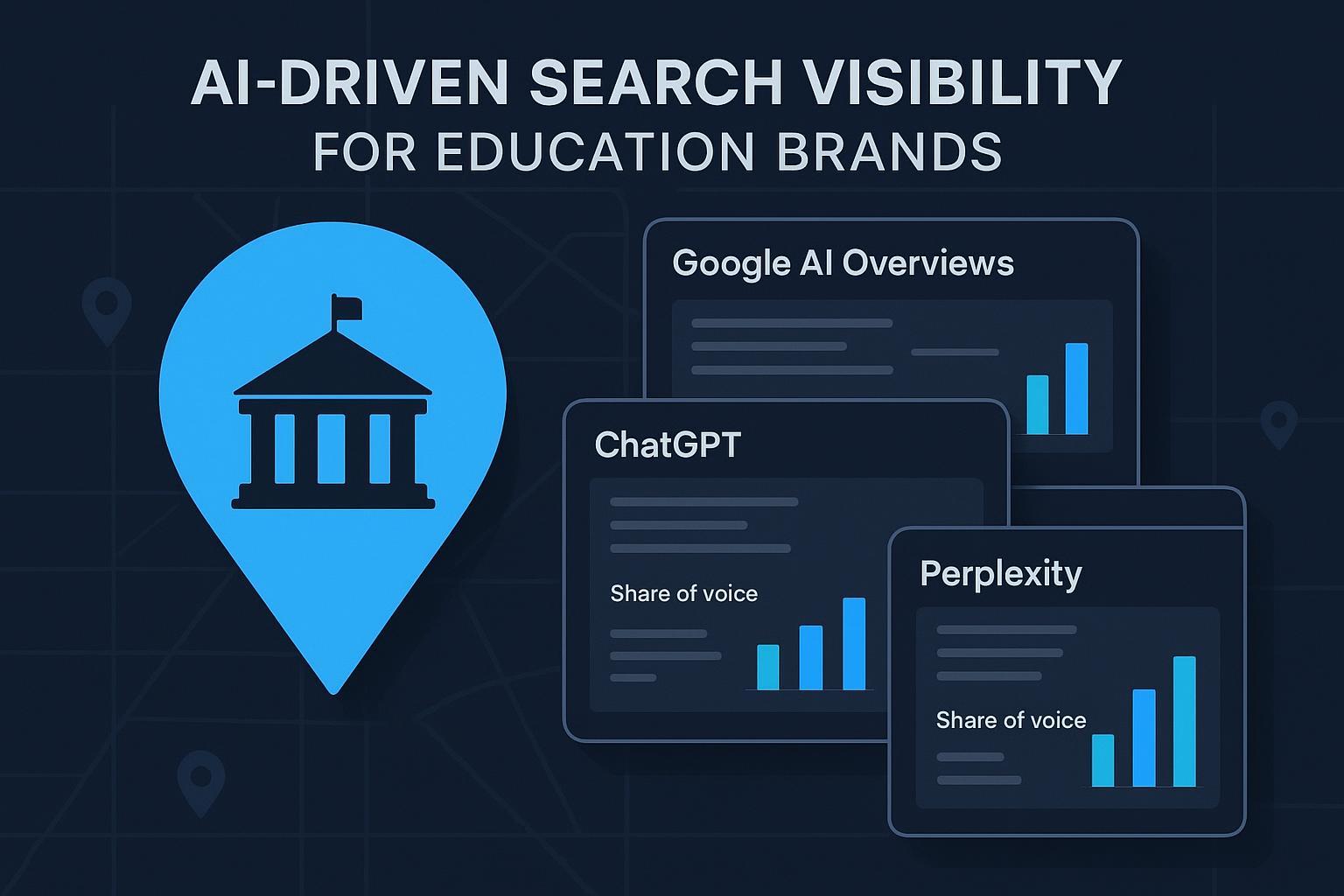
Families don’t just “Google it” anymore. They ask Gemini for program comparisons, skim Perplexity’s citation cards, or check ChatGPT’s summary before clicking anything. If you manage visibility for a university, college, or training center, your brand must show up in those AI answers—and be referenced credibly. That’s where GEO (Generative Engine Optimization) meets local SEO: aligning entity signals, structured content, and campus‑level intent so AI systems can confidently cite you.
What GEO really means for education brands
GEO isn’t a buzzword. For schools, it’s the discipline of making your institution easy for AI engines to understand, trust, and cite—across local queries (“best nursing programs near me”), program research (“tuition vs. outcomes”), and event discovery (“open day this weekend”). In practice, GEO blends local foundations (Google Business Profile and campus NAP governance), hyper‑local content and structured data (location pages, Course/Event schema), and monitoring/iteration across AI surfaces (AI Overviews/AI Mode, Perplexity, ChatGPT).
Why does this matter now? Google states that AI features generate responses from a broader set of sources and present supporting links more prominently than classic results. Site owners can monitor performance through Search Console’s web search type, and content aligned to helpful, people‑first guidance is more likely to be included, as described in Google’s “AI Features and your website” and the developer blog on succeeding in AI Search (2025).
Foundation first: Google Business Profile for schools and universities
Treat GBP as the bedrock for map‑pack visibility and entity clarity.
- Categories and campuses: Choose precise categories (e.g., “University,” “Community college,” specialized training) and maintain separate verified listings for each campus with consistent NAP and UTM conventions.
- Hours and attributes: Represent access accurately—some departments are appointment‑only—and keep photos, attributes, and posts current.
- Reviews: For eligible institutions (commonly higher‑ed), pursue steady, authentic review growth and respond promptly. Claims about K‑12 review disablement surfaced in forum threads during 2025; they are not backed by a canonical Google policy page. Verify your profile behavior directly and avoid strategies based solely on unconfirmed assertions.
For deeper practice references, see independent guidance like Whitespark’s 2026 Local Search Ranking Factors.
Hyper‑local intent landing pages
Think in terms of student, parent, and educator intent. Structure campus and program pages so AI systems—and humans—can quickly extract answers.
- Page structure: Clear H1/H2s, scannable sections for admissions, tuition, outcomes, syllabi, faculty bios, accreditation, and campus logistics. Tie each page to a physical location with consistent NAP.
- Copy and queries: Target geo‑modified intents (city, neighborhood, commuter patterns) and long‑tail questions you see in student emails and chat transcripts. A mix of short and detailed paragraphs helps both users and machines parse meaning.
- Measurement: Track calls, directions, appointment requests, and GSC impressions. Map these to AI appearances over time to see which questions trigger inclusion.
Structured data that still moves the needle
Not all schema types drive rich results equally in 2026. Prioritize those that reinforce real content and active eligibility.
- Event/EducationEvent: Mark open days, workshops, and campus activities with required properties (startDate, endDate, location) and validate in the Rich Results Test. Eligibility and properties are documented in Google’s Event structured data guide.
- Organization/EducationalOrganization: Clarify entity basics—name, logo, address, sameAs, accreditation—and keep markup aligned with visible content. See Google’s search appearance overview.
- Course: Use Schema.org’s Course on program detail pages when it mirrors real content; keep it up to date. Reference the Schema.org release notes to stay current.
- FAQ strategy: Build helpful FAQs for users, but don’t plan your visibility around FAQ rich results. Google has restricted FAQ rich results in recent updates; check the Search updates page for support status.
How AI engines cite sources
Understanding citation behavior informs content decisions.
- Google AI Overviews/AI Mode: Overviews fan out across sources and surface supporting links. Inclusion correlates with helpful, authoritative content and clear entity signals. Site owners can review performance in Search Console, per Google’s AI features guidance and the AI Mode announcement.
- Perplexity: Answers showcase numbered citations and favor authoritative domains. A developer Search API quickstart highlights the importance of clean, well‑structured pages.
- ChatGPT/OpenAI: New research experiences list sources, and OpenAI’s Deep Research emphasizes transparent citations.
The takeaway? Make it simple for these systems to quote you: titles that match questions, concise answers above the fold, citations to authoritative third‑party validators (accreditors, government education data), and structured data aligned to visible content.
A 90‑day GEO plan for education brands
A repeatable agency workflow that balances local SEO and AI visibility.
- Weeks 1–2: Audit GBP, NAP, campus pages, and policies. Document categories per campus; establish UTM standards; identify priority intents and questions. Stand up measurement (GSC, call tracking) and a log for observed AI answers.
- Weeks 3–4: Build or refresh hyper‑local landing pages with campus‑specific sections (admissions, outcomes, logistics). Draft event calendar and implement Event schema. Add Organization/EducationalOrganization markup.
- Weeks 5–6: Expand Course detail pages where applicable; add faculty bios and accreditation details. Publish FAQs for users; mark up only if eligibility is confirmed. Start reputation workflows for eligible profiles; verify K‑12 review status locally before acting.
- Weeks 7–8: Strengthen citations and local backlinks (community partners, education directories with editorial standards). Add campus photo sets and virtual tour content.
- Weeks 9–10: Analyze AI appearances: which queries trigger Overviews or citations? Refine titles and sections to match observed phrasing. Iterate on events and outcomes data.
- Weeks 11–12: Ship adjustments (copy, internal links, schema fixes), document changes, and present progress with combined local SEO and AI visibility metrics.
Monitoring and reporting: AI mentions, Share of Voice, and dashboards
Agencies need to show how education brands appear across AI answers—not just classic search.
- Metrics to track: AI Mentions (when your institution is named or linked), Total Citations, Platform Breakdown (Google/Perplexity/ChatGPT), Share of Voice against local competitors, sentiment notes, and movement over time. Pair these with local KPIs (map‑pack ranks, calls, directions).
- Workflow example (disclosure): Our team has used third‑party AI visibility platforms to aggregate mentions and citations across engines and present client‑ready dashboards. For instance, Geneo offers white‑label reporting with a Brand Visibility Score and Share of Voice across AI surfaces; agencies can host dashboards on a custom domain and export reports for stakeholders. See the public Geneo agency overview for capabilities. For methodology context on rolling out GEO services, you can also review the internal resource how to pitch GEO services to non‑technical decision‑makers.
E‑E‑A‑T in education: governance, credentials, policies
Education topics touch YMYL‑like areas (tuition, financial aid, outcomes). Strengthen credibility signals to match quality expectations.
- Authorship and expertise: Name authors, list faculty credentials, and date content. Align with the Search Quality Rater Guidelines.
- Transparent policies: Admissions timelines, refund policies, privacy, accessibility, and outcome reporting should be obvious and consistent.
- Source integrity: Cite accreditors and government data; link to canonical sources and avoid thin pages.
Pitfalls and adaptation
A few patterns can stall AI visibility—and they’re fixable.
- Assuming FAQ markup will drive visibility despite restrictions. Use FAQ content for users; treat rich result eligibility as variable.
- Neglecting campus governance: inconsistent NAP, mixed categories, or outdated photos confuse systems and families alike.
- Ignoring measurement: without tracking AI mentions and citations, you can’t prove progress or learn which questions to answer next.
Compact toolkit: tasks and helpful tool categories
| Task | Helpful tool categories |
|---|---|
| GBP audit and governance | Local listing managers; analytics for calls/directions |
| Schema validation | Rich Results Test; schema linters; CMS plugins |
| Content and intent mapping | Keyword tools; on‑site search logs; CRM/chat transcripts |
| AI visibility monitoring | Dashboards tracking mentions, citations, Share of Voice |
| Reputation workflows | Review management platforms; policy templates |
References worth bookmarking:
- Google’s owner guidance on AI features: AI Features and your website
- Structured data eligibility and changes: Search updates
- Local search factors: Whitespark’s 2026 Local Search Ranking Factors
- Perplexity developer docs: Search API quickstart
- E‑E‑A‑T expectations: Quality Rater Guidelines (PDF)
If you’re thinking, “Where do we start?” start with governance: one clean campus footprint, one set of credible pages answering real questions, and one dashboard that shows how those answers surface across AI engines over time. Then iterate. That’s GEO for education in practice.