
GEO Best Practices for Chinese Manufacturers Going Global (2025)
Explore 2025’s best practices for GEO (Generative Engine Optimization) to boost Chinese manufacturers’ global presence across Google, Baidu, and AI-driven search engines.
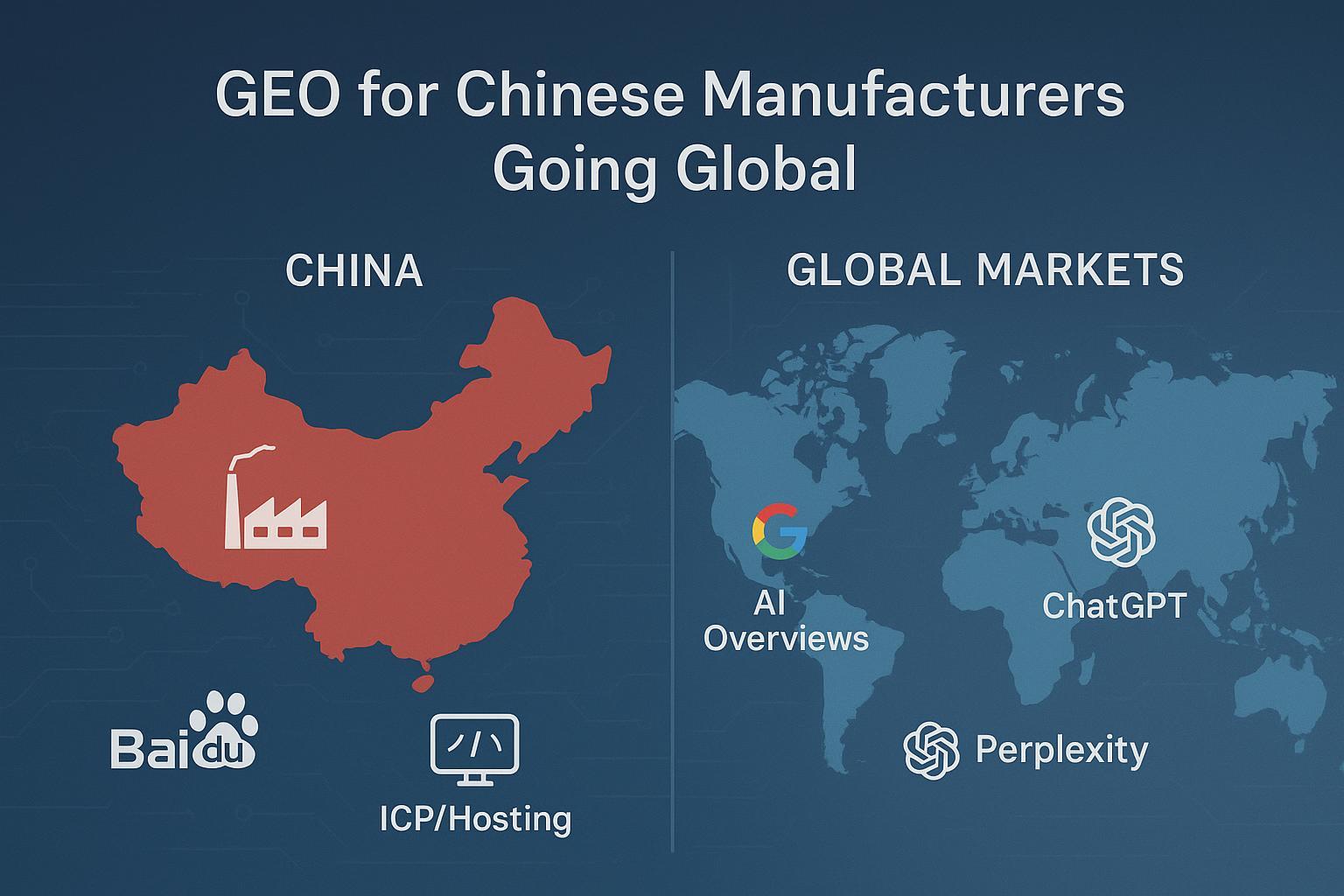
If your buyers increasingly get “good‑enough” answers without clicking through, how do you stay visible? In 2024–2025, AI summaries and answer engines—Google’s AI Overviews, ChatGPT, Perplexity—now mediate discovery for many informational queries. Independent tracking shows AI Overviews appear across a meaningful share of searches, especially informational; see the Semrush AI Overviews prevalence study (2025). Google’s Search Central advises focusing on high‑quality, helpful content rather than “special tricks” for AI features. The practical takeaway: manufacturers must complement classic SEO with Generative Engine Optimization (GEO) to make their pages citable, trustworthy, and structurally easy for AI systems to reference. For foundational differences between the two, see GEO vs Traditional SEO (Geneo).
Foundations for Dual Markets: Technical Readiness and Compliance
Global stack (Google ecosystem). Confirm site ownership in Search Console, keep crawlable HTML, and monitor performance. Google’s guidance on AI features and your website (2025) reiterates that AI appearances reflect overall site quality. Ensure Core Web Vitals are healthy, security is tight (HTTPS), and structured data/schema is precise for products, organization, and reviews. Track impressions and clicks where AI Overviews appear; use Web “appearance” reports, then correlate with attribution from your analytics.
China stack (Baidu ecosystem). Baidu’s Ziyuan/站长平台 is the control center for verification, URL submission, and sitemap management: https://ziyuan.baidu.com/. After verifying ownership, use push tools to submit fresh URLs, maintain accurate sitemaps, and prioritize mobile‑first rendering. For mobile performance and caching patterns, consult MIP developer hub. Given China’s network realities, optimize TTFB/LCP via local CDN and fast hosting.
Compliance and hosting. Serving Mainland audiences usually requires ICP filings or licenses with China’s MIIT via beian.miit.gov.cn, with rules and processes administered provincially. International teams often evaluate three paths: (1) Mainland hosting with ICP (lowest latency, highest compliance), (2) Hong Kong hosting plus China acceleration (mid‑latency, fewer filing obligations), or (3) a China‑specific site on a local CDN with regulatory checks.
GEO Content That Gets Cited: Structure, Authority, and Localization
What makes content “AI‑citable”? Think of it this way: LLMs prefer material that is verifiable, current, and neatly packaged. That means:
- Clear provenance and dates. Attribute claims to primary sources, include years near statistics, and keep facts fresh with update notes.
- Structured, scannable pages. Use headings, concise paragraphs, lists only when needed, and schema for products/specs. Avoid bloated, auto‑generated text.
- Expert authorship and bylines. Showcase credentials relevant to manufacturing (materials engineering, compliance), and link to the author’s profile.
- Rich manufacturing context. Include technical specs, standards (ISO/IEC), tolerances, test methods, and use‑case diagrams that answer buyer questions outright.
- Localization done right. Publish English and Simplified Chinese versions with native‑level terminology: e.g., “die casting (压铸)”, “surface roughness (表面粗糙度)”, “RoHS/REACH 合规”. Avoid machine‑translated jargon; assign bilingual reviewers.
- Regional authority signals. Earn links and citations from reputable industry directories, trade associations, and local/regional media; keep review pages and datasheets updated.
Side‑by‑Side Priorities: Google vs Baidu
Below is a compact comparison to help teams sequence work across markets.
| Focus Area | Google (Global) | Baidu (China) |
|---|---|---|
| Ownership & Tools | Verify in Search Console; track AI appearances under “Web” | Verify in Ziyuan; use URL Push & Sitemap tools |
| Crawl & Index | Clean HTML, robots.txt, sitemaps; multilingual signals | Maintain sitemaps; push fresh URLs; monitor indexation in Ziyuan |
| Performance | Core Web Vitals; fast global CDN; HTTPS | Mobile‑first delivery; optimize TTFB/LCP; local CDN/hosting |
| Structured Data | Product/Organization/Review schema; consistent specs | Structured, parsable HTML; schema support is mixed—prioritize clarity |
| Mobile Strategy | Responsive, fast, image optimization | Consider MIP patterns for caching; mobile rendering reliability |
| Hosting/Latency | Global infra; region‑appropriate CDN | Mainland hosting typically with ICP; HK + acceleration as alternative |
| Compliance | Data/privacy per destination markets | ICP filings/licenses via MIIT; content compliance |
Practical Workflow: Monitoring AI Answer Engines and Iterating
Here’s a pragmatic, repeatable loop for GEO in AI‑first environments:
- Define gold‑prompt scenarios. Use buyer questions your sales team hears (e.g., “best aluminum die‑casting tolerances for automotive parts”).
- Capture answers across platforms. Check Google queries with AI Overviews; run prompts in ChatGPT/Gemini; test Perplexity (record citations). Perplexity’s documentation details how answers return source objects; see its Pro Search quickstart for citation structures.
- Audit visibility and quality. Score each answer for accuracy (grounded claims), relevance (intent satisfaction), and personalization (fit for target segments). Geneo’s LLMO rubric outlines how to measure these dimensions; see LLMO metrics for AI search.
- Fix gaps and ship updates. Strengthen provenance, clarify specs, add diagrams/tables, and refresh dates. Update structured data, and ensure pages are easily parseable.
- Monitor changes over time. Re‑run prompts monthly, note citation presence, sentiment, and freshness. Track AI Overviews impressions in Search Console and Perplexity citation counts.
Disclosure: Geneo is our product.
Neutral example of tool fit. Mid‑campaign, a team might log brand mentions and citations across ChatGPT, Google AI Overviews, and Perplexity to spot where datasheets are being referenced and where they’re missing. A platform like Geneo can centralize this by recording prompt histories, citation URLs, and sentiment over time, helping marketers decide which product pages need provenance upgrades without conflating Baidu‑specific SEO tasks.
Teaming and Governance: In‑house vs Agency Collaboration
Global expansion introduces many moving parts, so define ownership clearly. In‑house product and compliance leaders should supply specifications, certifications, and test data; content leads handle localization, author bylines, and provenance; and web teams maintain structured data and performance. Agencies or consultants can operate dual‑market technical work (Search Console and Ziyuan), coordinate ICP/legal with local counsel, and run GEO monitoring cycles with agreed SLAs for submissions, performance thresholds, and citation audits. Keep a bilingual terminology glossary, translation QA checklists, and a provenance ledger (source, date, link) for every claim. If citations drop after a model update, revisit content clarity, schema, and recency, then re‑test prompts. For Baidu crawl issues, confirm Ziyuan status, push URLs, and check mobile delivery.
Pitfalls and Troubleshooting
Common failure modes in dual markets include:
- Improper localization. Machine‑translated terminology breaks trust. Fix with bilingual SMEs and a maintained glossary.
- Missing verification or submissions. Unverified sites don’t surface diagnostics. Confirm Search Console/Ziyuan setup and keep sitemaps/pushes active.
- Slow China delivery. High latency hurts crawl and ranking. Evaluate Mainland hosting + ICP or HK + acceleration; check CDN edge coverage.
- Outdated or weak provenance. LLMs avoid stale sources. Date your updates, link to standards, and cite primary documents.
Recovery tactics:
- For Google: Audit Core Web Vitals and schema; refresh technical and spec pages; watch AI Overviews appearance trends in Search Console.
- For Baidu: Verify indexation in Ziyuan; push recent URLs; improve mobile rendering and local delivery; ensure content complies with local rules.
- For AI engines: Add structured facts, diagrams, and citations; track accuracy/relevance using a standard rubric; iterate monthly.
What to Do Next: A 90‑Day Action Plan
- Days 1–30: Compliance and technical readiness. Decide on China hosting strategy and, if needed, begin ICP filing via beian.miit.gov.cn. Verify sites in Search Console and Ziyuan; ship clean sitemaps; set up performance dashboards.
- Days 31–60: Authoritative content build. Publish bilingual spec sheets, testing protocols, and buyer FAQs with clear provenance and dates. Implement schema and add diagrams/tables where they clarify specs.
- Days 61–90: GEO monitoring and iteration. Establish gold prompts, measure AI appearances across platforms, and fix gaps using LLMO metrics. For concept depth, see LLMO metrics for AI search (Geneo) and the AI platform comparison guide (Geneo).
Staying visible in AI‑first search isn’t about gaming new features; it’s about shipping verifiable, well‑structured manufacturing content and tracking whether AI systems can cite it. With the right dual‑market stack—Search Console for Google, Ziyuan for Baidu, reliable hosting, and disciplined GEO workflows—you’ll make it easier for buyers (and machines) to find and trust you. Ready to run the first monitoring loop and see where you’re already being cited?