10 Best Generative Engine Optimization Tools for Agencies
Compare 10 top GEO tools for agencies in 2025: white-label, multi-client, and AI search visibility. Pick the right tool—start your free trial now!
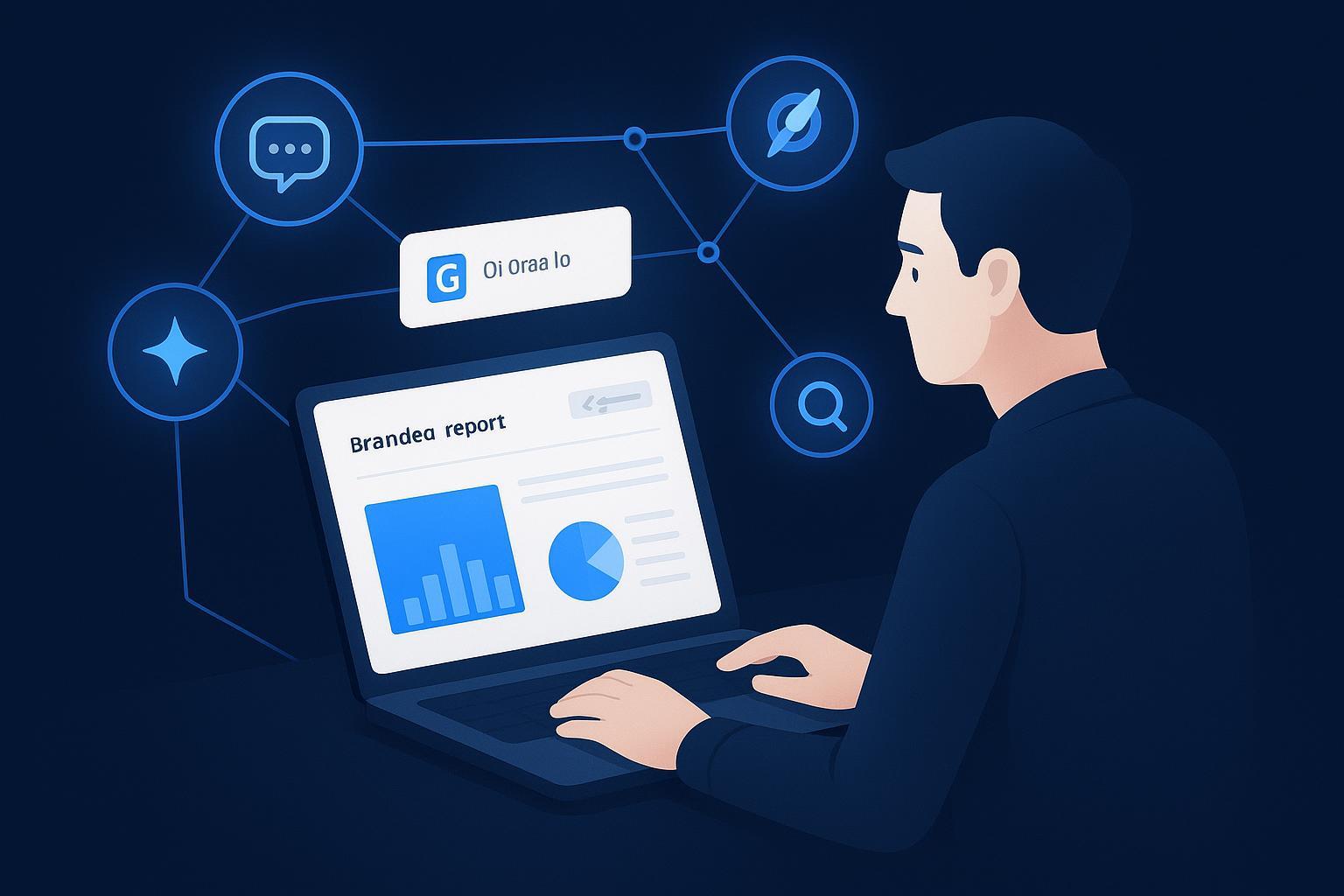
When AI answers grab the spotlight, clients still expect you to show up—and show proof. Agencies need two things fast: reliable visibility across ChatGPT, Google AI Overviews/Mode, Perplexity, Copilot (and friends), and client‑ready reporting they can brand as their own. This guide compares 2025’s leading Generative Engine Optimization (GEO) options through that lens.
How we evaluated these tools
We scored platforms against agency workflows and reporting realities—what you need to pitch, deliver, and retain.
Capability match to agency workflows (multi‑engine coverage, reporting, workspaces) — 30%
Client reporting and white‑label options (branding, custom domains) — 20%
Evidence quality and data freshness (official docs preferred) — 15%
Learning curve and adoption (GA4/exports/integrations) — 15%
Value for money (transparent ranges, limits) — 10%
Support and reliability (security, roadmap signals) — 10%
For KPI framing—visibility, sentiment, and conversion hand‑offs—see our 2025 AI search KPI frameworks. If acronyms feel fuzzy, this plain‑English GEO vs. AEO vs. AIO explainer may help.
What agencies actually need from GEO in 2025
Multi‑engine coverage that reflects where answers form: ChatGPT and other LLM chat, Google AI Overviews and AI Mode, Perplexity, and Copilot. “AI visibility” isn’t a single metric; it’s appearance, prominence, and citation quality across engines. For definitions, see AI visibility explained.
Branded, client‑ready reporting: white‑label dashboards or exports, ideally under your custom domain with your logo.
Signal quality: screenshots, citations, and sentiment to catch misattribution or risky portrayals.
Team scalability: workspaces, roles/permissions, and integrations (at minimum GA4 and CSV/Looker exports).
Pricing logic you can forecast as you add clients.
Comparison snapshot (indicative)
Tool | Engines Covered (indicative) | White‑Label / Branding | Reporting & Workspaces | Pricing (indicative; subject to change) |
|---|---|---|---|---|
Profound | ChatGPT, Google AI Overviews/Mode, Perplexity, Copilot, Claude | Not explicitly stated | Enterprise dashboards, multi‑account | Enterprise / contact sales |
BrightEdge Prism | Enterprise SEO suite with AIO/AEO extensions | Not specified | Enterprise reporting | Enterprise / contact sales |
Semrush AI Toolkit (+ AGK) | Strong AI Overviews focus; SEO suite context | White‑label via My Reports | Client portals, agency workflows | Core plans from Pro/Guru/Business; add‑ons vary |
Geneo | ChatGPT, Perplexity, Google AI Overviews/Mode | White‑label, custom domain, agency branding | Multi‑client workspaces | Start Free Trial; tiers via sales |
AthenaHQ | Major LLMs and answer engines | Not explicitly stated | Team dashboards | Contact sales |
Gauge | ChatGPT, Gemini, Perplexity | Not specified | Dashboards, recommendations | Contact sales |
Peec AI | ChatGPT, Perplexity, AI Overviews (+ others) | Not explicitly stated | Dashboards, benchmarking | From ~€75–€89/mo starter |
Writesonic GEO | ChatGPT, Gemini, Perplexity, Claude | Not specified | Analytics dashboards | Plan‑dependent; some features in beta |
51Blocks (services) | Services for GEO/AEO across engines | White‑label services | Agency fulfillment | Custom / contact sales |
Note: Coverage and pricing change quickly; verify details on vendor pages during evaluation.
Best for enterprise/global portfolios
Profound — enterprise governance and deep AI visibility
If you manage regulated or global portfolios, Profound combines broad engine coverage with enterprise controls. The company publicly documents support for Google AI Overviews (Dec 2024) and AI Mode (June 2025), alongside answer‑engine insights across LLMs. See Profound’s announcement on Google AI Overviews support (2024) and its AI Mode support update (2025). Its features page details share‑of‑voice, citations, and strategist‑backed recommendations.
Why agencies choose it
Wide coverage with screenshots/citations and enterprise SSO/security.
Analyst and practitioner write‑ups position it as a system of record for AI visibility programs.
Keep in mind
Public white‑label language is limited; treat as enterprise dashboards with multi‑account support.
Pricing is quote‑based.
BrightEdge Prism — for SEO‑first enterprises bridging to AEO
For large brands already standardized on BrightEdge, Prism acts as a bridge from SEO to AI answer visibility. BrightEdge’s research is widely cited for analyzing AI Overviews; for context, see this Search Engine Journal analysis (2024). Treat specific AEO features as enterprise suite capabilities rather than a separate, self‑service tool.
Why agencies choose it
Continuity for teams embedded in BrightEdge processes.
Enterprise reporting expected within the suite.
Keep in mind
Dedicated Prism product docs were not located in this pass; rely on enterprise sales for details.
Quote‑based pricing.
Best for mid‑market, multi‑client reporting
Semrush AI Toolkit (+ Agency Growth Kit) — SEO‑led agencies adding AI visibility
Semrush layered AI Overviews research and workflow guidance onto its familiar SEO platform, useful for agencies that live inside Semrush already. See Semrush’s AI Overviews research guide (2025). White‑label reporting is available via My Reports with paid branding options; Semrush walks through setup in their reporting builder guide (2025). Client portals and prospecting tools land under Agency Growth Kit.
Why agencies choose it
All‑in‑one SEO + AIO context with reporting clients recognize.
White‑label reports and client portal are well documented.
Keep in mind
AI visibility depth varies by engine; stronger on AI Overviews.
Pricing stacks (core plan + AGK + report branding) can add up; verify the current mix.
Geneo — white‑label client reporting with custom domains and branding, plus multi‑platform visibility with sentiment
Disclosure: Geneo is our product. Explore the platform on the Geneo homepage and see agency‑specific features on Geneo’s agency page.
Geneo focuses on agency operations: multi‑client workspaces, branded client‑facing reporting, and coverage across ChatGPT, Perplexity, and Google AI Overviews/Mode. You can present insights under your own domain and logo, with screenshots, citations, and sentiment signals to flag misattribution or risky portrayals. For fundamentals and measurement philosophy, our resources cover AI visibility and KPI frameworks for 2025.
Why agencies choose it
White‑label delivery: custom domains and agency branding for client trust.
Multi‑engine monitoring with sentiment to enrich client conversations beyond “did we appear?”
Actionable guidance that feeds a prioritized content roadmap.
Keep in mind
Tiers and limits depend on your portfolio size; start with a free trial, then align on workspaces and volume.
Best for content‑led teams and SaaS
AthenaHQ — GEO monitoring and guidance for growth teams
AthenaHQ positions GEO as a discipline beyond SEO and supports monitoring across major engines with optimization guidance. For their perspective and coverage narrative, see the AthenaHQ GEO overview (2025). Teams like the straightforward dashboards and coaching‑style recommendations.
Why agencies choose it
Clear GEO framing helps educate clients moving beyond SEO.
Practical monitoring and guidance to keep content roadmaps honest.
Keep in mind
Explicit white‑label language was not found on official pages reviewed.
Pricing typically via demo; confirm data freshness windows and export options.
Gauge — AI‑specific analytics for data‑driven teams
Gauge is built for answer‑engine measurement: it runs prompts across engines and quantifies how often and how well your brand appears, then turns that into prioritized recommendations. For the platform’s approach and current scope, see Gauge’s 2025 resources guide and YC profile.
Why agencies choose it
Strong analytics focus with growth‑oriented recommendations.
Useful when tying AI visibility to funnels and experimentation.
Keep in mind
Public pricing wasn’t available at the time of writing; expect a sales‑led motion.
Confirm export and integration pathways (GA4, Looker) during trials.
Best for budget‑conscious starters
Peec AI — approachable pricing to kick off AI visibility tracking
Peec AI offers an accessible on‑ramp with prompt‑based tracking and competitor benchmarking across core engines. Plans and limits are listed on the official pricing page; see Peec AI pricing for current tiers and engines.
Why agencies choose it
Lower entry cost to prove value and learn the motions with smaller clients.
Clean dashboards and easy “first visibility checks.”
Keep in mind
White‑label isn’t emphasized; evaluate export/share paths for client‑facing reports.
Engine depth and data windows vary by plan.
Writesonic GEO — AI visibility analytics paired with content capabilities
If your team already uses Writesonic for content, their GEO and AI Traffic Analytics modules add cross‑engine visibility tracking and analytics. Review Writesonic’s GEO page (2025) for scope and current status.
Why agencies choose it
Combines content tooling with AI search analytics in one place.
Helpful for content‑heavy retainer workflows.
Keep in mind
Some features have rolled out in stages; confirm what’s GA vs. beta.
White‑label specifics weren’t documented on official pages during this pass.
Best white‑label services partner (not a tool)
51Blocks — fulfillment partner for agencies that want services
If you prefer a services partner, 51Blocks offers white‑label Answer Engine Optimization programs you can resell under your brand, spanning ChatGPT, Claude, Perplexity, and Gemini. Learn more on their white‑label AEO services page.
Why agencies choose it
Outsource fulfillment while keeping the client relationship and brand.
Useful when demand outpaces your in‑house capacity.
Keep in mind
Service outcomes depend on process alignment and shared definitions of success.
Custom pricing; request sample deliverables and pilot scopes.
How to choose: three quick agency scenarios
You run a mature SEO program and just added AI visibility KPIs. Start with Semrush AI Toolkit (+ AGK) to layer AI Overviews analysis into your existing reporting—then add a GEO‑native tool if you need deeper cross‑engine coverage or sentiment.
You need branded, client‑ready reporting across multiple engines. Choose a platform that supports true white‑label and custom domains so clients see your brand on the report. Geneo is designed for this use case; enterprise portfolios may evaluate Profound as well.
You’re testing GEO with smaller retainers. Pilot with Peec AI or Writesonic GEO to validate value quickly, then standardize and scale.
Disclosures and updates
Conflict of interest: Geneo is our product; we included it because many agencies prioritize white‑label, custom domain branding, and multi‑engine visibility with sentiment.
Evidence policy: We prioritize official vendor materials and clearly label third‑party reports. Pricing and features change frequently—always confirm on the vendor site before purchasing.
Ready to show clients their brand in AI answers—and do it under your own banner? Start your evaluation and Start Free Trial on the platform that fits your portfolio best.