
Generative Engine Optimization (GEO) for Industrial Manufacturing
Learn what Generative Engine Optimization (GEO) means for industrial manufacturers—how to earn AI citations, optimize assets, and track B2B visibility.
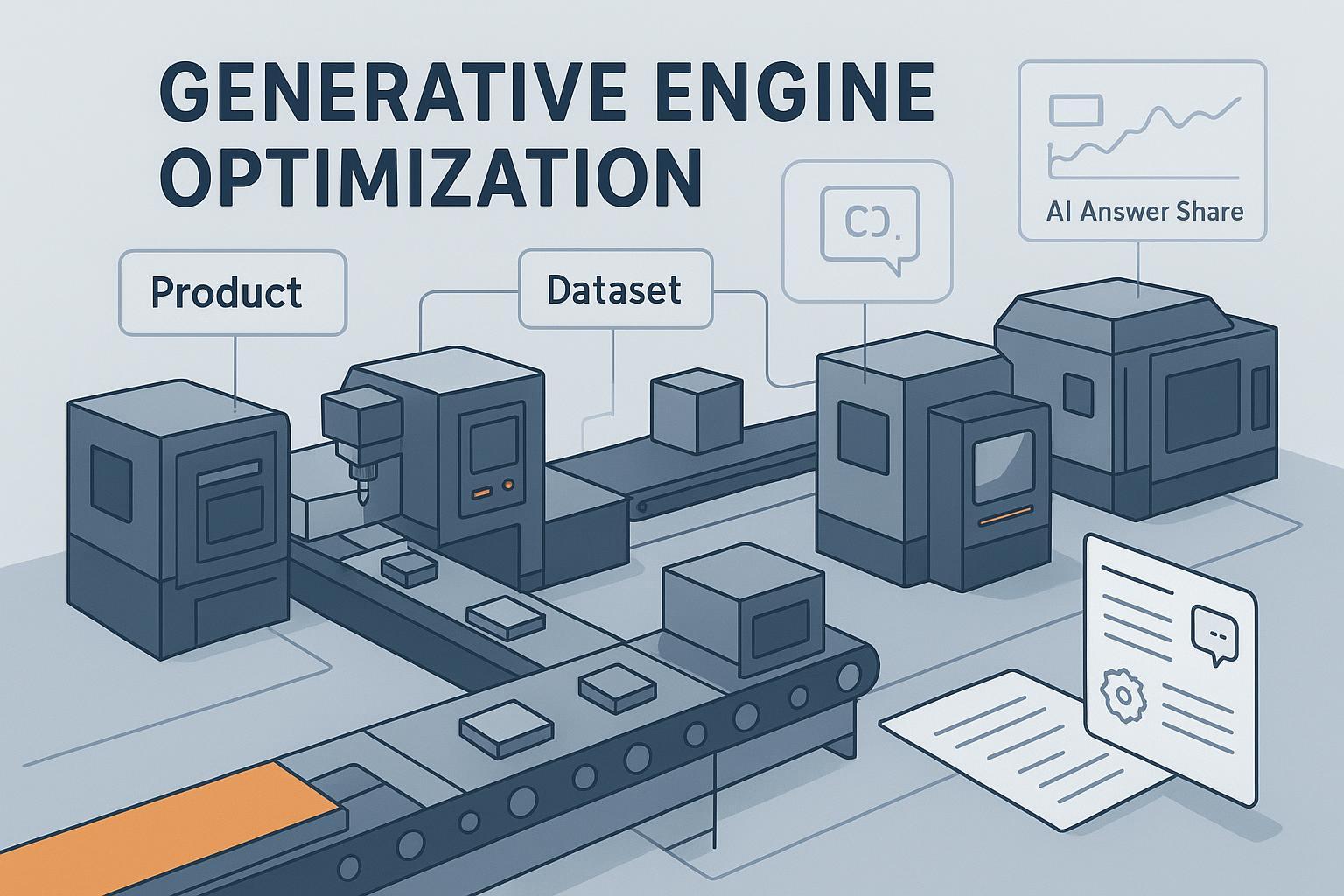
Generative Engine Optimization (GEO) is the practice of preparing your technical content so AI-driven answer engines—Google’s AI Overviews, Perplexity, ChatGPT with browsing/search, and Copilot—can discover, extract, accurately summarize, and cite it inside the answers people read. For manufacturers, that means your spec sheets, datasheets, and compliance notes show up as named sources when engineers and procurement teams ask detailed questions about tolerances, materials, or standards.
According to the industry definition captured by Search Engine Land’s overview of GEO (2024), the north star in GEO is inclusion and citation in the answer itself—not classic blue-link rankings. Google’s own guidance for AI experiences emphasizes people-first, helpful content rather than gaming citation mechanics; see Google Developers’ “Succeeding in AI Search” (May 2025).
GEO vs. SEO for manufacturers: what changes and what doesn’t
Think of GEO as an extension to your SEO playbook tailored to how generative systems assemble answers.
What changes:
- Target outcome: You’re optimizing for being cited inside an AI answer, not just ranking on a page of links.
- Content shape: Engines prefer compact, self-contained “answer blocks”—tables with units, clear limits, named standards, and provenance.
- Signals: Entity clarity, technical evidence, and structured context matter more. Versioned PDFs, explicit test methods, and links to raw data reduce hallucinations.
- Measurement: Replace/augment rankings with AI Answer Share, citation rate, sentiment of mentions, and accuracy audits.
What stays the same:
- People-first content and trust: Helpful, original, and verifiable material wins. Google reiterates this across AI Search updates—no shortcut exists for citation beyond quality and usefulness.
- Technical SEO hygiene: Crawlability, speed, canonicalization, and internal linking still matter. They make your evidence discoverable.
To deepen the distinction between visibility, citations, and sentiment within AI experiences, see our internal explainer What Is AI Visibility?.
How major engines treat citations (and why it matters in manufacturing)
Each engine expresses attribution a bit differently. The practical takeaway: build citable technical assets and monitor visibility per engine.
Quick comparison: AI engines and citation behavior
| Engine | How it cites sources | Practical notes for manufacturers |
|---|---|---|
| Google AI Overviews | Links within/under the overview. No publisher program guaranteeing inclusion. | Prioritize helpful, unique technical content; Google’s AI Search guidance (2025) underscores usefulness over tricks. |
| Perplexity | Citation-first UI with clickable sources; has a Publishers’ Program (2024). | Provide precise spec pages and datasets; expect no deterministic guarantees even with program enrollment. |
| ChatGPT Search/Browsing | Named sources and a “Sources” panel; behavior shaped by web retrieval and partnerships. See ChatGPT Search introduction (2024). | Ensure clear attribution-friendly pages; avoid ambiguous claims; prepare versioned PDFs and on-page methods for trust. |
| Microsoft Copilot/Bing | Hyperlinked citations grounded in Bing results; transparency notes document behaviors. See Microsoft’s Transparency Note (2024). | Maintain strong technical SEO and evidence; Bing’s ranking signals still influence what Copilot cites. |
For deeper platform behavior comparisons across monitoring tools, explore ChatGPT vs Perplexity vs Gemini vs Bing: AI Search Monitoring Comparison.
Structuring technical assets for AI citation
Industrial buyers ask specific questions. Your content must answer them with clarity and provenance—and in a form engines can quote.
- Use appropriate schema.org types:
- Product for spec sheets (identifier/mpn/sku; additionalProperty as PropertyValue; QuantitativeValue for measurements; manufacturer/brand). Reference: schema.org/Product.
- Dataset for test results (variablesMeasured, temporalCoverage, distribution links, license). Reference: schema.org/Dataset.
- TechArticle for manuals/technical notes (learningResourceType, keywords, inLanguage). Reference: schema.org/TechArticle.
- FAQPage and HowTo for troubleshooting and procedures. References: schema.org/FAQPage and schema.org/HowTo.
- Create compact answer blocks:
- Present tolerances, materials, temperature limits, and standards in well-labeled tables with units. Include “Standards referenced” (e.g., ISO 2768-mH, ASTM A240) and “Test method” statements.
- Add page-level versioning and timestamps; link to underlying datasets (CSV/JSON) where possible. Engines and readers value traceable evidence.
- Respect current rich-result realities:
- Google simplified some rich results in 2025. Treat schema as machine-readable context for extraction, not a guarantee of special SERP features; see Google’s simplification note (June 2025).
Measurement for B2B manufacturing: what to track and how
You can’t manage GEO without measuring it. Build a program around visibility, accuracy, and impact.
- AI Answer Share: Percentage of sampled prompts where your brand or pages appear in AI answers across engines and topics.
- Citation Rate: Count/frequency of owned pages cited. Methods include monitoring engines for citation links and analyzing server logs for AI bot hits.
- Sentiment Index: Polarity/tone of mentions in AI answers. Pair automated sentiment with manual QA for sensitive technical claims.
- Content Extraction Rate (CER): Rate at which your content is pulled/incorporated across engines.
- Conversation-to-Conversion: Leads attributable to AI exposure; add “How did you hear about us?” to forms and map monitored prompts to pipeline entries.
Limitations to respect:
- Outputs vary by time/context; use consistent prompts and statistical sampling.
- Platform behaviors differ; measure per engine rather than seeking a single score.
- GA4 may undercount AI referrals; supplement with server-side logs and dedicated trackers. For buyer behavior and zero-click implications, see AI Search User Behavior 2025.
A practical workflow example (with disclosure)
Disclosure: Geneo is our product.
Here’s a replicable, vendor-neutral way a manufacturing team can audit GEO for a single product line:
- Define critical queries by buying stage: discovery (material suitability), evaluation (tolerance ranges), specification (standards/ratings), procurement (certifications, MOQ/lead times).
- Inventory evidence: versioned datasheets, spec tables, compliance statements (e.g., ISO 9001:2015), and test method notes. Ensure each page has clear units, limits, and references.
- Structure and chunk: add Product/TechArticle schema; convert key specs to labeled tables; include “Standards referenced” and “Test method” sections; link to Dataset files for raw results.
- Sample prompts across engines: run a small prompt set monthly in Google AI Overviews, Perplexity, ChatGPT Search, and Copilot; record citations, snippets used, sentiment, and accuracy.
- Monitor and compare: tools like Geneo can be used to track citations and sentiment across engines, compare answer share against competitors, and flag accuracy drift.
- Close the loop: update pages where answers omit your content or misstate facts; add missing evidence and clarifications; re-audit quarterly.
For prompt-level monitoring techniques and dashboards, see our review of a specialized tracker in Peec AI Review 2025: Prompt-Level Search Visibility.
Risk, governance, and compliance for industrial GEO
- Standards currency: Reference exact designations (ISO/ASTM/CE) and keep them current. ASTM published hundreds of new/revised standards in 2024—ensure your claims align with the latest versions; see the ASTM Annual Report 2024.
- Claims substantiation (U.S.): Follow FTC principles—performance and environmental claims need “competent and reliable scientific evidence.” The FTC Green Guides offer practical boundaries.
- Accuracy audits: Institute quarterly reviews of AI answers for your critical product lines. Include versioned PDFs, on-page test methods (sample size, environment), and dates to minimize misquotes.
- Privacy/IP: Redact confidential parameters and secure approvals for customer case details.
Where to go next
- Start with one product family. Build answer blocks, add schema, and publish versioned PDFs with clear test methods.
- Instrument measurement: set up prompt sampling, log-file tracking, and a light sentiment/accuracy review cadence.
- Expand to adjacent lines once you see consistent citations.
If you’re ready to monitor citations and sentiment across Google AI Overviews, Perplexity, ChatGPT, and Copilot, Geneo can support your workflow with cross-engine visibility tracking and accuracy checks—reach out via our agency/white-label monitoring page.