Geneo vs Sitechecker vs Otterly.ai: Best GEO Platforms 2025 Comparison
Comprehensive 2025 GEO platform comparison: Geneo, Sitechecker, Otterly.ai, RanksPro.io, Semrush, Profound, SE Ranking. Compare features, AI engine coverage, sentiment, and pricing.
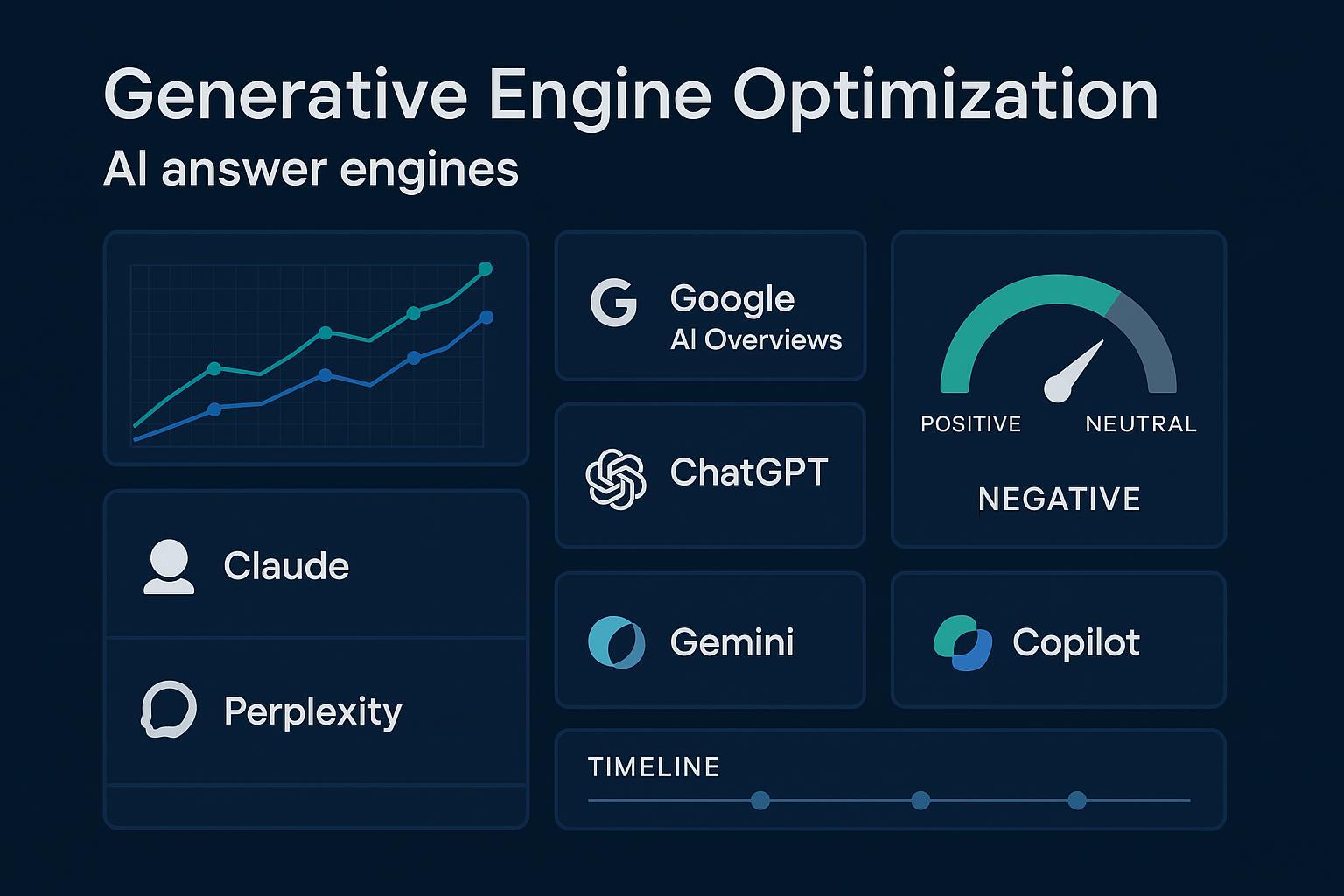
If your brand is already showing up in AI answers, you need to measure and improve that visibility—not just in classic SERPs, but across Google AI Overviews, ChatGPT, Perplexity, Claude, Gemini, Copilot, and more. That’s where Generative Engine Optimization (GEO) comes in: a framework for tracking citations, mentions, accuracy, and recommendations across answer engines. For definitions and context, see the GEO acronyms explainer on our blog in GEO vs. AEO and related terms, and the concept of AI visibility.
Method and disclosure: We reviewed seven GEO platforms using official product docs and recent feature pages. We prioritized cross-engine coverage, evidence capture (screenshots/logs), sentiment analysis, optimization guidance, integrations/exports, collaboration and governance, alerts, and pricing notes (as of late 2025). Ordering inside scenarios is alphabetical for fairness. Disclosure: Geneo is our product.
For Google’s context on AI Overviews, including its global expansion and behavior changes through 2025, see Google’s official AI Overviews and AI Mode updates.
Quick comparison matrix
Below is a compact parity view of core focus areas. Treat “verify in demo” as a flag to confirm in your trial or sales conversation.
| Platform | AI engine coverage | Evidence capture | Sentiment analysis | Optimization guidance | Integrations/export/API | Collaboration/governance | Alerts | Pricing notes (late 2025) |
|---|---|---|---|---|---|---|---|---|
| Geneo | Google AI Overviews/AI Mode, ChatGPT, Perplexity (focus on cross-LLM brand visibility) | Time-stamped logs; screenshots referenced (frequency not public) | Built-in sentiment on AI answers | Strategy suggestions and content guidance | Integrations partially documented; verify in demo | Multi-brand/team features; permissions detail to verify | Email/Slack-style alerting referenced | No public pricing page; contact sales or start trial |
| Sitechecker | Google AIO; AI Visibility Tracker lists ChatGPT, Gemini, Perplexity, Copilot, Claude, DeepSeek | Captures AIO presence and cited pages | Not primary; focus on visibility and citations | Practical checks and competitive views | GSC import; alerts; exports in suite | Team features within Sitechecker suite | SERP and AIO alerts | Pricing bundled in suite; confirm module limits |
| RanksPro.io | Primarily Google AI Overviews | Rank positions and daily updates; screenshot logging not explicit | Not primary | Tactical rank tracking | Exports typical of SEO suites; confirm API | Standard user roles; confirm audit trails | Email-style alerts | Public pricing exists; confirm AIO keyword limits |
| Otterly.ai | ChatGPT, Google AIO/AI Mode, Perplexity, Copilot; Gemini add-ons; multi-country | Weekly tracking; prompt-based logs and GEO checks | Sentiment/mention tracking for brands | GEO content checks and recommendations | Semrush App Center presence; confirm exports/API | Agency program; roles; confirm SSO | Alerts via email; confirm Slack | Transparent pricing page; trial available |
| Semrush AI Toolkit | Google AIO visibility integrated with Position Tracking; citations analysis | Large-scale AIO studies and visibility reports | Limited sentiment; emphasis on sources/visibility | Recommendations embedded in Semrush workflows | Deep SEO integrations, exports, API | Enterprise controls via Semrush One | Alerts in Position Tracking | Bundled by tier; Enterprise AIO is custom |
| Profound | 10+ consumer AI engines (ChatGPT, Perplexity, Copilot, Google AIO/AI Mode, Gemini, Claude, DeepSeek, etc.) | Agent Analytics with direct monitoring | Emphasizes accuracy/quality via scoring | AEO/GEO content score and playbooks | Exports/API likely by plan; confirm | SSO/SAML noted; verify SOC 2 details | Email/Slack-style alerts | Plans listed, amounts typically via sales |
| SE Ranking | Google AI Overviews tracker with studies on incidence/volatility | Presence, positions, featured sources; research coverage | Not primary; research-driven | Practical guidance tied to AIO behavior | Integrations/export as part of suite | Team features in SE Ranking | Alerts in rank tracking | Pricing bundled; confirm limits by subscription |
Scenario picks (alphabetical inside each bucket)
Best for cross-LLM brand monitoring and sentiment
Geneo — Disclosure: Geneo is our product. On first setup, brands use Geneo to track mentions, citations, and tone across multiple AI engines. You’ll see time-stamped query histories, sentiment trends, and optimization suggestions grounded in entity and content strategy. If your comms team needs to spot inaccuracies fast, the sentiment panel helps prioritize what to fix. Internal resources explain AI visibility and 2025 AI search KPIs so you can tie visibility to outcomes. Limitations: a public integration catalog and permissions matrix aren’t centrally documented; confirm exports, SSO, and screenshot cadence in your demo.
Otterly.ai — If you want cross-engine brand mentions and weekly tracking, Otterly’s GEO tools cover ChatGPT, Google AIO/AI Mode, Perplexity, and Copilot, with add-ons for Gemini and country-level monitoring. Their prompt-based logs and GEO checks make it easy to review how answers change over time. Limitations: weekly frequency may be too coarse for volatile topics; verify alerting depth and API/export options for enterprise workflows.
Profound — Teams looking for breadth across 10+ engines and quality scoring should consider Profound. Agent Analytics emphasizes direct monitoring to mirror real user experiences, while AEO/GEO content scoring guides remediation. Limitations: pricing amounts are typically handled via sales, and compliance features (SSO/SAML, SOC 2) should be confirmed contractually.
Best for Google AI Overviews tracking
RanksPro.io — For hands-on SERP watchers, RanksPro’s AI Overviews tracker focuses on Google, with daily updates, rank positions, and competitor monitoring. It’s a tactical fit for SEO teams measuring how AIO impacts specific keywords. Limitations: screenshot/evidence logging isn’t clearly documented; confirm before committing if you need auditable records.
SE Ranking — If you prefer AIO tracking wrapped into a wider SEO suite, SE Ranking’s AI Overviews tracker monitors presence, positions, and sources, backed by extensive research into AIO volatility and incidence. It’s useful for understanding patterns by state, topic, and query type. Limitations: pricing is bundled and feature limits vary by subscription; verify exact quotas and refresh frequency.
Sitechecker — Sitechecker’s AI Overview checker reports which keywords trigger AIO, the cited sources, and competitive visibility. If your priority is seeing AIO presence and getting practical checks inside a familiar SEO toolkit, it’s a straightforward option. Limitations: sentiment isn’t a core focus; validate module-specific limits and engine coverage within the AI Visibility Tracker.
Semrush AI Toolkit — For teams already in Semrush, the AI Visibility Toolkit adds AIO presence, citations, and competitive tracking to Position Tracking, plus research-backed visibility reports. It’s best when you want GEO metrics alongside keyword, content, and technical SEO workflows. Limitations: sentiment is limited, and access differs by Semrush One tier; enterprise AIO features are custom.
Best for SEO stack integration
SE Ranking — Because AI Overviews tracking sits inside a full SEO platform, SE Ranking integrates naturally with keyword tracking, competitor analysis, and reporting. If your org prefers one vendor, this minimizes tool sprawl. Limitation: confirm how AIO data exports and alerting fit your reporting cadence.
Semrush — Semrush’s AI Visibility Toolkit overlays AIO metrics on familiar dashboards and exports, making GEO insights actionable inside established SEO workflows. Limitation: ensure your tier includes the right AI modules and that API access covers AIO fields you need.
Best for agencies managing many brands
Geneo — Agencies often need multi-brand dashboards, role-based workflows, and reporting that crosses answer engines. Geneo emphasizes multi-brand collaboration and sentiment tracking that comms teams can act on quickly. For playbooks that translate visibility to action, review our KPI frameworks and LLMO metrics explainer. Limitation: confirm white-label options, export granularity, and SSO in a demo.
Profound — With breadth across many engines and enterprise-oriented controls, Profound suits agencies standardizing monitoring across client verticals. Agent Analytics can help prove what users actually see. Limitation: pricing and limits are generally custom; clarify tracked prompts, refresh cadence, and compliance assurances.
Sitechecker — Sitechecker offers practical visibility tracking that agencies can deploy quickly across clients, with imports and alerts familiar to SEO operators. Limitation: map exactly which AIO/AI engines are included per plan, and how reports can be standardized for client delivery.
Best for competitive benchmarking
Otterly.ai — Otterly provides brand mention and link tracking across several engines, with prompt-based logs that make side-by-side comparison practical. If your question is “Who gets cited for our topic?” Otterly gives a clear starting point. Limitation: confirm country coverage and refresh frequency versus your competitive cadence.
SE Ranking — With research-rich AIO insights and tracker features, SE Ranking helps teams visualize how competitors surface in AI answers and when volatility may reshuffle results. Limitation: bundled pricing and limits differ by tier; confirm alignment with your monitoring scope.
Semrush — Semrush’s visibility and citations reporting, documented in their toolkit, gives competitive context inside Semrush without leaving your SEO stack. Limitation: sentiment detail is limited; combine with qualitative reviews of answer quality.
Sitechecker — Sitechecker surfaces which domains are cited in AIO for your keywords, useful for spotting competitive incumbents. Limitation: sentiment and answer quality metrics are sparse; supplement with manual reviews or a tool that scores answer accuracy.
How to choose a GEO platform
Think of GEO as your brand’s “share of voice” across LLMs and answer engines. Before you shortlist, clarify what you must see and how you’ll act on it:
- Coverage: Which engines and countries matter for your audience? If your customers search via Perplexity or Copilot, you’ll need monitoring beyond Google.
- Evidence and sentiment: Do you require time-stamped screenshots and sentiment scoring to audit brand accuracy? If you’re in a regulated sector, evidence trails are non-negotiable.
- Optimization guidance: Will your team use playbooks, entity suggestions, or schema checks to fix gaps? The faster you can translate findings into changes, the more value you’ll get.
- Integrations and exports: Can you pipe GEO data into BI, GA4/GSC, or Slack for alerting? Check API availability and field coverage.
- Collaboration and governance: Do you need multi-brand workspaces, roles, audit trails, or SSO? Confirm these early.
- Pricing and limits: Seats, tracked queries/prompts, refresh frequency, and engine coverage vary. Ask vendors to state limits per plan and date-stamp any pricing they share.
For a deeper framing of KPIs and measurement, explore our AI search KPI frameworks for 2025.
Implementation gotchas
AI Overviews are volatile. Answers can change with location, language, personalization, and time. Two practical guidelines:
- Reproducibility and respect for ToS: Document regions, devices, and timestamps for your checks, and respect platform terms and rate limits. Tools that simulate user experiences (vs. only APIs) can reduce surprises.
- Attribution caveats: AIO referrals don’t always show up cleanly in analytics. Use consistent tagging and compare GEO visibility against business outcomes. If you measure output quality, see our LLMO metrics explainer for accuracy, relevance, and personalization signals.
If your team needs workflow examples, the LinkedIn branding use case offers practical patterns in team branding best practices for AI search.
Closing
No single GEO platform wins for everyone. Match your decision to engines, evidence needs, and team workflows, then pressure-test with a demo and a short monitored query set. If you’re evaluating Geneo alongside others, start a trial or request a walkthrough and verify integrations, permissions, and export details against your requirements.