
Geneo vs Brandlight (2025): Best for Tone‑of‑Voice & AI Visibility?
Compare Geneo vs Brandlight for tone-of-voice governance and AI visibility in 2025. Evaluate white-label reports, CNAME domain support, multi-engine tracking, and key decision factors.
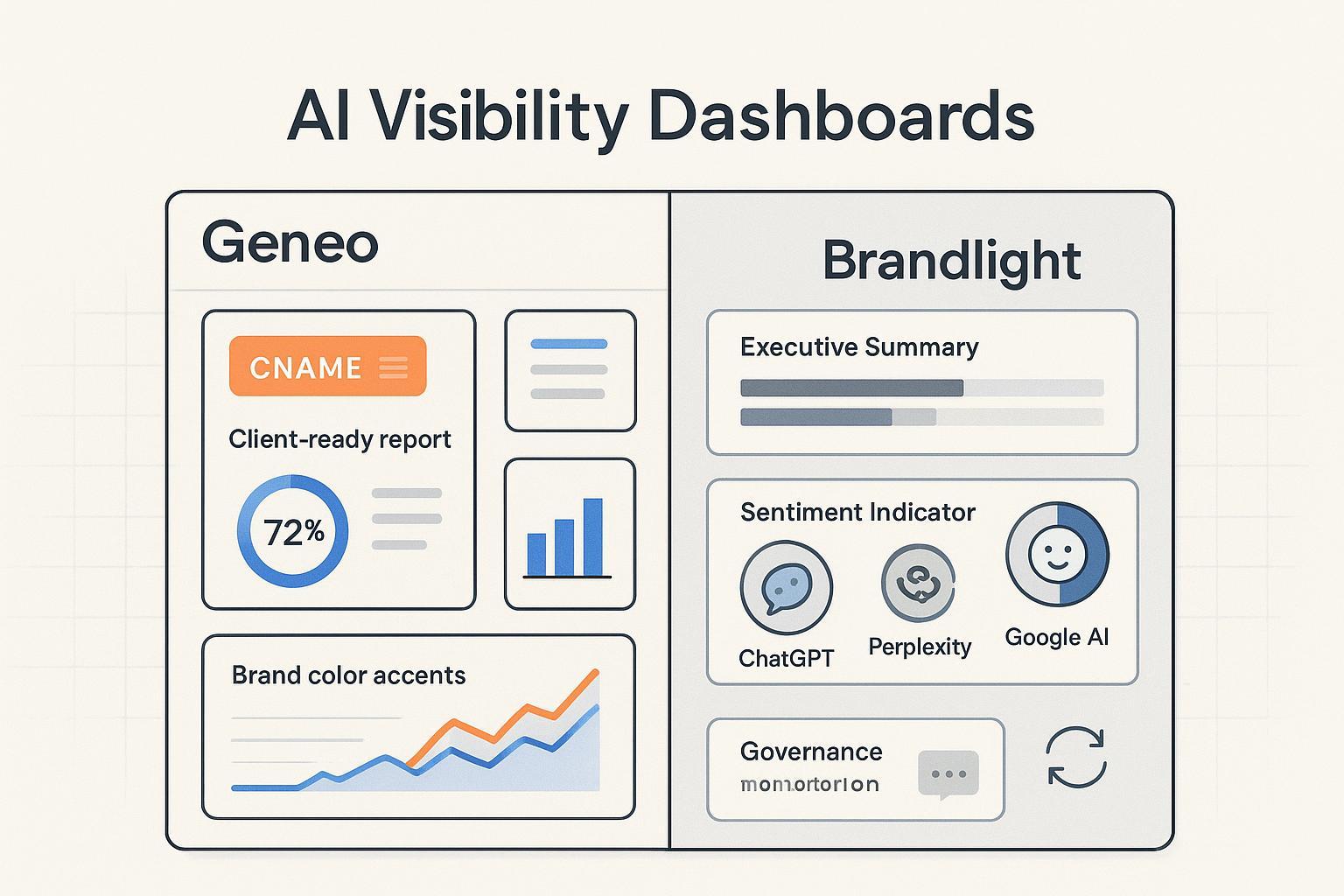
If your team is formalizing tone‑of‑voice standards and needs to see how they play out across ChatGPT, Perplexity, and Google AI Overview, the tool you choose will shape both governance and buy‑in. Here’s the deal: tone guidance that lives only in a PDF won’t move the needle. You need cross‑engine visibility, measurable deltas, and client‑ or leadership‑ready reporting that people actually read.
Disclosure: Geneo is our product.
To ground the discussion, we align on terminology. By AI visibility, we mean how often and how favorably a brand is surfaced in AI answers, including tone and sentiment context, citations, and recommendation types. For a deeper primer, see What Is AI Visibility? Brand Exposure in AI Search Explained (Geneo explainer).
Why white‑label + CNAME matters for tone governance
Tone governance is as much change‑management as it is measurement. When brand standards shift, you need to communicate progress to executives, legal, regional leads, and agency partners. Two delivery details make that smoother:
White‑label reporting lets you present findings under your own brand rather than a vendor’s. That reduces “tool fatigue” and builds trust with non‑technical stakeholders.
Custom domain (CNAME) means your reports and dashboards live at a URL you control (e.g., insights.yourbrand.com). It’s a subtle but powerful signal that this is an internal governance asset—not another third‑party portal.
Geneo documents both capabilities on its Agency page—white‑label client reports and CNAME custom domain across plans—so brand‑side leaders can package tone‑of‑voice progress as an internal product for stakeholders (Geneo Agency page). Brandlight’s public pages describe enterprise governance and partnership models, but we did not find public documentation confirming white‑label or custom‑domain reporting; we treat that as not publicly documented (see Brandlight site and Solutions).
The governance loop: monitor → baseline → recommend → track change → deliver
Whether you’re cleaning up off‑tone summaries or trying to increase share of AI recommendations, success hinges on a repeatable loop:
Monitor across engines
You need consistent snapshots from ChatGPT, Perplexity, and Google AI Overview to detect tone drift and citation gaps. Geneo explicitly lists support for these engines on public pages and methods content, with examples of measuring sentiment/tone context and answer quality via LLMO‑style metrics (cross‑engine comparison; LLLMO metrics framework).
Brandlight’s thought‑leadership mentions these engines (and others like Gemini and Copilot) and talks about share of AI recommendations and sentiment, but there’s no single, public spec enumerating supported engines in product documentation (Brandlight blog example).
Establish a baseline
Define a visibility score, tone distribution, and citation coverage per engine and intent. When leadership asks “Are we improving?”, the baseline answers that. Geneo’s content provides example metrics and query reports to help teams stand up this baseline quickly (see the explainer linked earlier and sample query reports like Enterprise Database Disaster Recovery Planning on geneo.app).
Recommend actions
The gap between “monitoring” and “training” is filled by editorial and technical recommendations: clarify positioning pages, add source coverage, improve FAQs, seed structured evidence. Geneo’s content emphasizes actionable suggestions tied to observed answer patterns—turning visibility data into content updates.
Track change
Did citations appear? Did tone shift from overly casual to aligned? Did recommendations include your brand more often? Without change logs and snapshots, you’re guessing. Public Brandlight materials discuss governance concepts and industry shifts but provide fewer product‑level examples of change‑tracking workflows.
Deliver reports people trust
This is where white‑label and CNAME pay off. If you need to share weekly progress with legal or regions, a familiar domain and your own branding increase adoption. Geneo documents both (Geneo Agency page); Brandlight’s approach likely varies by enterprise engagement, but details are not publicly documented.
Think of tone governance like a relay: monitoring hands the baton to recommendations, which pass to content updates, which loop back to monitoring. If any handoff is slippery, the race slows.
What’s publicly documented (at a glance)
Dimension | Geneo | Brandlight |
|---|---|---|
White‑label reporting | Yes, documented on Agency page (Geneo Agency) | Not publicly documented on site |
Custom domain (CNAME) | Yes, documented on Agency page (Geneo Agency) | Not publicly documented on site |
Engines called out on public pages | ChatGPT, Perplexity, Google AI Overview (multiple Geneo pages) | Engines referenced in blogs (e.g., ChatGPT, Gemini, Perplexity, Copilot); no consolidated spec page |
Pricing/trial disclosure | Agency plan bullets visible; no consolidated pricing page | No public pricing/trial; enterprise partnership positioning (Brandlight Solutions) |
Tone governance documentation | Articles on visibility metrics, tone/sentiment context, and methods (AI visibility explainer; LLMO metrics) | Conceptual governance and industry analysis on blogs; product‑level specs not centralized |
Note: We rely on public pages as of December 19, 2025; where items aren’t published, we avoid assumptions.
Product capsules (balanced and evidence‑bound)
Geneo (agency‑first, white‑label focus)
Specs (public): Multi‑engine monitoring for ChatGPT, Perplexity, Google AI Overview; tracks mentions, sentiment/tone context, recommendation types, and citations; competitive benchmarking and visibility scoring; white‑label dashboards and CNAME custom domains (homepage, Agency page, methods posts linked above).
Who it’s for: Brand‑side leaders who partner with agencies or internal centers of excellence and need to share governance progress under their own domain.
Strengths: Documented white‑label/CNAME; pragmatic governance loop content; examples for baselining and measurement; agency‑friendly reporting for cross‑team adoption.
Constraints/unknowns: No public API/RBAC spec pages surfaced; pricing isn’t centralized; “tone training” is delivered via monitoring plus optimization recommendations rather than a standalone training module page.
Evidence: See links above; definition/methods articles and Agency plan bullets substantiate claims.
Brandlight (enterprise partnership model)
Specs (public): Enterprise AI visibility narrative focused on share of AI recommendations, sentiment of mentions, and brand intelligence across engines referenced in thought‑leadership (ChatGPT, Gemini, Perplexity, Copilot). No consolidated engine support or white‑label/CNAME spec page was found on the public site (main site; Solutions; selected blogs).
Who it’s for: Enterprises seeking white‑glove onboarding, strategy sessions, and potentially bespoke governance workflows managed with vendor partnership.
Strengths: Executive‑level framing around trust, SOV in AI answers, and governance; likely strong consultative engagement for complex organizations.
Constraints/unknowns: White‑label/CNAME not publicly documented; pricing/trial undisclosed; fewer product‑level artifacts describing change‑tracking or export/reporting options on public pages.
Evidence: Cited site and blogs; conclusions limited to what’s published.
Scenario guidance for brand‑side leaders
You need leadership‑ready reporting under your own domain: Prioritize platforms that document white‑label plus CNAME. Geneo publishes both on its Agency page, which can shorten internal adoption cycles and standardize the “single source of truth” for tone governance.
You need to operationalize a baseline this quarter: Favor tools with public methods content and examples for ChatGPT, Perplexity, and Google AI Overview. Geneo provides such materials that teams can adapt quickly to policy and tone standards.
You expect a bespoke enterprise rollout with heavy strategic support: Explore Brandlight to understand its partnership model and how it can tailor governance and monitoring to your org’s complexity—be prepared to engage its team for specifics not listed publicly.
For regional or platform‑specific considerations (e.g., tracking Google AI Overview availability across markets), see Geneo’s guidance on regional tracking nuances (China AIO tracking guide).
FAQs
Is “tone‑of‑voice training” different from monitoring? Training in this context means using monitoring insights to change content inputs and evidence so AI engines shift how they speak about and recommend your brand. The practical loop is monitor → recommend → update content → re‑measure.
Do we need white‑label and CNAME if governance is internal‑only? Even internal stakeholders engage more with familiar branding and domains. If your org collaborates with agencies or regions, white‑label/CNAME reduces friction and boosts report adoption.
Which engines matter most right now? Most teams start with ChatGPT, Perplexity, and Google AI Overview. If your audience relies on Microsoft ecosystems, add Copilot; if you’re investing in YouTube/Google surfaces, watch Gemini. The key is consistent measurement across whichever set matches your buyers.
What to do next
Visit official sites:
Geneo — Visit the official site (evidence and onboarding options): https://geneo.app
Brandlight — Visit the official site for enterprise partnership details: https://www.brandlight.ai
If you’re an agency‑enabled brand or need client‑ready delivery, consider starting with Geneo’s white‑label + CNAME setup. Start Free Analysis: https://geneo.app
If you’d like a deeper dive into definitions and measurement, start with the AI visibility explainer on geneo.app and bring those metrics into your first governance baseline.