
Geneo vs Agency Needs: Pros & Cons as an AI SEO Tool
Explore the pros and cons of Geneo as an AI search engine optimization tool for agencies. Compare coverage, reporting, and ROI proof to decide if Geneo fits your 2025 agency needs.
Disclosure and context: why agencies are evaluating GEO tools
Disclosure: Geneo is our product. Agencies are being asked a new question in every QBR: “How does our brand show up in ChatGPT, Perplexity, and Google’s AI Overviews—and is it improving?” If your team can’t answer with evidence, you risk losing trust, upsell opportunities, and even the renewal. That’s why Generative Engine Optimization (GEO) platforms are moving from “interesting” to “operational.” This article lays out where Geneo fits, where it doesn’t, and how agencies can make a clear-eyed decision.
The lens here is practical and agency-first. We’ll anchor on three pain points that decide most bake-offs: proving ROI to retain/upsell, trusting data accuracy and coverage across major AI engines, and scaling white-label reporting without manual lift.
What Geneo actually does (in agency terms)
Think of Geneo as your GEO workspace: it tracks how your clients are represented inside AI-generated answers and gives you a single KPI to report progress. If you’re used to traditional SEO rank trackers, the shift isn’t just a new chart—it’s a different playbook. For a primer on how GEO KPIs and cadences differ from legacy SEO, see the side-by-side explained in the Traditional SEO vs GEO comparison on Geneo’s blog, which breaks down how presence/share-of-answer, citation attribution, and freshness become frontline metrics for agencies. Read: the Traditional SEO vs GEO comparison on Geneo’s blog (2025 update) for the framing and workflow differences: Traditional SEO vs GEO: How Geneo measures visibility in AI engines.
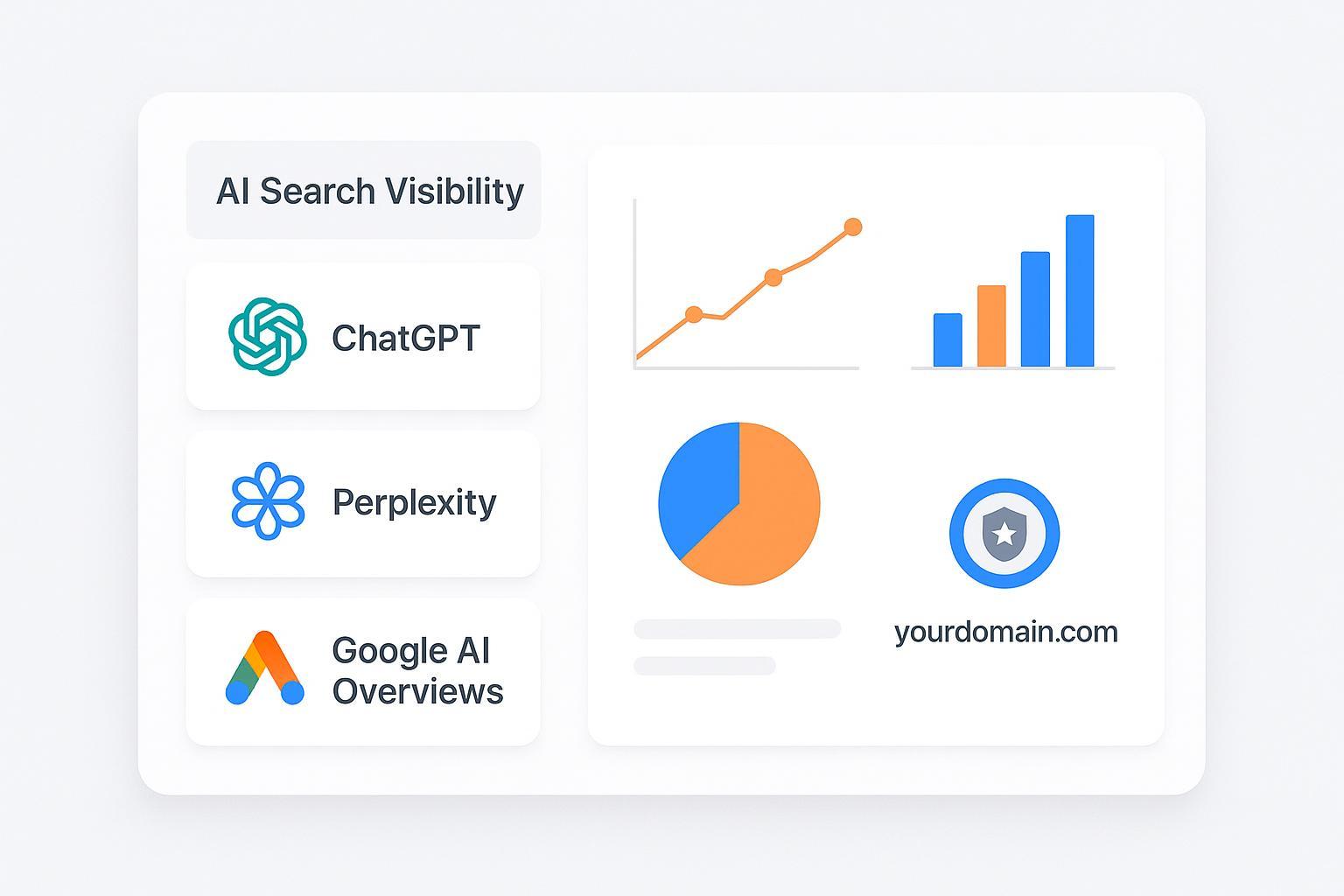
Under the hood, Geneo monitors AI answer surfaces across ChatGPT, Perplexity, and Google AI Overviews. Results are aggregated into an actionable Brand Visibility Score supported by a methodology that weights accuracy, relevance, and personalization alongside operational signals like sentiment and citation rates. For the scoring pillars and how they roll up into a KPI agencies can report, see the methodology overview: LLMO Metrics: Measuring accuracy, relevance, and personalization in AI answers.
For client communications, Geneo supports fully branded, white-label reports and the option to deliver them on your own domain via CNAME—useful for agencies that want their GEO offering to look and feel like in-house tech. Details are on the agency overview page: White-label reporting and custom domain (CNAME) for agencies.
Pros: where Geneo tends to fit agency needs
ROI proof and narrative. Geneo’s Brand Visibility Score, paired with tracked shifts in citations and sentiment, gives account teams a storyline for QBRs: where the brand is included today, where it’s omitted, how the score is moving, and what to do next. Because the score is tied to observable answer outputs, it’s easier to show before/after compared to abstract “visibility” claims.
Broad coverage in one place. For agencies juggling multiple dashboards, consolidating ChatGPT, Perplexity, and AI Overviews into a single monitoring view reduces swivel-chair time. Teams can compare client and competitor presence without exporting CSVs from three tools and reconciling definitions.
Reporting that scales with your roster. White-label reports and CNAME delivery help you ship polished updates under your brand. That matters when you’re trying to turn GEO from “experimental” to a billable line item—clients see a consistent, professional artifact without your team hand-assembling slides.
Operations-friendly workflows. Multi-client workspaces, permissions, and alerting support the realities of agency life: different pods, frequent handoffs, and the need to respond quickly when AI answers shift. When visibility changes, the platform nudges you—so your team isn’t discovering problems weeks later.
Cons: constraints and trade-offs to consider
Few published SLAs and limited third-party reviews. Geneo documents behaviors like continuous tracking and alerting, but you won’t find minute-level update SLAs or a deep bench of external reviews yet. If your process requires formal SLOs or external validation, plan for a proof-of-concept and internal QA period.
Audit trail depth not fully public. Permissions and collaboration are supported, but if you need granular, exportable audit logs for every user action, you’ll want to confirm details with the team before committing it to a regulated client’s workflow.
GEO learning curve. GEO isn’t just “SEO for AI.” Account managers and analysts may need a short ramp to translate AI answer dynamics into client-ready recommendations. The upside: once the new KPIs click, teams often find the narrative more tangible than traditional rankings.
Who benefits most (and when to be cautious)
Best fit: Growth-focused agencies managing 5–100 clients, where a single platform for cross-engine AI visibility and branded reporting can quickly turn into a differentiated offering. It’s also a strong fit for agencies already fielding “How do we show up in ChatGPT?” questions and needing a verifiable answer with screenshots, citations, and a KPI trend.
Be cautious if you require strict SLAs or formalized audit trails that haven’t been validated yet, or if your team won’t allocate a few hours to establish a GEO reporting cadence. If your clients are not yet asking about AI visibility, adoption might be premature—though an early pilot can still be a competitive hedge.
Practical scenarios: piloting, onboarding, and scaling
Start with a 5-brand pilot. Choose a mix of high-priority clients and a known challenger brand in each portfolio. Configure tracking for core queries, capture current inclusion and citation patterns, and benchmark the Brand Visibility Score. Set a 30-day sprint to publish two sets of optimizations and track resulting answer changes. For a workflow feel and content tactics that translate well to GEO, see the playbook-style guide on team content updates and retraining cadences: LinkedIn team branding best practices that improve AI visibility.
Scale to 20+ brands across mixed verticals. Create client folders by vertical to compare inclusion patterns (SaaS vs local service) and assign owners. Use alerts to triage sudden drops or negative sentiment spikes. Quarterly, roll up the Brand Visibility Score and inclusion deltas into your white-label template; highlight two improvements and one gap per client to keep recommendations focused and believable.
For 100-brand portfolios, formalize a GEO ops rhythm. Standardize weekly checks for critical terms, monthly competitor sweeps, and a quarterly executive view that shows which clients moved from “Absent” to “Included” in AI answers. The point isn’t to monitor everything; it’s to instrument the 20% of terms that drive 80% of conversations and renewals.
At-a-glance: strengths vs watchouts
Area | Where Geneo helps | What to watch |
|---|---|---|
ROI proof | Brand Visibility Score tied to observable AI answers simplifies QBR narratives | Educate clients on what the score represents to avoid apples-to-oranges comparisons |
Coverage | Single view across ChatGPT, Perplexity, AI Overviews | Confirm edge cases for niche queries or locales |
Reporting | White-label + CNAME supports agency-branded deliverables | Align report cadence with your existing comms to avoid duplication |
Operations | Workspaces, permissions, alerts fit multi-team agencies | Clarify audit trail depth if you have regulated accounts |
Adoption | Fast pilot potential with credits/trials | Plan a short enablement sprint for AMs/analysts |
How to decide: a short checklist
Do your top 5 clients actively ask about ChatGPT/Perplexity/AI Overview visibility, and would a single KPI help them grasp progress?
Can you replace 2–3 manual slides per QBR with a white-label report and free your team for insight work?
Are you willing to run a 30-day pilot to validate coverage, recommendations, and reporting flow before a larger rollout?
Bottom line and next step
If your agency needs to prove AI answer visibility, trust what you’re seeing across major engines, and standardize client-ready reporting, Geneo is built for that job. The trade-offs—pricing transparency, published SLAs, and documentation depth—are manageable with a time-boxed pilot that establishes internal confidence and client value.
Ready to see it with your own clients’ queries? Start a free AI visibility analysis on the Geneo homepage and pressure-test the workflow with real data: Start a free AI visibility analysis on Geneo.