
Top Questions FinTech Customers Ask AI Assistants — And How Agencies Can Optimize for Them
Discover the top questions fintech customers ask AI assistants and actionable strategies agencies use to optimize content for AI answer engines.
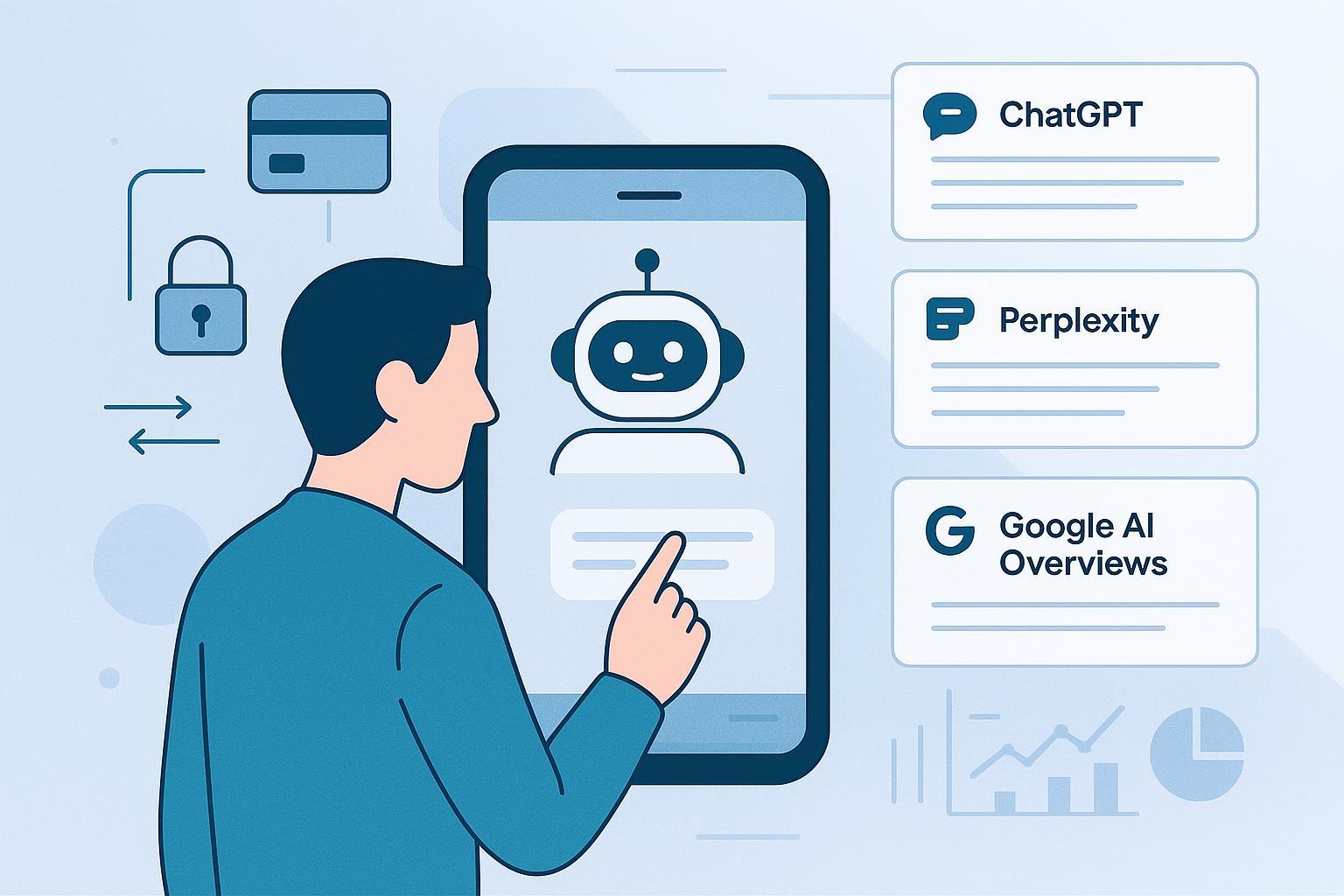
FinTech customers now ask AI assistants everything from “Where did this charge come from?” to “How fast will my transfer land?” For agencies serving fintech brands, that means two jobs: make the right answers easy for AI to extract, and keep tabs on where (and how often) those answers get cited across ChatGPT, Perplexity, and Google’s AI Overviews. Below is a field-tested FAQ you can hand to product, support, and compliance teams—followed by concrete optimization and monitoring steps.
What FinTech customers ask AI assistants (2026 snapshot)
Across neobanks, payments, lending, and wallets, the heaviest question volume clusters around:
- Account access basics (balance, transaction history, password resets)
- Payments and transfer timing
- Card controls (freeze/unfreeze) and security
- Disputes and chargebacks (steps, timelines, evidence)
- Fraud and account compromise response
- Onboarding and KYC/AML requirements
- Privacy rights (consent, retention, data exports)
- Regional differences (fees/limits by country, supported corridors)
Industry analysts note that AI assistants increasingly handle multi‑step queries and route sensitive scenarios to humans. That pushes brands to publish precise, cite‑ready language and disclaimers that AI can safely reuse. For optimization fundamentals, see the answer‑engine playbooks compiled by HubSpot in its 2025–2026 guidance on answer-first formatting, E‑E‑A‑T signals, and schema usage in the article, Best practices for Answer Engine Optimization. You can review those tactics in the section titled “How to Optimize Content for AI Answer Surfaces” below and consult the original summary in HubSpot’s guide: HubSpot’s answer engine best practices (2025).
Practical FAQs: concise answers to high‑volume questions
Regulatory note: The answers below are general and educational. They’re not legal, tax, or financial advice. Always confirm your program’s policies and regional rules.
1) How do I check my balance or see recent transactions?
Most providers surface balances and recent activity directly in their mobile app or web dashboard (often with filters for date and merchant). If you can’t access the account, use the “forgot password” flow, update MFA, and contact support if you suspect compromise. Agencies should ensure the public help article mirrors the same steps customers see in‑app; AI assistants tend to quote whichever version is clearest and most complete.
2) How long will my transfer take?
Transfer speeds vary by rail and corridor. Many cross‑border providers publish plain‑English timelines; a good public example shows that simple card-payment disputes may resolve in about 30 days while complex cases can take longer—those same help centers also detail transfer ETAs by route. For reference on how timelines are communicated to consumers, see Wise’s public help content on transfers and dispute lifecycles in its help center, including the article “How do I dispute a Wise card transaction?” and related timing pages: Wise dispute and timing references (2025–2026).
3) How do I freeze or unfreeze my card?
Most fintech apps offer instant card controls. As one example, Chime documents a simple toggle to disable or enable transactions in‑app, which is the model many neobanks follow in 2026. See Chime’s help entry “How can I enable or disable transactions on my card?”: Chime card control guidance (2026).
4) How do I dispute a charge, and how long does it take?
In the U.S., the Consumer Financial Protection Bureau explains that you should contact your card issuer promptly and follow up in writing—generally within 60 days of the statement with the error. The issuer acknowledges in 30 days and typically completes the investigation within two billing cycles. See the CFPB’s consumer guidance: CFPB: how to dispute a credit card charge (2026).
If the dispute involves a wallet or marketplace, check its program rules. PayPal, for instance, outlines time windows for opening disputes and escalating claims under its Buyer Protection terms. Details and timeframes are published here: PayPal Buyer Protection timelines (US, 2026).
5) What should I do if I suspect fraud or account compromise?
Move fast and preserve evidence. A practical sequence many issuers recommend includes: lock or freeze the card/account in your app and change your password, turn on or re‑confirm multi‑factor authentication (MFA), review recent activity and contact your issuer’s fraud line with notes on suspicious charges, and follow your provider’s instructions for a police report or regulator notice if required. The CFPB’s dispute guidance above also covers error‑resolution rights that may apply to fraudulent charges.
6) What do I need for onboarding (KYC/AML)?
Expect identity verification with a government ID, liveness checks or biometrics, and questions about your source of funds and intended use. High‑risk customers (e.g., PEPs, sanctioned countries, certain industries) may face enhanced due diligence. In the EU, crypto and digital asset providers are covered under MiCA and related AML rules, which tighten travel‑rule data and supervision. The European Securities and Markets Authority maintains an overview: ESMA’s MiCA overview (accessed 2026).
7) How does privacy work—consent, data retention, and my rights?
Under GDPR, consent must be freely given, specific, informed, and unambiguous; you also have rights to access, rectification, erasure, restriction, portability, and objection, typically with a one‑month response standard. For a practical summary, see this plain‑language explainer: GDPR consent and rights primer (Transcend, 2026 update).
8) Are there regional differences in fees and limits?
Yes. Cross‑border payments, card usage, and ATM limits vary by country and rail. The safest path is to publish a regionalized fee/limit matrix and keep a single canonical page per region that AI can cite. When details change, update the canonical first and ensure help articles point back to it.
How agencies can optimize content for AI answer surfaces
If you want your client’s answer to be the one assistants quote, design for extractability. Here’s a compact checklist you can share with content and engineering:
- Lead with the direct answer in the first paragraph; follow with short context.
- Write in plain, scannable language with clear headings that match how users ask.
- Add evidence: cite official policies and regulators; include author bylines and update notes.
- Mark up single‑answer Q&As with FAQPage; use HowTo for step‑by‑steps (e.g., dispute submission).
- Keep the page technically clean: fast, crawlable, stable DOM, and no gated critical text.
- Publish a canonical, region‑specific page for fees, limits, and KYC requirements.
- Repurpose data into tables or bullets that are easy to quote.
HubSpot’s guidance on answer‑engine optimization aligns with these patterns and emphasizes E‑E‑A‑T and structured data: see the section on schema and content clustering in HubSpot’s answer engine best practices (2025).
How sourcing differs across major AI surfaces
These platforms don’t cite the same way. Research indicates that assistants weigh different source types when composing answers—so diversify your eligible content formats.
| Platform | Typical sourcing tendencies (2025–2026 research) | Optimization implication |
|---|---|---|
| ChatGPT | Heavily favors structured, authoritative guides and consolidated explainers | Create canonical policy pages and crisp FAQs with clear ownership and bylines |
| Perplexity | Leans into community/forum threads and videos alongside official docs | Publish concise explainers and consider a companion video or community Q&A summary |
| Google AI Overviews | Mixes professional sites with social/video snippets | Make definitions and steps “snippable” with headings, lists, and tables |
See methodology notes in the 2025–2026 comparison of citation patterns: Study of AI platform citation patterns (Profound, 2025).
Minimal viable schema for FAQs (JSON‑LD)
Use JSON‑LD that exactly mirrors visible content. Keep each Q&A atomic (one question, one accepted answer). Validate with a rich‑results tester before shipping.
{
    "@context": "https://schema.org",
    "@type": "FAQPage",
    "mainEntity": [
      {
        "@type": "Question",
        "name": "How do I dispute a charge, and how long does it take?",
        "acceptedAnswer": {
          "@type": "Answer",
          "text": "Contact your card issuer promptly and follow up in writing—generally within 60 days of the statement with the error. The issuer acknowledges in 30 days and typically completes the investigation within two billing cycles. Check wallet or marketplace program rules for additional timelines."
        }
      },
      {
        "@type": "Question",
        "name": "How do I freeze or unfreeze my card?",
        "acceptedAnswer": {
          "@type": "Answer",
          "text": "Use your app’s card controls to toggle transactions on or off instantly. If you can’t access the app, call your provider’s support line to block the card and request a replacement if needed."
        }
      }
    ]
  }
Tip: For procedural content (e.g., “Submit a dispute”), consider HowTo with HowToStep. Make sure steps are visible on the page and not hidden behind accordions.
Monitoring, reporting, and iteration
Winning inclusion once isn’t the finish line—answers evolve and so do the models. Build a light‑weight monitoring program with three pillars:
- Visibility metrics: Track Share of Voice in AI answers, AI Mentions (by platform), Total Citations, and sentiment/stance when assistants mention the brand.
- Prompt‑level tracking: Maintain a list of priority prompts (e.g., “dispute a charge [brand]”, “freeze card [brand]”, “KYC requirements [brand] [country]”) and check weekly.
- Quarterly content reviews: Refresh canonical policy pages first (fees/limits, KYC, disputes), then dependent FAQs; re‑validate schema and run a quick technical scan.
Disclosure: Geneo (Agency) is our product. It can be used to monitor brand visibility across ChatGPT, Perplexity, and Google AI Overviews, with agency‑friendly metrics like Share of Voice and AI Mentions, white‑label dashboards, and client portals.
For deeper context on the concept of AI visibility and why it differs from traditional SEO, see this explainer: What is AI visibility? (Geneo blog). If you’re comparing the major platforms’ monitoring nuances, this overview is useful: ChatGPT vs. Perplexity vs. Gemini vs. Bing for AI search monitoring (Geneo). And when you’re ready to formalize a cadence for measuring AI traffic and assistant mentions, this practical checklist helps: Best practices for tracking and analyzing AI traffic (Geneo, 2025).
If you operate in the EU or publish in multiple regions, keep legal the co‑owner of any page that cites laws, timelines, or rights; add a clear disclaimer and last‑reviewed stamp. Avoid prescriptive financial guidance, and route anything personalized to human advisors. Label AI interactions per the EU AI Act’s transparency requirements for customer‑facing assistants (see Article 50’s scope and examples here: EU AI Act Article 50 transparency (official explainer)).
Wrap‑up
Customers ask AI assistants for fast, reliable answers on money that moves, security that holds, and rights that matter. Agencies can help clients win those moments by writing answers that are easy to quote, marking them up correctly, and watching how often assistants bring the brand into the conversation. What’s your first prompt set to track next week?