
Top Questions Education Customers Ask AI Assistants — And How Agencies Can Optimize for Them
Solve key education-sector AI questions: Get FERPA/COPPA clarity, practical FAQ optimization steps, and tactics for agencies to boost AI answer visibility.
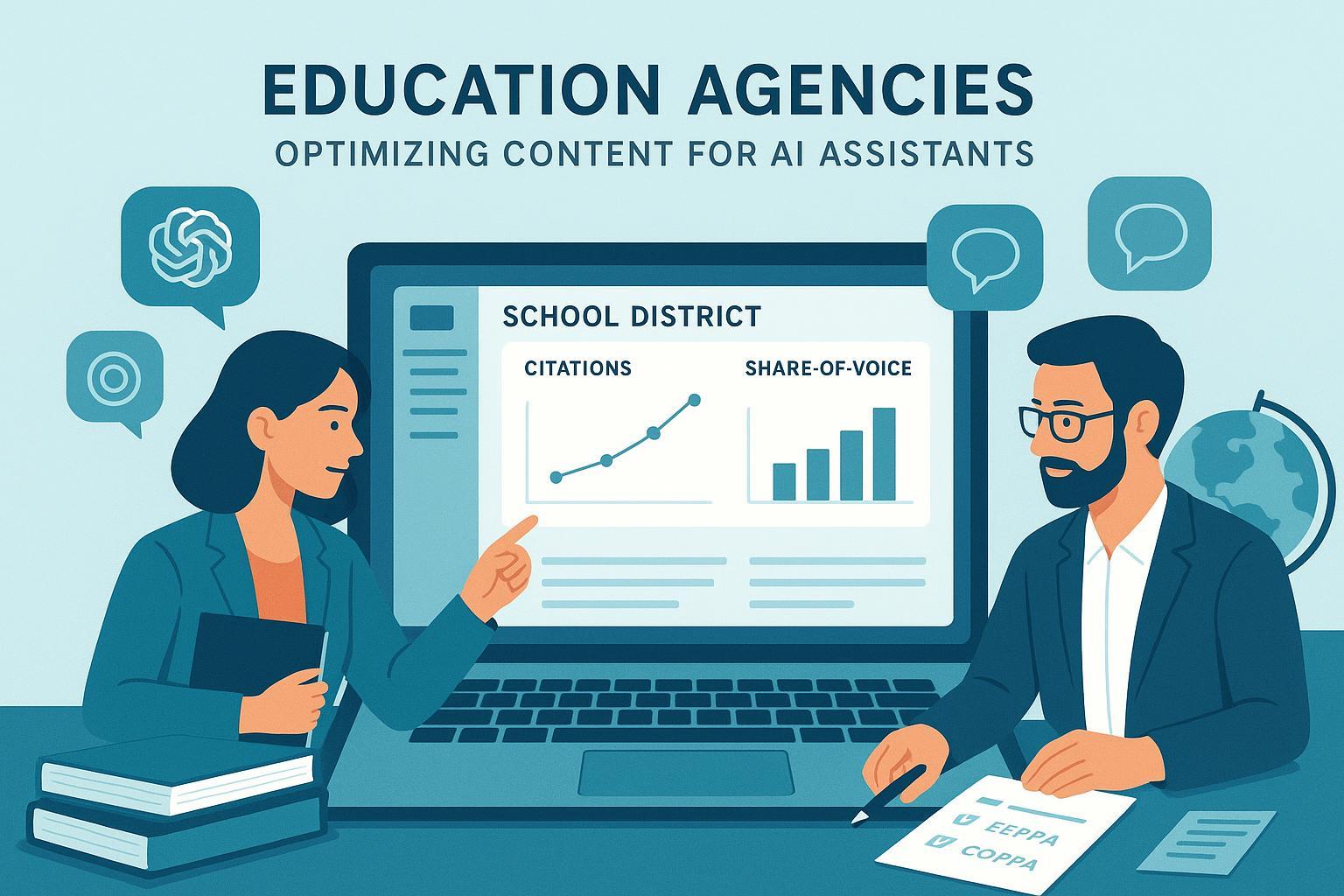
Agencies serving K–12 districts and higher‑ed institutions are seeing a surge of parent, student, teacher, and administrator questions directed to AI assistants like ChatGPT, Perplexity, and Google’s AI Overviews. The challenge isn’t just answering those questions—it’s ensuring your institution’s content is surfaced, cited, and trusted while respecting privacy rules and local policies. The entries below pair concise answers with practical optimization tactics you can implement today. Note: This FAQ is informational and not legal advice; partner with district counsel and privacy officers for binding interpretations.
Is using AI with students compliant with FERPA/COPPA?
Quick answer: Yes, but only within strict boundaries. FERPA protects students’ education records, and COPPA governs online collection of children’s data under age 13. Schools can use AI tools when they avoid sharing personally identifiable information (PII), obtain appropriate approvals, and align vendor contracts with privacy obligations.
- Identify whether information is PII and keep PII out of prompts unless an approved exception applies. For training, many districts reference FERPA basics through the Student Privacy Policy Office’s FERPA 101 materials for local agencies, which outline roles, consent, and exceptions in accessible terms; see the U.S. Department of Education’s FERPA 101 training for LEAs.
- Confirm COPPA obligations for tools used by children under 13. The FTC’s 2025 COPPA amendments strengthen consent, retention, and transparency; review the final rule in the Federal Register: Children’s Online Privacy Protection Rule (2025 final).
- Use school‑official designations and data‑sharing agreements to define authorized vendors and access boundaries. Provide annual notices and clear parent rights consistent with FERPA.
- Prefer vendor deployments that minimize data collection, disable behavioral ad features, and separate student data from public models. Educator‑oriented overviews from the NEA summarize key federal implications; see NEA’s overview of federal regulations related to AI (2025).
What’s a safe way for children to use AI?
Quick answer: Keep prompts generic, avoid sharing PII, and use school‑approved tools configured with privacy controls. For younger learners, require adult supervision, establish classroom guardrails (e.g., “no names, no unique identifiers”), and teach students to verify outputs against trusted sources. Agencies can support schools by publishing parent‑friendly explainers and child‑safe AI guidelines that emphasize age‑appropriate use, transparency, and alternate pathways for students who opt out.
How can AI support lesson planning and differentiation?
Quick answer: AI can reduce planning workload, generate leveled materials, and suggest scaffolds, provided teachers maintain oversight and verify accuracy. In 2025 findings, educators reported using AI for accessibility features and operational tasks—patterns agencies can reflect in content design to be quoted or cited by assistants; see the Microsoft AI in Education Report (2025). For visibility, publish guides that include prompt examples, plain‑language definitions, and classroom scenarios teachers can adapt.
How should students ethically use AI for homework and studying?
Quick answer: Encourage AI as a study companion for brainstorming, outlining, and feedback while banning impersonation and uncredited drafting. Make policies explicit: disclose AI assistance, cite sources, and cross‑check facts. Classroom guidance from respected organizations (ISTE, Edutopia) aligns on skills like questioning, verification, and reflection. Agencies should help schools by hosting ethics pages with transparent author bylines (teachers, privacy officers) and clear examples of permitted vs. prohibited use. One more point: if students ask “Can I put my essay into an AI tool?” your content should answer directly and offer safer alternatives, like pasting an outline and asking for suggestions without sharing personal details.
How do we structure content so AI assistants extract and cite it?
Quick answer: Make your pages easy to parse, rich with expert signals, and backed by authoritative citations. Google’s AI features draw on the core ranking system and high‑quality sources; follow publisher guidance for AI experiences via Google’s AI features documentation. Perplexity prefers clear author/date signals and explicit links; see how citations work in Perplexity’s help center.
- Write “quick answer” paragraphs at the top, then supporting context. Use headings and short sections. Keep claims conservative and source‑backed.
- Add visible author information (name, role, profile link) and updated dates (datePublished/dateModified) to strengthen trust.
- Place authoritative citations near the relevant sentences—ideally primary sources from .gov/.edu/nonprofits—so assistants have publisher‑friendly anchors.
- Validate crawlability and avoid thin or scaled content; ensure the text in any structured data exactly matches visible content.
Which schemas help education FAQs and guides surface?
Quick answer: Use FAQPage for Q&A content and Article (or BlogPosting) for longer explainers. In JSON‑LD, model each question and accepted answer under mainEntity for FAQ pages, and include author, headline, datePublished, and dateModified for articles. Validate with Google’s Rich Results Test before publishing. This structure makes it easier for AI systems and search engines to identify questions, answers, and expert signals without you needing to do anything exotic beyond solid SEO.
What data can be shared with AI tools, and what approvals are needed?
Quick answer: Default to minimal data collection, no PII in prompts, and documented approvals for any student‑related processing. State laws and district policies may add extra limits.
- Draft an approvals matrix that clarifies when AI tools can be used, who authorizes them (school officials/privacy officers), and under what data conditions. California’s statewide materials provide useful reference points and privacy notes; see the California Department of Education AI guidance.
- Align vendor contracts with FERPA and, where applicable, state rules that restrict K–12 data use (e.g., SOPIPA‑like prohibitions on targeted ads or profiling unrelated to school purposes).
- Document staff training on safe prompts, data retention, and incident response. Where uncertainty remains, escalate to district counsel and halt use until risks are addressed.
How do we adapt content for specific states, districts, and languages?
Quick answer: Publish variants that reflect state policy nuances, district tools lists, and community languages. Prioritize the highest‑traffic languages for your region and ensure accessibility (alt text, transcripts, readable typography). For AI visibility, keep core structure consistent—question phrasing that matches user queries, concise answers, and locally relevant citations. Think of localization as layering context: the core policy stays stable, but examples and procedures become state‑specific.
How do we track AI mentions/visibility and report outcomes to clients?
Quick answer: Establish a cross‑platform routine that monitors whether your institution is cited or recommended in AI answers, then report changes in Share of Voice, AI Mentions, Total Citations, and platform breakdown over time.
Disclosure: Geneo (Agency) is our product. Agencies can use multi‑AI visibility tools to observe mentions across ChatGPT, Perplexity, and AI Overviews and produce client‑ready dashboards. Keep your cadence practical: weekly scans for campaign work, monthly summaries for leadership, and quarterly deep dives to refine content clusters. Present trendlines, call out wins (e.g., a policy page being cited), and note gaps where assistants rely on other sources—then adjust content and citations accordingly.
A final word for agency teams: Optimization for AI assistants rewards calm, consistent execution. Publish quick, conservative answers that link to primary sources, attach credible authorship, and keep content fresh. If you’re wondering whether a new classroom scenario or state policy update warrants a page, the answer is often yes—especially when that page is cleanly structured, localized, and measured over time. Stay cautious on privacy, escalate gray areas to counsel, and keep iterating as platform behaviors evolve.