
How DTC Brands Are Using GEO to Drive Sales in 2025
Explore actionable GEO best practices for DTC brands in 2025—learn how to optimize for AI search, ensure data accuracy, and boost sales with proven frameworks and expert KPIs.
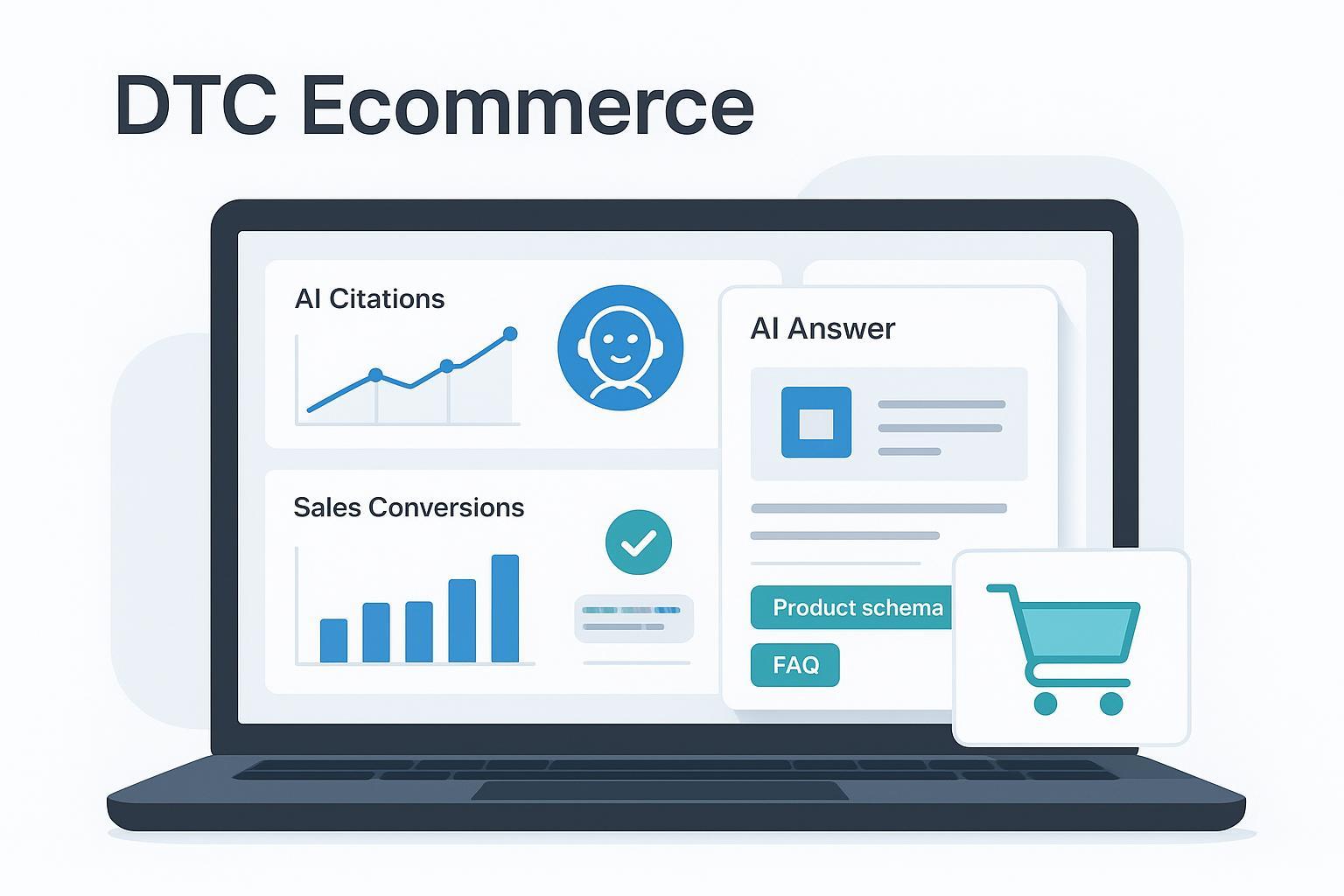
If your product pages aren’t showing up as cited sources inside AI answers, you’re leaving revenue on the table. Generative Engine Optimization (GEO) is how DTC brands get included—and recommended—across AI surfaces like Google’s AI Overviews/Mode, ChatGPT, Perplexity, and Copilot. This guide shows the exact playbook teams are using to turn those AI mentions into incremental sales.
GEO, in plain English for DTC
GEO optimizes your brand and product content so it’s selected, cited, and accurately represented inside AI-generated answers—not just ranked as a blue link. If you need a quick grounding, see this short primer on how GEO differs from SEO in scope and metrics in the GEO definition vs. SEO explainer.
Two realities drive GEO in 2025:
- AI answer engines increasingly pull from structured product facts, clear Q&A formats, and trusted sources.
- Google emphasizes crawlability and structured data as prerequisites for richer features, noting that structured data helps Google “understand the content of a page” and enable experiences beyond standard listings, per Google’s structured data overview.
Where GEO drives sales today
- Google AI Overviews/AI Mode: While Google hasn’t disclosed the exact citation algorithm for Overviews, their site owner guide on AI features clarifies that eligibility depends on content quality, indexing, and structured data readiness; see Google’s AI features and your website. Product-rich experiences also rely on complete Product/Offer/Review markup and up-to-date Merchant Center feeds; Google notes that using both markup and feeds “maximizes your eligibility,” in Product structured data guidance.
- ChatGPT, Perplexity, Copilot: These assistants show inline citations and links, though selection mechanics aren’t fully documented. Consistent, machine-readable facts and concise Q&A content tend to earn inclusion.
- Amazon Rufus (app): Visibility is inferred from catalog completeness, high-quality content, and review integrity. Treat product facts, attributes, and Q&A as inputs that Rufus can summarize for shoppers.
Think of GEO as ensuring your product facts and buying guidance are the “answerable” source across these systems. The more extractable and verified your data, the more likely you appear—and get clicked.
A phased GEO playbook for DTC teams
Below is a proven sequence you can run in a quarter. It’s designed for cross-functional collaboration between SEO, merch, content, analytics, and engineering.
-
Baseline and audit
- Inventory top-revenue PDPs and categories. Validate Product, Offer, Review, and AggregateRating schema, plus image alt text and variant data.
- Check feed parity: price, availability, shipping/returns in your Merchant Center feed match onsite values.
- Capture current AI mentions across Google AI Overviews/Mode, ChatGPT, Perplexity, and Copilot.
-
Content and data upgrades
- Add or fix Product/Offer/Review schema; include priceCurrency, availability, itemCondition, and canonical images. Keep reviews marked up and attributed.
- Add on-page Q&A/FAQ blocks for pre‑purchase intents (materials, sizing, care, comparisons, returns). Keep answers concise, factual, and visible to users.
- Publish and mark up shipping/returns policies. Clarify warranties and contact options.
-
Syndication and merchant alignment
- Ensure Merchant Center feeds mirror PDP facts; enable automatic item updates where supported. See Google’s Product structured data guidance for recommended properties and feed alignment.
- Align category and comparison content with ItemList and BreadcrumbList to clarify product relationships.
-
Monitoring and iteration
- Track AI citation share, sentiment of mentions, referral clicks, and assisted conversions weekly.
- A/B test FAQ phrasing, comparison tables, and images. Prioritize categories where AI mentions are trending up.
-
Scale and governance
- Codify checklists in the CMS. Establish monthly structured data QA and feed audits.
- Train CX to capture new FAQs; feed those back into PDPs and help content.
Workflow example: monitoring without guesswork Disclosure: Geneo is our product. In practice, teams set up an AI visibility dashboard to log AI Overviews mentions, ChatGPT/Perplexity citations, and sentiment on brand/product mentions by query theme. They compare that visibility to structured data coverage and merchant-feed match rates, then prioritize fixes that correlate with mention gains. Whether you build this in-house or use a platform, the key is weekly, comparable snapshots and a changelog of content and feed updates.
Measurement that ties AI visibility to revenue
GEO is only valuable if it drives sales. Treat AI surfaces as mid‑funnel assist that can close—or at least shorten—shopping journeys when your brand is explicitly cited.
Selected 2025 benchmarks to anchor expectations
- According to Adobe’s July 2025 cohort, AI‑driven visits to retail sites surged and revenue per visit rose compared to January; conversion likelihood improved from early‑year baselines as shoppers got more comfortable with AI help, per the Adobe Business analysis of generative AI shopping (Jul 2025).
- Microsoft reports Copilot-assisted journeys were shorter and more likely to reach lower‑funnel outcomes, as summarized in the Bing Webmaster blog’s 2025 conversion analysis.
- Similarweb’s 2025 ecommerce report indicates AI referrals are growing; in some cohorts, ChatGPT referrals showed stronger conversion rates than generic organic traffic, per the Similarweb global ecommerce findings (Sep 2025).
Interpretation: AI referral volume is still smaller than classic search, but quality is rising. For DTC, expect GEO to act as an assist—creating more branded sessions, higher intent traffic, and faster paths to checkout.
Two questions to guide your KPI design: Which AI surfaces mention us most for high‑value queries? When those mentions increase, do assisted conversions from AI referrals and branded search lift in tandem?
| KPI | How to measure | Why it matters |
|---|---|---|
| AI citation share | Weekly count of citations and brand mentions by surface (Google AI Overviews/Mode, ChatGPT, Perplexity, Copilot) divided by total opportunities for target queries | Indicates inclusion and progress toward being the “default” answer |
| Sentiment of mention | Classify mentions as positive/neutral/negative; track reasons (price, materials, returns) | Positive recommendations correlate with higher assisted conversion likelihood |
| Referral clicks from AI | UTM or referral parsing from AI experiences; landing pages and session quality | Validates that mentions translate into visits |
| Assisted conversions | Multi‑touch attribution linking AI‑referred sessions to downstream purchases within a lookback window | Connects visibility to revenue, even when last‑click is branded or direct |
| Schema and feed coverage | % of PDPs with valid Product/Offer/Review/Rating markup; % of feed items synchronized with PDP facts | Inputs that drive inclusion accuracy and trust |
| Policy clarity | % of PDPs with visible/marked‑up shipping and returns | Reduces friction in AI answers and onsite |
Notes on attribution: AI referrers can be opaque. For Google AI Overviews, clicks may register as google / organic with atypical landing‑page patterns. For LLM assistants, referrals may come via a shared link or in‑app browser. Use a combination of UTM conventions, landing‑page grouping, and sequence analysis rather than a single channel tag.
Mini case example: apparel brand pilot
Disclosure: Geneo is our product. A mid‑market apparel DTC ran a 6‑week GEO pilot on its activewear category.
- Baseline: Only 38% of PDPs had complete Product/Offer/Review markup; returns policy was buried in a footer PDF; no on‑page FAQs. AI citations: sporadic mentions in ChatGPT, none in Google AI Overviews.
- Interventions: Completed schema on all PDPs, added concise FAQs for sizing/care/returns, synchronized Merchant Center feed, and created a comparison table for top leggings. Monitored AI mentions and sentiment weekly alongside schema/feeds QA.
- Results: AI mentions rose from near‑zero to regular inclusion on core sizing queries; ChatGPT and Perplexity began citing size/fit guidance directly from PDP FAQs. Branded search sessions and add‑to‑cart rate improved in the tested category; assisted conversions involving AI‑exposed sessions increased week over week. While the Overviews click share remained modest, total category revenue outpaced the control line on a like‑for‑like basis.
What made the difference? Answerable product facts and clear policy data, presented in extractable formats and kept consistent between PDPs and feeds. The team continued A/B testing FAQ phrasing (“How do these leggings fit?” vs. “Are these true to size?”), observing that more conversational question forms were more likely to show up intact in LLM answers.
Risk and brand safety checklist
GEO requires guardrails. Use this quick pass before and after changes:
- Hallucinations and misattribution: Keep canonical facts consistent across PDPs, feeds, and support docs; correct AI answers via feedback tools when available.
- Review integrity: Follow FTC Endorsement Guides; mark incentivized reviews; prefer verified-buyer signals.
- Data privacy: Avoid PII in structured data; ensure consent and disclosures for any referral tracking.
- Claim substantiation: If you make health or performance claims, cite primary research and avoid YMYL territory without rigorous evidence.
Next steps for your team
Ready to test without boiling the ocean? Pick one revenue‑dense category, fix schema and feeds, add three to five FAQs per PDP, and measure AI citation share weekly for six weeks. For a structured orientation, this short primer is a good starting point: Beginner’s guide to GEO. If you need to design the plumbing and cadence, this overview of monitoring concepts can help: What is AI visibility?.
Soft CTA: Disclosure: Geneo is our product. If you prefer not to build dashboards from scratch, you can use a platform to track AI mentions, sentiment, and schema/feeds coverage side by side and standardize weekly reporting.
The short version: make your product facts answerable, keep them consistent everywhere, and prove the lift—are you ready to run your first six‑week GEO pilot?