Best Practices for Measuring Tone Inconsistency Across AI Engines and Its Impact on Brand Visibility
Learn how to quantify tone inconsistency across ChatGPT, Perplexity, and Google AI Overview and correlate it with measurable Brand Visibility Scores using Geneo's evidence-backed approach. Targeted for SEO/GEO professionals.
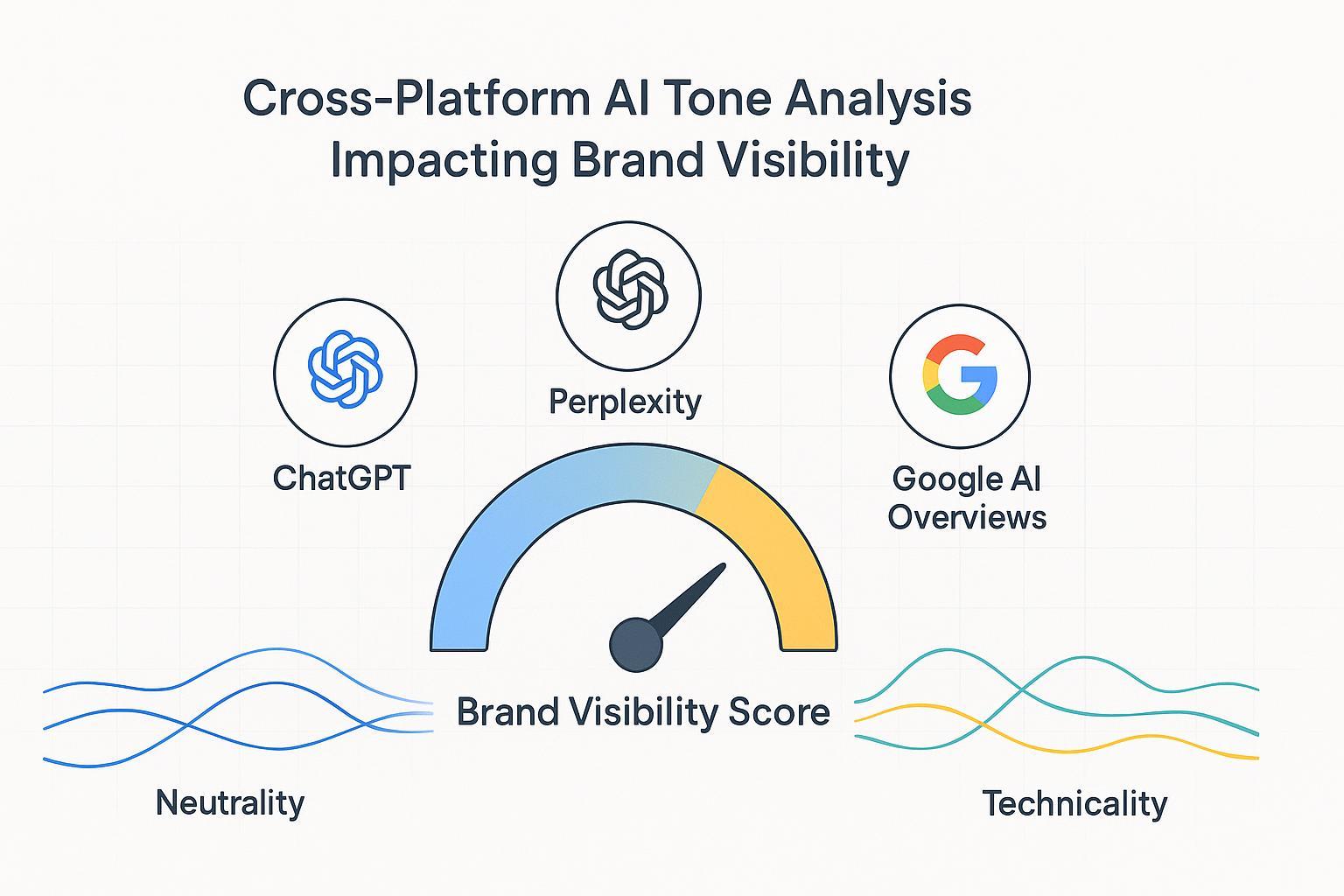
SEO/GEO teams fine-tune facts, structure, and schema. One quiet variable still moves the needle across AI engines: tone. When ChatGPT, Perplexity, and Google AI Overviews narrate your brand with different levels of neutrality, confidence, warmth, or technicality, visibility shifts—mentions, citations, and answer positions can change week to week. The question is not whether tone matters; it’s how to measure inconsistency and link it to a visibility score you can monitor and improve.
What “tone inconsistency” means in practice (and why engines care)
Tone inconsistency occurs when your brand is described with noticeably different emotional or stylistic traits across AI engines—e.g., confident on ChatGPT, overly promotional on Perplexity, and neutral on Google. Practically, we model tone along dimensions such as neutrality, confidence, warmth, and technicality. If those vectors diverge from your style guide differently per engine, the narrative the models produce can drift.
Why engines care:
ChatGPT often synthesizes learned brand narratives from training and user-supplied context; phrasing that feels extractable and balanced tends to be repeated.
Perplexity foregrounds citations and source freshness; copy that contains verifiable statistics and quotations is more likely to be referenced.
Google AI Overviews blend generative output with Search systems aligned to helpfulness and E‑E‑A‑T; consistent, people-first language with clear trust signals can shape which sources and claims surface.
For context, Google explains AI Overviews are powered by customized Gemini models integrated with Search systems and encourages publishers to focus on helpful, people-first content. See Google’s guidance: Search Central documentation for AI features and Google’s guidance on succeeding in AI-powered Search (2025).
Visibility mechanics by engine (observable signals)
Below is a concise view of the signals SEO/GEO teams can observe while auditing tone consistency alongside visibility behaviors. It’s not exhaustive, but it’s practical.
Engine | Observable tone/visibility signals | Useful reference |
|---|---|---|
ChatGPT | Narrative framing, confidence markers, technical density, presence/absence of brand mentions without explicit citations | Geneo’s overview of AI visibility and prompt-level tracking: AI Visibility definition: Brand Exposure in AI Search |
Perplexity | Citations count and recency; source types; quote/stat extraction; tone alignment with verifiable claims | Perplexity documentation: Help Center explainer |
Google AI Overviews | People-first language, trust signals, alignment with Search systems; frequency of brand surfacing in Overviews | Google’s official docs: AI features overview |
Two industry datapoints underscore the environment you’re measuring:
Across generative engines, citation behavior diverges. According to the Digital Bloom 2025 AI Visibility Report, only 11% of domains were cited by both ChatGPT and Perplexity (2025 cohort), and adding statistics (+22%) or quotations (+37%) improved visibility.
AI Overviews coverage fluctuated in 2025; treat it as a moving target rather than a fixed surface area.
A practical measurement model: from tone vectors to an Inconsistency Index—and linking to a Visibility Score
Here’s a model you can run without waiting for perfect standardization:
Define tone dimensions and an anchor style guide.
Dimensions: neutrality, confidence, warmth, technicality. Optionally include formality and risk-aversion.
Build a “brand tone vector” from your style guide and top-performing assets.
Capture cross-engine outputs with a fixed prompt suite.
Use three prompt categories: brand overview, product fit, differentiation. Sample weekly across ChatGPT, Perplexity, and Google AI Overviews (when surfaced).
Log versions, timestamps, and any content changes.
Score tone per engine and compute divergence.
Use lightweight classifiers to score each dimension (e.g., 0–1 scale). Compute cosine distance between the observed engine tone vector and your brand tone vector.
Per engine, that distance is your Tone Inconsistency Index (TII). Roll up the weekly TII across prompts.
Track visibility metrics in parallel.
Mentions per prompt, citation counts, link attribution rate, and position/ranking trends within answers. Geneo-style monitoring focuses on these elements as part of an AI Visibility Score, described in their resources: AI Visibility definition and GEO vs. traditional SEO comparison.
Correlate TII with Visibility Score movement.
Weekly, run correlations between TII and changes in mention share, citation rate, and your internal visibility score. Treat it as correlation, not causation; document confounders (content updates, model shifts, seasonality).
Remediate and re-test.
Harmonize copy to your tone vector, add verifiable statistics and quotes, strengthen trust signals, and re-sample the prompt suite.
Example (anonymized): Harmonize tone, monitor weekly impacts
Workflow snapshot for a mid-market SaaS cohort over six weeks:
Baseline (Weeks 1–2): TII averaged 0.32 (ChatGPT 0.28; Perplexity 0.41; Google 0.27). Mentions per 100 tracked prompts: 42 (ChatGPT 20; Perplexity 15; Google 7). Citation rate (Perplexity) 0.38. Internal visibility score 62.
Intervention (Week 3): Style guide tightened; product pages updated with three recent customer stats and two expert quotations.
Post (Weeks 4–6): TII fell to 0.19 (ChatGPT 0.17; Perplexity 0.23; Google 0.17). Mentions per 100 prompts rose to 55 (ChatGPT 25; Perplexity 21; Google 9). Perplexity citation rate improved to 0.51. Internal visibility score rose to 69.
Interpretation: Lower inconsistency (especially on Perplexity) coincided with higher mentions and citation rate and a visibility score uplift. This is correlation, not proof of causation, but it’s actionable.
Disclosure: This anonymized pattern aligns with practitioner observations that adding statistics and quotations improves visibility in citation-forward engines like Perplexity (see the Digital Bloom 2025 report referenced above). Always log confounders.
A practitioner workflow for SEO/GEO teams
Monitoring
Maintain a cross-engine dashboard tracking mentions, citations, sentiment, and share-of-voice. Geneo’s materials describe prompt-level monitoring and visibility scoring useful for this step: Cross-engine monitoring comparison.
Remediation
Replace vague or hypey copy with balanced, extractable phrasing. Insert recent statistics and quotations; ensure clear attribution to authoritative sources.
Experiment design
Standardize prompts; run weekly multi-engine samples; log outputs and changes; compute TII and visibility metrics; analyze trend shifts.
Governance
Document correlation vs. causation caveats; schedule quarterly tone/visibility reviews; track brand trust signal density and technical accuracy.
Methodological transparency: limits and guardrails
Platform opacity: Google does not disclose detailed selection logic for AI Overviews sources; rely on guidance oriented to helpfulness and E‑E‑A‑T.
Evidence scope: Few peer‑reviewed studies directly quantify tone-consistency’s causal impact on visibility. Treat TII↔visibility findings as correlation; confirm via controlled experiments where possible.
Moving targets: Engine behavior and coverage change over time; keep audits frequent and versioned.
Confounders: Content freshness, structured data, link quality, and competitive shifts also affect visibility. Annotate these factors in your logs.
Who should run this (and when)?
SEO/GEO practitioners and agencies owning AI search visibility programs.
Data and growth teams designing experiments to quantify narrative drift vs. visibility changes.
Comms/PR partners when tone drift risks misalignment with brand narrative or regulatory constraints.
If you’re building a repeatable practice, think of this as your lab notebook: tone vectors, prompt suites, weekly dashboards, and controlled edits that move the story closer to your brand voice—while you watch mentions, citations, and visibility respond.