
Content Marketing Automation in 2025: The Rise of 240+ AI Integrations
Discover how 240+ AI data source integrations are revolutionizing content marketing automation in 2025. Explore trends, expert insights, and practical strategies.
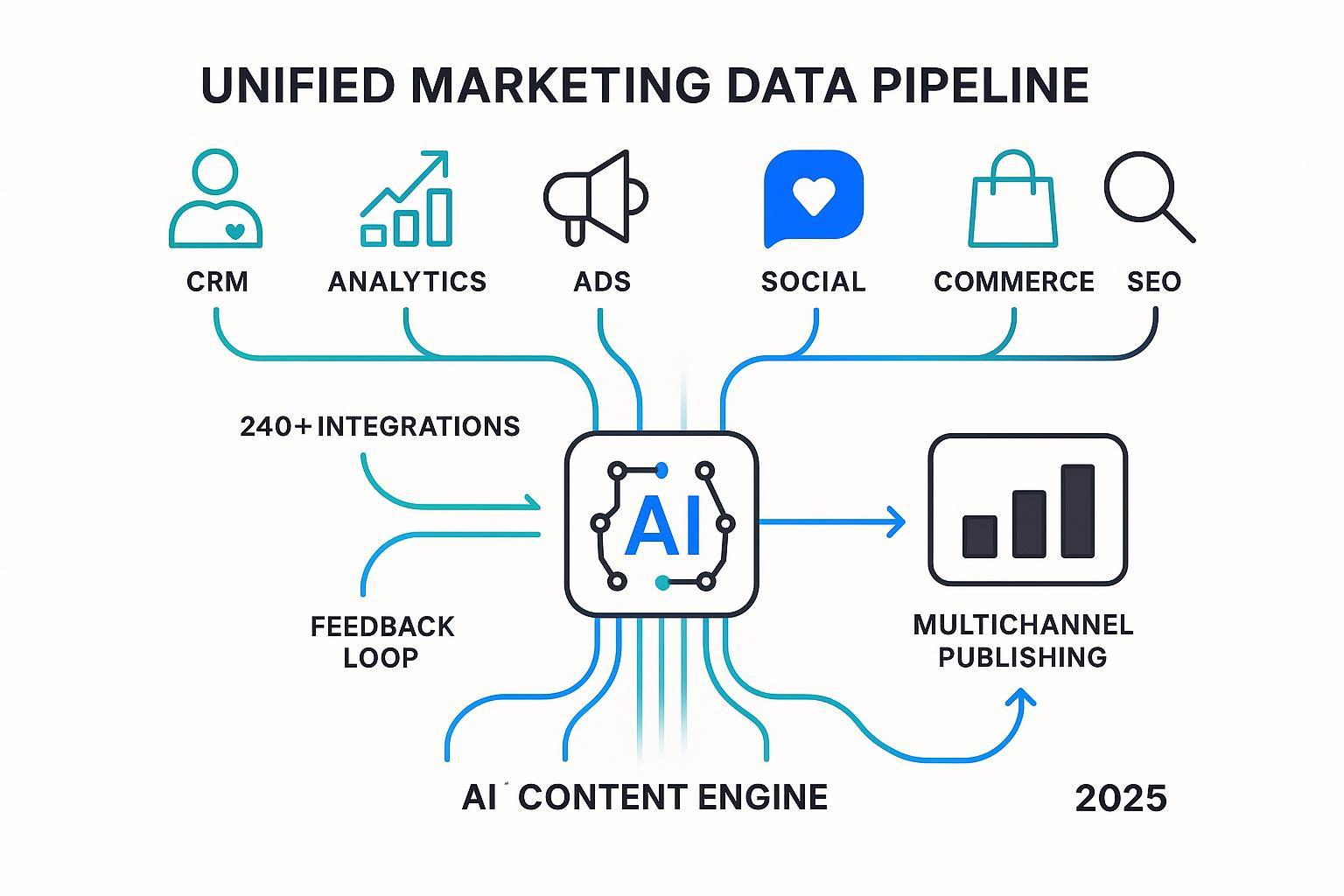
Content marketing is entering a new phase where AI doesn’t just write; it orchestrates. The biggest shift of 2025 is the rise of connector-driven automation: platforms unifying “hundreds” of data sources across CRM, analytics, ads, social, commerce, and SEO, then feeding those signals into generation, personalization, and measurement loops. In this world, “240+ integrations” is no longer a stretch goal—it’s a credible threshold for modern stacks that prioritize data gravity, reliability, and repeatable workflows.
Why 240+ integrations matter for content automation quality
When teams talk about AI content automation, they often focus on models and prompts. In practice, the quality ceiling is set by data breadth and cleanliness. The more trusted, consented signals you can unify—audience attributes from CRM, intent from search, engagement from social, conversions from commerce—the more precise your briefs, personalization, and experiment design become.
- Data gravity drives precision. A rich mix of sources reduces guesswork and accelerates iteration. It powers better topic selection, angles, formats, and timing.
- Feedback loops become reliable. Closed-loop reporting (from content to outcomes back to optimization) depends on consistent connectors, schema mappings, and versioning discipline.
- Cycle time drops. Unified pipelines cut manual prep/ETL, freeing teams to ship and learn faster.
Evidence: connector catalogs have scaled into the hundreds
Several credible vendors publicly document rapid expansion in 2025, underscoring that “hundreds” of integrations are now table stakes:
- Coupler.io’s 2025 update reports a leap to “300+ sources and counting,” contextualizing the “240+” milestone as part of a broader surge; see the Coupler.io blog: “240+ New Data Sources & AI Integrations” (2025-10-07).
- Airbyte’s official catalog states “hundreds” out of the box, including open-source breadth beyond prior 300+ figures; consult the Airbyte connectors catalog (600+ OSS) for the latest scope in 2025.
- Qlik’s Connector Factory posts show steady release cadence across mid-2025, reinforcing ongoing growth and maintenance; refer to Qlik Connector Factory May–June 2025 releases.
The takeaway: betting your content operations on “hundreds” of connectors is both realistic and increasingly necessary. But breadth alone isn’t enough—the hidden moat is reliability and governance.
Reliability and governance: the new moat for connector-first stacks
Connectors are living systems. APIs change, rate limits shift, fields deprecate, and auth flows get updated. Mature teams treat reliability and governance as first-order requirements:
- Uptime expectations: Enterprise-grade SLAs set a baseline. For example, Fivetran SLA — 99.9% uptime describes guarantees for core services and data delivery (2025), indicating what “reliable” looks like in managed integration.
- Versioning and monitoring: API volatility requires watchful change management. The Google Ads API release notes (2025) document frequent releases and sunsets (e.g., v18 sunset in Aug 2025), a pattern that demands alerting, retry logic, and schema drift handling.
- Data lineage and deduplication: Track how signals flow from source to content to outcomes. Deduplicate identities across CRM/commerce, enforce consent, and maintain canonical marketing schemas.
- Access control and retention: Work with legal/IT to enforce PII safeguards, retention windows, and audit trails.
Teams that invest here spend less time firefighting breakage and more time on creative and experimentation.
A reference architecture for unified content data pipelines
Think of your stack in four layers:
- Ingress (connectors): CRM (HubSpot/Salesforce), web analytics (GA4), ads (Google/Microsoft/Meta), social (Instagram/LinkedIn), commerce (Shopify), SEO data (SERP, keywords, competitors). Aim for “hundreds” coverage but prioritize reliability and governance.
- Transformation & governance: Standardize identities and events, map to a canonical marketing schema, enforce consent and retention, monitor freshness, and version connectors.
- AI content engine: Use unified signals to generate briefs, outlines, and variations; personalize by segment; design experiments; and enforce brand/style guardrails.
- Distribution & measurement: Publish across web, email, social; collect outcomes; feed learnings back to the engine.
Example workflow: from unified data to brief to publish
- Pull CRM segments, recent search intent, and social engagement into your canonical schema.
- Generate a brief tied to audience attributes, pain points, and timing.
- Draft, optimize on-page elements, and schedule multichannel distribution.
- Close the loop by measuring CTR/CVR by segment and feeding insights back into the brief template.
In the content creation step, platforms like QuickCreator can help translate unified signals into AI-assisted briefs, on-page optimization, and one-click publishing to WordPress, without adding engineering overhead. Disclosure: QuickCreator is our product.
For an operational walkthrough, see the internal guide Step-by-Step Guide to Using QuickCreator for AI Content.
Repeatable playbooks powered by 240+ integrations
Here are five practical, connector-driven playbooks you can pilot in Q4 2025:
-
Always-on SEO + blog loop
- Unify keyword trends, SERP gaps, and site analytics; generate briefs tailored to intent clusters; publish and measure by segment.
- Complement with on-page optimization and SERP guidance through modern SEO content tools.
-
Product launch amplifier
- Align CRM intent, waitlist cohorts, ad audiences, and social listening; spin up a content sprint with variant testing across landing pages, blog, email, and social.
- Monitor lift in qualified traffic and sign-ups; roll learnings into ongoing campaigns.
-
Commerce storytelling + UGC fusion
- Aggregate purchase data and reviews; create tailored stories per segment; amplify UGC on social; measure conversion contributions per narrative.
-
Account-based content for B2B
- Map target accounts to intent signals; generate executive one-pagers, case studies, and nurture sequences; measure content touches against pipeline stages.
-
Lifecycle email + blog personalization
- Blend behavioral data with content taxonomies; personalize article modules in newsletters; track CTR/CVR improvements.
As you scale, watch for quantified outcomes. For instance, unified, AI-enabled workflows have delivered measurable gains in adjacent marketing/sales contexts—HubSpot’s Aerotech case study (accessed 2025) cites a 66% win-rate lift and 18 hours saved weekly, illustrating the cycle-time and performance potential of integrated automation.
Governance tips and “watch for breakage” callouts
- Schema drift: Automate detection and alerts when upstream fields change; implement fallbacks to avoid pipeline downtime.
- Rate limits & quotas: Stagger syncs for high-volume sources; cache where permissible.
- Consent-first personalization: Respect opt-in scopes; segment only on consented attributes; document retention policies.
- Connector SLAs: Prefer managed connectors with uptime guarantees and transparent changelogs.
- Observability: Track freshness, error rates, and duplicate rates per source; document lineage from source to content to outcome.
Compact glossary (for busy teams)
- Canonical marketing schema: A standardized model for identities, events, and attributes across tools.
- Schema drift: Unplanned changes in upstream data structures that break pipelines.
- Versioning: Tracking API and connector versions and their compatibility windows.
- Lineage: The path data takes from source through transformation to usage and reporting.
- SLA: Service-level agreement that defines availability and performance guarantees.
What’s next: 2026 outlook
- AI agents for integration: Expect agents to auto-map schemas, detect drift, and propose transformations, reducing ETL toil.
- Connector consolidation: Long-tail sources may be covered via iPaaS-style bridges, while core connectors become more reliable and SLA-backed.
- Privacy-by-design pipelines: Consent management, retention enforcement, and PII minimization will be built into connectors and orchestration layers.
- Outcome-first orchestration: Pipelines will optimize toward business outcomes (pipeline, revenue, LTV) rather than vanity metrics, improving content ROI.
Final thoughts
“240+ integrations” isn’t the end goal—it’s the minimum viable backbone for trustworthy AI content ops in 2025. The real advantage comes from clean, governed data feeding fast, repeatable workflows. If you’re consolidating your stack this quarter, start with reliability, map a reference architecture, and pilot one or two playbooks before scaling.
If you want a lightweight way to turn unified signals into briefs, optimized pages, and fast publishing, QuickCreator can help as part of that workflow. Focus on governance and measurement first; tools should make the path from insight to publish—and back to learning—shorter and more reliable.
Further internal reading:
- Explore modern AI SEO tools for on-page optimization.
- Deepen your understanding of SEO content tools and real-time SERP optimization.
- Walk through an AI content workflow using QuickCreator.