
Conflicting Information in AI Search: How Platforms Reconcile Disputes
Learn how AI search platforms handle conflicting information, show provenance, and what steps brands can take to monitor and resolve inconsistencies.
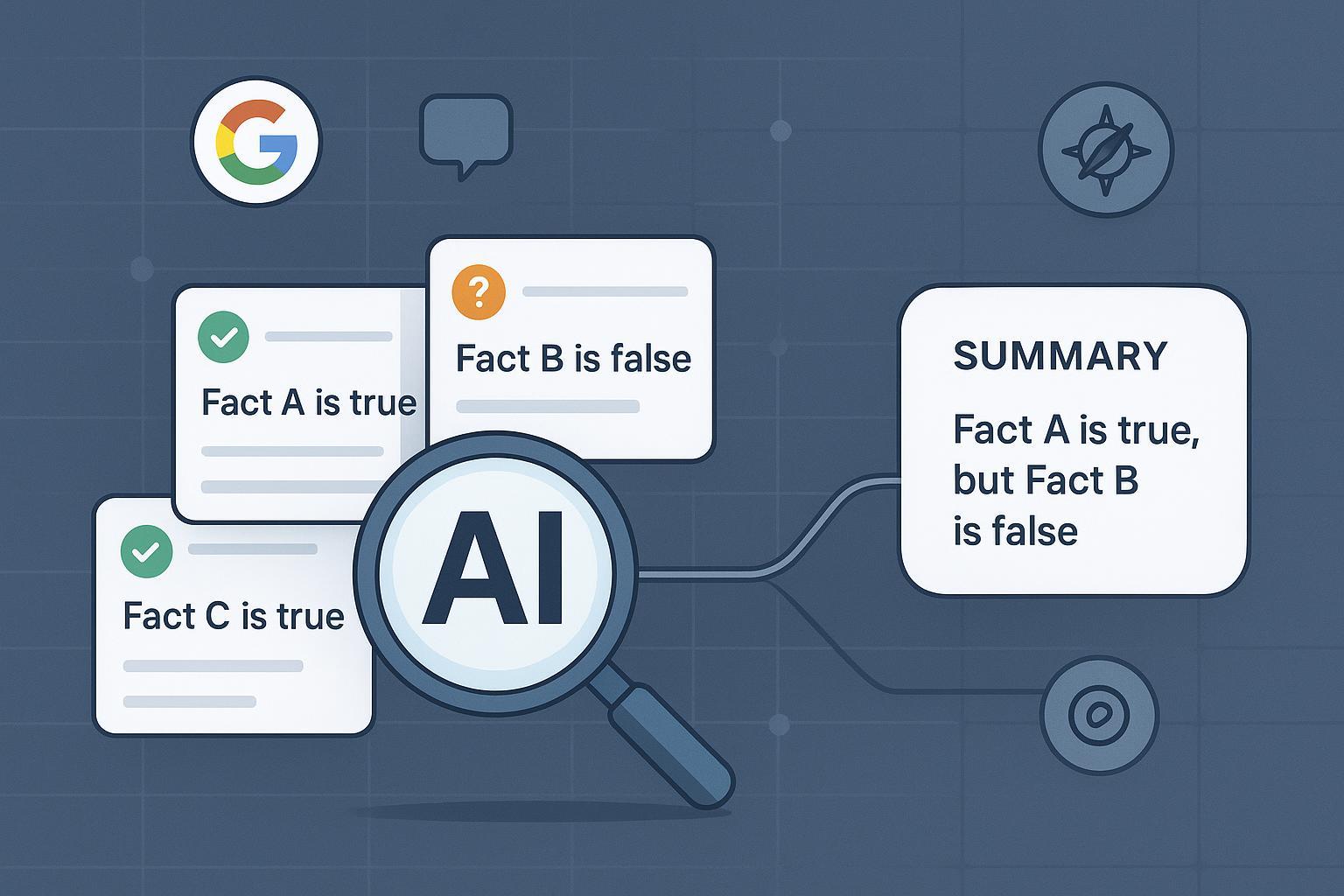
You ask three AI search tools a simple brand question—say, “Does Company X still offer a free tier?” One cites a 2023 blog post that says yes, another quotes a 2024 pricing page that says no, and a third blends both into a fuzzy “it depends.” Which one should your team trust, and how do these systems decide what to show when sources disagree?
This article explains what “conflicting information in AI search” really means, how leading platforms reconcile contradictions and display provenance, and what marketers can do to verify, monitor, and fix brand‑affecting errors. If your job includes protecting and growing your brand’s AI visibility, this is your playbook.
What “conflicting information in AI search” means
In this context, conflicting information appears when AI systems pull incompatible claims from different sources (or from a model’s prior training vs. fresh retrieval) and must decide whether to synthesize, present multiple perspectives, or defer. It’s not the same as a hallucination (content with no source basis) and it’s not simple omission (relevant sources weren’t retrieved).
For marketers, conflicts matter because they directly affect AI visibility—how often and how accurately your brand gets mentioned or linked inside AI answers. For a deeper primer on why visibility inside AI answers differs from classic blue links, see What Is AI Visibility? Brand Exposure in AI Search Explained: AI visibility definition and brand exposure.
Why conflicts happen in AI answers
Think of conflicting sources like three eyewitnesses describing the same event from different angles. In AI search, disagreement often arises from:
- The interplay between training and retrieval. A model’s internal “memory” can blend with live web results, producing synthesis that preserves older facts even when newer citations disagree.
- Recency and source quality gaps. Publishers update at different cadences; syndicated copies and derivative summaries may lag or omit key context.
- Synthesis and UI choices. Summaries can compress disagreement into a single line, or show multiple perspectives. Some products suppress answers when confidence is low; others surface more links and let you compare.
As of 2025, different platforms make different trade‑offs between brevity, confidence thresholds, and how prominently they show sources.
How major platforms reconcile conflicts and show provenance
Below is a practitioner’s snapshot of behaviors you’re likely to encounter when answers collide.
| Platform | How it reconciles conflicts | Provenance UI | When it defers/suppresses | What marketers should watch |
|---|---|---|---|---|
| Google AI Overviews | Synthesizes a concise snapshot supported by web results and knowledge systems; may present “explore more” perspectives on complex or contested queries. | Source links beneath the overview; paths to explore results. | Appears when systems have “high confidence”; can reduce or avoid showing overviews on low‑confidence or sensitive topics. | Whether cited pages actually support claims; whether an outdated page is driving the summary; gaps in contested topics. |
| Perplexity | Retrieval‑first, citation‑forward answers; encourages comparison via clickable, numbered sources. | Inline, numbered citations linking to sources. | Tends to answer with citations even on recent topics; may show multiple viewpoints via additional sources. | Support‑mismatch (link doesn’t back the claim), duplicate/syndicated sources, and recency of cited pages. |
| ChatGPT Search | Uses browsing/search to attach links when answering web‑grounded queries; core behavior and UI remain in flux. | Links/citations can appear with browsing; base model can also produce unattributed synthesis. | UX is evolving; may summarize with selective links or brief source panels. | Treat links and uncertainty language as evolving; verify claims and watch for partial sourcing. |
Google AI Overviews
Google says AI Overviews are generated by a customized Gemini model working with core Search systems and the Knowledge Graph, and that they appear when the systems have high confidence in answer quality. Overviews include links to “dig deeper” into the web, and product posts emphasize nuance for complex queries. See Google’s May 2024 product explainer for details: Generative AI in Search (Google, 2024) and implementation guidance in AI Features and Your Website (Google Search Central).
Implication: a concise summary may hide disagreement if one outdated or overly broad page dominates. Always click through and verify the exact supporting paragraph on the cited page.
Perplexity
Perplexity positions itself as citation‑forward: answers typically include clickable, numbered citations you can open and compare. That makes conflict more transparent—if the sources disagree, you’ll see it quickly. For an overview of product behavior, see How does Perplexity work? (Perplexity Help Center).
Implication: visibility is tightly coupled to whether your canonical pages are retrievable and support the claims Perplexity summarizes. If a third‑party write‑up is fresher (or more structured), it may out‑rank your own page in the citations.
ChatGPT Search
OpenAI’s materials describe ChatGPT Search adding links when it browses or retrieves the web for real‑world queries, aiming to improve factuality and reduce hallucinations. But public documentation doesn’t pin down stable rules for when and how links appear. Treat the UX as changing and verify empirically. See Introducing ChatGPT Search (OpenAI).
Implication: do not assume a link is present for every claim; when it is, confirm the exact page supports the specific statement in the answer.
How to read provenance signals the right way
A link isn’t proof on its own. Audit like an editor: open each citation and locate the sentence or data the answer relies on; confirm the passage truly supports the claim rather than adjacent context; check author and date to catch 2022 sources being used for 2025 facts; prefer multiple independent, high‑quality sources on contested topics; and treat product “confidence” wording as a starting signal, not a guarantee. Independent evaluations in 2025 highlight recurring support‑mismatch and misattribution across AI search tools—see the Tow Center’s analysis: AI Search Has a Citation Problem (Columbia Journalism Review, 2025).
A brand‑safe monitoring and remediation workflow
You don’t need a sprawling data stack to keep conflicts from harming your brand. You do need disciplined, repeatable steps.
- Establish coverage
- Track answers for your top brand, product, and competitor queries across Google AI Overviews, Perplexity, and ChatGPT Search.
- Log platform, query, date/time, model/version (if visible), and every cited URL.
- Verify and classify conflicts
- For each claim→citation pair, check whether the page truly substantiates the statement; flag support‑mismatch.
- Label recency conflicts (outdated descriptions), attribution errors (wrong publisher), and syndication copies versus originals.
- Prioritize remediation
- High‑stakes topics (medical, legal, finance): prefer authoritative sources and professional review; note that platforms may suppress answers in such domains.
- Ask publishers to update outdated or incorrect pages; prioritize the original source over copies.
- Strengthen your evidence: ship a canonical page with clear headings, structured data, and a crisp facts section. Reinforce author identity and social proof; for practical tactics, see our guide to LinkedIn team branding for AI search visibility.
- Re‑check and document outcomes
- Re‑run the same queries in 7–14 days; record changes in citations, sentiment, and the phrasing of answers.
- Maintain a provenance log with fields for query, platform, model/version, sources (URL + publisher + date), claim↔evidence notes, confidence signals, and remediation actions.
Tip: Why do assistants sometimes mention your competitor but not you? Selection often reflects retrievability, authority, and how clearly your content answers the query intent. For background, read Why ChatGPT mentions certain brands.
Micro‑example: tracking disagreements across platforms (neutral)
Disclosure: Geneo is our product.
Let’s say Perplexity cites a recent analyst note that describes your pricing correctly, while Google AI Overviews leans on an older blog post that’s now inaccurate. A practical workflow: capture both answers with timestamps and the full citation lists; open each cited page and verify the supporting passages; flag the outdated source and identify the canonical page you want systems to use; contact the publisher of the outdated page (or update your own if applicable) and add clear, structured facts plus a changelog; then re‑test the same queries after 7–14 days to confirm the change propagates. Log each step so future audits are faster.
Governance and conflict resolution, briefly
Audits go faster when evidence is captured at the source. U.S. governance guidance frames accountability as an information‑flow problem: organizations should document AI outputs, logs, and provenance so internal teams and independent evaluators can check claims. For a policy‑level reference, see the NTIA AI Accountability Policy Report (2024), which encourages durable provenance, standardized documentation, and disclosures that enable verification. Even a lightweight internal template—logging query, platform, model/version, sources, and outcomes—pays dividends when you need to trace how a conflict arose and prove it’s fixed.
What to do next
Define your conflict hot‑zones (pricing, product availability, leadership, compliance statements, and competitive comparisons); monitor Google AI Overviews, Perplexity, and ChatGPT Search for core queries; verify every cited claim on its source page and update originals as needed with structured, authoritative information; reinforce author identity and social proof; and re‑check on a schedule while keeping a provenance log so you can demonstrate progress.
If you’re operationalizing this across multiple brands or markets and want a consolidated workflow, our agency solutions can help. Explore the capabilities on the Geneo agency page.
For definitional context on how AI answers shape exposure, start with our explainer on AI visibility and brand exposure in AI search. And if you’re wondering why assistants feature certain brands more often than others, see Why ChatGPT mentions certain brands for practical levers you can control.