
Understanding AI’s “Confidence Scoring” for Brand Mentions
Learn how confidence scoring works in AI for brand mentions, its key concepts, use in dashboards, and why calibration is vital for accuracy.
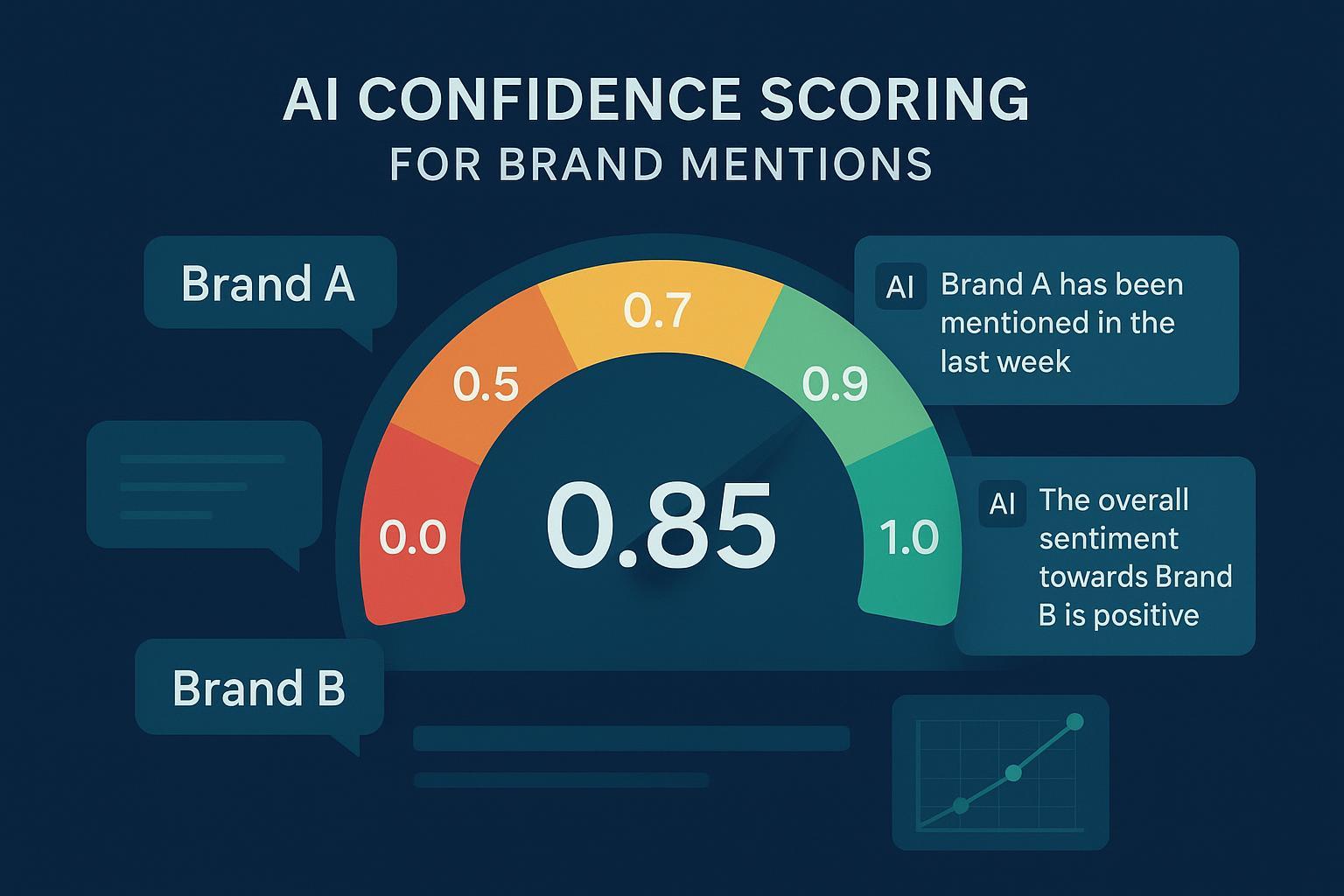
You open a report and see a brand mention scored at 0.82. Is that good enough to push to your dashboard? Should a PR analyst review it first? Or is 0.82 just a number without context?
Here’s the deal: a confidence score can be one of your most useful signals—as long as you understand what it really means, how it’s computed, and how to act on it.
What a confidence score actually represents
A confidence score is a probability-like value, usually between 0 and 1, that estimates how likely an AI system’s prediction is correct. In our context, the prediction might be “this span of text is a brand name” (named-entity recognition, or NER) and/or “this mention refers to your specific brand identity” (entity linking).
Major providers describe it similarly. Microsoft explains in its AI Language documentation that the confidence score is “a decimal number between zero (0) and one (1)… an indicator of how confident the system is with its prediction,” and recommends threshold tuning based on your use case, especially for precision vs. recall needs. See Microsoft’s guidance in the Custom NER characteristics and limitations and PII overview in Azure’s official documentation (Microsoft, accessed 2025). Amazon Comprehend returns a Score field (0–1) for each detected entity, intended for threshold-based filtering in applications—refer to AWS Comprehend’s Entity API reference (Amazon, accessed 2025). Google Cloud’s Natural Language API v2 exposes probability values at both the entity and mention levels, indicating the probability of correctness; see Google Cloud Natural Language v2 reference (Google, accessed 2025).
Two quick distinctions help avoid confusion: confidence vs. accuracy (confidence is the model’s estimate and won’t equal observed accuracy unless calibrated) and confidence vs. credibility (confidence is internal to the model, while credibility weighs external evidence like source quality and citations).
If you’re framing confidence within broader AI visibility metrics and outcomes, this explainer on AI visibility and brand exposure in AI search can help tie the concepts together.
How systems compute the score
Under the hood, most modern classifiers output raw numbers (logits) for each possible label. A softmax function converts those logits into probabilities across labels; the probability assigned to the chosen label is surfaced as the “confidence.”
For multi-token mentions (e.g., “Acme Financial Group”), NER models produce token-level confidences that must be combined into a span-level score. There’s no single standard, but common strategies include averaging token probabilities or taking the minimum across the span. Practitioner discussions highlight these heuristics and trade-offs; see this Hugging Face community thread on NER confidence aggregation (community forum, accessed 2025).
Entity linking introduces another layer. After detecting a mention, a linker maps it to a specific brand or entity in a knowledge base. That linking score typically blends string/alias similarity (including common misspellings and abbreviations), contextual similarity between the mention’s surrounding text and the brand’s descriptions, priors (for example, how frequently a surface form maps to a given brand in your domain), and a learned scorer or ranker that weights these signals. Because linking depends on context and name collisions (“Apple,” “Delta,” “Mint”), confidence can drop even when NER is certain that a span is a brand name. That’s expected—and useful—because it points you to potential ambiguity.
Why raw scores need calibration
Raw softmax probabilities are often overconfident, especially on ambiguous inputs or on data that differs from what the model saw during training. Calibration techniques adjust those probabilities so that, for example, items scored around 0.80 are actually correct about 80% of the time.
- A widely cited study by Guo et al. shows how reliability diagrams visualize calibration (binned confidence vs. observed accuracy) and how simple post‑hoc temperature scaling can reduce overconfidence without changing who wins a given prediction. See “On Calibration of Modern Neural Networks” (ICML 2017).
- Under dataset shift (new platforms, languages, or topics), calibration can degrade. Ovadia et al. document this effect and compare uncertainty methods under shift. See “Can You Trust Your Model’s Uncertainty?” (2019).
Think of calibration like aligning a car’s speedometer: the needle might move, but you want the number you read to match your true speed. The goal isn’t to change the model’s rankings; it’s to make its probabilities honest.
From score to action: a practical triage framework
Below is an illustrative framework for brand monitoring teams. Validate and tune these bands on your data before adopting them in production.
| Score band | What it likely means | Recommended action | Risk posture notes |
|---|---|---|---|
| 0.90–1.00 | Very likely correct mention and link | Auto-accept to dashboards; sample-audit weekly | Best for share-of-voice and trend reporting |
| 0.70–0.89 | Probably correct, but context may be ambiguous | Queue for analyst review; prioritize by reach/sentiment | Good balance for PR/brand safety triage |
| 0.50–0.69 | Uncertain or ambiguous; useful in aggregate | Low-priority review; use for trend signals, not single-item alerts | Consider for exploratory analysis only |
| <0.50 | Likely noise or wrong link | Exclude by default; keep in a research bucket | Raise thresholds in legal/high-risk workflows |
Trade-offs to consider: raising thresholds improves precision (fewer false positives) but can miss important mentions; lowering thresholds captures more but increases noise. Microsoft echoes this precision–recall tuning in its NER/PII guidance (linked above). For highly sensitive contexts (legal claims, safety incidents), dial thresholds up; for visibility tracking, you can dial them down and rely on aggregation and deduplication.
Platform and language variability
Confidence behaves differently across platforms and languages because answer styles, source distributions, and entity ambiguity differ. It’s smart to maintain separate thresholds per source (e.g., ChatGPT, Perplexity, Gemini, Bing) and by language/script. For a sense of how these platforms vary in practice, see our comparison post ChatGPT vs. Perplexity vs. Gemini vs. Bing for AI search monitoring.
A neutral workflow example (with disclosure)
Disclosure: Geneo is our product.
Here’s a simple, neutral way a dashboard could use confidence scoring without making any performance claims:
- Color-code mentions by band: green (≥0.90), yellow (0.70–0.89), amber (0.50–0.69), red (<0.50).
- Auto-route 0.70–0.89 to an “Analyst Review” queue ordered by reach and sentiment; send ≥0.90 straight to reporting widgets; park <0.50 in “Research.”
- Log the decision taken (accepted, corrected entity link, dismissed) to build a human-labeled set for monthly calibration checks.
That last step is key: the review outcomes become your ground truth for evaluating precision/recall and for recalibrating.
Monitoring and governance
Treat confidence like any other production metric: measure, audit, and iterate. Each month, plot reliability diagrams and compute Expected Calibration Error (ECE) on recent samples, and track precision/recall/F1; each quarter, re-fit temperature scaling on a fresh validation set drawn from current platforms and languages. For storage and trend analysis, persist raw scores, the thresholds in effect, and human decisions so you can analyze drift over time. If you’re evaluating storage backends for fast queries at dashboard scale, this overview of real-time analytics database options can help frame the trade-offs.
Related concept: confidence vs. visibility
Confidence tells you how likely a mention/link is correct. Visibility tells you how often and how prominently your brand appears across AI answers and search-like experiences. They complement each other. For a deeper primer on visibility metrics and outcomes, see the visibility explainer referenced earlier.
Quick checklist to get started
- Set provisional thresholds for your key workflows (e.g., 0.90 auto-accept; 0.70–0.89 review).
- Label a small, representative sample across platforms/languages; compute precision/recall and a reliability diagram.
- Apply temperature scaling if needed, and revisit thresholds monthly until stable.
One final question to keep you honest: when your dashboard says 0.82, do you know—empirically—what that means for your data? If not, you’re one calibration run away from clarity.
If you want a single place to monitor AI-driven mentions and apply the kind of triage described here, you can explore our work at https://geneo.app.