
Case Study Playbook: Improving AI Recommendation Rates in 30 Days
Authoritative 2025 guide for marketers to boost AI recommendation rates in 30 days. Includes KPIs, playbook, week-by-week workflow, and compliance. SEO for professionals.
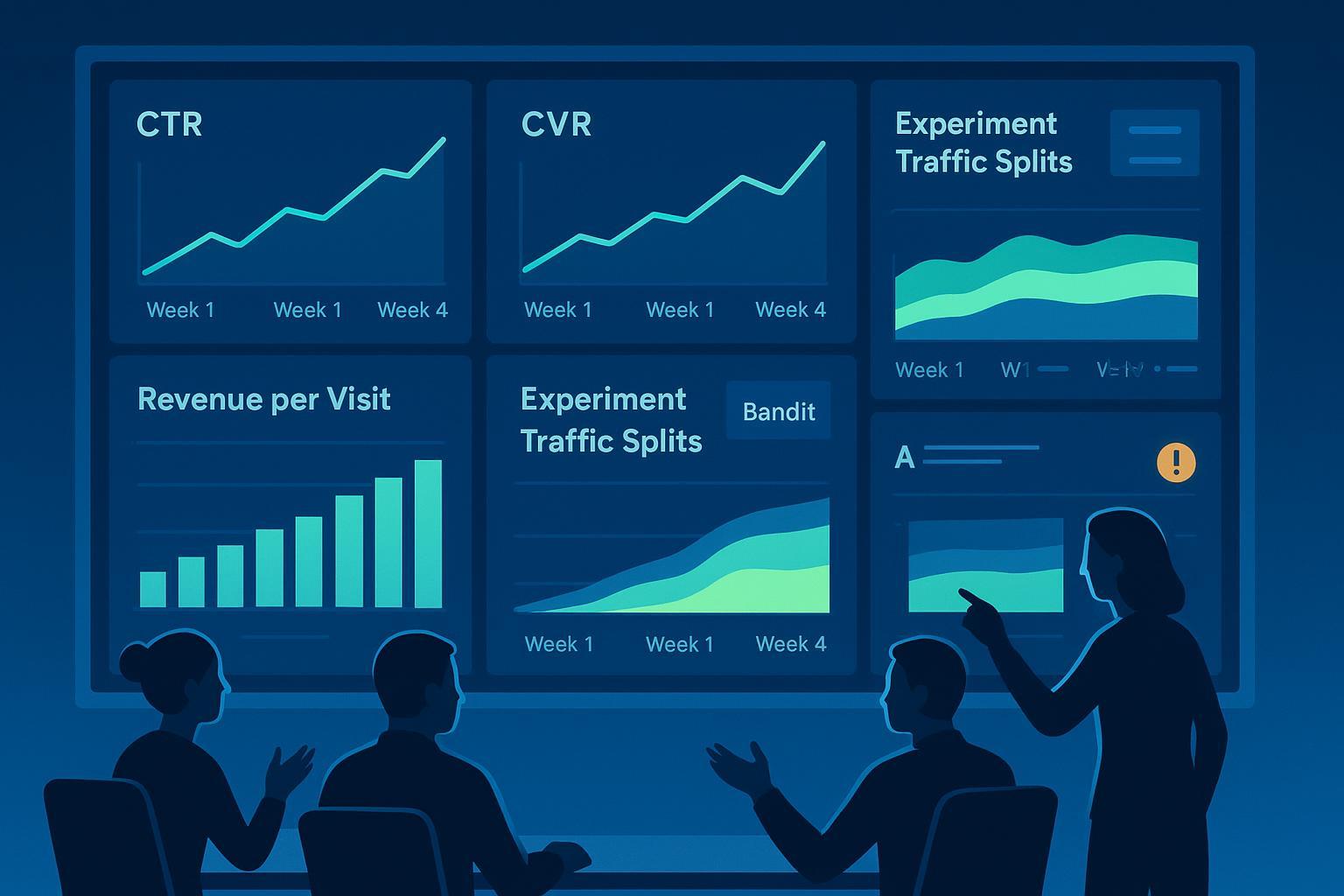
If you have 30 days to lift recommendation performance, you don’t have time for big rewrites or open‑ended research projects. You need a tight plan, fast instrumentation, and a clear finish line. This playbook lays out a week‑by‑week path to improve on‑site and in‑app recommendation rates while keeping risk low and compliance intact.
What “recommendation rate” actually means
Teams often chase clicks without tying them to business outcomes. In practice, you’ll monitor a small, connected set of KPIs:
- Engagement: click‑through rate (CTR) on recommendation widgets and surfaces
- Outcome: conversion rate (CVR), add‑to‑cart rate, or downstream success event
- Value: revenue per visit (or per session), average order value (AOV)
- System health: latency (P50/P95/P99), error rate, and coverage (what percent of users/items get quality recs)
Make the KPIs visible on day one. If you want a deeper methodology for choosing and validating these signals in AI contexts, see the overview in the LLMO metrics guide: Measuring accuracy, relevance, and personalization in AI systems.
The 30‑day plan (week by week)
Week 1: Data readiness, consent, baselines
Stand up clean interaction, item, and user tables with consistent IDs; validate required fields and timestamps. Confirm consent and tracking are legally sound (cookie/ID storage, profiling disclosures, opt‑outs), and wire logging so every recommendation impression and click is captured. Establish baselines for CTR/CVR and value metrics on your top surfaces (homepage, product page cross‑sell, cart upsell). If you’re using a managed platform, align schemas to the provider’s expectations and set business rules (e.g., hide items already purchased).
A practical starting point many teams execute in days is the “dataset group” and schema path in Amazon Personalize, which pairs clean data with quick training later. For reference, see the official workflow in the Amazon Personalize Getting Started guide (2024).
Week 2: Train, score, and pick a first deployable model
Choose a baseline recipe or architecture (e.g., a user‑personalization model or a simple two‑tower retrieval + lightweight ranker), train, and review offline metrics. Prepare both real‑time and batch inference paths. Keep feature scope lean: interaction history, a few content features, and obvious context (device, locale, time). Define an initial guardrail policy (blocked categories, minimum inventory/status checks) and a diversity constraint to prevent echo chambers.
Week 3: Progressive rollout on high‑impact surfaces
Ship to 10–20% of traffic on one or two high‑leverage placements. Start a clean control vs treatment A/B test. Log impressions, clicks, conversions, and latency. If your ranking changes are small and you need faster signal on preference, add an interleaving test on a subset of traffic where two models mix results within the same session to detect lift with fewer users. For practical guidance on experiment setup for recommenders, see the practitioner notes in Statsig’s 2025 perspective on A/B testing for recommender systems.
Week 4: Iterate with speed—and discipline
Tune blending (recency/popularity), tighten diversity, adjust cold‑start logic, and expand traffic only if lift holds and system health is stable. Use formal stopping rules and minimum sample sizes when deciding a winner, and keep a persistent control cell for guardrails. Adobe’s documentation provides simple traffic and sample‑size heuristics for decisioning in production personalization; see the Adobe Experience League guidance on Auto‑Target optimization (2025).
Quick wins you can stack early
- Cold start: Combine content features (title, category, embeddings) with collaborative signals; seed new users with lightweight preference prompts or contextual priors (locale/time) until interactions accrue.
- Freshness: Blend recency and overall popularity to avoid stale results; schedule frequent refreshes for fast‑moving catalogs.
- Diversity and novelty: Add a small novelty boost and a diversity constraint to avoid homogenization; track a diversity metric next to CTR.
- Business rules and safety: Pin strategic items, filter out do‑not‑suggest classes, and enforce inventory/price thresholds.
- Placement focus: Prioritize the few placements that drive the most revenue or engagement before spreading effort to long‑tail contexts.
Experimentation and MLOps that keep you fast—and safe
Move quickly, but never blind. Use a progressive rollout plan (e.g., 10% → 25% → 50% → 100%) with automatic rollback if CTR, CVR, or latency regress beyond thresholds. Interleaving helps detect subtle ranker gains faster; A/B remains the source of truth for causal impact. Bandit allocation is useful for multiple variants when you want to reduce regret, but make sure the reward aligns to business value, not just clicks. Monitor data drift and retrain on a daily or weekly cadence for volatile catalogs; keep feature definitions consistent between training and serving.
If you need a reference architecture you can implement inside a month, Amazon’s managed stack provides an end‑to‑end path from data ingestion to campaigns, with training often completing in hours (see the Getting Started link above). For stopping‑rule discipline and experiment hygiene, the Statsig and Adobe documents linked earlier offer pragmatic thresholds and pitfalls to avoid.
Micro case snapshot (and what realistic lift looks like)
One retailer example with public A/B metrics: Rossmann Hungary reported a 3.5× revenue increase, 2.5× more transactions, and a 30% AOV lift after switching their recommendation engine in a time‑boxed experiment. See the primary case detail in the Prefixbox Rossmann study (2024). Your mileage will vary by sector, surface, and baseline quality, but the lesson is consistent: focus on top placements, instrument properly, and iterate on relevance, diversity, and guardrails.
Monitoring AI surfaces and brand mentions (neutral example)
Disclosure: Geneo is our product. In a 30‑day sprint, you don’t just tune your on‑site engine—you also want to understand how AI answer engines reference your brand and content. As a neutral example, Geneo can monitor brand mentions and sentiment across ChatGPT, Perplexity, and Google AI Overviews so your team can see where recommendation‑style mentions and links appear, whether they’re favorable, and which queries trigger exposure. That context helps you prioritize surfaces and content types that influence AI‑driven discovery while your on‑site tests run. If “AI visibility” is new to you, this primer explains concepts and use cases: What is AI visibility? Brand exposure in AI search.
Troubleshooting: why lifts stall—and quick fixes
- Data gaps or sparsity: Backfill recent interactions, widen lookback windows, and add content features to support hybrid recommendations.
- Latency spikes: Cache top results, precompute embeddings, and separate retrieval (fast) from ranking (slightly heavier) to keep P95 in check.
- Noisy experiments: Freeze merch rules during tests, declare hypotheses upfront, and avoid mid‑test changes that pollute attribution.
- Homogeneous results: Increase diversity penalties slightly and add novelty rotation; watch long‑term engagement alongside CTR.
- Compliance blockers: Verify consent flows and profiling disclosures; keep an opt‑out path and document guardrails and rollback.
Why this works in 30 days
You’re combining three forces: clean signals, a deployable baseline model, and disciplined online learning. Think of it this way: Week 1 makes the data trustworthy; Week 2 builds a model you can ship; Week 3 gets real traffic and feedback; Week 4 uses that feedback to harden the system and scale. Could you spend months tuning embeddings and architectures? Sure—but will that beat a tight 30‑day loop focused on your highest‑impact placements?
Wrap‑up
A credible 30‑day lift is about focus, not magic. Define KPIs that tie to value, ship a baseline fast, experiment on the placements that matter, and keep a feedback loop running with guardrails. As you scale, extend the same discipline to more surfaces, richer features, and stricter monitoring. When you can show both engagement and revenue‑aligned lift, you’ve earned the right to invest in deeper model work.