
How to Build Trust Signals for AI Recommendations (2025)
Best practices for building trust signals to boost visibility in AI recommendations. Actionable strategies for Google, ChatGPT, Perplexity & advanced E-E-A-T compliance.
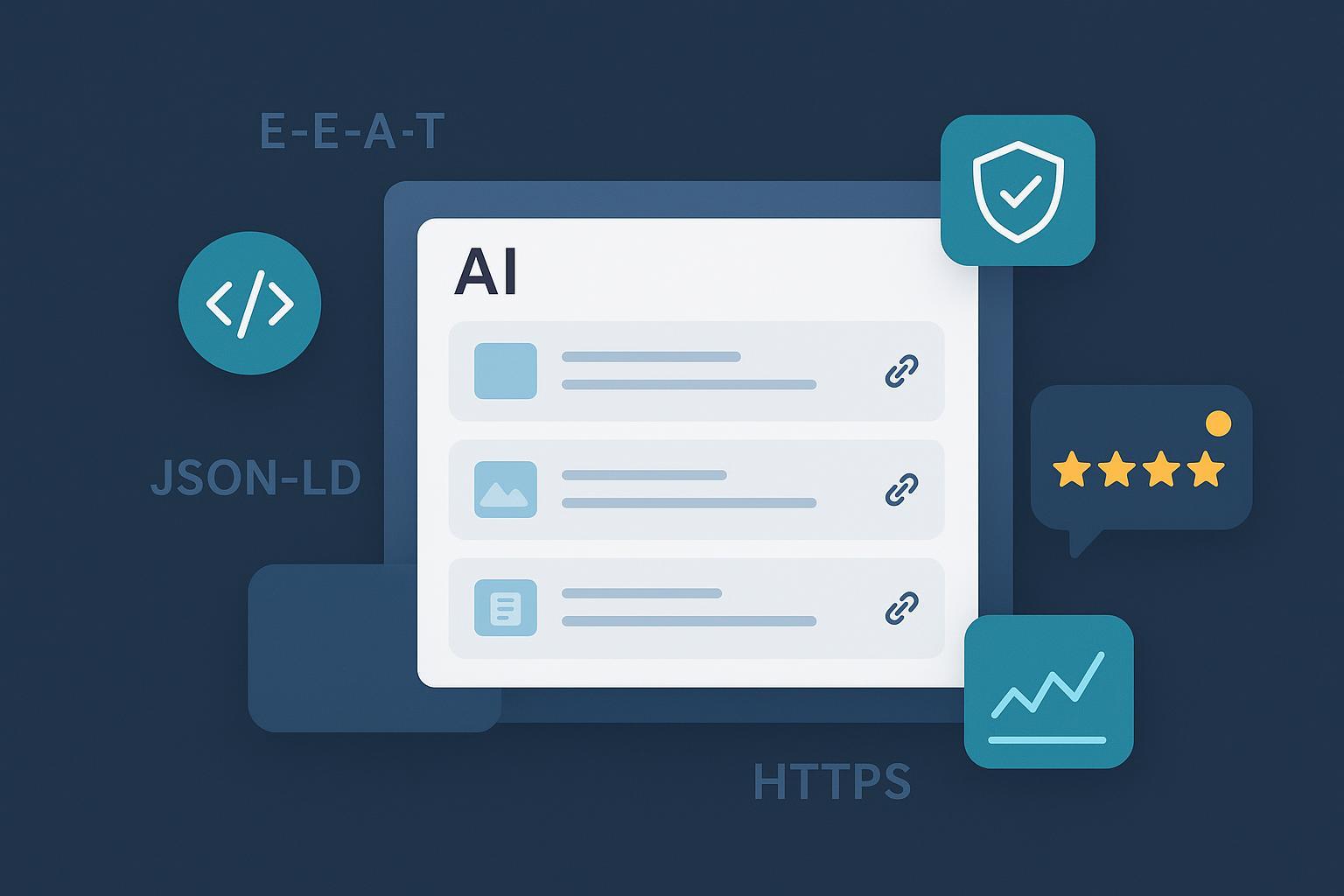
If AI systems are the new “front door” to discovery, what convinces them—and your buyers—that your brand deserves a prominent recommendation? Trust isn’t a single badge. It’s a stack of signals that machines can verify and people can feel.
This guide distills what senior marketers and digital leaders can implement in the next 90 days to strengthen trust signals across Google’s AI experiences, ChatGPT Search, Perplexity, and Copilot—without fluff.
What AI systems treat as trustworthy right now
Google’s latest guidance emphasizes E‑E‑A‑T and helpful, original content as the foundation for visibility across classic search and AI surfaces. In May 2025, Google reiterated that brands should publish firsthand expertise, clear authorship, citations to reputable sources, and maintain strong page experience signals, as outlined in its advice on succeeding in AI search experiences in Google’s Succeeding in AI Search (May 2025).
In simple terms, AI systems favor sources that:
- Declare who they are and who wrote the content.
- Provide evidence, citations, and original perspective.
- Are machine-readable via structured data.
- Load fast, are secure (HTTPS), and accessible.
If you’re new to AI visibility concepts, this background primer helps map the landscape without duplicating definitions: see the internal explainer on acronyms and frameworks in Decoding GEO, GSVO, GSO, AIO, LLMO.
A six‑layer framework for AI trust signals
Think of trust as a layered system. Each layer reinforces the others; together they add up to credible, machine‑verifiable identity and evidence.
1) Identity layer
Your entity must be unambiguous to machines and humans. Use Organization schema with legal name, logo, contact points, and sameAs links to canonical profiles (LinkedIn, Crunchbase, Wikipedia if applicable). Maintain author bio pages tied to real people and link their external profiles with Person schema. Keep brand style and NAP (name, address, phone) consistent across major directories.
A compact JSON‑LD example tying Organization and Article authorship together:
[
    {
      "@context": "https://schema.org",
      "@type": "Organization",
      "name": "Example Brand, Inc.",
      "url": "https://www.example.com",
      "logo": {
        "@type": "ImageObject",
        "url": "https://www.example.com/logo.png"
      },
      "contactPoint": [{
        "@type": "ContactPoint",
        "contactType": "customer support",
        "email": "support@example.com"
      }],
      "sameAs": [
        "https://www.linkedin.com/company/example",
        "https://twitter.com/example"
      ]
    },
    {
      "@context": "https://schema.org",
      "@type": "Article",
      "headline": "How to Choose a B2B CRM",
      "author": {
        "@type": "Person",
        "name": "Alex Rivera",
        "sameAs": ["https://www.linkedin.com/in/alex-rivera/"]
      },
      "datePublished": "2025-09-15",
      "publisher": {
        "@type": "Organization",
        "name": "Example Brand, Inc."
      }
    }
  ]
Validate with Google’s Rich Results Test and ensure the markup reflects visible content and real people.
2) Evidence layer
Claims need receipts. Publish original data, methods, and precise citations. Attribute quotes and statistics inline with links to primary sources. Where you have certifications or awards, state them on relevant pages and mirror them in schema (award, certification) when appropriate. Authors should explain their direct experience—what they did, what they measured, and what changed.
3) Reputation layer
Third‑party validation travels farther than self‑praise. Encourage named‑user reviews on platforms your buyers consult. A widely cited study found substantial consumer skepticism below three stars; building credible volume matters, not just averages, as reported in the BrightLocal Local Consumer Review Survey 2024. Publish a public review response policy and respond within defined SLAs. Showcase independent awards, partnerships, and media mentions—then connect them via sameAs and award schema so machines don’t miss the context.
4) Technical hygiene layer
Secure the basics so nothing undercuts your authority. Adopt HTTPS everywhere, maintain healthy Core Web Vitals, and pass accessibility checks. Keep URLs clean and indexable. Because ChatGPT Search and Copilot rely on Bing’s index for web retrieval, confirm Bing indexation alongside Google. Broken breadcrumbs, slow scripts, or noisy interstitials are small things that make a big dent in perceived trust.
5) Transparency and compliance layer
Disclose material connections in endorsements and follow the rules for reviews. The U.S. FTC now enforces a dedicated Consumer Reviews and Testimonials Rule that bans fake or suppressed reviews and undisclosed insider testimonials; penalties are real. Review the requirements and examples in the FTC Consumer Reviews & Testimonials Rule Q&A (2024). For AI‑assisted content and media, adopt provenance practices. Content Credentials (C2PA) provide a visible “nutrition label” for how an asset was created and edited; adoption is growing across creative tools, as described in Adobe’s overview of Content Credentials (2024).
6) Measurement layer
If you can’t measure inclusion and sentiment, you can’t improve them. Track how often AI systems cite your domain, whether your links appear prominently or as footnotes, and whether AI summaries describe you positively. Monitor review health (average rating, velocity, response time) and schema coverage across critical pages. Tie changes back to publishing cadence and technical updates so you can infer cause and effect.
Disclosure: Geneo is our product. For teams that want a single place to monitor AI citation share of voice across ChatGPT, Perplexity, and Google’s AI experiences, plus sentiment in AI answers and schema coverage trends, a purpose‑built tracker reduces manual spot‑checking. You can also explore internal explainers on AI visibility fundamentals and monitoring nuances in AI Visibility for Brands and the cross‑engine differences outlined in ChatGPT vs. Perplexity vs. Gemini vs. Bing: Monitoring Comparison.
Cross‑platform nuances (ChatGPT Search, Perplexity, Copilot)
No AI provider publishes a full rulebook for how sources are chosen, but several public signals guide us:
- ChatGPT Search emphasizes web retrieval with visible citations; OpenAI’s announcement highlights improved source surfacing and browsing behavior in Introducing ChatGPT Search (Oct 2024). Ensure indexability, answer‑first pages, and credible author bios.
- Perplexity consistently shows inline citations and prioritizes concise, directly relevant pages. Its terms underscore citation and verification norms, as noted in the Perplexity Terms of Service. Q&A‑style headings, FAQ/HowTo schema, and clean URLs help machines map question-to-answer.
- Microsoft Copilot leans on Bing’s index. Align with Bing SEO hygiene: fast pages, structured data, and authoritative references.
Across all three, the through‑line is consistent: create verifiable, machine‑readable answers written by identifiable experts, hosted on fast, secure pages.
Negative‑signal defense and resilience
Two threats can quietly erode your trust posture. First, site reputation abuse: hosting low‑value third‑party content that rides on your domain’s authority. Google expanded spam policies in 2024 and clarified enforcement later that year; audit and either elevate or remove third‑party sections that aren’t aligned with your editorial standards and core purpose. Details and definitions are in Google’s policy updates on site reputation abuse (Nov 2024).
Second, fake or mishandled reviews: never post or solicit fabricated reviews, never suppress the negative, and document your moderation process. The FTC’s 2024 rule makes this a compliance and financial risk as well as a trust risk; use the guidance linked above to train teams and vendors.
When misinformation appears about your brand, act quickly but with empathy. Publish a corrective on owned channels, cite third‑party sources, and ask partners to update outdated references. Measured, transparent responses compound your reputation even when the news cycle is messy.
Your 90‑day execution playbook
-
Weeks 0–2: Baseline and prioritize
- Inventory entity coverage (Organization/Person schema), author bios, and bylines; validate with Rich Results Test.
- Crawl for indexability issues, HTTPS gaps, and CWV failures; document high‑impact fixes.
- Capture AI citation share of voice, answer prominence, and stance across target queries; snapshot review averages, volume, and response times.
-
Weeks 3–6: Ship the trust layers
- Publish or update author bios with credentials and external profiles; add source citations and methods to top content.
- Implement/repair Organization, Person, Article/Product/Review schema; link awards/certifications; standardize breadcrumbs and contact pages.
- Launch or refine your public review policy; begin a compliant review acquisition program targeting named reviews on priority platforms.
- Add clear disclosures for endorsements; label AI‑assisted media with Content Credentials where feasible.
-
Weeks 7–12: Measure, iterate, and harden
- Re‑run AI citation and sentiment checks; correlate with content updates and technical fixes.
- Address negative signals: remove low‑value third‑party pages; improve or de‑index thin content.
- Improve page performance and accessibility on underperforming templates; confirm Bing indexation for key pages.
- Publish a quarterly trust report to stakeholders with actions, outcomes, and next bets.
| KPI | What to track | Cadence | Decision use |
|---|---|---|---|
| AI citation share of voice | Percent of target answers citing your domain on ChatGPT, Perplexity, Copilot, Google AI experiences | Weekly/Monthly | Prioritize content/topics with low share; test formats |
| Prominence & stance | Primary vs. footnote citations; positive/neutral/negative descriptors | Weekly/Monthly | Escalate content refresh or add evidence where stance is weak |
| Schema coverage | % of key pages with valid Organization, Person, Article/Product/Review schema | Monthly | Fix markup gaps; add missing author and sameAs links |
| Review health | Avg rating, review volume, named-user share, response SLAs | Weekly/Monthly | Adjust acquisition and response ops; address recurring issues |
| Page experience | CWV pass rate, HTTPS coverage, accessibility scores | Monthly | Prioritize template-level performance and accessibility fixes |
Final thoughts
Trust signals aren’t a veneer you apply at the end—they’re the structure your brand is built on. The win isn’t just inclusion in an AI answer; it’s being cited, described accurately, and remembered. Start with identity and evidence, harden the technical and compliance layers, and report relentlessly. In a world where AI systems summarize everything, the brands that show their work—clearly and verifiably—get recommended more often. Ready to start? Run your baseline audit this week and commit to shipping improvements every Friday for the next three months.