
Brandlight vs Profound: GEO/AEO Benchmark Comparison (2025)
2025 executive guide: Benchmarking Brandlight vs Profound for emerging AI query topics. Includes TtFA, cross-engine coverage, and decision metrics for CMO leaders.
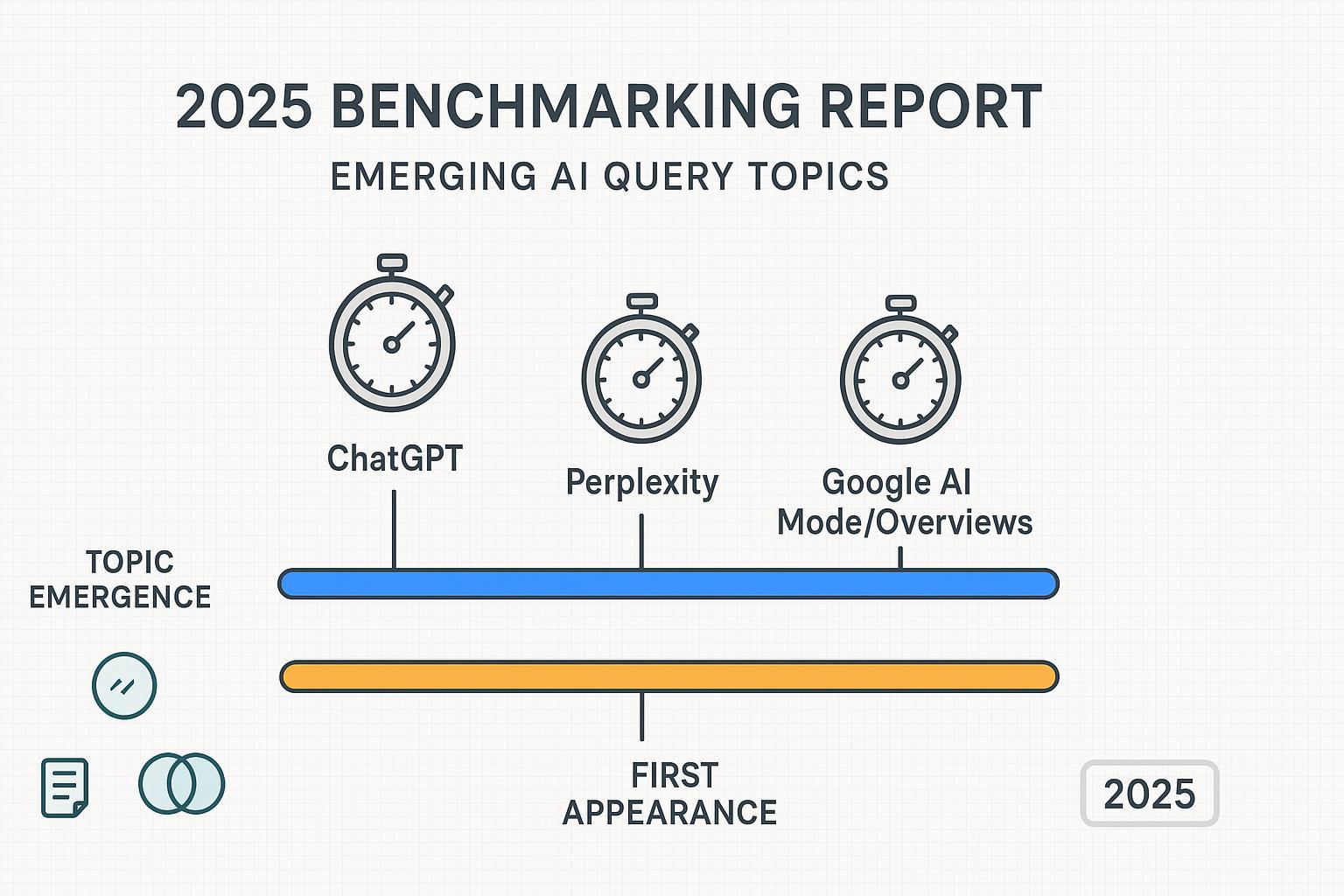
For brand leaders, the first 24–72 hours of a fast-moving topic can shape perception for months. If your brand isn’t present in early AI answers, competitors—or worse, incorrect narratives—fill the void. That’s why we center our benchmarking around one question: how quickly do platforms help a brand show up, with evidence, in answers generated by engines like ChatGPT, Perplexity, and Google’s AI Mode/Overviews?
Time-to-First-Appearance (TtFA) is the metric we use to answer that question. It measures the elapsed time from a topic’s emergence to the first citation or mention of your brand in AI answers, per engine and in aggregate. Shorter TtFA means earlier share of voice, better narrative control, and faster revenue capture on trending queries.
What counts as an “emerging AI query topic” in 2025
In this article, “emerging topic” means a source-novelty event: the topic first appears across at least N engines within a short window and the answers draw on newly crawled, real-time web sources rather than only historical training data. Google’s 2025 updates describe how AI Mode draws on fresh sources via query fan-out, the Knowledge Graph, Shopping Graph, local and live feeds—capabilities outlined in Google’s own explanation of AI Mode’s rollout and sourcing. See Google’s overview in Expanding AI Overviews and introducing AI Mode (2025) for details on real-time sourcing mechanics: Google: AI Mode announcement (2025).
For readers new to the space, we use “AI visibility” to refer to how consistently a brand appears—with links, mentions, or product placements—inside answers across engines. For a deeper primer, see our concise explainer: AI visibility: what it is and why it matters.
How we benchmark: a TtFA‑first methodology (with supporting metrics)
Disclosure: Geneo is our measurement framework for this analysis. We use it to monitor, time-stamp, and report on multi-engine answers and citations while keeping evaluation criteria transparent and repeatable.
Here’s the core of the method.
TtFA (lead metric): We time-stamp topic “emergence” in UTC when ≥N engines output answers on that topic within a short window and those answers cite fresh web sources. We then measure the elapsed time to the first brand/domain mention or citation in each engine’s answers. We report per-engine TtFA and an optional weighted composite.
Supporting metrics: We capture cross-engine overlap (how consistently a brand is included across engines for the same topic), normalized citation/mention rate, share of voice, and sentiment distribution. These clarify whether early appearances are isolated or durable across engines.
Evidence capture: For auditability, we store answer snapshots/logs with timestamps and the cited links. This makes it easier to defend findings with boards or legal teams when needed.
If you’re comparing engine behaviors in parallel, it helps to understand how they differ in freshness and sources. Our overview of cross-engine monitoring sheds light on practical differences: Monitoring ChatGPT vs. Perplexity vs. Gemini vs. Bing: what to expect.
Comparison snapshot: Brandlight vs. Profound (public signals in 2025)
The table below summarizes publicly stated capabilities, with a focus on what matters for emerging topics. Neither vendor publishes TtFA as an official metric; that’s why we measure it independently.
Dimension | Brandlight | Profound |
|---|---|---|
Engine coverage (examples) | Public pages claim monitoring across “11 top AI engines,” explicitly including ChatGPT, Google AI (Overviews/Mode), Gemini, Perplexity (Brandlight site) | Official content cites support for 10+ engines: ChatGPT, Claude, Perplexity, Google AI Overviews/Mode, Gemini, Copilot, DeepSeek, Grok, Meta AI (Profound features) |
Notable modules | Real-time monitoring, citations, sentiment, share of voice, source attribution, competitor benchmarking | Prompt Volumes (AI search volume), Answer Engine Insights, Agent Analytics (server‑log/bot analytics), ChatGPT Shopping, workflows and integrations (Profound features) |
Case studies & customers | Enterprise positioning; site leans on testimonials and partnerships; limited public case studies; funding covered by Adweek (Adweek on Brandlight funding) | Multiple public case studies and customer logos; e.g., 1840 & Co. case reports measurable AI visibility gains (Profound: 1840 & Co. case) |
Pricing posture (public) | Undisclosed on site; enterprise/white‑glove engagement | Tiers referenced in blog content and site copy; pricing page lists options without dollar amounts |
TtFA published by vendor? | Not published | Not published |
Cross‑engine overlap metric published? | Not published | Not published |
Two context notes for CMOs:
Brandlight emphasizes enterprise orientation and broad engine claims on its public pages, along with partnerships and executive‑level messaging. See the official site for positioning and capabilities: Brandlight homepage.
Profound surfaces more hands‑on modules and customer narratives, including a shopping‑focused path inside ChatGPT. Its feature pages outline technical integrations and measurement workflows: Profound’s Agent Analytics.
What “good” looks like for TtFA on emerging topics
TtFA is the headline, but speed without consistency can be misleading. A strong program pairs fast first appearances with cross‑engine coverage and verifiable citations. Think of it like securing beachheads on multiple shores—winning early matters, yet holding them across engines determines lasting share of voice.
Practically, the hallmarks of a mature TtFA program are straightforward: a well‑curated watchlist, disciplined UTC time‑stamping, and a normalization plan for engines that answer at different cadences. Also, you’ll want a plan for overlap analysis; it’s the difference between a lucky early hit and a repeatable presence across the engines your customers actually use.
Decision scenarios for CMOs
Every organization will weight scenarios differently, but these are the most common trade‑offs we see in 2025.
Rapid TtFA for reputation defense or launch windows: If your priority is to show up in the first wave of answers, evaluate how quickly each platform helps you detect fresh sources and nudge those signals into engines that cite. Ask: Which workflows shorten the gap from topic emergence to your first cited appearance across multiple engines?
AI commerce and shopping visibility: Profound provides specific modules for ChatGPT Shopping and related commerce flows on its site. If AI‑assisted shopping queries are core to your roadmap, pressure‑test those paths with time‑stamped prompts and look for cited product detail pages, pricing, and availability in early answers.
Governance, audit trail, and board‑ready reporting: Enterprise teams often need legally defensible logs, sentiment tracking by engine, and clean executive visuals. Scrutinize how each vendor captures and exports evidence for reviews and board materials.
Global launches or crisis response: When topics go global, engines may surface localized sources at different speeds. You’ll want evidence that first appearances are not just fast in one market but reasonably consistent across the engines that dominate each region.
Limitations and what we didn’t measure here
No vendor publishes TtFA or cross‑engine overlap as formal, standardized metrics today. Public pricing is partial. Engine behaviors evolve quickly as policies and models update. That’s why we recommend treating any snapshot as directional and pairing it with a short, well‑scoped pilot that mirrors your risk and growth priorities.
If you want a sense of how engines differ and why measurements vary, our broader review of multi‑engine monitoring context is helpful: Geneo review: AI search visibility tracking.
Run a fair 30‑day pilot: a simple checklist
Define a watchlist of 10–20 emerging topics tied to launches, category news, or regulatory shifts; include a few control topics.
Set your emergence rule (e.g., first appearance across ≥3 engines within 24 hours with fresh web citations) and log in UTC.
Capture TtFA per engine, plus citation counts, share of voice, and overlap; store answer screenshots and links.
Compare week‑over‑week; watch for consistency and sentiment shifts as topics mature.
Document limitations (missed answers, rate limits, model updates) to keep the board conversation grounded.
Also consider: measurement and reporting
Geneo can serve as the neutral measurement and reporting framework that underpins a side‑by‑side pilot of Brandlight and Profound across engines, with executive‑grade logs, visuals, and white‑label options for agencies. Disclosure: Geneo is our product. Learn more here: Geneo platform overview.
Closing thought
If the next topic that matters to your brand took shape tonight, would you be cited in tomorrow’s answers—and would that presence hold across multiple engines? That’s the real test. Build your bench around TtFA, validate it with overlap and sentiment, and keep your audit trail tight. The brands that prepare now won’t just respond faster—they’ll own the early narrative when it counts most.