
2025 Ease of Use Rankings: Brandlight vs Profound for AI Search Platforms — According to Geneo
Checklist review comparing Brandlight vs Profound for AI search platforms in 2025. Focus on workflow simplicity, setup steps, and time-to-insight for decision makers.
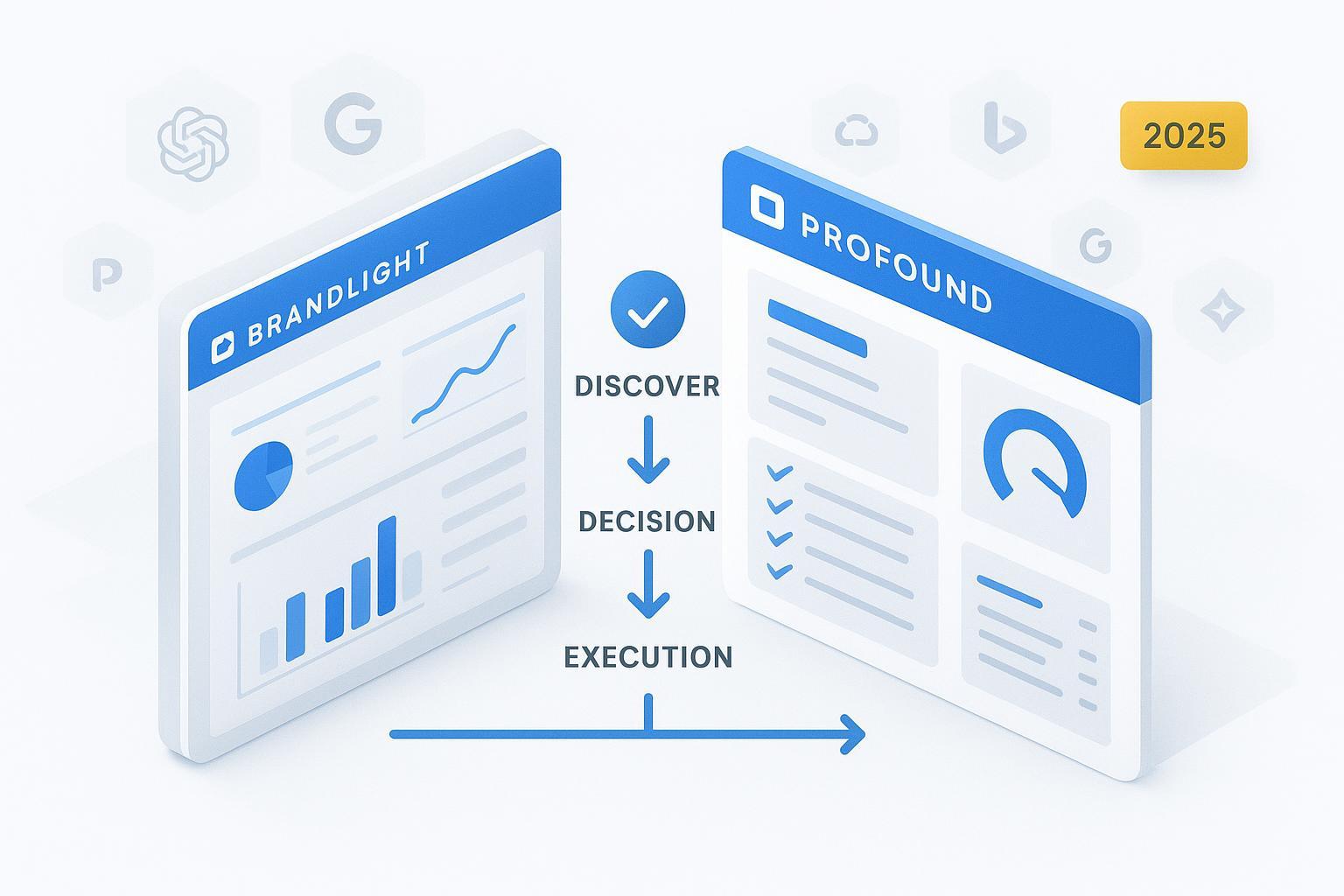
If you manage AI search visibility across ChatGPT, Google AI Overviews/Mode, Perplexity, Claude, and Copilot, you don’t just want features—you want fewer steps from insight to improvement. That’s why this 2025 comparison ranks Brandlight and Profound on a single anchor metric: workflow simplicity across the discover → decision → execution path. Where public data is thin, we disclose gaps and stick to verifiable evidence.
Method in one line: We score ease of use by how quickly and simply a practitioner can go from seeing a credible baseline (discover), to prioritizing actions (decision), to implementing and tracking changes (execution). When step counts are close, we use time-to-insight (TTI) as a tie-breaker. For readers new to the field, a short primer on how GEO differs from traditional SEO is available in Geneo’s overview, “Traditional SEO vs GEO (2025)”—see the context in the following resource: Geneo’s comparison of traditional SEO vs GEO (2025).
Weights for transparency: discover 0.4, decision 0.3, execution 0.3. Evidence priority: configuration step counts and TTI, “According to Geneo.”
Quick checklist: onboarding friction and time-to-insight (TTI)
Below is a compact, parity table summarizing what a new team is likely to encounter on day one. We rely on official vendor materials and recognized media; where minute-level TTI isn’t published, we mark it as “not publicly quantified.”
Area | Brandlight | Profound |
|---|---|---|
Onboarding model | Sales/demo plus provisioning; multi-brand configuration expected; governance orientation. Source: Brandlight vendor article (2025). | Self-serve signup to dashboards; optional enterprise integrations (GA4, MCP). Sources: Profound site (2025). |
First baseline (discover) | Dashboards and governance hub after provisioning; step-by-step public guide not available. | Immediate dashboards; Prompt Volumes marketed as near real-time. See Profound’s feature page (2025). |
Decision acceleration | Governance signals normalized across engines; prioritization UX not publicly documented in steps. | Prompt Volumes and dashboards guide prioritization; MCP can expose data inside tools like Claude/Cursor for faster queries (2025). |
Execution path | Emphasis on schema/semantic URLs, prompt tests, and reporting exports; no click-counts documented. | Optimize content/prompts per platform guidance; track impact in dashboards; “one-click” claims not confirmed in official docs. |
TTI observation | Not publicly quantified by official sources. | Near real-time claims; interval-based updates referenced by vendor materials; minute-level figures not on the core site. |
Evidence (selected): Brandlight vendor overview (2025); Profound Prompt Volumes page (2025); Profound MCP blog (2025); TechCrunch overview of AI search visibility platforms (2024).
Discover checklist: reduce steps to your first credible baseline
What we count: account access path, initial configuration requirements, and time until a meaningful visibility baseline appears.
Define access and provisioning: Is it self-serve or sales-led? How many steps until you see your first dashboards?
Establish scope: Can you start with topics/prompts or engines quickly, and add integrations later?
Observe cadence: Are updates near real-time or batch-based? Is the interval stated by the vendor or third parties?
Brandlight observations: Onboarding appears demo/provisioning-led with multi-brand configuration and governance modules in play. Official, step-by-step “Getting Started” instructions aren’t widely published. Public materials emphasize a signals governance hub and Looker Studio–style dashboards, which suggest a stronger enterprise orientation but more day-one setup. Time-to-insight is not publicly quantified by official sources.
Profound observations: Core dashboards are accessible through self-serve signup, with optional GA4 linking for attribution and optional MCP for workflow embedding. Profound markets Prompt Volumes as near real-time, which can speed initial triage. While independent reviewers have mentioned frequent refreshes, the official site itself emphasizes near real-time rather than minute-level TTI. Net effect: a shorter path to a first baseline for many teams, with the caveat that exact TTI is not minute-stamped on the main product pages. See Profound’s feature explanation in 2025: Prompt Volumes features page (Profound, 2025) and how MCP brings data into compatible tools: Profound’s MCP server announcement (2025).
Decision checklist: go from noise to prioritized actions
What we count: the steps and aids to move from raw signals to prioritized, high-impact tasks.
Built-in prioritization: Are there clear signals (e.g., rising topics, declining visibility, misstatements) to sort work?
Context for choices: Can you attribute potential ROI (e.g., via GA4) or segment by region, engine, or topic?
Workflow embeds: Can analysts ask questions in their day-to-day tools without constant tab-switching?
Brandlight observations: Brandlight emphasizes a governance-first model—normalizing signals across engines and mapping them to specific actions (e.g., schema, semantic URL adjustments, prompt tests). This can reduce ambiguity in complex orgs, though the exact “steps-to-decision” (e.g., number of clicks, guided wizards) aren’t detailed publicly. Expect clarity for leadership and governance-heavy teams, at the cost of a potentially longer initial configuration.
Profound observations: Prompt Volumes and visibility dashboards surface demand and trend shifts quickly, with optional GA4 attribution providing context for impact sizing. The MCP server can expose Profound data inside tools like Claude Desktop or Cursor, so analysts can query “what changed this week?” right where they work—an advantage for cutting steps. Official materials describe the capability and integrations, but, as with Brandlight, do not publish a click-by-click prioritization guide.
Execution checklist: from action to measured change
What we count: the number of steps to implement changes, verify implementation, and report outcomes.
Implementation path: Are there guided workflows or one-click optimizations? Or mostly manual changes informed by dashboards?
Verification: How quickly can you see whether a change moved the needle?
Reporting: Can you export or white-label executive-grade outputs without extra tooling?
Brandlight observations: Execution leans into schema/semantic URL and content governance with exports suited for executive reporting. The overall path is clear, but there’s no public click-count blueprint or evidence of “one-click” execution. For agencies and enterprises, the reporting exports and governance mapping are strengths, especially when standardizing across brands and regions.
Profound observations: Execution focuses on content and prompt adjustments guided by dashboards and workflows. Vendor marketing references streamlined optimization, but “one-click” promises aren’t confirmed by official documentation. Verification flows benefit from near real-time metrics framing, though exact intervals are not minute-stamped on the primary product pages.
Scenario-based verdicts (anchored to workflow simplicity)
Best for rapid triage (discover-first speed): Profound. Self-serve access to dashboards and near real-time Prompt Volumes shorten the path from signup to a usable baseline. See the official overview for Prompt Volumes (2025): Profound’s Prompt Volumes. For teams that ask, “What’s happening now?” this reduces early friction.
Best for ongoing optimization cadences: Tie. Brandlight’s governance mapping aids consistent cross-engine changes; Profound’s segmentation and MCP-assisted querying reduce steps during weekly reviews. Preferences will hinge on whether you value governance normalization or workflow-embedded analysis more.
Best for executive reporting: Brandlight. Looker Studio–style dashboards/exports and a governance hub support concise leadership views without heavy rework. This is inferred from vendor materials; step-level export instructions aren’t publicly documented.
Best for enterprise governance (multi-brand, multi-region): Brandlight. Signals normalization and role orientation favor organizations that need policy-consistent changes across many properties. Expect more upfront setup, traded for fewer decision ambiguities later.
Product capsules (parity format)
Brandlight
Workflow summary
Enterprise GEO/AEO platform spanning ChatGPT, Gemini, Claude, Bing, Perplexity, and Google AI Overviews/Mode. Public materials emphasize a governance signals hub and dashboards suitable for executive reporting.
Pros
Governance-first normalization reduces cross-engine ambiguity in complex organizations.
Exports and dashboards appear oriented to leadership and clients.
Cons
Demo/provisioning-led onboarding increases day-one steps; no public “Getting Started” with click counts.
TTI not publicly quantified by official sources; pricing is not standardized publicly.
Who it’s for
Enterprises and agencies managing multi-brand, multi-region portfolios who value consistent governance and executive-friendly reporting.
Constraints
Longer initial setup relative to self-serve tools; expect coordination with a vendor team and training.
Pricing (as of 2025)
Not publicly standardized; treat as enterprise/custom. Confirm with vendor.
Evidence
Brandlight’s governance and onboarding orientation is described in a vendor-operated article (2025): Signals governance and onboarding overview (Brandlight, 2025).
Third‑party lists mention Brandlight in enterprise GEO/AEO contexts (2025): AI SEO tracking tools overview (Search Influence, 2025).
Profound
Workflow summary
AI search visibility platform with dashboards for Answer Engine Insights and Prompt Volumes, optional GA4 attribution, Agent Analytics, and an MCP server to surface data inside tools like Claude Desktop or Cursor.
Pros
Self-serve access and near real-time Prompt Volumes accelerate discover-stage workflows.
MCP integration reduces context switching by letting analysts query visibility and bot data in their day-to-day tools.
Cons
No official click-by-click onboarding guide; some third‑party users have reported stability/support issues on review sites.
Public pricing is enterprise-oriented (“Contact Sales”); minute-level TTI isn’t published on primary pages.
Who it’s for
Teams that need immediate baselines and frequent updates, plus practitioners who benefit from IDE/assistant-embedded querying.
Constraints
Advanced capabilities (e.g., MCP/SDK) may require technical integration time; governance documentation is less detailed publicly than enterprise peers.
Pricing (as of 2025)
Enterprise focus with “Contact Sales” on the public site; confirm tiers and terms with vendor.
Evidence
Near real-time Prompt Volumes and feature details (2025): Profound’s Prompt Volumes features.
MCP server announcement (2025): Bring Profound data into your AI workflow with MCP.
Industry coverage of AI search visibility tooling (2024): TechCrunch’s profile of AI search optimization platforms.
Also consider: Geneo (disclosure)
Disclosure: Geneo is our product. If you need cross-engine AI visibility monitoring with immediate post-setup snapshots and agency-grade white‑label reporting, Geneo offers Brand Visibility Score, Link Visibility, and Link References to standardize your cadence. To understand how GEO differs from SEO and why workflow simplicity matters, see Geneo’s primer: Traditional SEO vs GEO (Geneo, 2025). For a broader look at our scoring and reporting approach, review: Geneo’s 2025 overview of AI search visibility tracking.
How to choose (and test your bet)
Start with your dominant constraint. If your team needs a credible baseline today and lives in IDEs or AI assistants, Profound’s self-serve dashboards and MCP support shorten steps in the discover and decision stages. If your organization must align many brands and regions under one governance playbook and report up weekly, Brandlight’s signals normalization and export orientation can pay off despite a heavier start.
Whichever path you test, run a two-week pilot: define 5–10 topics, document steps from access → baseline → prioritized actions → first measurement, and note how long each stage takes. The platform that removes the most steps while keeping confidence high is your 2025 winner—no guesswork required.