
Why “Brand Examples” Matter More Than Keywords
Discover why brand examples drive higher clicks and trust in SEO and AI search. Learn 2025 best practices, KPI benchmarks, and tactics for branded search visibility.
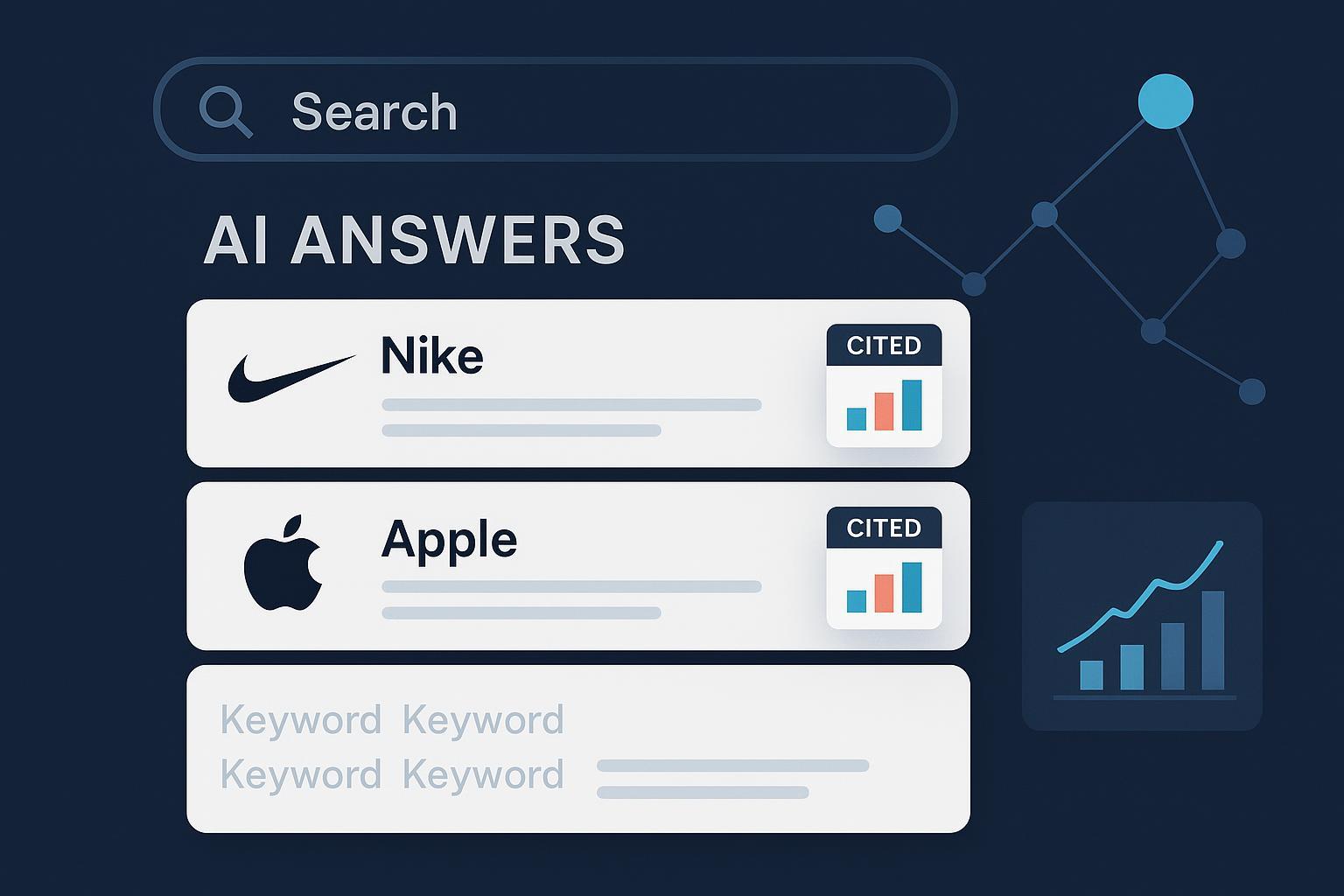
If AI answers and zero-click results are siphoning your hard-won traffic, ask yourself: when a buyer searches, are they seeing your name—or just your keywords? In 2025, search systems and buyers gravitate to trusted entities and proof, not strings of text. That’s why “brand examples” (named, citable stories, data, and entities) outperform generic keywords across classic SEO, paid search, and AI answer engines.
From keywords to entities: how selection actually happens
Search used to be about matching terms. Today, engines resolve queries to entities—people, products, companies—and choose which entities to cite. Google’s public docs describe how the Knowledge Graph and related systems connect content to entities, while selection quality is reinforced by E‑E‑A‑T signals (experience, expertise, authority, trust). In practice, the pages that win are those that unambiguously represent a trustworthy entity and offer concrete, quotable material.
AI Overviews (AIO) amplified this shift. Google expanded AIO in 2024 and continued rollouts in 2025, changing the layout and what gets clicks, as Google confirmed in its May 2024 AIO announcement. When the answer box appears, users scan a few cited brands and sources; if you aren’t one of them, your “keyword relevance” rarely saves you.
Proof it works: what the data says
Public, apples-to-apples branded vs. non‑branded datasets are limited, but the strongest 2024–2025 evidence points the same way.
- In B2B Google Ads, Dreamdata’s 2024 cohort study found ROAS of 1299% for branded terms versus 68% for non‑branded, with CPC roughly €5.5 vs €21.1—and yet most budgets still favor non‑brand. See the study: Dreamdata – Branded vs Non‑Branded in B2B Google Ads (2024).
- As AIO has become common, independent tracking shows lower organic CTR when AIO appears, but brands cited inside AIOs get outsized gains. Seer Interactive’s Sept 2025 panel observed organic CTR around 0.64% with AIO vs 1.62% without; when a brand is cited inside AIO, they saw roughly +35% organic CTR and +91% paid CTR uplift relative to non‑cited peers. Read the analysis: Seer Interactive – AIO Impact on CTR (Sept 2025).
- AIO prevalence is material. seoClarity estimated AIOs on about 30% of U.S. desktop queries in 2025. Source: seoClarity – AI Overviews Impact Research (2025).
Put simply: when AI answers show, being named as a brand example swings outcomes.
| Context | Branded performance (indicative) | Non‑branded performance (indicative) | Primary source |
|---|---|---|---|
| Google Ads (B2B) ROAS | 1299% | 68% | Dreamdata (2024) |
| Google Ads CPC (B2B) | ~€5.5 | ~€21.1 | Dreamdata (2024) |
| Organic CTR with AIO | If brand cited: +35% vs non‑cited | Baseline with AIO ~0.64%; without AIO ~1.62% | Seer Interactive (2025) |
| AIO prevalence | ~30% of U.S. desktop queries | — | seoClarity (2025) |
Note: Methodologies vary and some figures are directional, but the pattern holds across channels: named brands get the click, the trust, and the conversion.
What makes a strong “brand example”
A brand example isn’t a tagline or a feature list; it’s a credible, specific artifact that an AI or human would cite. Think of it like a well‑labeled specimen in a museum—clear identity, provenance, and a story that teaches something.
- Authorship and credentials are visible (real people, real expertise).
- Specific numbers or outcomes are included (before/after, cohort results, or benchmarks).
- The brand entity is unambiguous across the site and the wider web (logo, Organization schema, sameAs links, consistent naming).
- It’s syndicated where AI systems pick up context: LinkedIn posts from practitioners, YouTube explainers, respected community threads, and press coverage.
- It’s link‑worthy and quotable: a table, a visual, or a crisp how‑to that others will reference.
The workflow: create, structure, and distribute brand examples
If you had to win more citations in the next 90 days, what would you do?
-
Entity hygiene and structure
- Implement Organization structured data with logo and sameAs to official profiles; validate with Google’s tools. Start here: Organization structured data.
- Ensure your brand spelling, logo usage, and executive names are consistent across your site, LinkedIn, YouTube, and press bios.
- Add Product and Review snippets (when eligible and compliant) to relevant pages; see Google’s guidelines.
-
Publish quotable assets
- Produce one original data asset per quarter: a benchmark, teardown, or cohort study with clear methods. Make it easy to cite with charts and a downloadable CSV.
- Package 2–3 practitioner‑led case stories with named customers and specific outcomes. Include author bios with credentials and editorial notes.
-
Seed where AI listens
- Repurpose your asset for LinkedIn carousels and short YouTube explainers; encourage SMEs to post from personal accounts.
- Join high‑signal community threads (e.g., relevant subreddits, industry forums) with transparent context and links back to the canonical post.
- Coordinate PR to secure coverage from domains frequently cited by AI answer engines.
-
Monitor, fix, and iterate
- Track where your brand is cited (or omitted) in AIOs and other AI engines. Log inaccuracies and correct them with content edits, FAQs, and community replies.
- Refresh key assets quarterly with new data; update timestamps and changelogs to signal recency.
For definitions and the evolving AI search stack, keep this explainer handy: GEO, GSVO, GSO, AIO, LLMO—AI SEO acronyms explained.
Measurement: the KPIs that matter now
You can’t manage what you don’t measure. Track brand example creation and impact across both traditional and AI search. Focus on three clusters:
- Branded demand and visibility: branded search volume and share of clicks (GA4 + GSC), and CTR on branded SERPs by feature, including observed AIO citations.
- Entity health and citation presence: inclusion rate in AI Overviews/answer engines for priority queries; number of third‑party citations from authoritative domains/communities; sentiment trends for AI answers and pages.
- Efficiency and revenue: branded vs non‑branded CPC/CPA and ROAS in paid; assisted conversions from pages featuring brand examples.
If you need a structured way to connect visibility, sentiment, and conversion into an AI‑era scorecard, see this framework: AI search KPI frameworks for 2025.
Example: monitoring and improving brand citations in AI (disclosed)
Disclosure: Geneo is our product.
Here’s a replicable approach we use with Geneo: set up tracked cohorts for branded and non‑branded queries, then monitor where your brand appears as a cited example across Google AI Overviews/Mode, ChatGPT, and Perplexity. When priority queries trigger AIO but omit your brand, create an action ticket: add an original stat to the canonical page, pitch a practitioner post on LinkedIn, and secure one third‑party mention from a domain AIO often cites. Over the next 30 days, watch for inclusion rate, sentiment changes, and CTR lifts. For leader activation on social, pair this with LinkedIn team branding best practices.
Cross‑sector snapshots and pitfalls
B2B SaaS teams win by publishing brand‑named frameworks and quantified onboarding/time‑to‑value stories; thin authorship or inconsistent entity signals depress AIO inclusion. In e‑commerce, Product schema and authentic reviews lift eligibility and trust, but stores that skimp on citable comparisons lose to brands with better evidence. Services firms that combine founder‑led LinkedIn narratives with downloadable checklists get cited by press and communities; the common failure is fragmented bios and naming that muddle entity resolution.
Guardrails: trademarks, disclosures, and policy hygiene
Competitor brand bidding is broadly allowed in Google Ads, though use of trademarks in ad text is restricted and enforced via complaints. Review Google’s policy hub to stay onside: Google Ads trademark policy.
If you publish customer stories or influencer content, ensure clear, conspicuous disclosures when there’s a material connection. The FTC updated civil penalty amounts in 2024 and finalized rules against fake reviews/testimonials in 2024; non‑compliance can be costly. Start here: FTC guidance on reviews and endorsements.
The two‑move action plan for this quarter
- Publish one citable brand example within 30 days: a data‑backed teardown or case with specific numbers, named authors, Organization schema, and cross‑channel distribution (site, LinkedIn, YouTube, one community thread).
- Stand up entity and AI visibility monitoring: track branded query KPIs, AIO inclusion rate, and sentiment weekly. When you’re not cited on a priority query, trigger a content/PR play until you are. Simple, repeatable, effective—let’s dig in.