
A beginner’s guide to blog writing that earns AI citations
An evidence-backed beginner's guide to writing blogs that earn AI citations and boost multi-engine visibility, with templates, reproducible mini-studies, and measurement tips.
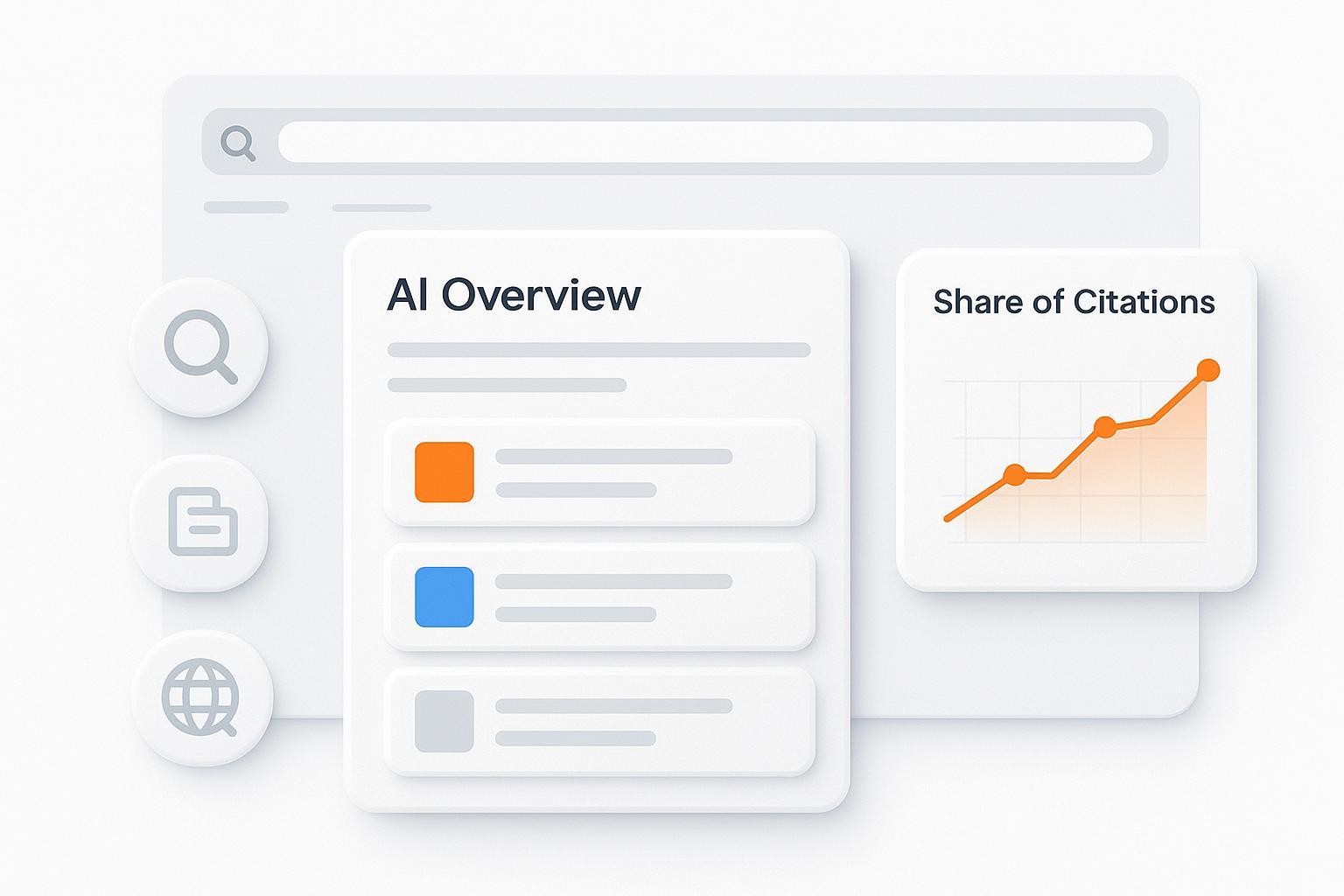
If you’ve noticed your organic traffic bending toward “zero‑click” surfaces, you’re not alone. Answer engines now summarize the web and attach source links—what we’ll call AI citations. When your content is cited, you gain visibility, trust, and qualified clicks even when the full answer appears above the fold. In this primer, we’ll focus on the primary KPI for beginners: multi‑engine Share of Citations (SOC) across Google AI Overviews, Perplexity, and ChatGPT browsing. For foundational concepts, see this short explainer on what AI visibility means for brands.
What “AI citations” are and why they matter
AI citations are the source links that engines attach to generated answers so users can verify claims. Google emphasizes that AI Overviews select links from its index and surface them prominently within the overview body to support discovery, not replace it, as described in Google’s AI Overviews update (2024). Perplexity also explains that its answers include clickable citations to original sources so readers can validate information—see “How does Perplexity work?”. OpenAI’s rollout of ChatGPT Search states responses can include links to relevant sources, noted in “Introducing ChatGPT Search”.
The takeaway: if you want to be included in these answers, publish content that’s concise, verifiable, and easy to extract.
Map formats to engines and intents
Different engines reward different query intents. Aligning your post format to intent increases your odds of being cited.
Google AI Overviews → Informational “what/how/why” questions. Keep answers focused, link to primary sources, and avoid speculation. Google’s guidance on helpful, people‑first content and the March 2024 core update and spam policies reinforce evidence and originality.
Perplexity → Comparisons and “best vs” queries. State criteria up front, offer a short verdict, and cite original documents (docs, changelogs, pricing pages). Perplexity’s Search docs outline retrieval with citations.
ChatGPT (with browsing/search) → Procedural/how‑to tasks. Provide numbered steps, prerequisites, and concise tables. OpenAI notes that search can fetch current information and link sources; see the ChatGPT Search help.
A realistic expectation baseline helps. Independent studies found low overlap between AI assistant citations and Google’s top‑10 results on many queries, while Google AI Overviews often cite top‑ranked pages. Ahrefs reported only about 12% overlap overall for assistants, but AI Overviews cite top‑10 pages 76% of the time and top‑100 86% of the time in their samples; see Ahrefs’ overlap analysis and AIO citation share findings (2024–2025).
Quick wins you can ship this month
The fastest path to citations is content that answer engines can verify at a glance. Here are two beginner‑friendly formats that punch above their weight.
Quick win 1: A reproducible mini‑study template
Pick a narrow, high‑intent question with real user value. Then publish a tiny, transparent study that any engine—and human—can check.
Scope a small question tied to outcomes (e.g., “Which USB‑C chargers actually meet Qi2 spec for iPhone 16?” or “Do passwordless prompts reduce checkout time on SaaS trials?”).
Add a short “Methods” box near the top listing data sources, timeframe, sampling rules, inclusion/exclusion, and limitations. Link primary sources and publish raw data when possible.
Provide a 1–2 sentence “Answer” box summarizing the result with inline primary citations and a timestamp.
Version the page and refresh quarterly if the topic is volatile.
Example layout you can copy:
Methods (80–120 words): Data source links, collection window, sample size, criteria, limitations.
Answer (1–2 sentences): The finding with 1–2 primary source links and a date.
Details: The supporting paragraphs, charts, and table if needed.
Why this works: Google’s people‑first guidance and core update documentation stress originality, evidence, and clear sourcing. Perplexity and ChatGPT favor responses that point to primary materials, which your methods and data links provide.
Quick win 2: A comparison page that cites primary sources
Comparison and “best vs” queries are fertile ground for citations—especially in Perplexity.
Define evaluation criteria up front (e.g., supported platforms, licensing, integration, evidence policy).
Provide a short verdict and “who it’s for” before the deep dive.
Use a compact table to summarize differences and include a final row for primary sources.
Example table structure you can adapt:
Option | Summary verdict | Key strengths | Evidence policy | Primary sources |
|---|---|---|---|---|
Tool A | Best for teams that need strict audit trails | Signed change logs; exportable evidence | Requires links to original docs | Product docs; pricing page |
Tool B | Strong for fast iteration | Great API coverage; generous rate limits | Accepts secondary sources with notes | API reference; changelog |
Tool C | Balanced choice for mixed stacks | Solid integrations; steady updates | Prefers primary evidence; clear disclosures | Docs hub; release notes |
Present criteria and sources clearly so engines can extract a trusted summary and link trail. For broader context on AI features and content expectations, see Google’s AI features and your website and the results simplification notice (schema helps parsing but isn’t a citation switch).
Measure what matters: Share of Citations and iteration
Your north‑star KPI for this guide is multi‑engine Share of Citations (SOC).
Definition and formula: Your Share = (Your Citations ÷ Total Citations) × 100. A common approach is to sum your citations across engines for a query set and divide by the total citations across all tracked competitors. See Search Engine Land’s guide to measuring brand visibility for a plain‑English walkthrough.
Weighting (optional): Some teams weight “definitive” citations higher than “supporting” ones (e.g., 3:1). If you do, document your rules and apply them consistently.
Analytics and reporting tips:
Segment AI referrals in GA4: Create a custom channel group and use regex that captures openai|chatgpt|perplexity|gemini|copilot|edgeservices in source/medium/referrer. Build Explorations for landing pages that receive AI traffic. Practical walkthroughs are covered in segmenting LLM traffic in GA4.
Expect incomplete referral data: Not all engines pass referrers or UTMs. Use landing page spikes and time‑series patterns as proxies, and annotate when major algorithm changes ship (e.g., Google core updates noted above).
Refresh cadence: AI Overview answers change often. Ahrefs observed that AIO content updates shift frequently with about 45.5% citation changes between consecutive responses in their sample; see their change‑frequency analysis. A practical plan is weekly monitoring and quarterly refreshes for content that targets dynamic queries.
For a visual sense of what a tracked query looks like over time, see this illustrative live query report. If you’re surveying the tooling landscape, here’s a neutral roundup of AI Overview tracking tools.
Practical monitoring example (neutral tools, with disclosure)
Disclosure: Geneo is our product.
Here’s a simple, vendor‑neutral workflow to monitor SOC across engines and tie it back to content iteration:
Define a query set by intent: informational (Google AIO), comparisons (Perplexity), and how‑to (ChatGPT browsing). Assign each query to a target page or cluster.
Track citations weekly across engines. You can log them in a spreadsheet, use custom scripts, or adopt specialized tools. Options include internal dashboards, general web monitors, or platforms that aggregate AI mentions. Geneo, for example, supports multi‑engine monitoring and SOC calculations, while you can also use your own scrapers or analytics annotations for a lightweight start.
Compute SOC by engine and overall: Your Share = Your Citations ÷ Total Citations. Flag gaps where competitors are repeatedly cited and you’re not.
Diagnose and act: If Perplexity ignores your comparison page, tighten criteria, add a short verdict, and link primary sources. If Google AIO skips your informational piece, add a succinct Q&A answer and make sure your claims are dated and sourced.
Re‑run mini‑studies and refresh pages quarterly; document changes in a simple changelog and keep the “Methods” box up to date.
Common mistakes to avoid
Treating structured data as a switch. After Google’s results simplification, FAQ and HowTo visuals are restricted and aren’t a direct path to AIO citations. Prioritize helpful content and primary evidence. See Google’s simplifying results update and AI features guidance.
Publishing long posts with no extractable answers. Add tight Q&A blocks, short “Answer” summaries, and clear step lists.
Making claims without dates or primary sources. Add inline links and timestamps. For significant stats, include a brief methods note.
Skipping measurement. Track SOC and segment AI referrals in GA4; monitor weekly and refresh quarterly. For policy and quality context, revisit Google’s core update explainer.
Next steps
Set up a lightweight SOC tracker for your top 25–50 queries by intent, publish one mini‑study and one comparison page this quarter, and schedule a quarterly refresh. If you’d like guidance on setting up multi‑engine monitoring, you can review the Geneo docs and adapt the workflow that best fits your stack.