
Tools for Tracking Entity Signals Across the Internet (2025)
Discover 16 top tools to monitor entity signals across AI, Knowledge Graphs, reviews, and more. Full evidence, key features, and next steps. See which fits you!
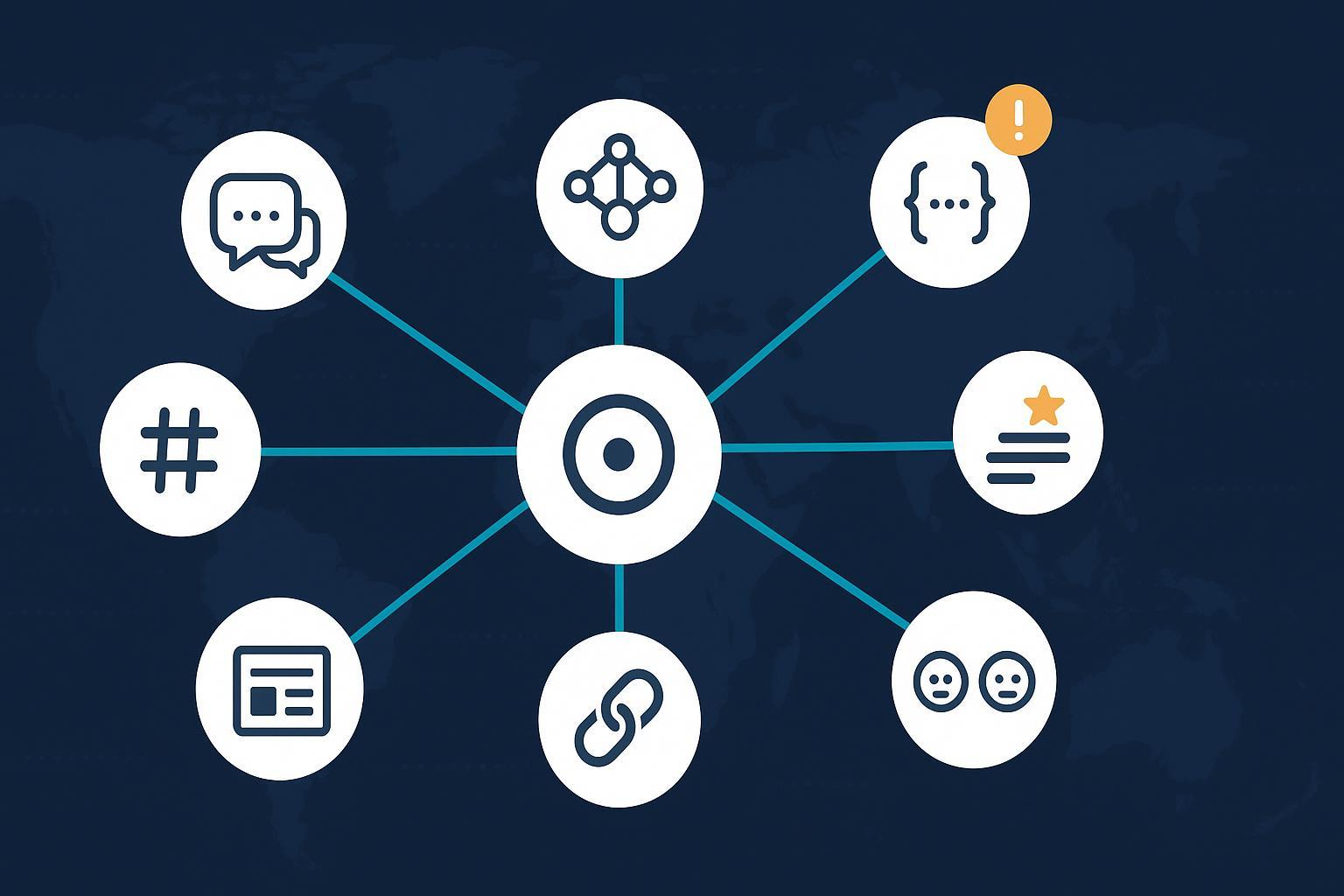
Entity signals are the machine-readable breadcrumbs that define who you are across the web: how AI answer engines cite you, whether your Knowledge Panel is stable, how consistent your schema is, what reviews say, who links to you, and the tone of public conversation. If you lead SEO, comms, or brand, you don’t just need dashboards—you need trustworthy coverage across these signals and a way to validate what the tools report.
Methodology in brief: I grouped tools by signal type, then evaluated coverage, evidence quality, data freshness/alerting, workflow fit, and integrations. Where vendors don’t publish details (e.g., some pricing), I note reviewer-only claims as such. For a current market overview of AI visibility platforms in 2025, see Backlinko’s analysis of engines covered, citation tracking, and reporting approaches in the section on AI answer engines.
Which signal segment should you prioritize?
Two common goals dominate: “be visible in AI answers” and “keep my entity consistent in Google’s ecosystem.” Here’s a quick mapping.
| Goal | Start with this segment | Why it matters |
|---|---|---|
| Capture brand presence in ChatGPT/Perplexity/Gemini/AI Overviews | AI answer engine visibility & citations | These answers shape discovery and trust; they’re increasingly the first touch |
| Stabilize Knowledge Panel and entity identity | Knowledge Graph/Brand SERP & entity home | Consistent facts reduce ambiguity and help search systems resolve your entity |
| Improve eligibility and consistency of rich results | Schema & linked data validation | Clean, verifiable structured data underpins entity understanding |
| Monitor public conversation and coverage velocity | Social/news brand mentions | Early alerts let you respond, amplify, or mitigate |
| Prove product/service quality and fix friction points | Reviews & ratings | Ratings directly influence conversions and local visibility |
| Quantify authority and discover partnerships | Backlinks & authority mapping | Links remain a durable proxy for reputation and reach |
| Track tone and drivers of perception | Sentiment analysis | Turns raw mentions into interpretable signals for PR and CX |
AI answer engine visibility and citations
Evidence context: For a snapshot of the landscape and why this category is surging, Backlinko’s 2025 roundup of AI visibility tools explains engines covered, citation tracking, and reporting approaches in the current market: see “5 AI Visibility Tools to Track Your Brand Across LLMs” (2025) on Backlinko.
Geneo — Tracks brand exposure, citations, and sentiment across ChatGPT, Perplexity, Google AI Overviews, and Claude, with historical trends and benchmarking. Disclosure: Geneo is our product. You can review public example reports for how cross‑engine results and tone are captured, such as the AI visibility snapshot on traffic safety tech (see the AI visibility public report example on Geneo). Best for teams that want AI answer coverage plus lightweight sentiment and share‑of‑voice views; not for organizations needing deep custom pipelines today. Pricing: free credits, Pro trial, agency/custom; subject to change. Learn more on the Geneo homepage.
Semrush AI Visibility Toolkit — Adds AI Mode/AI Overviews tracking into the broader Semrush suite, surfacing mentions, cited pages, and visibility gaps alongside classic SEO metrics. It’s a good fit if you already live in Semrush and want AI coverage in the same workspace. Plan gating varies by tier; consult official docs, such as the Semrush AI Visibility Toolkit guide. Less ideal if you need granular prompt-orchestrated testing across many locales.
Profound — Enterprise-first monitoring with live response capture, screenshot evidence, and conversation explorers that make audits easier. Teams handling regulated categories appreciate the verifiability. Pricing is typically custom; reviewer reports cite lower-tier options but treat those numbers cautiously. Suits large brands and agencies; less suited to small teams with limited budgets.
Peec.ai — Prompt-based tracking across engines with multi-language support reported by reviewers; helpful for international teams running daily prompt sets. Reviewers note add-on fees for additional engines and limited public API details; evaluate fit against your data export needs.
GenRank.io — Lightweight tracking with ChatGPT mention alerts and a documented API for programmatic access; cross‑engine coverage is expanding. Good as a budget-friendly augment; less compelling if you need multi-engine parity out of the box.
How to compare in this segment: prioritize engine coverage you actually need, refresh cadence, citation capture fidelity (are sources stored with evidence like screenshots/logs?), and export options.
Knowledge Graph, Brand SERP, and the entity home
Kalicube Pro focuses on Brand SERP and Knowledge Panel management, with sensors for Knowledge Graph magnitude and volatility plus a methodology for building a strong entity home. If your KP shakes or merges with a namesake, this kind of monitoring can surface the problem early. For a capability overview, see the Kalicube Knowledge Graph Sensor.
Wikipedia and Wikidata aren’t “tools” you buy, but their policies and watchlists are essential to entity hygiene. Align with notability and verifiability, maintain a clean Wikidata item linked to your official site, and keep facts consistent across your entity home and profiles. Monitoring changes via watchlists and the Wikidata Query Service helps catch drift before it spills into search.
When to start here: If your brand is young, has common-name collisions, or operates in multiple languages, invest in this segment early.
Schema and linked data validation
Google’s structured data guidance remains the best way to validate support for rich result types and catch errors that block presentation. If your structured data relies on deprecated types, you won’t see the benefits. Use Google’s structured data gallery for current support and guidance from Search Central.
For schema beyond Google eligibility, validator.schema.org confirms syntax and required properties, while JSON‑LD playgrounds help debug contexts, compaction, and framing. These checks reduce ambiguity and improve machine understanding for other systems that consume Schema.org. For scale and governance, enterprise platforms like Schema App add deployment monitoring and an entity-centric approach.
What to watch: Keep schema synchronized with your entity home and public profiles; inconsistent facts create confidence gaps.
Social/news brand mentions
Brand24 offers broad coverage across social, news, forums, and podcasts, with alerting, AI summaries, and Share of Voice views. It’s approachable for SMBs and agencies that need quick wins and simple exports. Their overview of brand tracking workflows is a helpful orientation.
Sprinklr serves enterprise consumer intelligence and social listening with sophisticated theming, anomaly detection, and export APIs across many channels. It’s powerful, but comes with the complexity and cost that enterprises expect.
Meltwater blends media intelligence and social listening with AI-assisted insights. It’s a strong fit when earned media monitoring and newsroom workflows matter; typically purchased under enterprise contracts.
Mention provides real-time monitoring with SMB-friendly integrations; a pragmatic choice when you need alerts fast without an enterprise learning curve.
Signal quality tip: Ask how each platform handles duplicates and near-duplicates across syndication and whether it preserves source URLs for audit trails.
Reviews and ratings aggregation
Google Business Profile supplies native notifications and in-dashboard responses; programmatic reply management comes via the Business Profile API. Policies around incentivization and moderation are strict; build compliant workflows.
Trustpilot streamlines invitations, widgets, and analytics to collect and showcase social proof. Features and quotas vary by plan; confirm data export rights before you scale.
Birdeye centralizes multi-site review capture and response (email/SMS), with AI-assisted summaries that help large, multi-location brands triage faster.
Yext combines review monitoring with listings management and a first-party Knowledge Graph used to power schema-rich pages; it’s a good match when you also need distribution guardianship.
When reviews surge or slip, tie the trend back to operational fixes—not just star averages.
Backlinks and authority mapping
Ahrefs provides a large backlink index with new/lost link alerts, Link Intersect, and exports to CSV or Sheets. For a sense of pace and data-surface improvements in 2025, Ahrefs’ feature updates outline alerting and workflow enhancements in recent releases.
Moz offers Link Explorer with DA/PA, Spam Score, and a unified API for links and metrics. It’s practical for teams that want broad authority trendlines and simple diffs against competitors without heavy setup.
How to decide: Coverage size matters, but so do freshness, alert latency, and how cleanly you can export/link metrics into BI.
Sentiment analysis
Awario is an affordable listening tool with sentiment classification, Boolean queries, and lead discovery—solid for SMBs and agencies that need directional sentiment without enterprise overhead.
Sprout Social is a social management platform with a listening add-on and enterprise connectors (e.g., Salesforce/Tableau) that make it easier to feed sentiment into reporting stacks. Costs vary by seat and add-on scope; model TCO before rollout.
Sanity check: Always read a sample of mentions yourself. Automated tone classifiers are helpful, but domain-specific sarcasm and slang can trip them up.
How to choose (and avoid over-buying)
- Define the signals that actually drive your goals for the next two quarters (e.g., AI answer citations, Knowledge Panel stability, or multi-location reviews). Map platforms to those signals only.
- Validate evidence quality: ask for screenshots, raw logs, or archived responses for AI engines; run sample prompts and compare.
- Test exportability: CSV/JSON, API depth, and frequency caps. If you can’t move the data, you’ll struggle to prove impact.
- Run a refresh-cadence test: how often does each system update results, and can you set alerts when things change?
- Model total cost of ownership: seats, add-ons (listening, extra engines), overage fees, and the human time to keep it tuned.
- Pilot with a narrow prompt set or entity subset before committing to a platform-wide rollout.
Here’s the deal: most teams need one platform from the AI answers segment, plus one for social/news listening, and either Ahrefs or Moz for links. Everything else can follow once you’ve proven data quality and a basic reporting cadence.
Next steps
-
Pick one high-priority signal segment and run a 30‑day pilot with clear success criteria (e.g., “increase cited source share in AI answers by 20% across our top 10 prompts”). If AI answer visibility is your immediate gap, consider starting with a platform that stores evidence and tracks sentiment over time. For a concrete example of what cross‑engine tracking looks like, review this AI visibility public report example on Geneo. Then document your methodology (prompts, locales, refresh cadence) so results are reproducible.
-
If you’re evaluating AI answer engine platforms side by side, use an identical prompt set, capture dates, and target locales. Save screenshots/logs and compare citation overlap and stability week over week.