Why Your Brand Might Not Appear in AI Search
Diagnose why brands don’t appear in AI search answers. Covers 2025 root causes, technical fixes, KPIs, and an actionable best practice playbook for AI visibility.
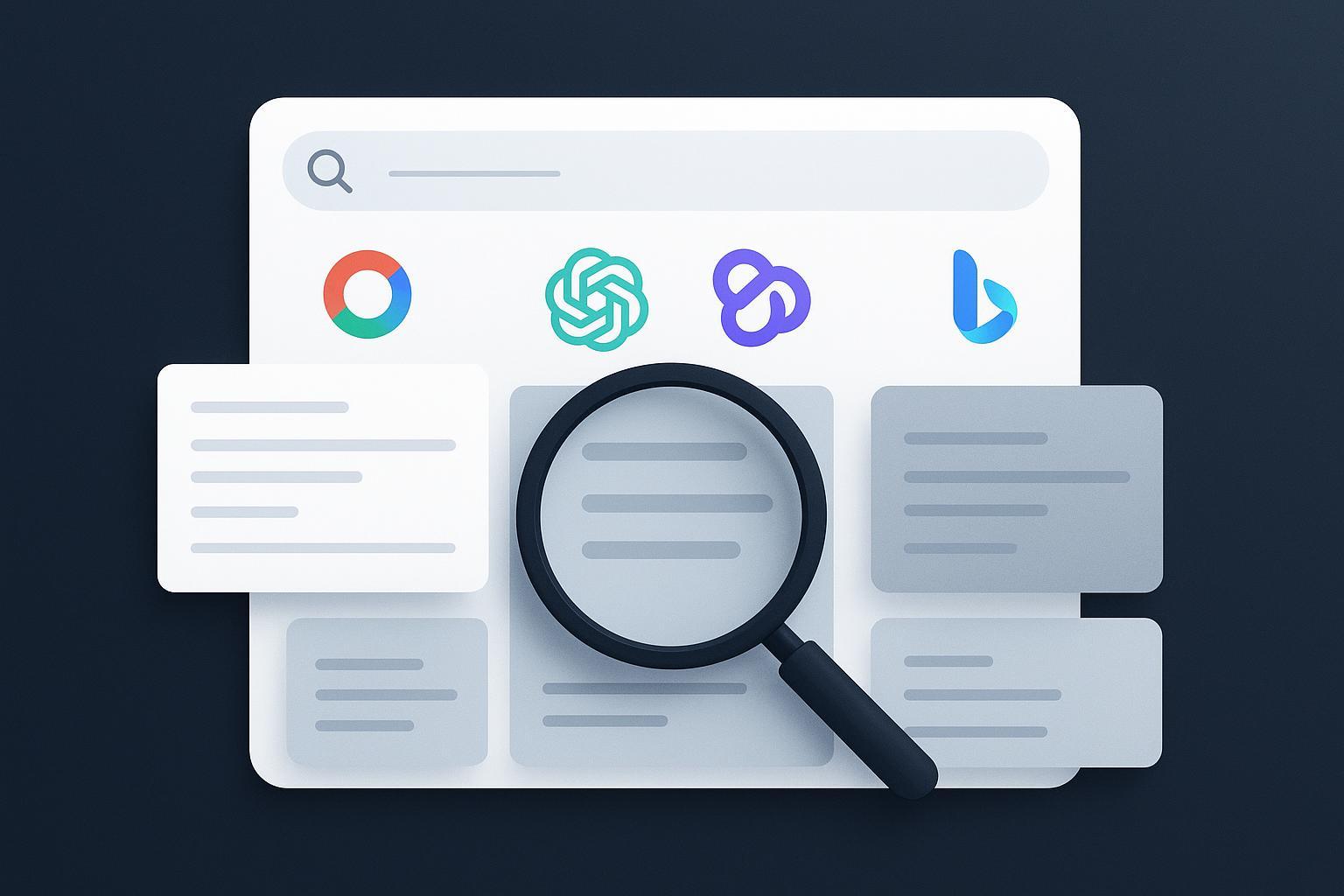
If your team still equates “visibility” with ranking positions, you’re missing where attention is moving. In 2025, the moment that matters often happens before a click: when Google’s AI Overviews, ChatGPT, Perplexity, or Bing/Copilot summarize an answer and decide which brands to cite. If you’re not named or linked there, your content can be excellent—and still invisible.
How AI search picks sources today (and where brands get filtered out)
AI answers combine traditional indexing with model-driven retrieval and synthesis, and each platform behaves a little differently. Google’s AI Overviews require pages to be eligible for Search snippets and indexed; selection frequently overlaps with top organic results and leans on authority, clarity, and freshness. Google explains eligibility in its AI features documentation (May 2025), while independent observational studies describe patterns in source selection.
ChatGPT, when browsing is on, displays a sources panel. Third-party audits have noted concentrated citations and inconsistent treatment of paywalls and robots in some tests, highlighted by the CJR Tow Center audit (2025). Perplexity is built for live retrieval with visible citations, often emphasizing recency and community content; aggregated tests summarized by Search Engine Roundtable (via Profound) suggest broader domain diversity than ChatGPT—see the 2025 citation pattern summary. Bing/Copilot operates with live retrieval via Bingbot; IndexNow can speed discovery, and source sets may diverge from other tools in some cohorts.
A few realities cut across platforms: if you’re not crawled and indexed, you won’t be cited; recency helps on Perplexity; strong E‑E‑A‑T signals correlate with Google AI Overview inclusion; and community/UGC often outranks brand pages in ChatGPT answers. Meanwhile, Google still dwarfs chat-style tools in query volume; SparkToro estimated Google received roughly 373× more searches than ChatGPT in 2024—context that reminds us why optimizing both AI answers and classic search still matters, according to SparkToro’s 2025 analysis.
For foundational definitions and scope, see What Is AI Visibility? Brand Exposure in AI Search Explained.
A practical diagnostic: five lanes to check
Brands typically disappear from AI answers for predictable reasons. Work through these lanes:
- Organization and governance. Is there a clear owner for AI visibility? Do PR, SEO, content, and engineering coordinate on citations, UGC, and technical controls? If not, campaigns drift and opportunities get lost.
- Technical crawl/indexation. Are relevant pages indexable, rendered server-side or statically, and correctly canonicalized? Are XML sitemaps current with lastmod? Is robots.txt allowing intended crawlers? Blocking AI crawlers prevents inclusion, full stop.
- Entity and structured data. Does your site use JSON‑LD Organization/Brand/Person schema with consistent @id values, logo, description, and sameAs links to Wikidata/Wikipedia/LinkedIn where appropriate? Without clear entity resolution, models may misattribute or prefer better-established profiles.
- Content relevance and freshness. Are your category and how‑to pages up-to-date with explicit answers, scannable structure, and primary citations? Recency biases matter; SEER observed roughly half of Perplexity citations referencing content from the same year in 2025—see SEER’s recency study (2025).
- Authority, citations, and UGC presence. Do respected third-party sites cite you? Do you participate where models look for human context (forums, Reddit, expert communities)? UGC often surfaces in ChatGPT/Perplexity answers.
For behavior trends and prompt patterns, you can explore AI Search User Behavior 2025: Aligning Content for Visibility.
Quick wins and deeper fixes
-
Quick wins (2–4 weeks)
- Fix robots.txt, meta robots, and sitemap errors; ensure key pages are indexable and rendered server-side where possible.
- Add or correct Organization/Brand/Person schema on homepage, About, People, and product pages; include sameAs to authoritative profiles.
- Refresh top category and explainer pages: add direct answers, source citations, and updated examples; publish minor changelogs.
-
Mid/long-term fixes (60–90 days)
- Build third‑party validation: secure citations from associations, industry lists, and respected blogs; contribute data or methods others can cite.
- Grow credible UGC: foster expert participation in communities your buyers read; encourage Q&A where your brand adds substance.
- Establish a prompt testing program across branded/category/alternative/competitor queries; track citation share and sentiment over time.
Technical foundations you can’t skip
Keep access open to crawlers you expect to cite your content. Maintain clean XML sitemaps with lastmod and submit them via Search Console and Bing Webmaster Tools; IndexNow can accelerate discovery on Bing and partners. Ensure critical content is available without heavy client-side rendering—if important text loads only after multiple scripts run, some crawlers will miss it. Align rel=canonical, internal links, and sitemaps to avoid indexation ambiguity, especially for multilingual sites.
On LLMs.txt: the proposed /llms.txt file is optional; adoption remains limited and major crawlers largely ignore it. Treat it as future‑proofing, not a must‑do. Search Engine Land’s llms.txt explainer (2025) provides useful context.
Make your brand a resolved entity (schema that actually helps)
Entity resolution is the difference between “we think we know who you are” and “we’re certain.” Practical steps:
- Organization schema on the homepage. Include name, url, logo, description, sameAs entries to Wikidata/Wikipedia/LinkedIn when appropriate, and contactPoint. Use a stable @id and reference it across the site.
- Brand and Product schema. If you market named products, nest Brand under Product or reference via brand properties; include alternateName variants.
- Person schema for executives/authors. Add name, jobTitle, worksFor linking to your Organization @id, image, and sameAs.
- Validation and monitoring. Use Google’s Rich Results Test and monitor Search Console for structured data errors. Changes often take weeks to reflect in models—stay patient and consistent.
Measure AI visibility like you mean it
Optimizing without measurement is guesswork. Shift from rank tracking to answer inclusion and citation quality. The following KPIs keep teams honest and aligned.
| KPI | Why it matters | Typical window to see change |
|---|---|---|
| Citation/mention share across prompt clusters | Shows whether your brand is present where buyers research, not just on branded terms | 2–4 weeks for initial movement; steadier by 60–90 days |
| Link attribution accuracy | Ensures your domain receives credit vs. syndications or mirrors | Immediate to 4 weeks depending on platform refresh |
| Sentiment of AI answers | Captures how your brand is framed (positive/neutral/negative) pre‑click | 2–6 weeks as content and citations update |
| Freshness cadence coverage | Tracks whether priority pages are updated often enough to qualify for recency‑biased answers | Immediate visibility; impact within 2–8 weeks |
| UGC/community presence metrics | Indicates third‑party validation where models source human context | 4–12 weeks depending on community activity |
| Referral clicks/conversions from AI panels | Measures downstream value when links appear | Variable; often low, but trend direction is what matters |
For deeper frameworks and scoring, see LLMO Metrics: Measure Accuracy, Relevance & Personalization in AI and our comparison of monitoring workflows in ChatGPT vs Perplexity vs Gemini vs Bing: AI Search Monitoring Comparison.
Workflow example: monitoring and responding to omissions
Disclosure: Geneo is our product.
Here’s a brief, replicable process our teams use when a category query shows no brand citation in AI answers:
- Define a prompt cluster. Include “what is,” “best X for Y,” “alternatives to,” and “compare X vs Y” queries relevant to your category.
- Test across platforms weekly. Capture whether your brand or domain appears as a citation and note the sources that do.
- Diagnose the gap. If community sources dominate, plan UGC participation. If competitors’ guides are cited, refresh your own with clear answers and primary references.
- Ship technical fixes. Confirm indexability, rendering, and schema across the pages that should earn citations; align canonical and lastmod.
- Re‑test and annotate. Track movement in citation share and sentiment. When you see incorrect attribution, pursue the primary source to correct it or publish clarifying material on your domain.
Governance and ops: don’t get blocked by your own policies
AI visibility crosses teams. A simple operating model helps:
- Crawler policy. Maintain a reviewed robots.txt and avoid blanket disallows that block AI retrieval you actually want.
- Editorial standards. Require bylines, reviewer lines for sensitive topics, and visible source citations. Tag claims in your CMS with references.
- Privacy and compliance. Coordinate with legal on data collection and terms; avoid publishing sensitive information you don’t want synthesized.
- Change cadence. Set a quarterly refresh schedule for cornerstone pages and a monthly check for structured data health.
Next steps
Start with the diagnostic: fix crawl/indexation, add schema, and refresh answers on your priority pages. Stand up a prompt testing routine and measure citation share and sentiment. If you’d like a structured way to monitor AI visibility across platforms and coordinate responses, Geneo can help—Disclosure: Geneo is our product. Explore our workflows and resources linked above, then adapt them to your stack and governance.
According to Google’s own guidance, eligibility is about indexation and Search best practices, but selection is observational and evolving; see the AI features documentation (2025) and industry context from the CJR Tow Center audit (2025) and SparkToro’s analysis (2025). The goal isn’t to chase every rumor; it’s to build a system that keeps your brand present and correctly cited wherever AI answers appear.