
How to Improve AI-Generated Summaries Using Brand Context
Learn proven strategies to enhance AI-generated summaries using structured brand context. Elevate accuracy, consistency, and digital presence with leading best practices.
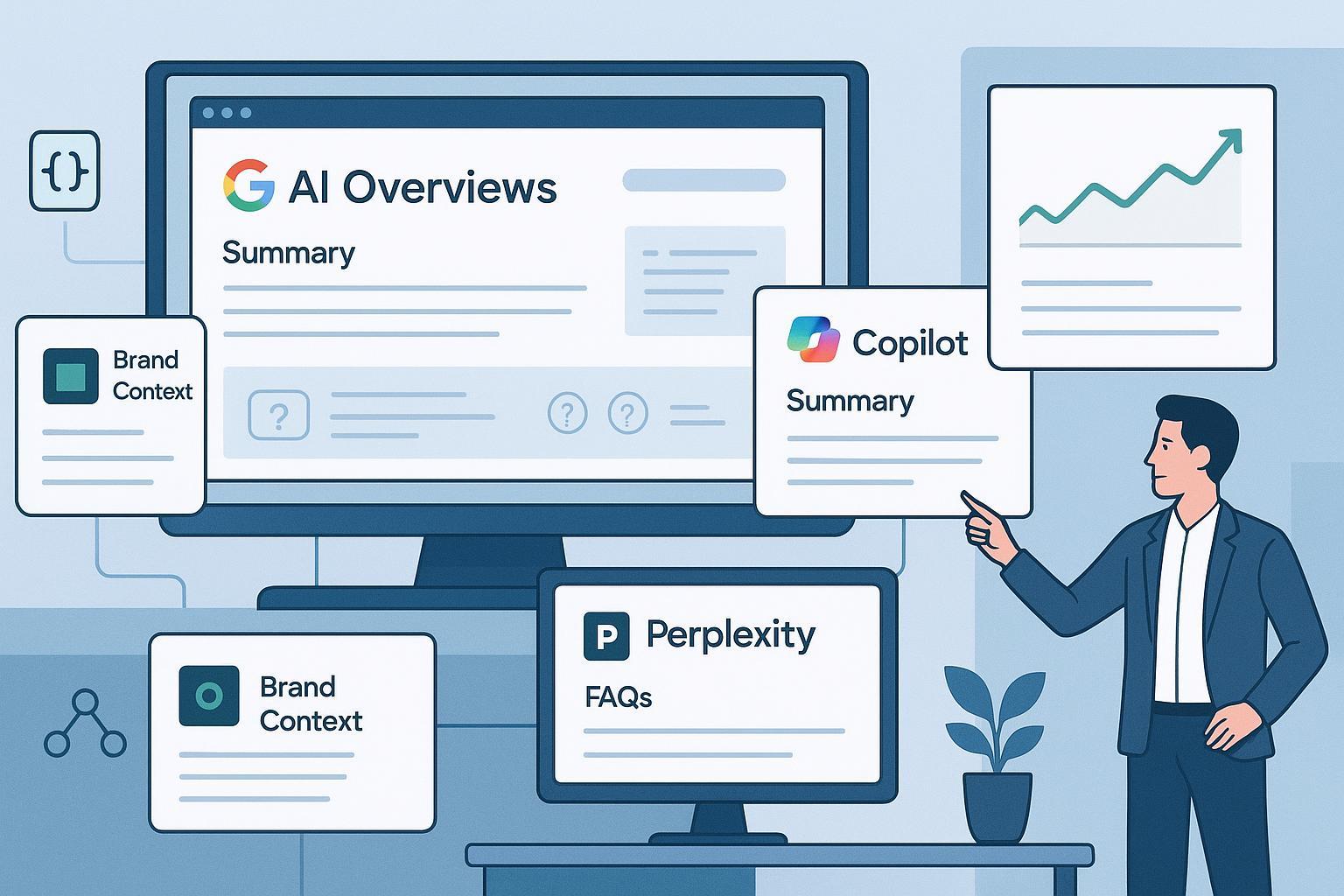
If AI can answer the question before your link gets a click, how do you still control the story? The short answer: you don’t fight the summary—you feed it. The best-performing teams package authoritative brand context, make it machine-readable, and build guardrails and measurement around the workflow. Here’s a practical playbook you can put to work this quarter.
1) Package a single source of truth for brand context
Think of your brand context like a “flight case” you bring to every show. It travels with you—lightweight, current, and complete enough to run the performance.
Build a compact, versioned corpus that your teams (and your own AI workflows) can rely on:
- Company overview and positioning, plus boilerplate differentiators
- Top product/plan sheets with specs, availability, and pricing policy
- Customer-proof points: case blurbs, ratings methodology, awards (verifiable)
- Policy and compliance statements: security, privacy, refunds, SLAs
- FAQs that clarify common confusions and red-line statements
- Entity IDs and links (Wikipedia/Wikidata/company profiles) for disambiguation
Maintenance habits matter more than volume. A 20-page, up-to-date corpus beats a 200-page archive that’s stale by two quarters. Assign owners, keep change logs, and require content parity (your site must say what your corpus says). Before putting the corpus in production, confirm that every fact is verifiable on a page you control, each doc shows last updated and owner, and naming is consistent for entities, products, logos, and URLs.
2) Make your content machine-readable and unambiguous
AI answer surfaces and retrieval systems resolve “who you are” through entities and structure. Help them out.
- Implement Organization/Logo, Product, FAQ, and HowTo JSON-LD where relevant. Ensure parity with on-page text and validate regularly using Google’s tools. Google’s guidance on AI features emphasizes people-first content and eligible structured data to improve how content is surfaced in AI experiences; see AI features and your website (Google Search Central).
- Use sameAs to authoritative profiles (e.g., Wikipedia/Wikidata, LinkedIn, Crunchbase) to reduce ambiguity.
- Standardize naming (one canonical brand spelling, product line taxonomy, release/version labels) across pages and assets.
Example Organization JSON-LD (adapt to your site; validate before shipping):
<script type="application/ld+json">
  {
    "@context": "https://schema.org",
    "@type": "Organization",
    "name": "YourBrand",
    "url": "https://www.yourbrand.com",
    "logo": "https://www.yourbrand.com/assets/logo.png",
    "sameAs": [
      "https://www.linkedin.com/company/yourbrand",
      "https://en.wikipedia.org/wiki/YourBrand"
    ],
    "contactPoint": {
      "@type": "ContactPoint",
      "contactType": "customer service",
      "email": "support@yourbrand.com"
    }
  }
  </script>
3) Context engineering for owned LLM workflows
When you control the summarizer (assistants, site chat, internal tools), nail the mechanics: precise prompts, retrieval rules, and lightweight evaluation. Here’s a compact scaffold you can adapt.
Prompt template (designed for retrieval-enabled assistants):
System (role): You are a brand-safe summarization assistant for <Brand>.
  Rules (non-negotiable):
  - Cite the exact source chunk IDs for any claim about <Brand>.
  - If no relevant chunk is found, say “Not available in brand docs.” Do not infer.
  - Use <tone guidelines> and banned claims list from the brand corpus.
  User task: Summarize <topic> for <audience>. Include 3–5 key facts.
  Acceptance criteria: No unsupported claims; include 1–2 differentiators; 120–180 words; end with sources [chunk-IDs].
Add guardrails: filter retrieval to your curated corpus; prefer structured outputs for claim-by-claim references; and run quick evals (e.g., spot checks plus a small hallucination test set). OpenAI’s guidance on RAG and Evals offers practical patterns for chunking, retrieval, and systematic evaluation; see OpenAI’s Cookbook and Evals documentation for implementation ideas.
4) What AI answer surfaces reward (and how to feed them)
Different answer surfaces have different mechanics and controls. Align your tactics accordingly.
| Surface | How answers are grounded | What you can influence |
|---|---|---|
| Google AI Overviews / AI Mode | Synthesizes with links to sources; quality and eligibility depend on people-first content and structured data | Publish clear, up-to-date pages with aligned schema and visible facts; maintain Q&A content the model can cite. See Google’s AI features overview. |
| Microsoft Copilot (web) | Generates and grounds via Bing queries with visible citations; admins can control web grounding in enterprise contexts | Keep authoritative pages indexable and current; for enterprise, review grounding and audit logs. Reference Microsoft’s Copilot management docs. |
| Perplexity | Retrieval-augmented with inline citations and focus modes (Web, Academic, etc.) | Provide concise, authoritative explainers and FAQs; ensure titles/metadata are unambiguous. |
Practical takeaway: Don’t hide your best answers behind PDFs and gated assets. Put the most-cited facts on clean, crawlable pages with matching schema, and maintain a tidy FAQ hub that mirrors your corpus.
5) Governance that protects the brand
Strong results come from strong habits. Treat brand-aware summarization as an operational capability, not a one-off experiment.
- Human-in-the-loop: Require pre-publication review for externally visible summaries and sensitive claims. Define escalation paths for legal and compliance topics.
- Policy anchors: Align your processes to recognized frameworks like NIST AI RMF 1.1 and an AI Management System modeled on ISO/IEC 42001. Keep prompt/context/version logs for auditability.
- Ownership: Name owners for the corpus, schema, and monitoring; define SLAs for updates after product changes or incidents.
6) Measure what matters (despite limited analytics)
Native analytics for AI answer inclusion are still limited, so combine proxy KPIs and consistent monitoring. Each week, review inclusion and citation frequency across surfaces, note whether AI summaries match your approved facts and mention key differentiators, and track sentiment tone shifts after content updates. Because official inclusion/click metrics for AI Overviews aren’t exposed in Search Console as of late 2025, pair manual sampling with third-party monitoring and your own content logs. For a deeper KPI model and cadence planning, see our internal guides on AI visibility and AI search KPIs for visibility, sentiment, and conversion.
7) If the summary gets your brand wrong
Don’t panic—respond with process.
First, capture evidence: the exact query, the surface (e.g., AI Overview, Copilot), screenshots, and any sources cited. Publish or update a clear source-of-truth page correcting the fact, preferably with an accompanying FAQ that restates the disputed point in plain language and matching schema. Submit feedback through the surface that displayed the issue—Google explains user feedback controls on About AI Overviews—and, where applicable, contact third-party sites that propagate the incorrect detail.
Then, track remediation: log the incident, date of fix, and follow-up observations. Document the cycle per your NIST/ISO-aligned governance. If updates don’t propagate within a reasonable timeframe, escalate through the platform’s feedback mechanisms again and consider reinforcing signals (internal links, clearer headings, or a dedicated clarifications page).
Real-World Example: Monitoring brand mentions across AI answers (Disclosure)
Disclosure: Geneo is our product.
A B2B marketing team maintains a 15-page brand corpus and implements Organization, Product, and FAQ schema on key pages. They observe which of their differentiators actually appear across Google AI Overviews, Copilot, and Perplexity answers, and whether the brand’s own site is cited or third parties dominate. With Geneo, they track cross-platform AI visibility, citations, and sentiment week over week, spot mismatches between AI summaries and approved facts, and trigger updates to the corpus and FAQ pages. Over one quarter, the team reduces “missing differentiator” occurrences while increasing direct brand citations on priority queries—supported by fresher FAQs and tighter entity alignment.
Bringing it all together
You can’t fully control AI summaries, but you can shape them—by packaging authoritative brand context, making your site unambiguous, engineering your own prompts and retrieval, and running a real governance and measurement loop. Ready to operationalize this? Start with the corpus and schema updates, then set a weekly review to track citations and sentiment across AI surfaces. If you’d like a lightweight way to monitor brand visibility in AI answers, consider trying Geneo.