Definition of the Best Answer Engine Optimization Tools: What Sets Geneo Apart
Explore top Answer Engine Optimization (AEO) tools for agencies in 2026. Compare Brand Visibility Score, reporting, and multi-engine monitoring features.
If your clients are asking “Why aren’t we cited in AI answers?”, you’re already in Answer Engine Optimization territory. AEO isn’t classic rank tracking with a new label—it’s the practice of earning inclusion and citations inside AI-generated answers across engines like Google AI Overviews, ChatGPT Search, Perplexity, and Bing/Copilot. Industry primers describe AEO as answer-first content and technical readiness designed for synthesis, not just blue links. For a clear, vendor-neutral grounding, see Conductor’s practitioner explainer in the Academy, which frames AEO as structuring content so answer engines can interpret and surface it directly to users, alongside schema and entity alignment guidance in 2025’s resource, the Conductor Academy’s Answer Engine Optimization overview. For a concise contrast with SEO, Semrush’s AEO vs. SEO article (2025) summarizes the shift from rankings to inclusion and citation visibility.
What “best AEO tools” actually do
The best platforms help agencies measure, explain, and improve visibility in AI answers—consistently, across engines, and over time. Tooling should map to how engines retrieve, synthesize, and attribute content, while fitting agency workflows (workspaces, permissions, exports, white-label).
Below is an agency-oriented capability framework you can use in vendor evaluations.
Capability | What to look for | Why agencies care |
|---|---|---|
Retrieval exposure | Crawlability checks; access recency tests; coverage by content type | Ensures engines can even see the material you hope to be cited for |
Passage extractability | Detection of answer-first blocks; passage scoring; prompt test harness | Moves beyond “rankings” to the passages engines actually quote |
Entity/knowledge alignment | Canonical IDs; entity map; knowledge graph exports or validations | Reduces ambiguity so models attach claims to the right brand |
Schema/metadata auditing | JSON-LD checks; lifecycle awareness (FAQ/HowTo changes); author/byline signals | Connects technical hygiene to extractability hypotheses |
Provenance & citation readiness | Reference patterns; outbound evidence links; bylines/dates | Increases likelihood of linked citations vs mention-only |
Multi-engine monitoring | Inclusion rate, citation types, link positions, SOV per engine | Lets you report reality by engine, not averages that hide gaps |
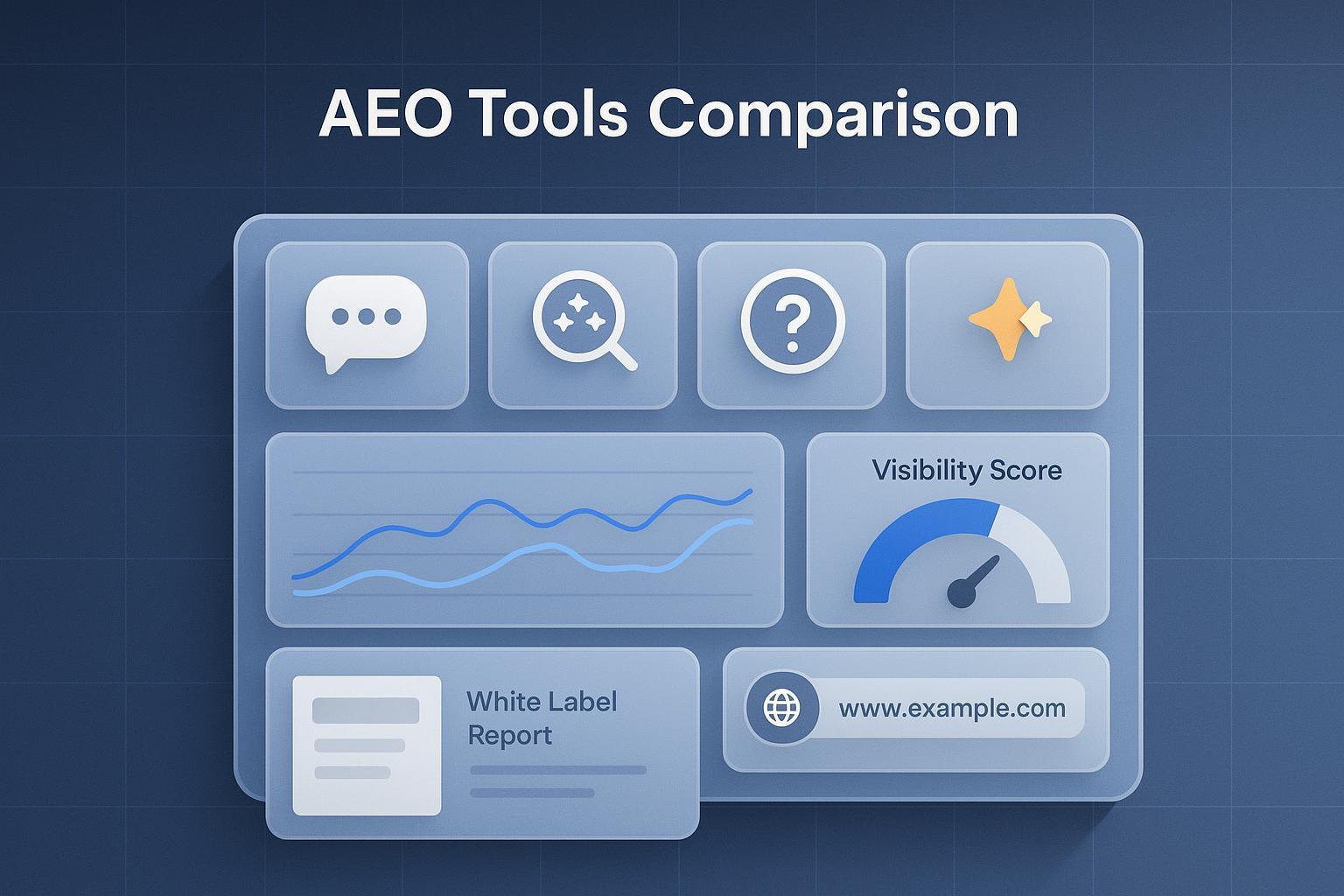
Trend reporting & visibility scoring | Composite Brand Visibility Score with explainability and time series | Provides a KPI leaders can track and compare in QBRs |
Competitive analysis | Cross-brand SOV, reference counts, sentiment, topic clusters | Puts wins/losses in market context clients understand |
Integrations & exports | APIs or reliable exports; white-label report generation | Reduces manual work and supports client self-serve |
Explainability & testing | Reproducible runs (prompt, mode, timestamp), snapshots | Makes findings auditable across teams and over time |
Compliance & brand safety | Audit trails, source provenance, tone monitoring | Supports enterprise/legal expectations |
ROI & attribution | Methods to connect citations to assisted outcomes or clicks | Grounds the program in measurable business value |
Engines behave differently—your tooling must adapt
Measurement has to match how each engine displays and attributes sources.
Google AI Overviews. Google says AI Overviews aim to connect users to the web with visible source links, including desktop right-rail link lists, tappable site icons on mobile, and tests of links in-line with the AI text. See Google’s guidance in Succeeding in AI Search (2025) for eligibility and extractability considerations: the document outlines how to build content that’s useful to AI features and how links are surfaced according to quality and relevance.
ChatGPT Search. When ChatGPT uses web search, it presents inline citations users can expand and click. OpenAI’s product introduction, Introducing ChatGPT Search (2024), describes how retrieval and attributions appear in the interface—useful for understanding inclusion vs. click pathways.
Perplexity. Perplexity treats citations as a transparency pillar: answers ship with numbered citations anchored to claims and link out with one click. Their Help Center article How does Perplexity work (updated 2024–2025) explains this behavior and why evidence is emphasized.
Microsoft Bing/Copilot. Microsoft’s Transparency Note for Copilot (2024–2025) states that web-grounded answers include linked citations or a sources list, so users can inspect the underlying pages.
Implications: your tooling should distinguish between linked citations, mention-only references, and unlinked inclusion. A visibility trend without this breakdown can mislead stakeholders. It also needs per-engine share-of-voice (SOV) and link-position context, since a sidebar link and an in-text link don’t perform the same way.
References mentioned above:
Google’s Succeeding in AI Search (2025): Google Search Central guidance
OpenAI’s Introducing ChatGPT Search (2024): OpenAI product post
Perplexity’s Help Center: How does Perplexity work
Microsoft’s transparency note: Transparency Note for Microsoft Copilot
For foundational definitions discussed in the intro:
Conductor Academy’s explainer: Answer Engine Optimization (Conductor Academy, 2025)
Semrush’s comparison: AEO vs SEO (Semrush, 2025)
A vendor-neutral comparison checklist for 2026
Use these prompts during demos and proofs-of-concept. They’re opinionated, and they’ll save you time.
Coverage: Which engines and modes are monitored (e.g., Google AI Overviews variants, ChatGPT web search, Perplexity, Copilot)? How often are prompts re-run, and can I reproduce snapshots with timestamps?
Measurement: Can the platform separate linked citations, mention-only, and unlinked inclusion? Does SOV aggregate by engine and topic? Is there a composite Brand Visibility Score with driver analysis and explainability?
Trends & benchmarks: Are deltas reported week-over-week and month-over-month? Can I benchmark against a defined competitor set and filter by topic cluster?
Reporting: Do white-label dashboards and exports meet our QBR/MBR needs (logo, colors, custom domain)? Can I schedule client-safe links without exposing other workspaces?
Workflow: Are there passage-level diagnostics or prompt harnesses to test extractability? Is there entity/knowledge support (canonical IDs, graph alignment checks)?
Integrations & data control: What exports or APIs exist? If none, do we still get structured exports that fit our BI stack?
Compliance: Are there audit trails, tone/sentiment checks, and provenance logs that work for enterprise clients?
ROI: What are the recommended methods to connect visibility changes to downstream impact (brand lift, assisted conversions, referral clicks where present)?
Practical example: an agency workflow for AEO reporting
Disclosure: Geneo is our product.
Here’s one way an agency can operationalize multi-engine AEO monitoring while keeping exec reporting simple.
Set up multi-engine monitoring and a baseline. Start by defining the client’s priority questions/prompts and competitors. Run a baseline across Google AI Overviews, ChatGPT web search, Perplexity, and Copilot. A neutral Brand Visibility Score creates a single KPI that busy leaders can follow over time; think of it like your “north-star” index, similar to a paid search Quality Score or a social share-of-voice rollup. As a reference for what such monitoring looks like in practice, see the platform overview on the Geneo homepage, which describes cross-engine tracking and a composite visibility score: Geneo overview of AI engine monitoring.
Diagnose extractability and entity alignment. For queries where inclusion is weak or citations are missing, inspect passage candidates, schema/authorship signals, and entity mappings. Capture snapshots with prompts, modes, and timestamps so analysts can reproduce the state later.
Track trends and competitive SOV. Report weekly deltas to executives using a single chart—visibility score plus a breakdown of linked citations vs. mention-only, by engine. Pair it with a competitive bar chart for SOV in the same time window. If your team prefers canned formats and client-safe delivery, agency-focused white-label guidance can help: see this neutral overview of white-label dashboards and custom domains for agencies: White-label and client workspace guide.
Close the loop with recommendations. Turn diagnostics into a short backlog: entity clarifications, answer-first rewrites, reference additions for provenance, and schema fixes. Re-test key prompts after changes and annotate the timeline so deltas are traceable.
This approach keeps analysts focused on reproducible evidence while executives get a readable KPI and clear before/after visibility trends.
Tradeoffs and gotchas when picking AEO tools
Inclusion isn’t the same as a linked citation. If a tool only reports “seen in answer,” you may be counting impressions that never create a click path.
Mention-only isn’t enough for ROI narratives. Ensure the platform distinguishes mentions from linked attributions, and records link position.
Overfitting to one engine backfires. A dashboard that looks great for Perplexity might hide gaps in Google AI Overviews. Insist on per-engine reporting.
Schema audits aren’t extractability tests. You need passage-level diagnostics and prompt harnesses, not just markup validators.
“No API” doesn’t mean “no exports.” If a vendor lacks public APIs, verify that exports and white-label reports still meet your delivery standards.
Trend lines without explainability create distrust. Annotated timelines and reproducible snapshots matter in QBRs.
Entity ambiguity is a silent killer. Without canonical IDs and knowledge alignment checks, brand mix-ups will derail your efforts.
What to do next
Shortlist 2–3 platforms and run a 30-day pilot focused on one client segment and a fixed prompt set. Require per-engine inclusion/citation breakdowns, a composite visibility score with explainability, and white-label exports suitable for QBRs. If you want a neutral baseline for Brand Visibility Score and cross-engine monitoring to anchor that pilot, Geneo can be part of the evaluation—then keep whichever stack your team can explain and your clients will trust.