10 Best Answer Engine Optimization Tools for Agencies 2026
Compare 10 top Answer Engine Optimization tools for agencies in 2026 — actionable workflows, white‑label reporting, and buying guidance to choose the right AEO/GEO stack. Read now.
Agencies are now judged on how well they can win visibility inside AI answers—not just blue links. Your clients ask: “Why does Perplexity cite our competitor?” or “How do we appear in Google AI Overviews more often?” The right stack of Answer Engine Optimization tools can turn those questions into a repeatable program you can deliver, month after month.
If you’re new to the discipline, AEO/GEO sits at the intersection of technical SEO, content strategy, and AI platform forensics—tracking how engines like ChatGPT, Perplexity, and Google AI Overviews assemble answers and citations. For a quick primer on the concept and KPIs, see the explainer on AI visibility and how it differs from classic rankings.
Disclosure: Geneo is our product. We include it below with a neutral, evidence-based description to help agencies compare options.
How we ranked the Answer Engine Optimization tools
This comparison emphasizes agency-readiness and actionability—the ability to go from insight to execution to measurement. We weighted:
Cross-engine coverage and monitoring accuracy (30%)
Actionable optimization workflows (20%)
Refresh cadence and reliability (15%)
Competitive benchmarking (10%)
Reporting and white-label options (10%)
Pricing/ROI (10%)
Evidence transparency (5%)
Why these weights? Agencies need to show outcomes fast. If a platform can’t turn answer insights into content and technical changes you can report on next cycle, it won’t stick.
1) Profound — Best for enterprise automation and scale
Quick take: Profound covers multiple answer engines and adds workflow automation to operationalize GEO. See the announcement of Actions for evidence in 2025 on the Profound blog: Introducing Actions.
Agency playbook in one line: Monitor prompts for lost citations or sentiment shifts, generate tasks to update sources and schema, then re-run prompt sets to verify gains.
Where it’s strong: Breadth of engines, automation, and enterprise governance. Where it’s weaker: Pricing skews enterprise; you’ll need adoption discipline to realize the automation value.
Best for: Enterprise client portfolios, regulated verticals, and teams with ops maturity. Not for: Small agencies hunting a lightweight, low-cost tracker.
2) Geneo — Best for agencies and white-label AI visibility reporting
Quick take: Geneo tracks brand visibility across ChatGPT, Perplexity, and Google AI Overviews and packages findings for client delivery with white-label reporting and competitive analysis. More on the platform at Geneo.
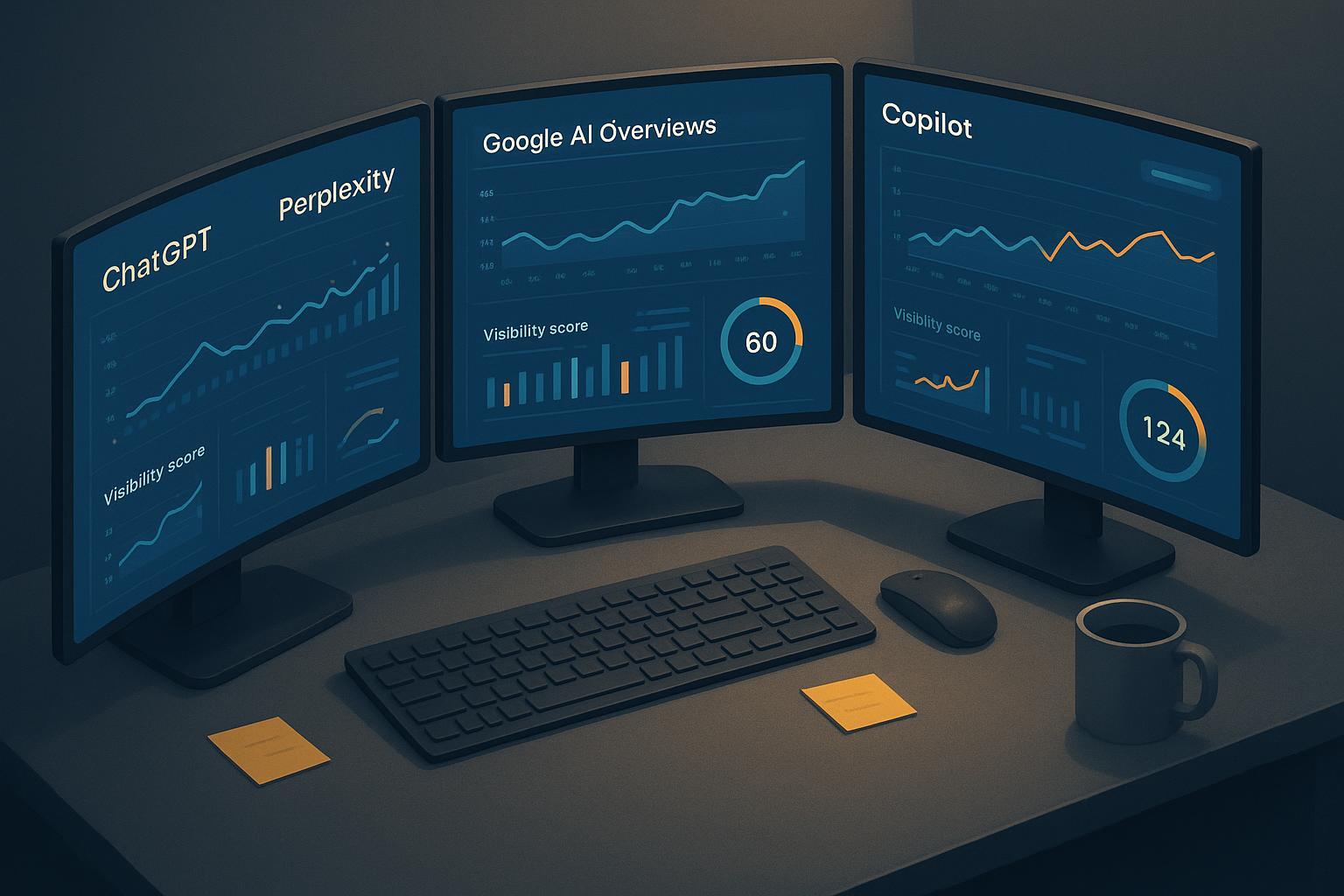
What stands out: Multi-platform AI monitoring; a Brand Visibility Score that helps non-technical stakeholders grasp progress; competitive comparisons that show how you stack up; and white-label reporting for hands-off delivery. The platform analyzes citations, brand mentions, and reference counts to inform concrete edits such as citeable fact updates, schema, and source consolidation.
Agency playbook in one line: Identify missing or weak citations across engines, apply the suggested content and evidence updates on target pages, then ship a branded report showing improvements in visibility and mentions.
Where it’s strong: Agency packaging (white-label), multi-client management, and competitive framing that translates well to QBRs. Where it’s weaker: Public API and BI specifics aren’t broadly documented; confirm export formats and cadences during procurement.
Best for: Agencies that need repeatable, client-ready AEO/GEO deliverables without custom reporting builds. Not for: Teams that require a published, granular API right away for deep BI pipelines.
3) SurferSEO AI Tracker — Best for content-forward teams that want visibility plus source-level guidance
Quick take: Surfer’s AI Tracker added Google AI Overviews and AI Mode to its ChatGPT/SearchGPT and Perplexity coverage, and it emphasizes real answer capture and cited sources you can act on. See Surfer’s update: New models in AI Tracker.
Agency playbook in one line: Track priority intents, pull cited sources, update target pages with clearer evidence and structured data, then recheck share-of-voice and citation frequency.
Strengths: Clear content optimization path; accessible learning curve. Trade-offs: Less emphasis on white-label packaging than dedicated agency platforms.
4) Peec AI — Best for analytics depth and conversions-minded teams
Quick take: Peec positions itself as analytics-first for AI search visibility with prompt-level monitoring across ChatGPT, Perplexity, and AIO, with add-ons for other models. Check its public plan scope here: Peec AI pricing.
Agency playbook in one line: Monitor prompts and track brand visibility and sentiment, prioritize pages and sources to influence citations, then attribute changes to downstream conversions where possible.
Strengths: Visibility, sentiment, and competitor analytics with a growth lens. Trade-offs: Heavier on analysis than packaging; confirm export and reporting paths.
5) Otterly.ai — Best for pragmatic cross-engine monitoring with scalable quotas
Quick take: Otterly provides cross-engine monitoring (Google AI Overviews, ChatGPT, Perplexity, Copilot) with plan-based prompt quotas and URL audits. Evidence of coverage and quotas appears on its pricing page: Otterly.ai pricing.
Agency playbook in one line: Configure prompt sets and GEO URL audits, spot missing citations and recurring competitor wins, then roll out targeted content fixes and recheck daily or weekly.
Strengths: Straightforward plans and daily tracking. Trade-offs: Public docs for advanced exports and BI are limited—ask during trials.
6) AccuRanker + AccuLLM — Best for rank-tracking teams integrating AIO and LLM prompts
Quick take: AccuRanker treats Google AI Overview as a SERP feature and exposes a dedicated AIO page per keyword, with bulk download, API, and a Looker Studio connector. AccuLLM expands into LLM prompt visibility across engines. See the documentation for the AIO page: AccuRanker AI Overview page.
Agency playbook in one line: Add AIO metrics alongside rankings, export bulk AIO data and combine with AccuLLM’s prompt visibility, then build client dashboards in Looker Studio using the connector.
Strengths: Data access (API, bulk export, connectors). Trade-offs: Not a full GEO suite; best when paired with content and forensics tools.
7) Advanced Web Ranking — Best for BI-friendly AIO tracking with BigQuery
Quick take: AWR ships a Google Search + AIO engine and new AI Keyword Performance reports (AI Visibility, AI Mentions, AI Citations), plus a BigQuery connector for BI pipelines. Review AWR’s guidance: Accurate AI Overviews tracking.
Agency playbook in one line: Track AIO presence and citations per keyword, push data to BigQuery to model visibility trends, then align with page-level fixes and report via dashboards.
Strengths: Data pipeline friendliness; flexible reporting. Trade-offs: Primarily Google-centric without deep cross-engine forensics.
8) Semrush — Best for integrating AIO into an existing SEO reporting stack
Quick take: Semrush surfaces AIO and AI Mode visibility indicators in Position Tracking and wraps it in My Reports with AI summaries—useful when clients already live in Semrush dashboards. See the tutorial on AI Mode tracking: Track Google AI Mode visibility with Semrush.
Agency playbook in one line: Flag keywords with AIO and brand mentions, pair with content audits and backlink cleanups, then share findings inside existing Semrush reports.
Strengths: Familiarity and breadth for SEO teams. Trade-offs: Cross-engine depth is limited compared to dedicated AEO/GEO platforms.
9) BrightEdge — Best for research-backed AIO presence and executive readouts
Quick take: BrightEdge publishes research on AIO prevalence and citation behavior and operationalizes tracking in its platform—helpful for executive buy-in. For context, see SEJ’s coverage citing BrightEdge studies on overlaps with organic: AIO overlaps organic by 54%.
Agency playbook in one line: Use visibility studies to set expectations, track AIO presence by priority themes, then translate into page and entity-level improvements.
Strengths: Executive-friendly narratives and research cadence. Trade-offs: Google-first focus; fewer hands-on cross-engine mechanics.
10) SE Ranking — Best for teams adding AIO to lightweight rank tracking
Quick take: SE Ranking documents AI Overviews analysis approaches and state-level research—useful when you need pragmatic AIO monitoring plus core SEO workflows. Start here: AI Overviews analysis guide.
Agency playbook in one line: Identify AIO presence and volatility, prioritize topics and pages, then combine with GSC and rank data in client reports.
Strengths: Accessible and budget-friendly. Trade-offs: Focus remains Google-centric, with limited cross-engine specifics.
Also useful (presence detection): Moz
Moz’s research and tooling help you see when an AI Overview appears for a keyword—a good early signal even if it doesn’t expose full citation analytics. For context, see Moz’s analysis of AIO value and targeting: Are AIOs worth pursuing?.
How agencies run AEO/GEO programs that clients love
A repeatable client program typically looks like this: align on KPIs that map to AI answers (visibility share, citation count and quality, sentiment), build prompt sets that mirror real customer questions by journey stage and region, triage where you lose citations to rivals and which claims lack citeable evidence, act by updating source pages with verifiable facts and schema while consolidating duplicative content and securing authoritative references, then measure by re-running prompt sets to compare visibility and citation share and package insights in an executive-friendly deck or white-label report.
Why does this matter now? Because AI answers compress the funnel. If your brand isn’t cited at the moment of synthesis, you may never get a chance to win the click.
Choosing the right stack for 2026
Need enterprise-grade coverage and workflow automation? Start with Profound and pair it with your content ops tooling.
Need client-ready delivery out of the box? Geneo’s white-label reporting and competitive analysis help agencies show progress without custom builds. See the agency capabilities overview here: Geneo for agencies.
Already standardized on classic rank tracking and BI? AccuRanker or AWR can pipe AIO metrics into Looker Studio or BigQuery while you layer a GEO-focused tool for non-Google engines.
Running content-led programs? Surfer’s AI Tracker or Peec can guide page-level edits from real answer and source captures.
Here’s the deal: You don’t need one “perfect” platform. You need a reliable way to sample answers, improve the sources engines trust, and report changes clearly. The tools above—used thoughtfully—let you do exactly that.
Frequently asked questions (quick hits)
What’s the difference between AEO and GEO? In practice, the terms overlap; both describe optimizing for AI-generated answers. Some teams use AEO for answer engines broadly and GEO for the generative layer. The more important question is whether your stack can monitor and influence the citations engines surface.
How often should we sample prompts? Weekly for priority clusters; daily if you’re in a volatile category or running tests.
What counts as success? Sustained gains in visibility share and citation quality on the engines that matter to your audience—paired with stable or improving sentiment.
Final thought: If you can connect answer-engine insights to specific page improvements—and then show movement in citations and visibility next cycle—you’ll earn trust fast. That’s the real ROI of modern Answer Engine Optimization tools.