
How to Tell if Brandlight Is Ahead of Profound on Emerging Topics (2025): A Step-by-Step Coverage Share Method
Learn how to determine if Brandlight is ahead of Profound on 2025's emerging AI query topics using coverage share across ChatGPT, Perplexity, Google AI Overviews, Bing, and You.com.
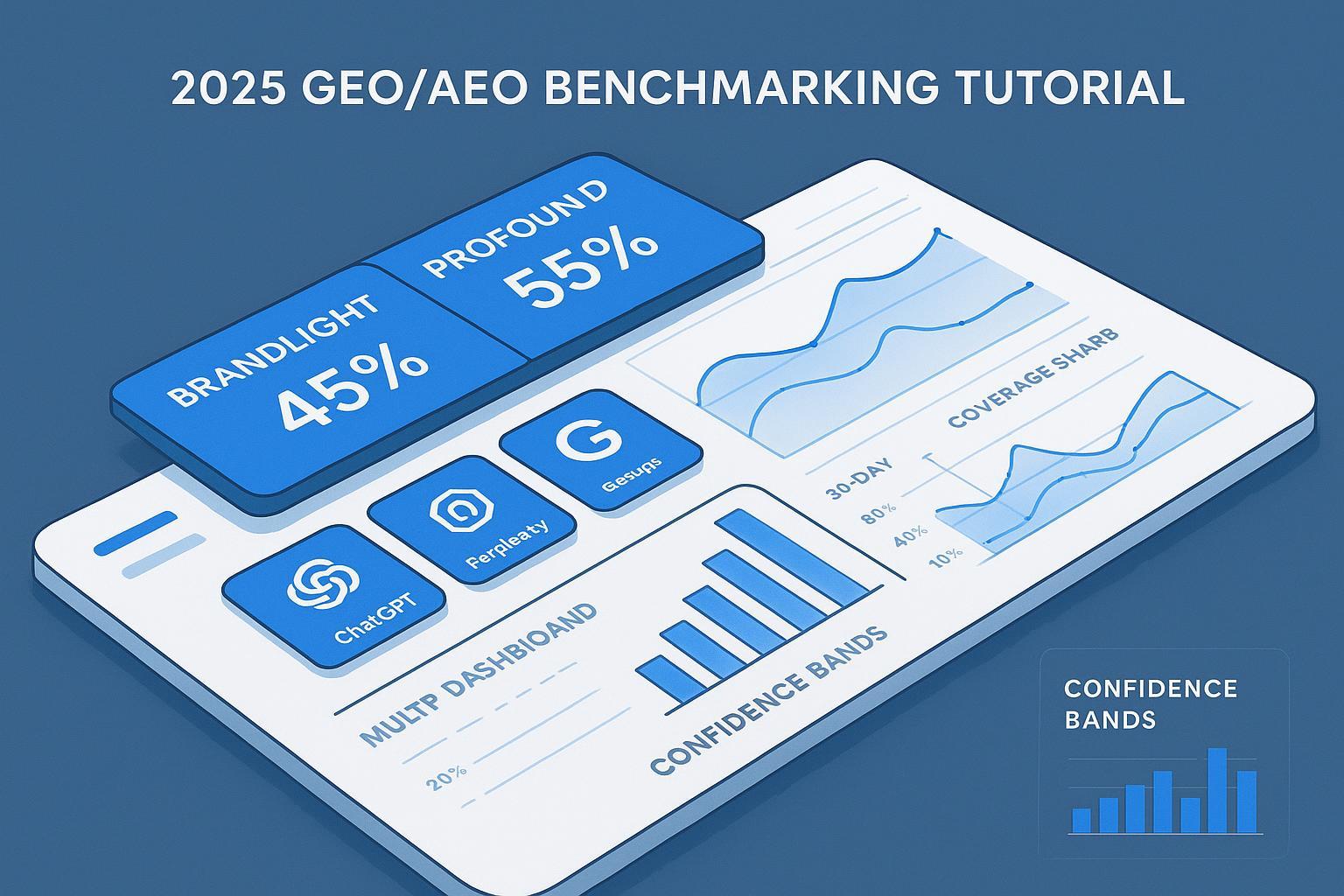
In competitive GEO/AEO work, “ahead” has to be defined quantitatively. For this tutorial, leadership means a higher AI answer coverage share: the percentage of evaluated answers across ChatGPT, Perplexity, Google AI Overviews (AIO), Bing/Copilot, and You.com that mention or cite a brand. We’ll focus on emerging query topics—areas where interest is spiking—and use external signals to discover them, then cross-validate by checking whether engines produce answers and citations. The workflow favors reproducibility, auditability, and statistical sanity.
Why coverage share? Industry guidance on AI visibility and share of voice treats appearance in AI-generated answers as a measurable presence signal. For framing and best practices, see the practitioner explainer on measuring brand visibility from Search Engine Land (2025) and KPI guidance in Seer Interactive’s AI search KPI overview (2025).
1) Fix scope, unit of analysis, and prompt registry
Begin by fixing the measurement window. A rolling 30-day window works well; freeze it before each run so your comparisons are clean. Define the unit of analysis as a single answer-instance per engine per prompt variant; this avoids conflating multiple prompts or engines into one observation and makes error bars meaningful. Build a versioned prompt registry that includes canonical prompts per topic—definition, comparison, recommendation, and how-to—plus fan-out variants to handle entity disambiguation and sub-intents. Normalize casing and brand tokens (e.g., “Brandlight,” “Profound”) to keep inputs consistent across engines. Finally, keep run parameters constant where you can (temperature/top‑p on stochastic engines) and record model/version metadata when available.
If you’re newer to AI visibility concepts, here’s a concise primer on why AI answer presence matters in GEO contexts: see AI visibility: definition and why it matters.
2) Discover emerging topics from external signals, then shortlist
You’re looking for topics that are new or accelerating in the last 30 days. Build a weekly pipeline:
Collect signals: Industry news, X/Twitter threads, Reddit/dev forums, major vendor blogs, standards bodies, and conference agendas. Embed and cluster via a vector database or semantic approach to catch rising themes.
Identify spikes: Compare 30-day activity to a baseline. Flag clusters showing significant growth and coherent semantics.
Shortlist rules (pragmatic): Treat a topic as “emerging” if (a) it shows a 30-day spike versus baseline in external signals, (b) appears in answers for at least two engines when tested, and (c) shows observable citation/domain turnover compared to the prior month (e.g., 40–60% churn as a working threshold). These thresholds are operational rules of thumb; document them.
Now convert clusters into queries/prompts (definition/comparison/recommendation/how-to), keeping brand tokens neutral so you don’t bias results.
3) Cross-validate candidates across the five engines (capture nuances)
Run your canonical prompts for each candidate topic and capture evidence per engine:
ChatGPT: Record prompt text, model/version (if shown), timestamp, and any displayed sources. Use screenshots; citing behavior varies by mode.
Perplexity: Archive the answer and the full citation list (domains/URLs). Perplexity is citation-forward, so source fields are reliable.
Google AI Overviews (AIO): Note presence (Y/N), count cited domains, and list them. Record if your brands are mentioned or linked. Log the link carousel/footnotes pattern.
Bing/Copilot: Capture answer text and reference list; if using a third-party API, parse source fields and store raw JSON alongside screenshots.
You.com: Archive answer and citations; track whether Brandlight/Profound appear as mentions or links and which domains are cited.
To justify engine scope and nuances, see ChatGPT vs Perplexity vs Gemini vs Bing: monitoring comparison.
4) Sampling and confidence: mitigate LLM variance
Generative answers can vary run to run, so sample multiple times per query-engine combo. Operationally, n=5–10 repeats per prompt variant is a practical balance.
For each combo, compute the coverage proportion p = mentions/citations of the brand ÷ total evaluated answers.
Approximate the 95% confidence interval with ±1.96 × sqrt(p(1−p)/n). If intervals for Brandlight and Profound overlap materially, treat the result as inconclusive for that slice.
If you need tighter bands, increase n or extend the window. Maintain constant parameters across runs.
5) Compute coverage share per brand, per engine, and overall
Your leader metric is coverage share. Calculate it for Brandlight and Profound:
Per engine: coverage_share_engine = (answers where the brand is mentioned or cited ÷ total evaluated answers for that engine) × 100.
Overall (unweighted): coverage_share_overall = (sum of brand-positive answers across all engines ÷ total evaluated answers across all engines) × 100.
Handle mentions vs citations explicitly:
Mentions: Brand name appears in the answer text.
Citations: The engine links to your domain or an authoritative source that names your brand.
You can report both, but the leader decision uses the merged definition (mention OR citation) unless you specify otherwise.
Example (illustrative): Suppose for a topic, across five engines, Brandlight is positive in 44 of 100 answer-instances and Profound in 36 of 100. Brandlight’s coverage share is 44%, Profound’s is 36%. If Brandlight’s 95% CI is ±6% and Profound’s is ±5% and these bands overlap, the advantage may be noise; increase n or segment by engine.
6) Interpret Brandlight vs Profound, apply tie-breakers
Declare leadership only when the gap exceeds the margin of error:
Clear lead: Non-overlapping 95% CIs and higher coverage share.
Inconclusive: Overlapping CIs or tiny deltas.
When inconclusive, use pragmatic tie-breakers:
Breadth: Who appears in more engines?
Recency: Who leads in the last 7–14 days?
Citation quality: Are the cited domains more authoritative or directly relevant?
Document your decision rules and avoid cherry-picking.
7) Evidence logging, audit trail, and repeatability
Create an evidence log for each run so you can defend decisions later. Capture fields like these:
Field | Description |
|---|---|
Topic cluster | Name and short description |
Time window | Dates covered; frozen before run |
Engines | ChatGPT, Perplexity, Google AIO, Bing/Copilot, You.com |
Prompt set/version | Canonical prompts + variants; registry ID |
Runs per combo | n per engine/prompt; parameters held constant |
Answer archive | Text, screenshots, model/version, timestamps |
Citations/mentions | Domains/URLs; whether Brandlight/Profound appear |
Coverage share | Per engine and overall for each brand |
95% CI bands | Calculated per engine and overall |
Decision notes | Lead/inconclusive; tie-breakers applied |
Schedule weekly checks on shortlisted topics, track deltas, and annotate any engine drift or sudden citation loss.
For documentation-style pointers, see Geneo docs.
8) Practical example: running this workflow with Geneo
Disclosure: Geneo is our product.
Here’s how a neutral workflow might look using Geneo for the operational pieces while keeping the methodology identical to what you just read:
Configure engines: Ensure monitoring for ChatGPT, Perplexity, Google AIO, Bing/Copilot, and You.com.
Topic intake: Import your externally discovered clusters and map canonical prompts plus variants into Geneo’s prompt registry.
Multi-run sampling: Schedule 5–10 runs per query-engine combo; store answer text, citations, and timestamps.
Coverage computation: Use Geneo’s visibility metrics to tag mentions/citations for Brandlight and Profound, then export per-engine and overall coverage shares.
Audit artifacts: Generate a white-label report with evidence logs (screenshots/exports) and CI bands. Maintain a change log for domain/citation churn.
To justify engine scope and nuances, see ChatGPT vs Perplexity vs Gemini vs Bing: monitoring comparison.
9) Troubleshooting (quick reference)
Variance noise: If gaps are small and CI bands overlap, raise n, extend the window, or segment by intent.
Prompt ambiguity: Normalize tokens, add entity disambiguation cues, and standardize prompt families.
Engine drift: Re-run across multiple days and annotate known update cycles; cross-engine corroboration helps confirm persistent advantages.
Citation volatility: Track week-over-week domain shifts; if quality drops, note how it affects tie-breakers.
Evidence gaps: When an engine under-discloses sources (e.g., certain ChatGPT modes), rely on screenshots and meticulous logs.
Closing: turn measurement into decisions
Once your pipeline is in place, decisions get straightforward: declare Brandlight ahead of Profound on a topic when the coverage share gap is statistically clear; otherwise, treat results as inconclusive and keep sampling. Want a practical way to keep runs on cadence and preserve audit trails? You can operationalize this method in your existing stack or with platforms that support multi-engine AI visibility and competitive benchmarking. For framing and KPI context, see Search Engine Land’s guide to measuring brand visibility in AI and Seer Interactive’s KPI overview for AI search.