
Ultimate Guide to Answer Engine Optimization (AEO) for AI in 2025
Master multi-engine AEO in 2025 with this complete guide—covering ChatGPT, Perplexity, Google AI Overview and unified strategies. Request a Geneo demo today.
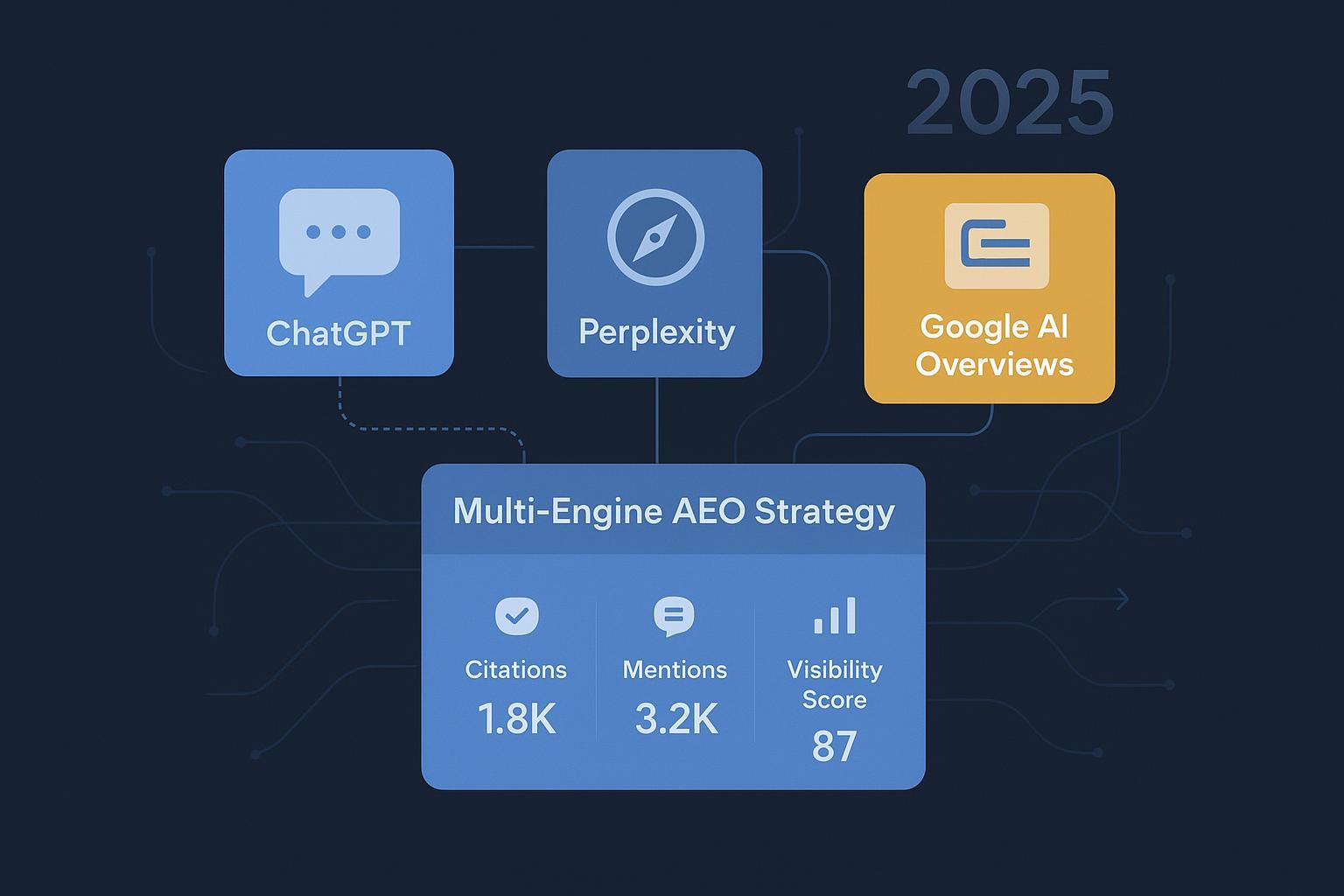
If you manage content and SEO in a fiercely competitive category, the old playbook—rank for keywords, wait for clicks—no longer tells the full story. In 2025, answers are the product. ChatGPT, Perplexity, and Google AI Overviews synthesize the web into direct responses, often with citations and links. Your job is to make sure your content is the material those answers trust.
That requires a unified approach across engines, plus tactical differences where it matters. Here’s the deal: we’ll define “best AEO” in 2025, map how the engines differ, lay out a repeatable playbook, and show how to measure what counts so you can prove impact.
What “best AEO” means in 2025
Best-in-class Answer Engine Optimization is not about gaming a single UI; it’s about producing helpful, reliable, and verifiable content that consistently appears as support for AI-generated answers—across engines and regions—and then proving the contribution. In practical terms, expect your pages to be cited or linked in AI answers for priority questions, make extraction effortless with clear Q&A blocks and concise summaries, and run a measurement stack that tracks citations, mentions, share of voice in answers, and prompt-level changes over time.
Google emphasizes that AI features like AI Overviews draw from indexed, snippet-eligible pages and broader query expansions; there’s no special “AI Overview markup,” but helpful, reliable content and crawlability remain foundational. See Google’s 2025 guidance in the Search Central documentation on AI features.
How ChatGPT, Perplexity, and Google AI Overviews differ
Each engine has distinct inclusion mechanics, answer styles, and citation behaviors. Understanding these differences helps you design content that travels well across all three.
Engine | How answers are generated | Citation behavior | Content style favored |
|---|---|---|---|
ChatGPT | Uses web-grounded modes such as Deep Research that read many sources to synthesize longer, conversational responses. | Sources appear via a sidebar or inline citations depending on mode; Deep Research produces citation-backed reports. See OpenAI’s Deep Research announcement (2025). | Detailed explanations with human tone; benefits from authoritative, well-structured pages and explicit source lists. |
Perplexity | Performs real-time web searches; composes an answer and prominently lists sources. | Frequently includes multiple numbered citations and emphasizes transparency. See Perplexity Help Center: How it works. | Timely, research-backed content; clear claims that can be verified; strong extraction-friendly structure. |
Google AI Overviews | Summaries generated via query fan-out that identify a diverse set of supporting pages; links surface when pages are indexed and snippet-eligible. | Support links appear below the overview; multimedia may be included. See Search Central: AI features (2025). | Concise, credible summaries; trustworthy, people-first content with clear answers and schema where appropriate. |
A unified multi-engine playbook (the five-step loop)
A reliable AEO program looks like an operating loop you can run monthly and quarterly. Think of it as moving from “keywords” to “questions,” and from “rankings” to “citations.”
Discover the right questions: Identify high-intent, complex queries where answers drive consideration—how/why/comparison questions, buyer enablement prompts, and category-defining topics.
Structure for extraction: Write crisp answer blocks (40–120 words), add supporting detail below, and use tables or lists only where they improve scannability. Implement FAQ/HowTo schema when it genuinely fits.
Evidence and freshness: Include verifiable sources (primary data, clear references), update pages on a cadence, and highlight proprietary insights that engines can cite.
Technical readiness: Ensure crawlability, snippet eligibility, and clean semantics. Avoid scaled, low-quality AI content; follow Google’s helpful-content guidance.
Measure and iterate: Track citations/mentions across engines, prompt-level visibility, and share of voice versus competitors; run controlled tests to see which formats earn more links and mentions.
For tactical depth, a good industry overview of AEO principles is the CXL comprehensive AEO guide (2025).
Engine-specific tactics that actually work
ChatGPT: prompts, depth, and source transparency
ChatGPT’s web-grounded modes reward content that is both authoritative and readable. If Deep Research is likely to canvas dozens or hundreds of sources, your page needs to stand out for clarity and unique value. In practice, prioritize a crisp summary at the top, sections that map to common sub-questions, explicit references and linkable evidence (methodologies, datasets, standards), and comparisons that answer “which is right for me?” without fluff.
Perplexity: recency, verification, and publisher alignment
Perplexity leans into timely, verifiable coverage. It tends to list multiple sources and rewards pages that make verification easy. Publish and refresh timely explainers with clear claims and references; use extraction-friendly formatting; and ensure your indexing is clean and consistent so your pages are discoverable.
Google AI Overviews: snippet eligibility, concise answers, and trust signals
AI Overviews are concise, often multimodal. They draw support links from pages that are indexed, snippet-eligible, and aligned with helpful-content guidance. Make your top answer scannable (40–120 words), follow with authoritative depth, keep schema honest and useful, and lean on primary sources and expert consensus to reduce ambiguity.
Measuring what matters (and proving it)
If answers are the product, visibility and credibility are the metrics. Move beyond generic rank tracking to prompt-level monitoring and answer-citation analytics. Instrument dashboards to capture mentions and citations by engine and query, your prompt-level share of voice versus competitors, and whether engines paraphrase your claims accurately. Then, run iterative content tests—adjusting structure, evidence, and freshness—and watch for changes in support links and mentions over time. For a broader perspective on GEO testing in 2025, see Search Engine Land’s GEO experiments.
Disclosure: Geneo is our product. Here’s a neutral, replicable workflow example for multi-engine monitoring: define a prompt library for your highest-intent questions, schedule recurring checks across ChatGPT, Perplexity, and Google AI Overviews, log citations and mentions (including placement and sentiment), benchmark share of voice against competitors, and prioritize fixes where one engine under-cites you relative to others. For an overview of how an answer-centric dashboard and Brand Visibility Score can look in practice, review the Geneo guide to AI search visibility tracking.
Risk, hallucination, and brand safety
Answer engines can misstate facts, mix outdated references, or surface unstable claims. Design for verification: cite primary sources and clearly label assumptions; monitor high-stakes queries and audit paraphrases; and establish correction workflows to refresh claims promptly. For context on why models hallucinate and how research is reducing it, see OpenAI’s explanation of hallucinations. Regulators are watching AI claims closely as well; note the FTC’s 2024 crackdown on deceptive AI claims.
International and localization notes
Global rollouts mean more opportunities—and more complexity. By May 2025, Google reported AI Overviews availability across 200+ countries and 40+ languages, expanding coverage in Europe and Arabic-speaking regions. See Google’s AI Overview expansion news (May 2025). Localize answer blocks thoughtfully, align references to regional standards, and test prompts in the target language to catch differences in phrasing and inclusion.
Failure modes and fast troubleshooting
Your answer block is buried: Move a crisp, source-backed summary to the top and reduce fluff.
Claims lack verifiability: Add named sources, methodologies, and, when possible, proprietary data.
The page doesn’t fit the question: Split topics and map content directly to high-intent questions rather than broad themes.
You’re too slow to refresh: Engines favor timely coverage; set editorial cadences.
Technical issues block eligibility: Check indexing, snippet controls, and site health.
Next step: try the workflow with your own queries
Ready to see how your brand shows up in real answers? Apply the loop to five priority questions, compare engine outcomes, and iterate. If you want a structured way to monitor and report results across ChatGPT, Perplexity, and Google AI Overviews, request a trial or demo from Geneo and use an answer-centric dashboard to track citations, mentions, and share of voice over time.