
Answer Engine Optimization Best Practices for AI Tech Brands (2025)
Discover 2025’s best practices for answer engine optimization (AEO/GEO) across ChatGPT, Perplexity, and Google AI Overviews. Actionable, measurable, and tailored to AI tech brands.
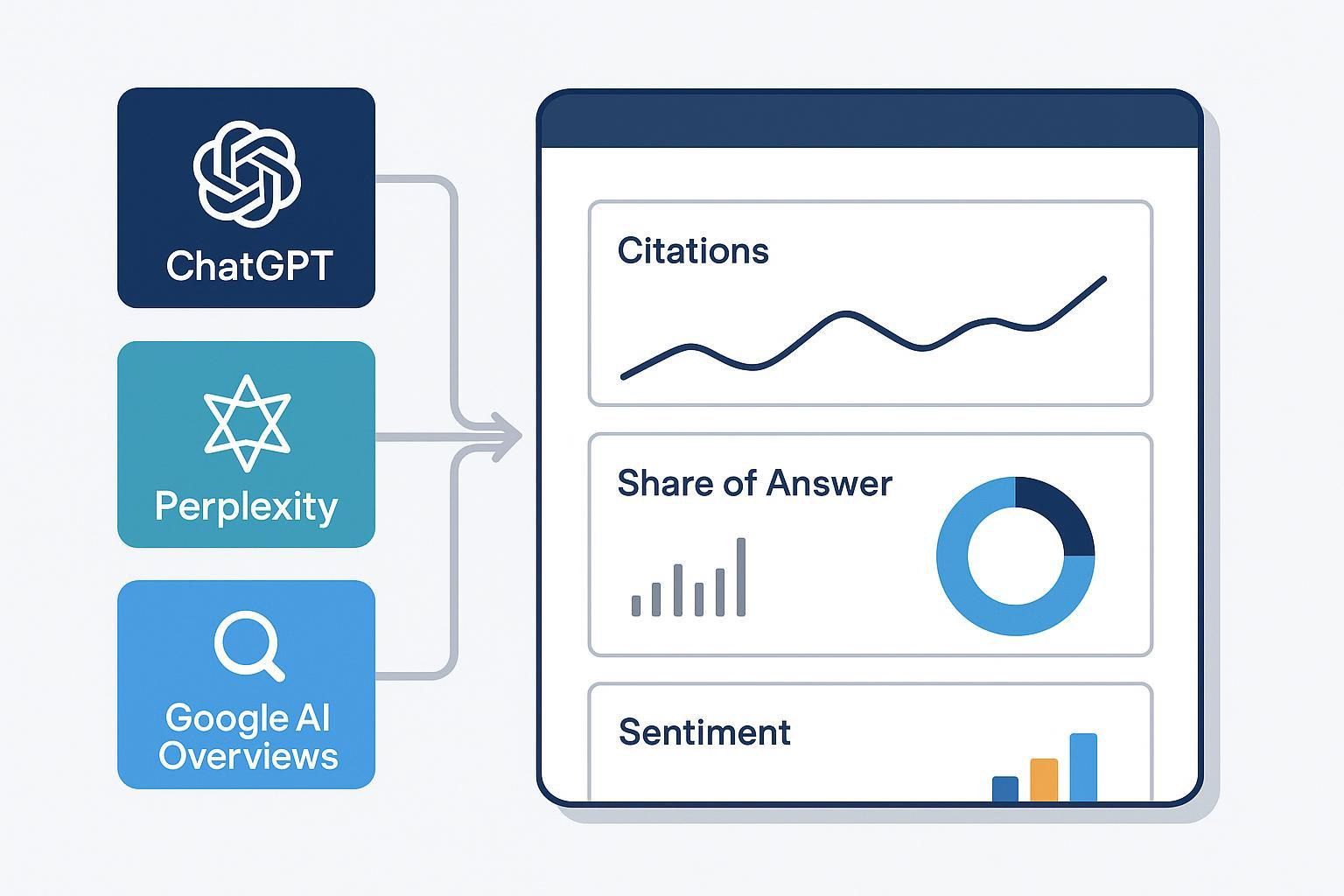
You can’t defend a brand narrative you can’t see. For AI tech brands, the real bottleneck isn’t a lack of ideas—it’s a lack of cross-engine transparency and quantitative KPIs that leaders trust. When ChatGPT, Perplexity, and Google AI Overviews synthesize answers, your content either earns citations and links—or you’re invisible in the very places prospects are making decisions.
Executives don’t want a channel report; they want proof. Which prompts consistently surface your brand? Which pages win links inside answers? How does your visibility compare against named competitors? Without a measurable multi-engine framework, it’s impossible to justify budget or prioritize the work that moves the needle.
What the Engines Reward—and How That Shapes Your Strategy
The three most important engines for AI search visibility behave differently. Understanding their citation mechanics prevents one-size-fits-all tactics.
Engine | How sources appear | Optimization implications |
|---|---|---|
Google AI Overviews | Synthesized answers draw on multiple sub-queries (“fan-out”) and frequently cite pages that already rank well in organic results; links are displayed in panels or inline, and Google states there’s no special markup beyond helpful content and indexability. See Google’s AI features guide (2025) and product updates. | Prioritize eligibility: indexable pages, clean technical SEO, clear definitions, comparison tables, step-by-steps, FAQs, structured data, and E-E-A-T. Freshness and authority correlate with citation odds; industry studies show overlap with top organic results. Coverage and link display continue to evolve. |
Perplexity | Performs live web search and displays numbered citations inline; favors recent, credible, extractable content and scholarly sources in academic modes. See Perplexity’s Deep Research announcement (2025). | Lead with direct answers and original data; surface key facts above the fold; make extractable structures (H2s/H3s, concise paragraphs, tables). Show publication/update dates and trustworthy references. |
ChatGPT (Search / GPT-4o) | Provides a Sources view in many search experiences; citation display varies by mode and can be inconsistent in previews. See OpenAI’s “Introducing ChatGPT search” (2025). | Target intents ChatGPT answers often cover: definitions, comparisons, “best X,” and how-tos. Keep copy trustworthy, structured, and current; reinforce authority with expert bylines and original research. |
Industry analyses throughout 2025 report that AI Overviews appear on a meaningful share of queries and often pull from top-ranked organic pages; see coverage like Search Engine Land’s prevalence study (May 2025) and Semrush’s later updates. The practical takeaway: technical quality, authority, and extractability aren’t optional—they’re prerequisites.
The KPI Stack That Proves Impact Across Engines
Executives need numbers that travel well across engines—a single language for investment and outcomes. Use this stack.
Share of Answer (Visibility Share): The percentage of tracked prompts where your brand is present in the synthesized answer for each engine. Segment by intent (informational vs. commercial) to show movement in high-value cohorts.
Citation Frequency and Link Visibility: The count of citations referencing your domain and the rate at which those citations include a direct link to official pages. Track per engine; links in answers can be more valuable than traditional SERP positions for certain queries.
Brand Mentions and Sentiment: How often your brand is named in answers and whether the sentiment is positive/neutral/negative. Set guardrails for negative mentions and monitor improvement.
Reference Counts and Source Diversity: The number of unique pages from your domain that appear as references, across content types (docs, blog posts, case studies, research). Diversity signals depth and reduces single-point fragility.
Entity Alignment and Schema Validity: Consistent entities (brand, product, features, pricing) reinforced via schema markup, authorship, and publication/update dates. Misaligned entities erode citation reliability.
Outcome Proxies: Executive-friendly indicators like uplift in branded queries, referral logs from engines (where available), or higher-qualified lead rates after content updates.
Cadence: Establish monthly baselines for the full prompt set, and weekly spot-checks for mission-critical prompts. Annotate changes (content refreshes, schema updates, PR placements) and compare pre/post windows so you can convincingly tie work to outcomes.
For foundational definitions and measurement context, see Geneo’s educational resource What Is AI Visibility?.
The Optimization Playbook: Actionable, Engine-Aware
A good AEO/GEO program is a content operations discipline, not a one-off checklist. Below are high-impact moves you can ship quickly.
Direct, Extractable Answers
Put the answer first—one or two crisp sentences that a model can quote. Follow with a short explanation that includes specific facts, figures, or steps.
Use predictable structure: H2/H3 headings, short paragraphs, and tables for comparisons. Think of extractability like “API endpoints” for content.
Original Data and Case Evidence
Publish proprietary data, experiments, or benchmarks. Perplexity and ChatGPT are more likely to cite unique contributions than generic summaries.
Include methodology notes and timestamps. Precision builds trust and reduces the risk of being displaced by aggregator sites.
E-E-A-T Signals, Explicitly
Add expert bylines with credentials; include quotes or commentary from recognized SMEs.
Reference authoritative sources with descriptive anchors; avoid thin link lists.
Maintain transparent policies (editorial standards, corrections, privacy) and ensure HTTPS, contact info, and company details are easy to find.
Technical Extractability
Ensure indexability and fast performance; compress images; avoid blocking important resources.
Implement schema for articles, FAQs, products, organizations, and authors. Validate JSON-LD.
Keep publication and last-updated dates visible. Models prefer current, reliable sources.
Topic Clusters and Entity Hygiene
Map clusters around core entities (brand, product lines, features, pricing, integrations) and intents (compare, define, evaluate, implement).
Consolidate duplicative pages; cross-link thoughtfully with descriptive anchors.
Need deeper tactical walkthroughs? See How to Optimize Content for AI Citations: Step-by-Step Guide.
Monitoring and Workflow: Make Visibility Measurable
Build a prompt set covering branded, category, and competitor queries (start with 100–300, tagged by intent and engine). For each engine, capture answer snapshots and citation links, then store before/after views whenever you ship changes. Maintain an annotation log for content refreshes, schema deployments, PR wins, and major model updates so you can correlate activity with visibility shifts. Benchmark mentions, citations, and link attribution against 3–5 named rivals to expose gaps you can act on. Keep the cadence tight: weekly highlights for critical prompts and monthly executive rollups for the full set—with narrative that connects actions to outcomes.
Example tool (neutral mention for context): Some teams use Geneo’s multi-engine monitoring to track ChatGPT, Perplexity, and AI Overviews answers with historical snapshots, citation counts, and visibility scores—helpful for reproducibility and trend reporting. For a broader tooling perspective, see Traditional SEO vs GEO (Geneo): 2025 Marketer’s Guide.
Reporting and Governance: Turn Data Into Decisions
Good reporting earns budget. Great governance sustains momentum.
Quarterly AEO/GEO council: Bring marketing, SEO, content, PR, and legal to validate KPIs, review engine-specific gaps, and approve refresh priorities.
Competitive benchmarking: Track Share of Answer, Citation Frequency, Link Visibility, and sentiment side-by-side with competitors; flag misattributed recommendations and correct them.
White-label executive packs: Provide a clean deck or portal that shows visibility trends, top-performing pages, and next quarter’s roadmap.
For answer quality evaluation frameworks beyond visibility, see LLMO Metrics: Measure Accuracy, Relevance, Personalization in AI.
Common Pitfalls—and Fast Fixes
Chasing volume over extractability: Long-form posts without an upfront answer rarely earn citations. Fix: Lead with the answer; then expand.
Ignoring update hygiene: Stale timestamps and outdated claims reduce trust. Fix: Adopt a quarterly review; refresh facts and dates.
Over-optimizing for one engine: Platform behaviors differ. Fix: Maintain an engine-aware checklist and track per-engine KPIs.
Weak authority signals: Anonymous posts and shallow references undermine E-E-A-T. Fix: Add expert bylines, cite primary sources, and show your methodology.
Fragmented topic clusters: Duplicate pages confuse entity signals. Fix: Consolidate and create hub pages with clear intent mapping.
Future-Proofing: Volatility, Model Updates, and Compliance
Models and display patterns evolve—sometimes abruptly. Build resilience.
Expect volatility: AI Overviews prevalence and link panels change over time; industry studies showed swings across 2025. Plan for ranges, not absolutes.
Track model updates: Log engine announcements and correlate with visibility shifts. OpenAI and Google publish frequent updates.
Guard against hallucinations: Monitor for incorrect brand portrayals and submit corrections through appropriate channels; publish clear facts pages.
Regulatory readiness: Maintain transparent sourcing, copyright awareness, and consent for proprietary data; document your methodology.
Next Steps: Get a White-Label Benchmark Report Sample
If you need an executive-ready baseline to present internally, you can obtain a white-label benchmark report sample via Geneo’s Agency page. It summarizes cross-engine visibility, citations, and competitor comparisons in a format teams can reuse for quarterly governance.
Request access here: Geneo — White-Label AI Visibility Platform.