
Why Offer AI Visibility Reports in Retainer Packages (2025)
Discover 2025 best practices for agencies: integrate AI visibility reports into client retainer packages to drive renewals, upsells, and measure zero-click impact across ChatGPT and Google.
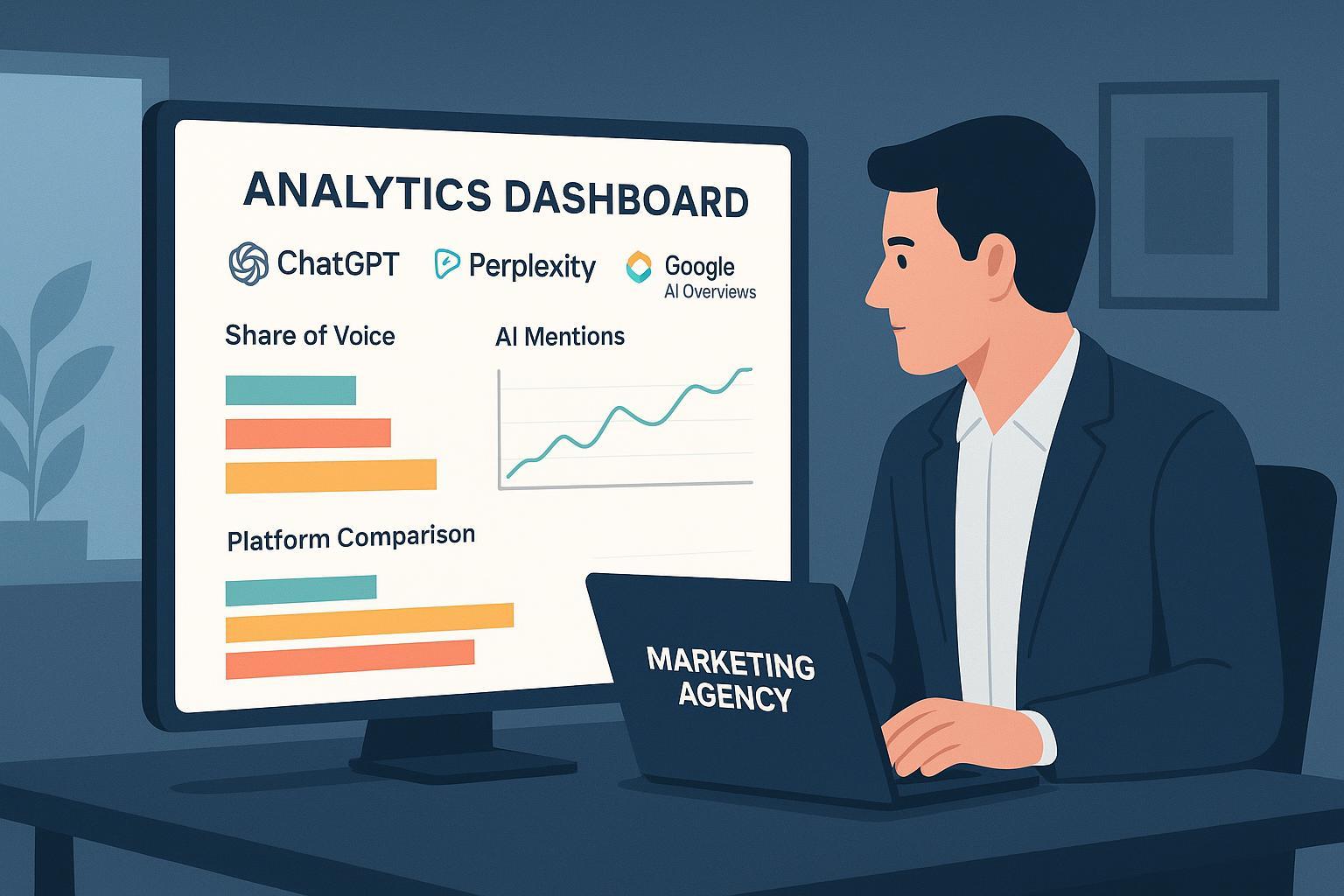
When do clients decide whether to trust a brand—on your site, or the moment an AI answer surfaces a recommendation? More and more, opinions form at the answer layer. That makes “AI visibility” a leading indicator of demand and brand equity, not just a vanity metric.
What “AI visibility” actually measures
AI visibility is the frequency and quality of a brand’s inclusion in AI-generated answers across engines like ChatGPT, Perplexity, and Google’s AI Overviews (AIO). Think of it like shelf placement at a supermarket: if you’re not on the eye-level shelf (the AI answer), fewer shoppers even notice you, no matter how good your product is.
Visibility isn’t only about being named. It’s also about representation quality—does the answer attribute the right strengths, cite credible sources, and position your client favorably against competitors? MarTech argues that in the AI era, marketers must measure inclusion and representation quality across AI engines because rankings and clicks alone understate influence when journeys compress into answers. See their perspective in Why visibility is the most important marketing metric in the AI era (2025) for context: MarTech’s visibility framing.
Why now: 2025 shifts you can’t ignore
Two things changed in 2024–2025:
- The AI layer expanded. BrightEdge’s one-year review of Google’s AIO found total Google search impressions up more than 49% since launch, with growth skewing toward longer, conversational queries—suggesting optimization for the generative layer matters, not just blue links. See the research summary in BrightEdge’s AIO Overviews One Year Review (May 2025): BrightEdge’s AIO deep dive (PDF).
- Click dynamics got messy. When AIO appears, multiple studies observed CTR shifts. Ahrefs and coverage at Search Engine Land describe material CTR declines for position-one results on informational queries when an AI Overview triggers, even as branded queries behave differently. For a concise industry snapshot, see Search Engine Land’s report: Google AI Overviews are hurting click-through rates (2025). Meanwhile, Semrush’s late-2025 study of 10M+ keywords found AIO coverage peaking mid-year and declining by November, with zero-click rates easing and actual clicks edging up for affected terms—a reminder the landscape is fluid. Details here: Semrush’s AI Overviews impact study (2025).
Parallel to Google’s shifts, AI discovery itself grew quickly. Search Engine Land tracked steep gains in AI-driven sessions across properties and spotlighted Perplexity’s usage growth to an estimated 780M monthly queries by mid-2025. See SEL’s coverage: Perplexity grows to 780 million monthly queries (2025).
Net result: whether clicks fall, rise, or move sideways for a given term, the answer layer heavily influences consideration. Offering AI visibility reporting helps you quantify that influence and steer content and entity work toward inclusion.
The agency business case
Let’s get practical: why add AI visibility to retainers?
- Stickier renewals and upsells. Clients want proof you’re managing the channels where buyers actually make decisions. When you show inclusion trends, Share of Voice vs. competitors, and what actions drove movement, you anchor your work to the moments that matter.
- Differentiation in a crowded market. Many competitors still report only rankings and traffic. Bringing AI answer inclusion and sentiment into the conversation elevates your positioning without bloating hours.
- Risk mitigation. If AIO or a popular model starts excluding a client, you want to see it early and intervene (schema fixes, content refreshes, third-party citations) before downstream traffic and conversions soften.
You don’t need to promise clicks you can’t control. You can promise vigilance and action where attention forms.
How to implement: a practical workflow
Here’s a straightforward way to add AI visibility reporting without overhauling your entire operation.
Onboarding and baselining Begin by aligning on priority prompts—25 to 50 questions that reflect how buyers actually ask (commercial intent, comparisons, “best for X,” and core branded queries). Map competitors and entities, confirming brand entities, product names, locations, and core attributes. Verify how engines currently render and cite them. Then baseline inclusion for each engine (ChatGPT, Perplexity, Google AIO): capture whether the brand is mentioned, how it’s described, and which sources are cited.
Monitoring and KPIs Track weekly changes in inclusion rate, AI citations/mentions, Share of Voice within AI answers, platform breakdown (by engine), and representation quality/sentiment. For KPI definitions and deeper setup advice, see this explainer: AI traffic tracking best practices (Geneo).
Iteration and improvement Address entity clarity and schema—strengthen structured data and entity disambiguation; ensure key differentiators are machine-readable and mirrored across high-authority third-party sources. Refresh content that feeds summaries: improve comparison pages, FAQs, and authoritative explainers likely to be summarized, and pursue citations from trusted sites models frequently reference. Expect swings and check volatility weekly; log competitor displacement events and tie each change to actions taken.
Reporting cadence Deliver a monthly executive summary showing trend charts (inclusion, SoV, AI mentions), top movements, and two or three actions for the next sprint. In QBRs, align AI visibility with traditional SEO and demand metrics. Where attribution is murky, narrate the sequence: visibility gains → more brand-led discovery → higher direct or branded search lift.
Packaging models that work (with pros and cons)
Superlines’ GEO playbook outlines practical service formats agencies are adopting. Adapting those for day-to-day operations, here’s a concise comparison.
| Package | What it Includes | When to Use | Pros | Cons |
|---|---|---|---|---|
| GEO/AI Visibility Audit | One-time baseline of AI inclusion across engines; entity/schema review; prioritized fixes | Pre-sale, new retainers, or quarterly pulse for execs | Fast to deliver; great for pitching | Limited ongoing value without monitoring |
| Monitoring Retainer | Continuous tracking of inclusion, SoV, platform breakdown, sentiment; monthly exec summaries; alerting on drops | Most SMB–midmarket accounts | Sticky value; aligns to weekly/ monthly ops | Requires process rigor and light content/tech iterations |
| Enterprise Strategy | Monitoring + playbooks, cross-functional workshops, governance, and roadmap | Complex organizations with many products or regions | Integrates SEO, content, PR, legal | Longer sales cycles; higher delivery overhead |
For Superlines’ model and rationale, see The GEO Playbook for Agencies (Dec 2025): GEO playbook overview.
Agency workflow example: white-label AI dashboard
Disclosure: The following example uses our own product to illustrate one way agencies implement white‑label reporting.
A common setup is to host a client-facing dashboard on your branded subdomain so your team can show AI answer inclusion trends without sending static screenshots. For instance, agencies use a platform like Geneo to configure a custom domain (CNAME), apply their brand design, and invite clients into a portal that tracks brand mentions and recommendations across ChatGPT, Perplexity, and Google AIO with daily history. The practical benefit isn’t the chart itself—it’s the narrative: “Here’s where we were excluded, here’s what we changed (schema and comparison page improvements), and here’s when inclusion returned.” If you need a refresher on how AI engines differ and what to monitor for each, this comparison helps: ChatGPT vs Perplexity vs Gemini vs Bing — monitoring differences.
Client communication: set expectations and win buy‑in
Clients may ask, “If AI answers reduce clicks, why should I care?” Buyers still form shortlists somewhere, and if that happens in the answer box, you want to be on that shortlist. Set expectations about volatility upfront and explain that weekly swings are normal as models refresh; this is why you track trends and log actions rather than chasing single screenshots. Define success in layers: being included for priority prompts, improving share versus named competitors, and ensuring the summary reflects the client’s true strengths. For attribution, correlate visibility gains with branded search, direct sessions, and qualitative win/loss notes from sales. Not every improvement will show up as a referral click, but you can make the sequence visible.
Provide a short one-page executive summary each month with the three charts leaders remember: inclusion trend, Share of Voice, and platform breakdown—plus the two actions you’re taking next.
Practical tips that prevent rework
- Start with 25–50 prompts, then expand. Boiling the ocean leads to noisy data.
- Log every change. Tie content and schema updates to subsequent visibility moves to build cause-and-effect confidence.
- Standardize visuals. Use the same three charts in every deck so stakeholders build intuition.
- Align with traditional SEO. For a helpful primer on where AI visibility complements classic SEO, share this piece: Traditional SEO vs GEO — comparison (Geneo).
What to look for in white‑label tools (a quick checklist)
Selecting a tracker or dashboard? Focus on capabilities that reduce operational drag: custom branding on your subdomain, multi-client projects with access controls, exportable dashboards/PDFs, and basic automation hooks. For an objective feature rundown of agency-ready white labeling (branding, subdomains, access, API/exports), see this summary: LLM Pulse’s agency white‑label features (2025).
Next steps: pilot it
Run a 60–90 day pilot inside one existing retainer. Baseline 30–40 priority prompts, set weekly checks, and deliver a monthly one-pager to the exec sponsor. In QBR, decide whether to bundle monitoring into the core retainer or offer it tiered by the number of tracked prompts and engines.
If you want a ready-made, branded dashboard with AI answer tracking and client portals, you can evaluate Geneo. It’s an agency‑first platform for AI visibility reporting with white‑label domains, dashboards, and exportable reports. Learn more here: Geneo overview and see a complementary deep dive on tracking setup: AI traffic tracking best practices (Geneo).
Further reading
- Strategic context on visibility as a north-star metric: MarTech’s visibility framing (2025)
- Google AIO’s first-year impact and long‑tail trends: BrightEdge’s AIO deep dive (PDF)
- AIO coverage and CTR/zero‑click shifts: Semrush’s AI Overviews impact study (2025) and SEL’s CTR report (2025)
- Packaging models for agencies: GEO playbook overview (Superlines, 2025)
- Engine differences for monitoring: ChatGPT vs Perplexity vs Gemini vs Bing — monitoring differences