

AI visibility monitoring at scale: a how-to for agencies
Practical checklist for scaling multi‑engine AI visibility monitoring, alerts, and BI integration—instrumentation, cadence tiers, normalization, and alerting runbooks for agencies.
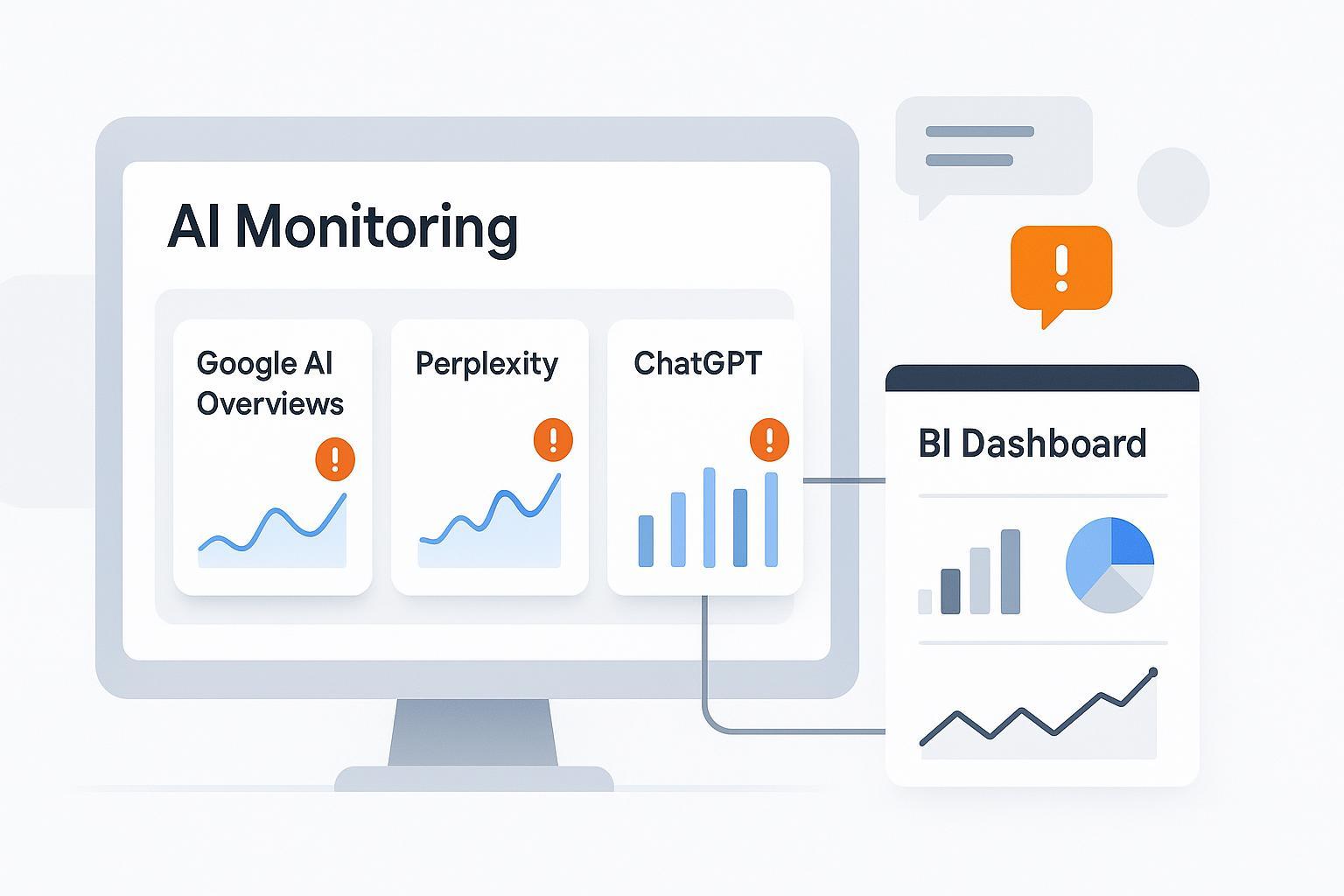
When AI answers decide whether your clients get seen or skipped, manual spot-checks won’t cut it. Agencies need a reproducible system for multi-platform AI visibility monitoring that captures signals from Google AI Overviews, Perplexity, and ChatGPT, reduces noise, triggers meaningful alerts, and pipes metrics into the SEO/BI stack. That’s the goal of this guide: a workflow-first runbook you can implement across portfolios.
If you need a crisp definition of what “AI visibility” covers—entity presence, citations, positioning, and sentiment across answer engines—see the first‑party primer What Is AI Visibility? Brand Exposure in AI Search Explained. We’ll focus here on monitoring/alerting and BI integration, not on content production.
According to the agency cohort analysis in Seer Interactive’s September 2025 AIO CTR update, brand citation presence in AI Overviews correlates with large CTR swings across 3.1k queries and 100+ clients—evidence that tracking inclusion and citations is not optional. Meanwhile, Google’s post‑2025 deprecation of num=100 constrains deep SERP visibility, pushing efforts toward top‑10 monitoring and AI extractability, as discussed in AIS Media’s overview of the num=100 shift.
Design your monitoring cohorts and canonical prompts
Start with cohorts you can defend. That means defining query and entity sets per client and a portfolio‑level cross‑section that reflects business value.
Client cohorts: Identify high‑value intent clusters (commercial, navigational, critical FAQs). For each, write canonical prompts (e.g., “best [category] software for [industry],” “how to [task] with [product]”). Keep wording stable; store versions.
Portfolio cohorts: Build a “health” set across clients—generic industry queries and brand/entity checks that catch systemic shifts.
Entities: Include brand names, product lines, and execs where relevant; track accuracy and sentiment alongside inclusion.
Establish a capture cadence by risk tier:
Critical: near‑real‑time to hourly on high‑stakes queries.
Standard: daily on core clusters; weekly sampling on long‑tail.
Light: weekly captures; monthly reviews for SMB.
Prompts drift. Slight wording changes can swing outputs. Assign prompt IDs and version tags so you can replay and compare apples to apples. Use multi‑run strategies (e.g., 3 runs per window) to smooth stochastic variance.
Instrument multi‑engine AI visibility monitoring with reproducibility
Monitor the engines your clients actually face—and log the context of every capture.
Google AI Overviews (AIO): Prioritize UI sampling for realism; store screenshots where allowed and record answer presence, link citations, and top‑level sentiment. Pair this with observed changes in the standard SERP and note constraints after
num=100deprecation (top‑10 focus).Perplexity: Use APIs to capture structured outputs—including citation arrays with title, URL, and snippets. See Perplexity’s Search quickstart for field references.
ChatGPT: Distinguish UI vs API. The OpenAI Responses API can tag model versions, tools used (e.g., web/file search), and usage metadata. Log capture_path (UI/API),
model_version,tools_used, and token counts.
Capture schema (common fields):
engine                // google_ai_overviews | perplexity | chatgpt
  capture_path          // ui | api
  model_version         // e.g., gemini-...
  prompt_id             // canonical prompt identifier
  prompt_version        // v1, v2...
  capture_ts            // UTC timestamp
  inclusion_flag        // present | absent
  answer_position       // ordinal or section flag
  citation_count        // integer
  source_domains        // array of root domains
  citation_types        // linked | unlinked (where detectable)
  sentiment_score       // -1..1 (simple model)
  entity_accuracy       // correct | incorrect
  competitor_overlap    // % of answer mentioning competitors
  snapshot_url          // storage link to screenshot/text
  input_tokens          // where available
  output_tokens         // where available
Record engine‑specific extras: Perplexity search_results[] arrays and indices; OpenAI response IDs and tool‑call metadata. This context enables replay and regression analysis later.
Normalize data and store for analysis
Different engines, consistent insights. Normalize to a shared schema and stage for BI.
Example normalized JSON (one visibility event row):
{
    "visibility_event_id": "ve_20260113_abc123",
    "client_id": "acme_b2b",
    "engine": "perplexity",
    "capture_path": "api",
    "model_version": "sonar-pro-2026-01",
    "prompt_id": "p_best_crm_smb",
    "prompt_version": "v2",
    "capture_ts": "2026-01-13T11:20:00Z",
    "inclusion_flag": true,
    "answer_position": 1,
    "citation_count": 4,
    "source_domains": ["acme.com", "gartner.com", "hubspot.com"],
    "citation_types": ["linked"],
    "sentiment_score": 0.35,
    "entity_accuracy": "correct",
    "competitor_overlap": 0.4,
    "snapshot_url": "https://storage.example/ve_abc123.png",
    "input_tokens": 1425,
    "output_tokens": 710
  }
BI star‑schema mapping:
Fact tables:
visibility_events(one row per capture),citations(one row per cited source with domain trust/recency weight fields).Dimensions:
engine_dim,query_dim(prompt_id/version, intent cluster),entity_dim,client_dim,model_dim,source_domain_dim.
Retention and cost controls: keep raw snapshots for 90–180 days; aggregate metrics beyond that. Monitor token/credit budgets per client; compress long‑tail sampling.
Reduce noise and set alert thresholds that matter
Volatility is the rule, not the exception. Treat noise explicitly.
Multi‑run averaging: Use rolling windows (e.g., 3–5 runs) for inclusion and share‑of‑visibility.
Hysteresis: Require sustained change before firing alerts (e.g., 3 consecutive misses). Guidance from operational monitoring mirrors this; see UptimeRobot’s monitoring guide or PagerDuty’s alert grouping.
Material thresholds: Define domain‑specific breakpoints—loss of inclusion on critical queries, ≥20% drop in share‑of‑visibility vs baseline, spikes in negative sentiment.
Sample SQL for delta detection (daily window):
WITH baseline AS (
    SELECT client_id, prompt_id,
           AVG(share_of_visibility) AS avg_share
    FROM visibility_kpis
    WHERE dt BETWEEN DATE_SUB(CURRENT_DATE(), INTERVAL 14 DAY) AND DATE_SUB(CURRENT_DATE(), INTERVAL 7 DAY)
    GROUP BY 1,2
  ),
  current AS (
    SELECT client_id, prompt_id,
           AVG(share_of_visibility) AS curr_share
    FROM visibility_kpis
    WHERE dt BETWEEN DATE_SUB(CURRENT_DATE(), INTERVAL 7 DAY) AND CURRENT_DATE()
    GROUP BY 1,2
  )
  SELECT c.client_id, c.prompt_id,
         c.curr_share, b.avg_share,
         (c.curr_share - b.avg_share) / NULLIF(b.avg_share,0) AS pct_change
  FROM current c
  JOIN baseline b USING (client_id, prompt_id)
  WHERE (c.curr_share - b.avg_share) / NULLIF(b.avg_share,0) <= -0.20;
Route alerts by severity: warn on early signals, critical for sustained drops. Deduplicate/group alerts; enforce maintenance windows during planned changes.
Route alerts and run triage like an on‑call team
Treat visibility incidents like production incidents.
Routing: Integrate Slack for warn‑level notifications and PagerDuty for critical escalation. Group related alerts (same engine/prompt cohort) to reduce fatigue.
Schedules: Maintain fair rotations; include backups and time‑boxed escalations.
Triage playbook: Confirm via replay, check UI vs API parity, identify competing entities that displaced you, assign remediation (content/PR/entity fixes), and track time‑to‑recovery.
Disclosure: Geneo is our product. Example configuration in a platform like Geneo (micro‑example):
Create a client cohort “Acme CRM – Critical Queries” with canonical prompts and IDs.
Set capture cadence to hourly for the critical set; daily for standard.
Define an alert: “Loss of inclusion for 3 consecutive runs or ≥20% drop in share‑of‑visibility over 7 days,” routed to Slack (warn) and PagerDuty (critical).
Tag captures with engine, capture_path, model_version, and store snapshots. The alert payload includes links to recent runs for immediate replay.
Plug into your SEO/BI stack with stable KPIs
Define KPIs once, reuse everywhere.
Share‑of‑visibility: percent of answer coverage mentioning your brand/entity vs competitors.
Citation quality index: weighted by domain authority/recency; prefer fresh, authoritative sources.
Sentiment trend: moving average of sentiment scores over time.
Time‑to‑recovery: days from incident to restored inclusion.
For deeper definitions and dashboard modules, see the first‑party guide AI Search KPI Frameworks for Visibility, Sentiment, Conversion. Note that UI/API divergence can affect readings; document capture paths and versions in methodology cards.
Example calculation (share‑of‑visibility):
SELECT client_id, prompt_id, dt,
         SUM(CASE WHEN entity = 'your_brand' THEN coverage_score ELSE 0 END) /
         NULLIF(SUM(coverage_score),0) AS share_of_visibility
  FROM entity_coverage
  WHERE dt BETWEEN DATE_SUB(CURRENT_DATE(), INTERVAL 30 DAY) AND CURRENT_DATE()
  GROUP BY 1,2,3;
Dashboards: build tiles for inclusion rate, share‑of‑visibility, citation quality, sentiment, and incident burndown. Provide drill‑through to raw captures and snapshots. This keeps AI visibility monitoring credible when executives ask “where does this data come from?”
Governance, QA, and cost control
Scaling across many clients requires discipline.
Audit logs: Record who changed cadences, thresholds, or prompt versions; keep approvals and timestamps.
Replay harness: Re‑run stored prompts with the same model/tool metadata to confirm incidents and measure recovery.
UI sampling: Periodically validate API parity with UI captures; document deltas.
False‑positive suppression: Use hysteresis and confirmatory checks (3 of 5 windows) before paging humans.
Budget caps: Track token/credit consumption; enforce tiered cadences and long‑tail compression.
Ownership/RACI: Assign a portfolio owner, client‑level analysts, and an incident commander rotation.
Methodology and references
Evidence, limits, and sources matter.
Impact & volatility: See Seer Interactive’s AIO CTR findings (2025).
SERP constraints: Review AIS Media’s summary of
num=100removal.Perplexity fields: Search quickstart.
OpenAI metadata: Responses API reference.
First‑party methodology transparency: Geneo Docs.
Agencies that treat AI visibility monitoring as observability—complete with cohorts, reproducible captures, noise‑aware alerts, and BI‑ready KPIs—build durable advantage and protect pipeline. Apply this runbook with your data stack and preferred tools. If you want a platform example that supports multi‑engine monitoring, alerts, and dashboards, Geneo can be one option.