
Measuring Your Brand’s Share of Voice in AI Search
Discover expert best practices for measuring your brand’s Share of Voice in AI Search platforms like ChatGPT and Google AI Overviews. Actionable metrics, workflows, and strategic insights for data-driven marketers.
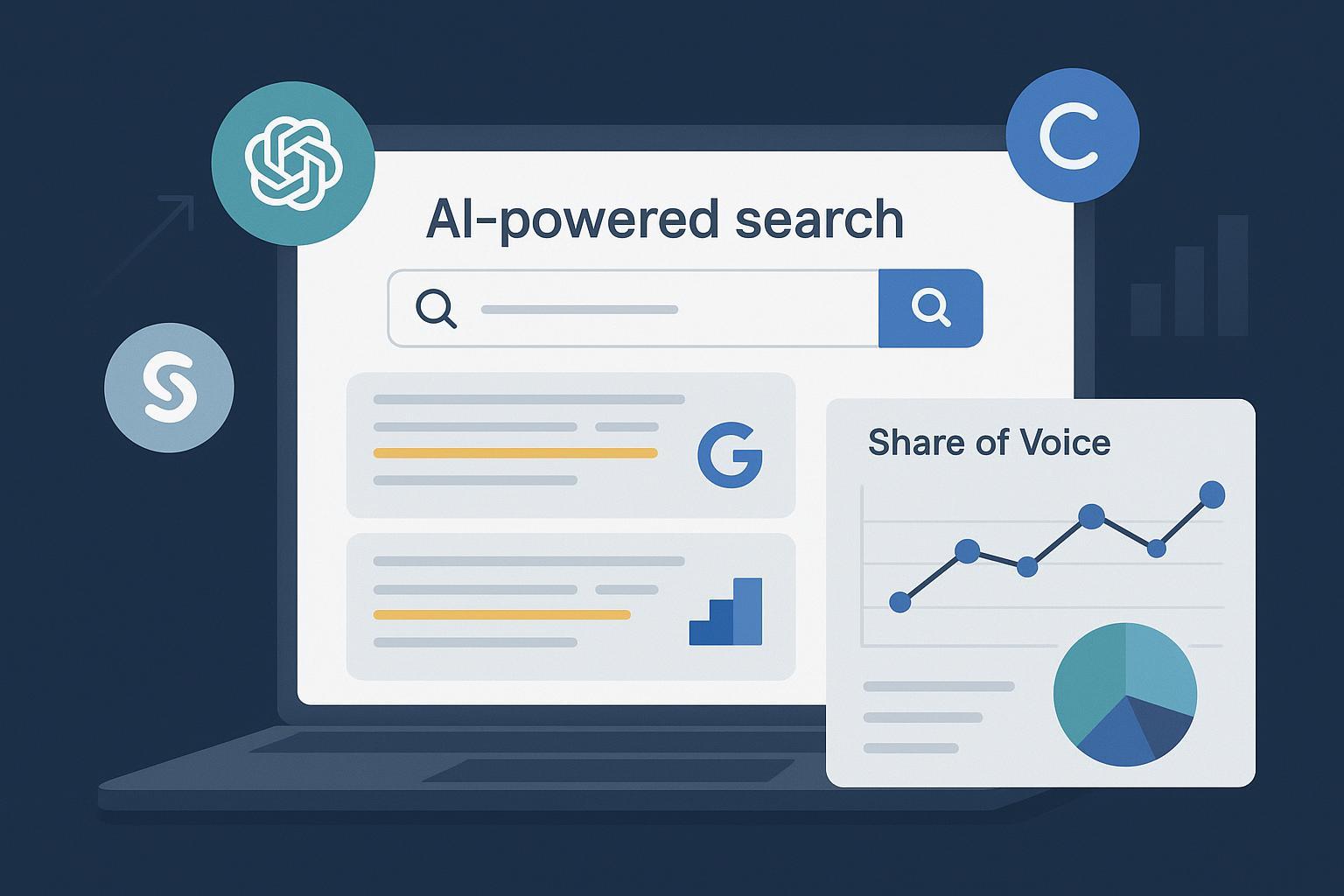
If your audience asks questions in ChatGPT, Perplexity, Google’s AI Overviews, or Microsoft Copilot, your brand is competing inside generated answers—not just blue links. That’s where AI Share of Voice (SOV) comes in: a way to quantify how often, how prominently, and how positively your brand appears in AI answers compared with competitors. If you’ve measured SOV across SEO, social, and PR, this will feel familiar—yet AI answers demand new rules.
To ground terminology up front: when we discuss GEO, GSVO, and LLMO, we mean the emerging practices focused on increasing accurate brand representation and citation rates in generative engines, not just classic “rankings.” For a primer on these acronyms, see our overview in Decoding GEO, GSVO, GSO, AIO, LLMO: New AI SEO Terms.
- Internal link: Decoding GEO, GSVO, GSO, AIO, LLMO: New AI SEO Terms: https://geneo.app/blog/geo-gsvo-gso-aio-llmo-ai-seo-acronyms-explained/
For definitions that set AI visibility in context with traditional SEO, you can also review What Is AI Visibility? Brand Exposure in AI Search Explained.
- Internal link: What Is AI Visibility? Brand Exposure in AI Search Explained: https://geneo.app/blog/ai-visibility-definition-brand-exposure-ai-search/
What to measure (and how): a practical AI SOV formula
AI SOV should capture three things at minimum: how often you’re cited, where those citations sit inside the answer, and whether the context is positive, neutral, or negative. A simple, defensible formula looks like this:
SOV_AI = [sum of (brand mentions × position weight × sentiment weight)] ÷ [sum of the same across all brands] × 100
- Position weight (example): first citation 1.0; second 0.7; third 0.5; anything 4+ at 0.3. Calibrate to each engine’s layout and your observed attention patterns.
- Sentiment weight (example): positive 1.2; neutral 1.0; negative 0.8. Adjust based on your risk tolerance and category norms.
Two practical notes:
- Treat “mentions” as any direct citation or named reference in the answer or its “Sources” area, not just hyperlinks in the body text.
- Use ranges rather than single‑point values because AI outputs vary. Report the median and a rolling range (e.g., past 14–28 days) for each cluster and engine.
When you graduate this into reporting, tie AI SOV to adjacent KPIs like referral traffic from cited links and changes in Search Console impressions/CTR for affected queries. For structure ideas, see AI Search KPI Frameworks for Visibility, Sentiment, and Conversion 2025.
- Internal link: AI Search KPI Frameworks for Visibility, Sentiment, and Conversion 2025: https://geneo.app/blog/ai-search-kpi-frameworks-visibility-sentiment-conversion-2025/
Platform nuances that change your numbers
AI engines don’t present citations the same way, and that directly affects your weighting and audit steps. Here’s a high‑level comparison:
| Engine | How citations appear | Where links live | Volatility considerations |
|---|---|---|---|
| ChatGPT Search | Inline citations within answers and a Sources view that aggregates links | Hover/click inline references plus a dedicated sources interface | Non‑deterministic outputs; UI and source selection may evolve; verify before scoring |
| Perplexity | Numbered citations embedded in the answer | Clickable, numbered links alongside snippets | Frequent multi‑source blends; answer rewrites on refresh can change mix |
| Google AI Overviews | AI summary with inline links inside answer text and supporting site cards | Inline links and supporting site modules | Layout changes have been introduced (e.g., more inline links), affecting attention distribution |
| Microsoft Copilot (Bing) | Inline links and an explicit list of sources used to generate the answer | Inline plus a consolidated sources list | Transparency features improve auditability but content and formatting can still shift |
References for UI behaviors: OpenAI confirms inline citations and a Sources control for ChatGPT Search; Google documents AI Overviews and its move to inline links in 2024; Perplexity notes that each answer includes numbered citations; Microsoft describes prominent citations and a list of every link used.
- External: OpenAI “ChatGPT Search help” (documentation): https://help.openai.com/en/articles/9237897-chatgpt-search
- External: Google “AI Overviews” product update (Oct 2024): https://blog.google/products/search/ai-overviews-search-october-2024/
- External: Perplexity Help “How does Perplexity work?”: https://www.perplexity.ai/help-center/en/articles/10352895-how-does-perplexity-work
- External: Bing Blog “Introducing Copilot Search in Bing” (Apr 2025): https://blogs.bing.com/search/April-2025/Introducing-Copilot-Search-in-Bing
A reliable measurement workflow
Below is a compact, repeatable process you can run across engines and markets.
- Define scope and competitors. Cluster prompts by intent (informational, navigational, transactional) and by product/category. Fix a competitor set per cluster so deltas are meaningful.
- Instrument your capture. For each prompt/engine, save answer screenshots, timestamp, engine/mode, and every citation with its position. Store the raw answer text for sentiment and context checks.
- Sample on a schedule. Run daily or weekly batteries and compute medians and rolling ranges. Use a small set of “control prompts” to track volatility.
- Score consistently. Apply the same position and sentiment weights within an engine. Normalize across engines that show very different numbers of citations.
- Audit sentiment and accuracy. Have humans review high‑impact prompts weekly to correct misclassifications and spot hallucinations or misattribution.
- Correlate to outcomes. Compare AI SOV movements with Search Console (Web) trends on affected topics, referral traffic from cited links, and pipeline/lead signals.
- Govern and document. Log model/UI versions when visible, and annotate any major platform change so stakeholders understand jumps or dips.
Why this cadence? AI answers are probabilistic, and layouts change. A rolling, range‑based view will prevent one odd answer from steering strategy.
What the market data says (and how to brief stakeholders)
Expect click behavior to shift when AI answers are present. According to Seer Interactive’s 2025 multi‑brand dataset, organic CTR on informational queries with AI Overviews fell significantly, and brands cited inside the Overview gained a relative CTR advantage over non‑cited peers. See Seer’s analysis: AIO impact on CTR (September 2025 update).
- External: Seer Interactive “AIO impact on Google CTR (Sept 2025 update)”: https://www.seerinteractive.com/insights/aio-impact-on-google-ctr-september-2025-update
Meanwhile, Google reports that newer designs—like inline links—have increased traffic to supporting sites versus earlier AI Overview layouts. See Google’s product update outlining these changes.
- External: Google “AI Overviews” product update (Oct 2024): https://blog.google/products/search/ai-overviews-search-october-2024/
How do you reconcile this? Methods and cohorts differ. When you present AI SOV results, cite your date ranges, engines, query sets, and business context. If your brand wins citations, you can partially offset CTR headwinds; if you’re absent, expect greater zero‑click exposure and lower discoverability.
Tooling and automation (with a short Geneo example)
Disclosure: Geneo is our product.
Whatever platform you choose, evaluate tools on three criteria: multi‑engine coverage (ChatGPT Search, Perplexity, Google AI Overviews, Copilot), capture fidelity (citations with positions, timestamps, modes), and reporting (weights, sentiment, competitor benchmarking, exports).
Example workflow in Geneo (reproducible with comparable tools):
- Create a prompt set per cluster and add your competitor domains.
- Schedule weekly runs across engines and geo profiles; Geneo stores citations, positions, and answer snapshots.
- Apply your position/sentiment weights in the dashboard; export an AI SOV time series with medians and ranges.
- Use the built‑in sentiment review to correct edge cases and tag misattributions for remediation in content/PR.
Prefer official data sources and UI‑based audits over unsanctioned scraping. Google does not provide an API for AI Overviews; its Search Central documentation covers AI features but not a programmatic endpoint. If you consider third‑party SERP/AIO APIs, get legal review first and throttle requests.
- External: Google Search Central “AI features & your website”: https://developers.google.com/search/docs/appearance/ai-features
Reporting to outcomes: dashboards and KPIs that matter
Executives need to see two pictures on one page: competitive AI SOV and business impact. A clean dashboard includes:
- A trendline of your AI SOV by cluster and engine (median with range bands)
- A side‑by‑side competitor SOV snapshot this period vs. last
- Referral sessions from AI citations by engine, plus examples of high‑impact answers
- Search Console impressions/CTR deltas on affected topics
- Notes on major model/UI changes that might explain swings
Make the “so what” explicit. Which clusters gained or lost SOV? Which citations drove referral traffic or assisted conversions? Which content or PR assets seem to be winning attribution? Tie action items to accountable owners.
Pitfalls and troubleshooting
-
Volatility and model drift. If your week‑over‑week SOV swings wildly, first check sampling variance: were the same prompts and modes used? Then review layout changes; Google’s move to more inline links, for example, can shift effective position weights. Consider adding more frequent samples or broader ranges.
-
Misattribution and sentiment errors. AI answers may attribute to the wrong source or summarize inaccurately. Manual review on high‑stakes prompts is non‑negotiable. Track error types and feed them back into your content and PR plans.
-
Over‑indexing one engine. If you only watch Google AI Overviews, you’ll miss conversational journeys in ChatGPT and Perplexity where buyers research vendors. Weight engines according to your audience, but report them separately.
-
Compliance gaps. Many teams are tempted to scrape everything. Don’t. Favor official documentation and lawful data collection. When in doubt, consult counsel.
Closing recommendations (prioritized next steps)
- Stand up a 4‑week pilot across your top three query clusters and four engines. Start with conservative weights and refine from observed behavior.
- Establish your weekly sampling cadence, sentiment review, and outcome correlation. If nothing else, connect AI SOV to referral traffic from cited links and to Search Console topic groups.
- Brief stakeholders using both AI SOV trends and CTR context. Be transparent about volatility and show ranges, not just point estimates.
- Turn insights into action: create or update entity‑rich content, strengthen author and brand profiles, and coordinate PR to seed credible, citable sources. Ready to get moving? Let’s dig in and turn AI visibility into measurable growth.